

A configuration sheet is the one artefact that makes a cycling smart glasses programme comparable, orderable and auditable, and the reason so many programmes do not have one is that each document in the chain gets written separately. The quotation asks for the model, the purchase order repeats it, the sample is approved against a list that nobody wrote down, the claims sheet is drawn from a brochure, and the technical file is indexed against none of them. This article sets out a single sheet with four blocks — a header, a specification, a set of brand decisions and an open-rows list — and the rule that makes it work: every field has a source, and a field with no source is left visibly open rather than filled with an assumption.
Smart glasses for cycling: one sheet that becomes the order, the criteria and the file
What the sheet is. One document, one configuration, one version. It starts as the request for quotation, because a buyer who has filled it in is asking a supplier a question the supplier can price. It becomes the comparison document, because two quotations can only be compared field by field when the fields are the same. It travels to the purchase order as an annex, so the thing that was priced is the thing that was ordered. It becomes the acceptance criteria for the sample, so the approved unit is approved against a list rather than against an impression. And it is the index the technical file and the claims sheet are keyed to, so a document question can be answered by pointing at a field rather than by searching a folder.
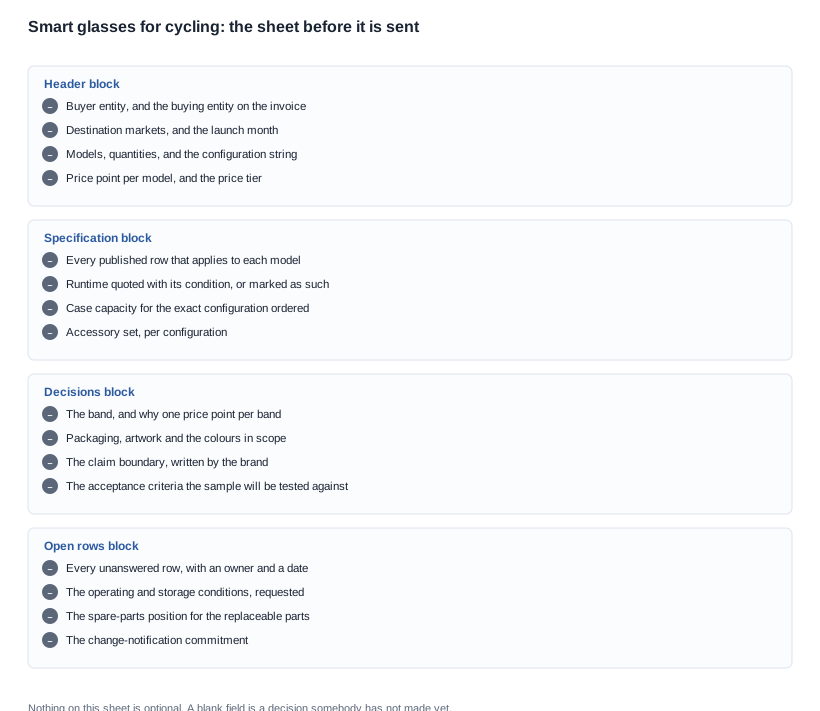
Why the four blocks, and why the fourth is the one that matters. The header block identifies the order. The specification block records what each model is, using published rows wherever they exist. The decisions block records the choices only the brand can make. The open-rows block records everything the first three blocks could not answer, with an owner and a date against each item. That last block is the block that turns the sheet from a form into a control, because a programme that names its unanswered rows can be held to closing them, and a programme that leaves them invisible cannot.
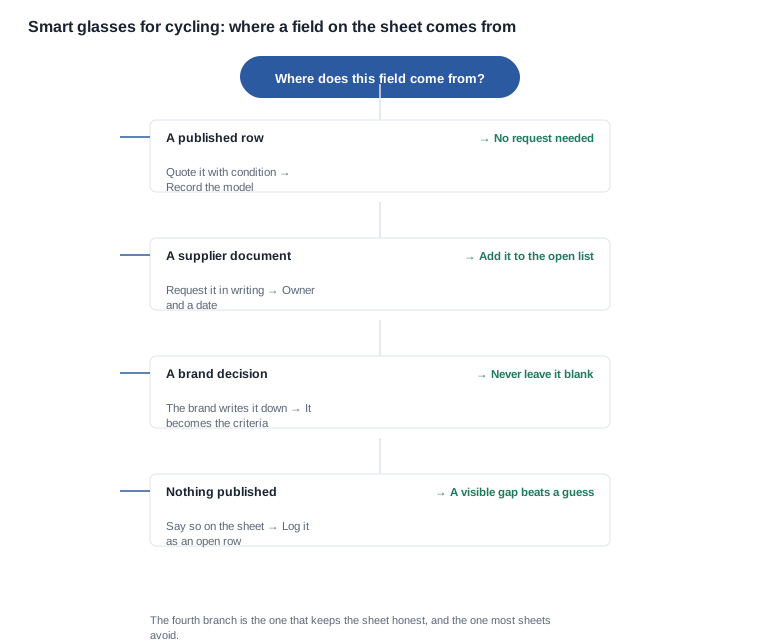
The rule underneath all four blocks. Every field has a source, and there are only four sources: a published row, a supplier document, a brand decision, or nothing published. The decision chart below is the whole method. Most fields are the first kind, and that is the useful part, because a published row needs no request and no negotiation — it is a fact that both sides already hold. The second kind needs a request with an owner and a date. The third kind is the brand's own work. The fourth is the one that gets avoided, and leaving it visible is what stops an estimate becoming a specification.
Who this is for. The reader is a brand owner or a channel buyer who has to specify a cycling line, the product manager who will fill the sheet in, and the person who will receive quotations against it. The sheet is also for the supplier representative who wants a precise request rather than a paragraph — because a supplier asked to quote against a specification answers in days, while a supplier asked to quote against a description answers in weeks and then quotes a different configuration.
What this template is not. It is not a technical file, and it is not a claims sheet. Those are separate documents with separate owners and separate purposes. The sheet points at them; it does not replace them. And it is not a template for a consumer purchase: every field in it is a field a buyer is negotiating, and a field a consumer would never see.

The two recording blocks: the header and the specification
The header block: who, where, and which configuration
The header block is short and it is the block most often left implicit. Four fields, and each one prevents a specific failure.
The buying entity and the invoicing entity. They are the same for most first orders and not the same for a brand selling through a subsidiary or a dealer who imports in its own name. When they differ, the entity that signs the agreement, the entity on the invoice, the entity named in the technical file and the entity named in the recall contact are four different names in four documents, and the mismatch is found at the worst moment. One line on the sheet prevents that.
The destination markets and the launch month. These two belong together because they determine which regulatory regimes apply and when the stock has to land. The market list decides whether one configuration can ship everywhere or whether the radio marking differs by destination, and the launch month decides the order date, the storage conditions and the review date for the whole programme.
The models, the quantities and the configuration string. The configuration string is the reference that everything else keys to, and it has to be precise enough that a different charging interface or a different case is not covered by it. In our range that string has to settle the case question, because five camera models publish a case capacity, two more ship with a case whose capacity is not published, and four camera models carry no case row at all — the V03 Pro and the V06, and the S7 and the V03. A sheet that says "the camera model" is a sheet that will be quoted three ways, and two of those three will not match the goods.
The price point per model and the price tier. The price tier is where the volume actually sits, and the pilot-versus-run split is a decision that is much cheaper to take now than after the first shipment. Two price points in one band, or two bands, is a decision with packaging and minimum order quantity consequences, and it belongs on the sheet rather than in a conversation after the first quotation.
The accessory set, per configuration. The cable, the dock, the cleaning item and the wipe are a per-unit cost and a per-unit return-reduction lever, and the accessory set also determines whether a case is in the box. Putting it on the sheet means the quotation includes it, and it stops the configuration string and the bill of materials from disagreeing.
The specification block: the published rows, field by field
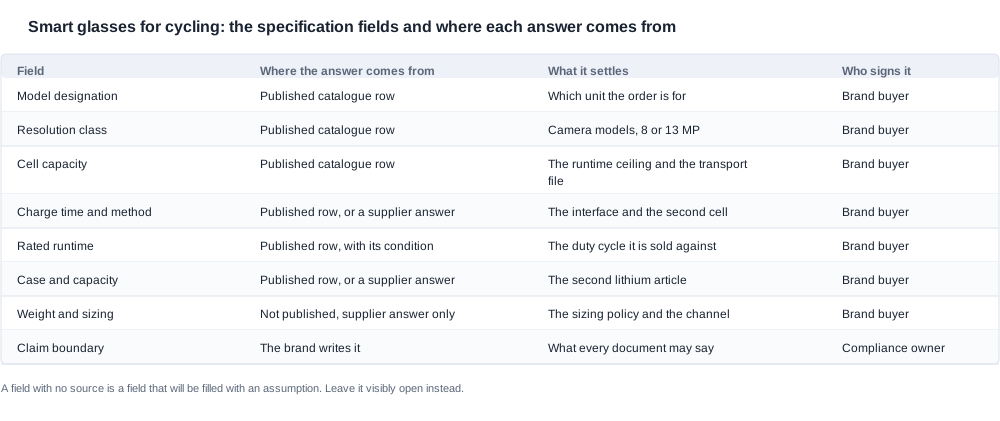
The specification block is mostly transcription. That is its virtue: copying a published row into a field takes thirty seconds and eliminates a whole category of error, because a transcribed row cannot be misremembered, and a specification written from memory is a specification with a different cell capacity in it. The block covers the resolution class on camera models, the cell capacity, the charge time and the charging method, the rated runtime, the Bluetooth version where the catalogue publishes it, the case capacity where it is published, the colour counts, and the structural features on the models that publish them — the ultra-slim detachable temples on the G07, the removable inner frame on the V06 and the S7, and the remote capture control on the D17 and the ZH12.
The two fields that need a condition rather than a value. The rated runtime is published without a test condition, and the charge time is published without a starting state or a completion criterion. Both fields on the sheet therefore have two sub-fields: the published figure, and the condition. Where the supplier supplies a condition, it is written next to the figure. Where it does not, the sub-field says so and the figure is described in the quotation as a catalogue value rather than as a commitment. The runtime figures in our range run from about five to eight hours by model, and the charge time is two hours or less on twenty-six models and about one hour on the D17 and the ZH12.
The field that is not published for any cycling model. The unit weight. Our catalogue carries one published weight, the 158 g whole-unit figure for the MT6, which is a foldable-case camera model and not a cycling model, and the figure covers the unit including its 265 mAh cell and camera rather than the 1200 mAh folding case, whose own weight is not published. A sheet that asks for the weight and receives that figure has been given the wrong model. The field therefore has to say which model the answer applies to, and the answer has to arrive as a per-model number or as a written refusal.
The field that decides the transport file. The charging method, on the four camera models whose pages carry cell capacity, charge time, runtime and a case capacity and no interface row at all: the CY03 and the MT6, and the L1 Pro and the CY05. The field is not optional for those four, and the reason is not the packaging. It is that a case is a second lithium cell, so the interface and the case together decide what the transport documentation has to cover. On the other twenty-four models the catalogue publishes the interface — magnetic on seventeen, Type-C on seven — and the field is a transcription.
The field that should not be on the sheet at all. Anything the programme intends to claim without a published row behind it. A field titled "waterproof rating" invites an answer that expands the published marking; a field titled "ingress marking" invites the fact. Same for "battery life" against "rated runtime", and for "fits a helmet" against the retention question that the training protocol has to answer, which is covered at how to test smart glasses for cycling.
The decisions block: the fields only the brand can fill
Four decisions, and none of them can be delegated to a supplier. The band and the price point behind it. The packaging, the artwork and the colours in scope. The claim boundary. And the acceptance criteria the sample will be tested against. Each of these is cheap to decide and expensive to leave undecided, because each of them is answered later by whoever is nearest — and each later answer is usually a copy of whatever the last document said.
The band decision, on the sheet, in one line. The band is a commercial decision expressed in technical language: one price point per band, with the model inside the band chosen from the published rows. Putting it in one line on the sheet does two things. It stops a supplier from quoting a better model as a substitute, which is helpful but not what the order was for, and it gives the comparison between two quotations a fixed structure, because both are answering the same band.
The packaging and artwork scope. The number of colour and logo variants, each of which carries a packaging set and a minimum order quantity, and each of which is cheap to change between runs and expensive to change after the print run. The sheet should carry the number of variants and the date the artwork is final, because the artwork date is what determines when the order can be placed.
The claim boundary. One page, written by the brand, listing what the listing, the dealer script, the insert and the packaging may say. It is the field that protects the programme from the three claims it cannot support — a waterproof claim wider than the published ingress marking on the V06 and the S7, any hearing or vision or health benefit, and any statement that the product is a safety device. It is a brand decision because it is about what the brand is willing to be held to, and a supplier cannot write it.
The acceptance criteria. What the sample will be tested against, in testable terms: the controls that have to be operable, the runtime condition that will be measured, the capture method, the installation in the launch market, and the return reasons that will be used afterwards. A sample approved against an impression becomes a programme approved against an impression, which is why the criteria belong on the sheet rather than in the quality assurance team's notes.

The open-rows block, and how it closes
What belongs in it. Every field the first three blocks could not answer, with three things attached: what is being asked, who owns the answer, and by when. In our range the standard entries are the operating and storage conditions, the runtime test condition, the charging interface on the four camera models where it is unpublished, the per-model unit weight, the spare-parts position for the replaceable components, the photochromic figures for the lens-response configurations, and the model-level document set with its index. Each of them is a question to a supplier, and each of them is a question that has a known answer somewhere in a supplier's file.
Why it is a block and not a note. Because a note gets read once and a block gets chased. An open-rows list with an owner and a date is a project; the same list in an email is a wish. The block is also what makes the sheet comparable: a supplier who can answer twenty of the twenty-three open rows has told the buyer more about how the programme will run than any unit price has.
The three legitimate answers to an open row. A number with a condition attached. A written statement that the row is not published and is not going to be. Or a date on which the answer will exist. What is not acceptable is an empty field that gets read as a zero, because an empty field on a specification is an invitation to fill it in later with whatever is convenient.
How the block closes. At the point where the quotation becomes a purchase order, every open row should be marked as answered, declined with a reason, or carried forward to a named milestone. A carried-forward row is acceptable; a row that quietly disappears between the quotation and the purchase order is not, because the two documents then describe different products.
The commercial value of the block. Three things come out of writing the open rows down. The first is schedule: a row that takes eleven weeks to answer is a row that has to be opened in week one, and knowing that is worth more than any price concession. The second is negotiating position: a buyer who has a written list of what is unknown is negotiating from information rather than from a hunch, and suppliers price that difference. The third is total cost: every open row is a conditional cost, and a programme that has listed them has priced the risk rather than discovered it.

How the sheet is used after it is filled
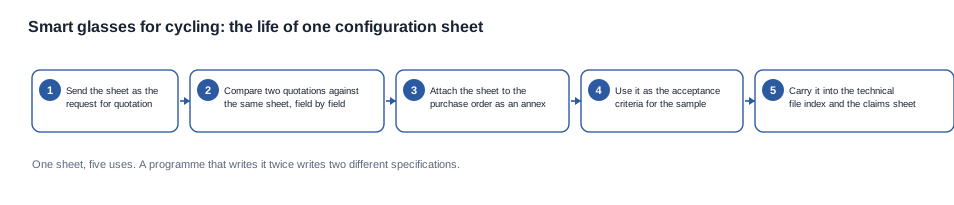
As a request for quotation. The sheet is the request. A supplier asked to quote against a completed sheet returns a price for the configuration, not a price for a description, and can price the accessory set, the packaging variant and the compliance work as part of the configuration rather than as an exception. It also shortens the cycle, because the supplier is not waiting for clarification.
As the comparison document. Two quotations are compared against the sheet, field by field, and the comparison that matters is not the unit price. It is the difference between the two answers to the open rows, the difference in the configuration each supplier priced, and the difference in what each one has committed to in writing. A programme that compares on unit price alone is comparing the cheapest way to get a different product.
As an annex to the purchase order. The sheet goes in as an annex, and the purchase order references it by version and date. That single line does more work than any warranty clause in the category, because it makes the priced configuration, the published rows and the acceptance criteria all part of the contract rather than part of the correspondence around it.
As the acceptance criteria for the sample. The sample is tested against the criteria on the sheet, and the result is recorded against the same field. This is where a lot of the value is: a sample approved against the sheet is an approval that means something, and a sample approved against an impression becomes the thing everybody quotes back to each other for the rest of the programme.
As the index for the file and the claims sheet. Every document the programme holds is filed against a field, and every claim the programme makes is checked against the claim boundary field. When a question arrives — from a customer, a dealer, a platform or an auditor — the answer is a field, and the field points at a document.
What to do with it at the end of the programme. Keep it. The sheet is the record of what was ordered, what was published at the time, what was claimed and what was outstanding, and it is the only artefact that can answer a question years later about why a particular configuration was priced the way it was. That record is also what the incoming owner needs, and it is what the sheet becomes in the handover.
What we will complete on this sheet, and what we will not
On a configuration sheet, the position is simple. Where the sheet asks for a published row, we will fill it in from the catalogue and we will not paraphrase it in a way that changes what it means. Where the sheet asks for a supplier document, we will supply it for the exact configuration and we will tell you which document it is. Where the sheet asks for a brand decision, that is yours and we will not make it for you, because the band, the packaging scope, the claim boundary and the acceptance criteria are decisions that belong to the channel and the market. And where the sheet asks for something we have not published, we will say so rather than filling it in.
The rows we publish for this range are the resolution class, the rated runtimes, the charging interfaces, the charge times where the catalogue publishes them and the cell capacities, the Bluetooth versions for the audio and sport families, the colour counts, the case capacities where they are published, the IP54 marking on the V06 and the S7 as a catalogue attribute, the photochromic lens configuration on the V03 Pro, the ultra-slim detachable temples on the G07, the removable inner frame on the V06 and the S7, and the remote capture control on the D17 and the ZH12. The scenario entry point is at smart glasses for cycling, the product families are at sport smart glasses, and the fault-handling side the acceptance criteria have to cover is at troubleshooting.
What we will not do is complete a field with an estimate, and we will not sign an acceptance criterion that depends on a row we have not published. We will not quote a weight for a cycling model, because the only published weight in the catalogue is the 158 g whole-unit figure for the MT6 and it belongs to a different model. And we will not write the claim boundary for you, because a claim boundary written by a supplier is a boundary written by the party with the least exposure to it.
What to send us next. Send the header block and the specification block, and we will return the published rows for each model, the supplier-side documents that cover each configuration, the open rows with what we can answer from our own file, and the model-level index. The parts of the sheet that remain yours — the band, the packaging scope, the claim boundary and the acceptance criteria — will come back marked as yours.
Related reading
- Where this scenario begins — smart glasses for cycling
- The acceptance testing side — how to test smart glasses for cycling
- Fault handling — troubleshooting
- The families covered — sport smart glasses
Send the header block and the specification block, and we will return the published rows and the open rows for each configuration.


