

The useful version of a pros and cons list for smart glasses for cycling is not a list of virtues and a list of vices. It is a ledger, in which each advantage is paired with the specific thing it is paid for by. In this range almost every advantage has a partner on the other side of the table, and in most cases the partner is a published row rather than a matter of opinion: two cells buy a longer published runtime and cost you a magnetic dock that has to travel with the product; a Type-C interface saves the case and costs you a cable you supply; a 1400 mAh case buys time between charges and adds a second lithium cell to every box. Below is that ledger, the three advantages that are usually sold as advantages and are not, and what a buyer should do with the result.
Smart glasses for cycling: the row each advantage is matched against
The conclusion first. There are no free advantages in this category, and the only question is whether you can name the partner. A buyer who can name it can plan around it; a buyer who cannot is going to discover it in the returns line, the freight bill or the legal file, whichever comes first. That is the whole of the argument, and it is why the table below has four columns rather than two.
Who this is for. The reader is a brand owner who has to sign off a range, a channel buyer who has to answer a dealer's question about why one model costs more than another, and a product manager who has to explain a decision to a colleague who liked the other one. All three are in the same position: they have seen a feature list and they need the other half of it. The fear underneath the question is not that the product is bad. It is that the advantage was bought with something nobody wrote down, and that the something turns up later in a cost the programme did not carry.
Where the honest list comes from. Every line in this article is anchored to a published row in our catalogue, which is the only kind of honesty that survives a negotiation: cell capacities, charging interfaces, rated runtimes, charge times, Bluetooth versions, resolution classes, case capacities, colour counts, and the structural features on the handful of models that publish them. Where a row is missing, the article says the row is missing rather than substituting a typical value, because the partner of an advantage is often exactly the thing the catalogue does not publish.
The three families, and the fact that they are not interchangeable. Our range separates into eight audio models — the K01, the K02, the D11, the D12, the LC-105 pair, the G07 and the YK12 — three sport models — the YKC02, the D17 and the ZH12 — and eleven camera models. Those three families do not have pros and cons in the abstract; they have published rows, and the rows differ enough that a statement about one of them is not a statement about the others. A buyer who says "the runtime is eight hours" is describing the LC-105 pair and the K01 and the K02, and is describing the G07 and the YK12 wrongly, because those two publish about six hours.
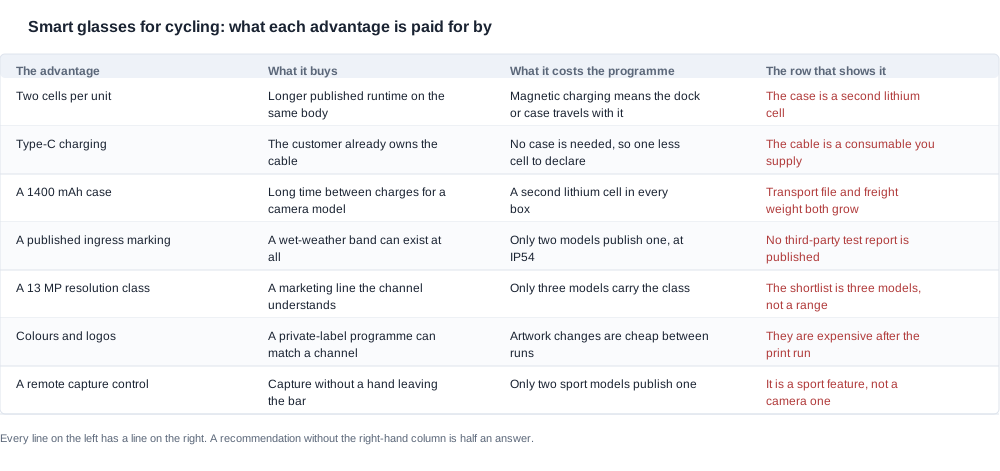
How to read the ledger. The first column is what a buyer gets. The second is why they want it. The third is what it costs the programme. The fourth is the published row that shows it, which is the column that makes the argument checkable rather than rhetorical. A ledger line with an empty third column is not a line you should act on.

The ledger, line by line, against the published rows
Two cells per unit. The K01 and the K02 publish 90 mAh by two with a Bluetooth V5.3 radio, magnetic charging and a charge time of two hours or less, and a rated runtime of about eight hours. The LC-105 pair, the G07 and the YK12 publish 55 mAh by two, Bluetooth V5.4, magnetic charging, and a rated runtime of about eight hours for the LC-105 pair and about six for the G07 and the YK12. The advantage is a longer published runtime on the same body, and the partner is the interface: magnetic charging means the dock or the case has to travel with the product, and the case is a second lithium cell that has to be declared for transport. The G07 carries a further published advantage in the same line, ultra-slim detachable temples, which makes a damaged temple a part rather than a write-off. The YK12 publishes a slim temple with surround sound, which is a different statement and does not carry the same consequence.
One cell and a Type-C port. The D11 and the D12 publish one 100 mAh cell, Type-C charging, Bluetooth V5.4, a charge time of two hours or less and a rated runtime of about seven hours. The advantage is the shortest bill of materials in the range: the customer already owns a cable, so there is no case to carry and no second cell to declare. The partner is the cable, which becomes a per-unit consumable you decide to supply or not, and the loss of the case as a retail accessory at a higher price point.
The 1400 mAh case. The L1 Pro and the CY05, and the CY03 publish a 1400 mAh charging case, and the L2 Utral publishes 900 or 1400 mAh as a configuration choice. The advantage is time between charges on a camera model, which is the largest published case capacity in the range. The partner is in the box on every single unit: a second lithium cell, with its own transport documentation, its own freight weight, and a case cell that has its own ageing behaviour and no published cycle life rating.
The published ingress marking. The V06 and the S7 are the only two models in the range that publish an IP54 marking, and both publish a removable inner frame as well. The advantage is that a wet-weather band can exist at all, because no other model in the range publishes any rating. The partner is that no third-party test report is published behind the marking, the digits cover splashing water rather than immersion or a sustained downpour, and the marking is a catalogue attribute rather than a verified performance figure.
The 13 MP resolution class. Three models carry it — the L1 Pro and the L2 Utral, and the S7 — against eight models in the 8 MP class. The advantage is a marketing line the channel understands immediately. The partner is that three models is a narrow shortlist, which changes the negotiating position, and that resolution is not the same thing as picture quality: the field of view is not published for any model, so the comparison has to be made on footage rather than on the number.
Colours, logos and private label. Most models publish colour counts, and the range supports logo and artwork customisation. The advantage is that a channel programme can match its own identity. The partner is a manufacturing fact that every buyer in this category learns the hard way: colour and logo changes are cheap between runs and expensive after the artwork is printed, and each variant carries its own packaging and its own minimum order quantity.
The remote capture control. The D17 and the ZH12 publish it, and the ZH12 publishes surround sound alongside it. The advantage is capture without a hand leaving the bar, which is the single most useful published feature in this range for the use case this article is about. The partner is that it is a sport-model feature, so a camera programme cannot inherit it — the camera models publish the capability as a camera, not as a remote.
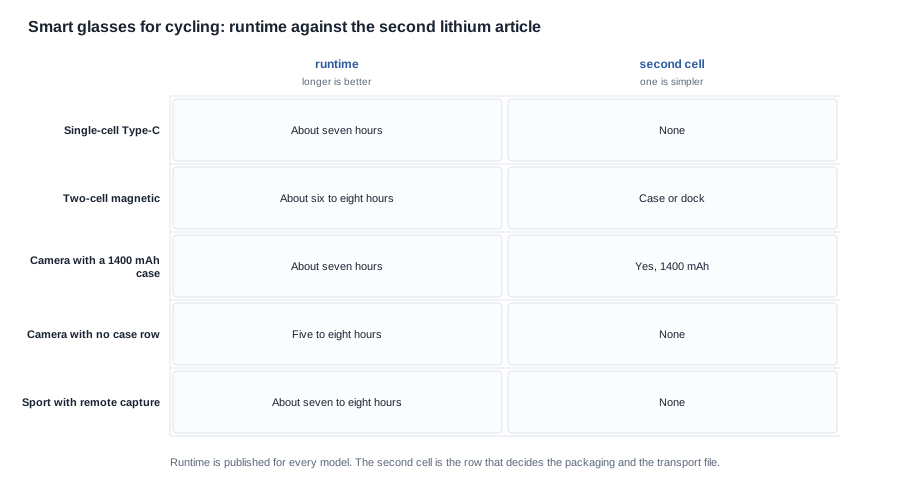
The matrix above puts the two rows that decide most of the practical trade-offs side by side: the published runtime, which is the number a channel will sell on, and the second lithium article, which is the number that decides the packaging, the freight and the transport file. A configuration with a good runtime and a second cell is a different commercial object from a configuration with the same runtime and none, and the difference is invisible in the product listing.
The three advantages that are usually sold as advantages
An ingress marking with no test report behind it. This is the most common over-read in the category. Two models publish IP54, which is a dust protection level and a splashing-water level, and no third-party report is published for it. It is not nothing — it is a published marking, and it is a real difference between the two models that carry it and the nine that do not. What it is not is a verified waterproof performance. A programme that sells it as the second is selling a claim it cannot defend.
A pixel number standing in for picture quality. Eight of the eleven camera models publish 8 MP and three publish 13 MP. Neither number tells a buyer how much of the scene the camera sees, because the field of view is not published for any model in the range. The class is a usable shortlisting input; it is not an output. Where a programme has to choose, the choice belongs on sample footage at riding speed, and the pixel number belongs on the order form.
A case capacity described as a free bonus. The 1400 mAh case on the L1 Pro, the CY03 and the CY05 is frequently presented as a value addition. It is not free: it is a second lithium cell in every box, with a transport file that has to cover it, freight weight that changes the carton, and a cell with no published cycle life rating. That is a good reason to price it separately and to decide deliberately whether the channel wants it in the box or sold as an accessory.
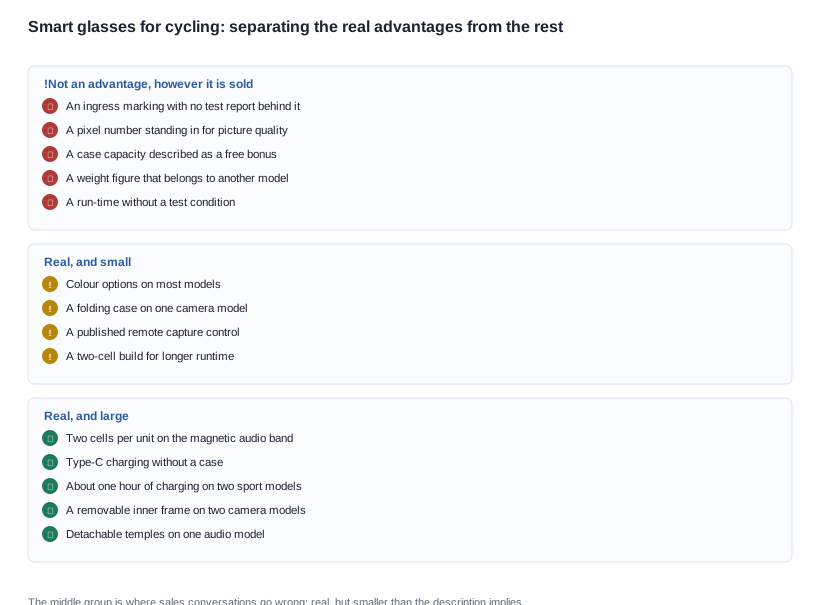
The checklist separates the three groups that get confused in a sales conversation. The first group is the one a buyer should refuse to act on at any price. The second group is real and small, and it is where most sales conversations go wrong, because a genuine advantage described at three times its size reads as a fabricated one. The third group is real and large, and it is short: two cells on the magnetic audio band, Type-C charging without a case, about an hour of charging on the D17 and the ZH12, a removable inner frame on the V06 and the S7, and detachable temples on the G07.

Where each cost lands, and who absorbs it
The most useful thing a ledger does is show which party ends up holding each cost, because the party that holds it is the one that will complain if it was not agreed.
The brand holds the packaging, the artwork and the minimum order quantities. Every colour and logo variant multiplies the packaging sets and the minimums, and a programme that quietly carries five variants carries five packaging sets. This cost is invisible until the purchase orders are raised, and it is entirely within the brand's control, which is why it belongs in the bill of materials decision rather than in a later negotiation.
The channel holds the returns and the claims. The wet-weather claim that outruns the marking, the runtime promise that outruns the published figure, and the assurance that a product does something the documentation does not cover — all of those arrive at the dealer first and reach the brand second. A claim sheet moves the cost back to where it can be managed, because the copy is written once and inherited by every marketplace listing, dealer sheet and insert card afterwards.
The customer holds the parts and the consumables. A cable, a dock, a wiped lens and a case that is not in the box are all items a customer notices on day one. What they should not notice is the absence of an instruction, because a consumable that is supplied without being explained is a per-unit cost with no return. This is the smallest line in the ledger and the one with the clearest return.
The forwarder holds the second cell. A configuration with a case travels as more than one article, and a transit file that does not cover the case is discovered at the wrong moment. Nothing in this is exotic; it is the ordinary consequence of a design decision, and the design decision was made before the freight file existed.
The supplier holds the unanswered rows. The four camera models with no published charging interface, the models whose charging method is published as a case only, the runtime figures with no test condition, the single published weight figure in the range. Each of these is an answer that exists somewhere in a supplier's file and has simply not been published. Asking for them is a normal part of due diligence, and a supplier who answers precisely has told you something about how the rest of the relationship will work.

Putting the ledger in front of a channel
A ledger is only useful if it survives contact with somebody who sells the product. Five steps take it from an internal document to something a dealer network can work with.

- Cut the ledger down to the three lines that decide this channel. A full ledger convinces nobody. For a channel that sells on runtime, the runtime line and the cell line are the argument; for one that sells on capture, the remote control line and the sport-model line are.
- Name the counterparty for each of the three lines. Which of them falls on the brand, which on the dealer, and which on the customer. The lines that fall on the customer are the ones the copy should not mention, because a copy that names a cost the customer has to absorb is a complaint waiting to happen.
- Take the two customer-facing lines out of the listing copy. This is the step that protects the brand, and it is the one most often skipped because the lines are true. A published runtime with no test condition and a case that is not in the box are both facts; stated badly, they are both complaints.
- Agree the claim sheet so that no line is claimed twice. The same fact appears in the catalogue, the dealer sheet, the listing copy and the insert card, and each one has been written by somebody different. The claim sheet is the single place a claim is decided, and it is what stops the programme from making a fourth version of a statement the other three have drifted away from.
- Put the agreed ledger into the dealer training material. Dealers are asked the same six questions in every showroom in the network. If the answers are written down and consistent, the channel is protected. If they are left to each dealer, the channel is protected only in the showrooms whose staff happened to read the manual.
What this does to the commercial conversation. A buyer who brings a paired ledger to a supplier negotiation asks better questions, because each question has a second half attached to it. "What is the runtime" becomes "what is the runtime, and what is the case capacity in that configuration". "What is the unit price" becomes "what is the unit price, and what is the landed cost with the case and the freight". The supplier who answers both halves has given you a usable quotation; the one who answers only the first has given you a price.
Where the negotiation room actually is. The room is not in the unit price, which is competitive and known. It is in the four places the ledger exposes: the configuration of the case, the mix between the pilot tier and the run tier, the accessory set that travels with the product, and the payment milestones attached to the documentation. Each of these changes the programme's cost without changing the product, and each of them is decided in the quotation rather than after it.
What we will say plainly, and what we will not
Concretely, a pros and cons list has to end in something a buyer can act on, and the only version of that we can stand behind is one built from published rows. For this range that means the cell capacities, the rated runtimes, the resolution class, the charge times, the charging interface wherever the catalogue publishes it, the Bluetooth versions for the audio and sport families, the colour counts, the case capacities where they are published, the IP54 marking on the V06 and the S7 as a catalogue attribute, the ultra-slim detachable temples on the G07, the removable inner frame on the V06 and the S7, and the remote capture control on the D17 and the ZH12.
What we will not do is describe an advantage without its partner, or fill a missing row with a typical figure so that the ledger looks tidier. The frame weight, the field of view, the video specification, the lens material and coating, the runtime test condition, the standby draw, the cycle life rating and the per-model unit weight beyond the single 158 g whole-unit figure for the MT6 are outside what we publish, and a ledger that quietly assumed them would be a ledger of our estimates rather than of our data.
What we will do is take the channel, the price band, the volume and the launch market, and return the published rows that apply, the advantages paired with their costs, the three lines that decide that particular channel, and the questions that still need a written answer before an order is released. The scenario background is at smart glasses for cycling, the safety side of the same scenario is at is it safe to record while cycling, the outdoor and weather reading of the same range is at weather considerations for sports and outdoor, and the product families are at sport smart glasses.
What to send us next. Send the channel, the price band, the volume and the claims your dealer network already makes, and we will return the ledger for that channel specifically — the three lines that decide it, the rows behind each line, and the questions to put in writing before the quotation is accepted.
Related reading
- The scenario background — smart glasses for cycling
- The safety side — is it safe to record while cycling
- Outdoor and weather — weather considerations for sports and outdoor
- The product families — sport smart glasses
Send the channel and the claims your dealers already make, and we will return the ledger for that channel.


