
Smart glasses for ecommerce: a bundle sheet that settles returns before merchandising
The short answer is this: in this category the accessory bundle is worth more as a return-rate control than as a basket builder, and the two accessory decisions that matter most cost a fraction of a unit each. Two consumables — a microfibre cloth and a contact wipe — ride in the packaging insert, change nothing about what the customer carries, and remove the two most predictable return reasons in the whole category. A third item, the charging case, is a completely different object: it is a second lithium cell, a configuration choice, a freight weight and a transport file all at once, and the decision about it is a price-ladder decision rather than a cost decision. A fourth item, a spare cable, is only relevant on the models that publish a Type-C charging port.
That split matters because a new e-commerce seller tends to treat "accessories" as one line in a bill of materials, and then discovers that the two cheapest items are the ones that decide the return rate while the most expensive item is the one that decides the freight bill and the price ladder.
Who this is written for, and the decision in front of them. The reader is a brand-side buyer, a channel buyer or an e-commerce seller assembling the first order for a listing. The question is not "what should we bundle for a bigger basket". It is: what goes in the box, what gets sold as its own SKU, and what does each choice do to the return rate, the parcel, the transit file and the margin. The fear behind it is the familiar one — a first shipment that converts badly and a returns desk that discovers, one reason at a time, that the cost was never in the plan.
Why the same product can carry two very different bundles. The configuration differences in this catalogue are structural rather than cosmetic, and the accessories follow them. The charging interface is published for twenty-four models — magnetic on seventeen and Type-C on seven — and is not published for four camera models, the CY03 and the MT6, and the L1 Pro and the CY05. The case position is published in four different forms. The result is that "the accessory bundle" is not one thing: on a Type-C model the customer already owns the cable, so the bundle is consumables only; on a magnetic model the case is part of the charging architecture, so the bundle cannot exist without it. Two sellers of the same model can therefore have completely different bundles, and only one of them is consistent with the interface.

The four accessory candidates and their cost treatment
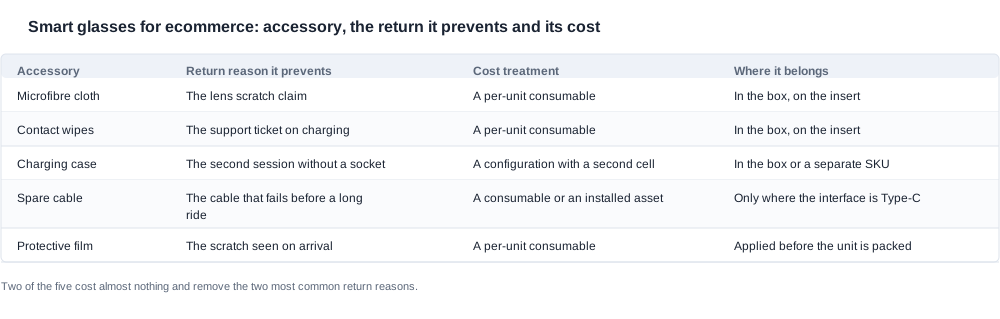
The five candidates below behave differently enough that they cannot share a line in a bill of materials. Two of them are consumables that belong in the insert; two are configuration decisions; one is a consumable that belongs at the packing station.
The microfibre cloth. It prevents the lens scratch claim, which arrives as a soft-image complaint and gets attributed to the camera rather than to the wipe. The reason it is a purchase decision rather than a nicety is that the lens material and the coating are not published for any model in this catalogue, so no instruction can promise that an abrasive surface is safe. The cost treatment is a per-unit consumable at the bottom of the bill of materials, and the measurable output is a ratio: of the units returned with a scratched lens, how many had a cloth in the box. That ratio is the cheapest measurement in the category and it is the one that decides whether the consumable stays in the bill of materials for the second year.
The contact wipes. They prevent the support ticket that arrives as "it stopped charging" and gets diagnosed as a battery fault. The mechanism is straightforward: the magnetic models publish magnetic charging, so there are exposed contacts that collect dried salt, and a ticket that arrives as a dead battery is a ticket that costs a replacement unit. The wipes are a per-unit consumable with a per-unit cost of pennies and they turn the most common hardware ticket into a two-minute support interaction. Their real value is not the saving, it is the consistency: the fault stops being a defect and becomes a step in the instruction.
The charging case. This is the only accessory on the list that changes the price ladder, the parcel and the transit file. It is treated in its own section below, because the case is where accessory decisions turn into configuration decisions.
The spare cable. Relevant only where the interface is proprietary in practice. On the models that publish a Type-C port — the V03 Pro, the L2 Utral, the D11, the D12, the D17, the ZH12 and the bone-conduction entry — the customer has a cable already, and the failure mode is a lost cable rather than a failed one. On the models that publish magnetic charging, the cable is not the failure point; the case is. The cost treatment is therefore a consumable or an installed asset depending on the channel, and the decision rule is simple: only put a cable in the box where the interface makes the customer carry something.
The protective film. It prevents the scratch seen on arrival, which is a different fault from the scratch seen in week three: the first is a packing and handling problem, the second is a habit problem. A factory-applied film is usually the cheapest reduction in the arrival-damage return rate available anywhere in the bill of materials, and it is also the only accessory on this list that sits at the packing station rather than in the box.
The cost treatment that decides the basket
| Accessory | Per-unit cost | What it changes | Measurable output |
|---|---|---|---|
| Microfibre cloth | A few cents | Nothing in the parcel | Scratch returns with and without a cloth |
| Contact wipes | A few cents | Nothing in the parcel | Charging tickets per thousand units shipped |
| Protective film | A few cents | The packing station | Arrival-damage returns as a share of all returns |
| Charging case | A configuration line | The parcel, the freight band, the transit file | Units sold without the device |
| Spare cable | A consumable or an installed asset | The parcel on Type-C models only | Cable-related tickets per thousand units |
The table above is the argument for putting the first three in the box without a debate. They cost a few cents each, they add nothing measurable to the parcel, and each one has an output you can measure on the first shipment. The case is a different decision entirely, and it belongs in the configuration string rather than in the accessory list.

The case is a second lithium cell, not a gift with the product
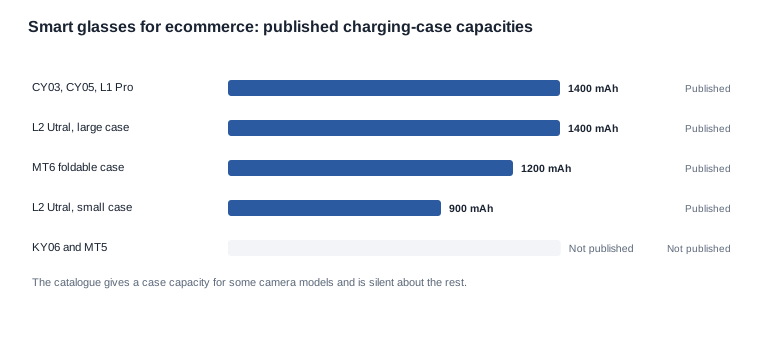
The bars above are the published case capacities in this catalogue, and they are worth reading carefully because the catalogue publishes them in four different ways. The L1 Pro and the CY05, and the CY03 each publish a 1400 mAh case. The L2 Utral publishes a choice of a 900 mAh or a 1400 mAh case, which means it is a configuration variable rather than a fixed feature, and the choice changes the artwork, the freight weight and the transit file along with it. The MT6 publishes a 1200 mAh foldable case. The KY06 and the MT5 are fitted with a case whose capacity is not published at all. And the catalogue publishes no charging-case row at all for the S7 and the V03, and the V06, while the V03 Pro has no charging-case row.
Three commercial consequences follow, and all three are invisible in a unit-price comparison.
First, the case is a declared item. A case is a second lithium cell, so a configuration that includes one carries a different transport file from the same device without one. The requirements are set out at battery transport, and the question to the supplier is narrow: does the file cover the configuration I am ordering, with the case in it. A channel that ships the device and the case separately has two configurations to document rather than one, and it has to know which one it is before the first purchase order rather than after the first consignment note.
Second, the case changes the freight band and the parcel. This is the item that a landed-cost model usually forgets, because the landed cost is computed from the device and then the case is added as an afterthought. A 1400 mAh case is a second cell in a second box, and it changes the parcel dimensions that determine the freight band, the pallet quantity and the fulfilment-centre storage. On a channel with a thin margin, the difference between a device-only parcel and a device-plus-case parcel is frequently larger than the difference between two competing unit prices.
Third, the case changes the return handling. A returned unit with the case is a larger and differently declared parcel than a returned unit without one, and the two-way freight on it is higher. That is a per-return cost, and per-return costs are multiplied by the return rate, which is the number nobody has quoted yet.
What the case does to the price ladder
The case is the main reason a channel in this category ends up with two price points instead of one. A device sold alone at one price and a device-with-case at another gives the customer a reason to choose the second, and it gives the seller a way to hold the device price against a competitor who bundles. The problem is that it also creates two configurations to document, two artwork states to approve, two parcel profiles to manage and two return paths to staff — and a channel that does not plan for that will discover the second configuration in the freight forwarder's spreadsheet.
The alternative is the one the L2 Utral's published case choice makes possible: treat the case as a separate SKU rather than a bundle. The device has one price and one configuration; the case has its own SKU, its own listing and its own freight profile; and the customer who wants the second session buys it as an accessory. That is a cleaner operation and a smaller basket, and for a channel whose margin is thin it is usually the better of the two, because a bundled case forces a price decision that mixes a product decision with a shipping decision.

In the box or sold as a separate SKU
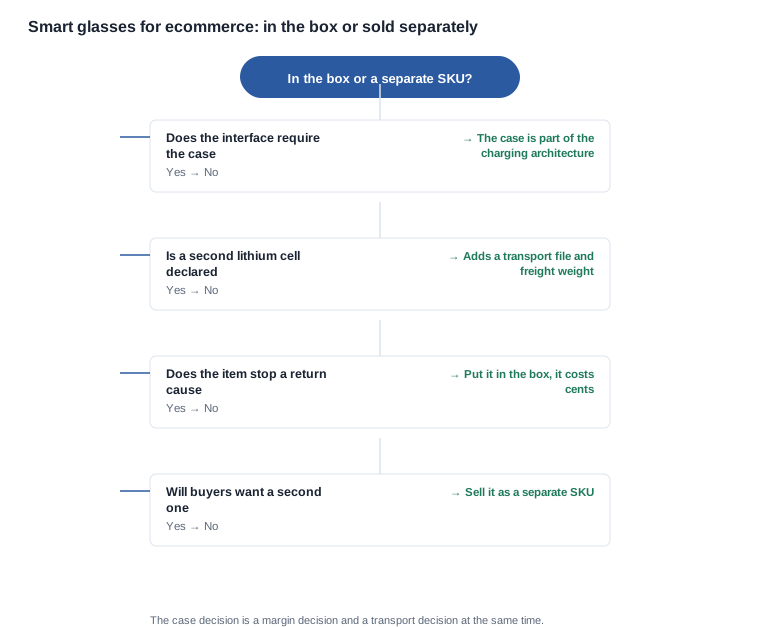
The four questions in the decision chart above are the whole accessory decision, and they are asked in the order that matters. The interface question comes first because it decides whether the case is optional or structural. The second-cell question comes second because it decides whether the case creates a transport obligation. The return-reason question comes third because it decides whether an item belongs in the box. And the second-purchase question comes last because it decides whether an item is a SKU.
The rule that falls out of it. An item that prevents a specific return reason and adds nothing measurable to the parcel goes in the box. An item that changes the parcel, the freight band or the document set is a configuration decision and belongs in the configuration string. An item that a customer would buy again anyway is a separate SKU. And an item that only makes sense for one interface family is scoped to that family.
Applied to the catalogue, the rule produces a bundle that differs by interface. On a magnetic model with a published case, the case is structural and the consumables ride in the insert. On a Type-C model, the cable already exists in the customer's pocket and the consumables are the whole of the accessory position. On a model with no published case row, the bundle is consumables only and the channel has to say so on the product page — because "with charging case" in a listing for a device that ships without one is the fastest way to generate a one-star review in this category.
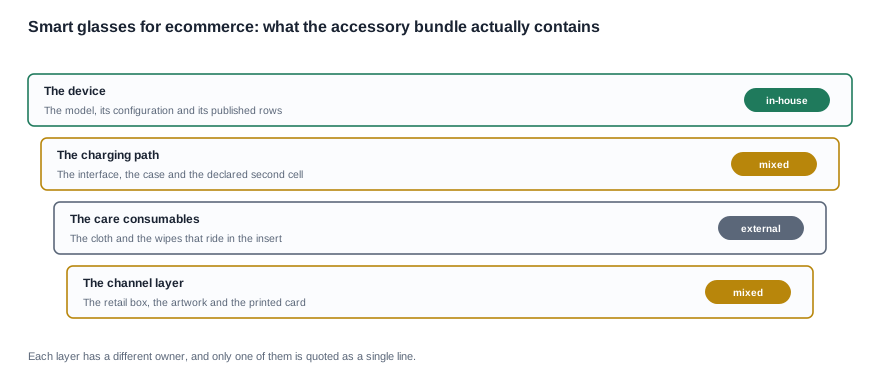
The layer view shows why a bundle is hard to quote as a single line. The device layer is the model and its configuration, and it is the part with published rows. The charging path layer is the interface, the case and the declared second cell, and it is mixed because part of it is in the device and part of it is a separate object with its own specification. The care consumables layer is externally sourced and carries no published row of its own — which is precisely why the instruction that goes with it matters, because nobody's catalogue row governs it. The channel layer is the retail box, the artwork and the printed card, and it is the layer that produces the arrival condition a customer actually judges.
The merchandising question that is really a documentation question
An accessory often gets bundled because it is described as a value-add, and the description is where the risk enters. "Free" is a claim. "Everything you need" is a claim. "Ready to ride" is a claim. Each of them is a promise about what is in the box, and each of them becomes a return when the box does not match the page.
The defensible version of the same idea is factual: the product page states the case option, states the charging interface, states whether a cable is included, and states that a cleaning cloth and contact wipes are in the insert. None of those sentences is a promise; all of them are checkable by the customer in the first thirty seconds, and a customer who finds the box matching the page does not write the review that would have been generated by a mismatch.
This is also where the unpublished rows matter for an accessories decision. Whether a charger is included is not published for any model in this range. Whether a cloth or a wipe is included is not published either — it is a channel decision, which is why the seller owns it and can decide it. And the compatibility of a bundled cable with the customer's own devices is not published, so a bundled cable is a promise the seller makes on the customer's behalf, and the safer version is a statement of the interface rather than a commitment about a third party's device.
The criteria that decide the bundle, and the questions to ask before you order
Four criteria decide every accessory line, and they apply in the same order whether the item is a cloth or a foldable charging case. Working through them before you order costs a phone call; working through them after the first shipment costs a returns ledger.
- Does it prevent a named return reason? A return reason has to be specific enough to be coded, and a specific reason has a measurable output. "The lens scratch claim" has an output — the ratio of scratch returns to units shipped. "Better presentation" has no output, and an accessory without an output is a per-unit cost with no return.
- Does it change the parcel, the freight band or the document set? If it does, it is not an accessory; it is a configuration. The case on the L1 Pro and the CY03, and the CY05 passes this test at 1400 mAh, the L2 Utral passes it as a choice of 900 mAh or 1400 mAh, and the MT6 passes it at a 1200 mAh foldable case. The cloth does not pass it, which is why it goes in the insert.
- Does the interface make it necessary? A cable only becomes a question on the models that publish a Type-C port. A case only becomes structural on the models that publish magnetic charging. An accessory that is only relevant to part of the range should be scoped to that part rather than added to the whole bill of materials.
- Can the product page state it factually? If the sentence cannot be written without the word "free" or "everything you need", the item is being sold as a promise rather than described. That is the test for whether it belongs in the box.
The questions to ask the supplier are the ones the catalogue cannot answer, and they are worth asking together because each one has a different owner. For every model in the bundle: what is the exact bill of materials, per configuration, including the insert. For every model with a published case: the case's own charge time, its charging interface and its capacity in the configuration being ordered. For every configuration with a case: whether the battery transport file covers that configuration with the case in it. And for every model: the per-model certification position in writing, because the catalogue text contains no reference to CE, FCC or RoHS and carries no per-model certification row.
Red flags in a bundle specification. There are five that repeat. A bundle described by its contents rather than by its configuration, which means the same bundle is being proposed for models that publish different interfaces. A case offered on a model where the catalogue publishes no case row, which is a claim about a row that does not exist. A cable offered on a magnetic model, where the customer has no use for it and where the actual failure point is the case. A consumable counted as a variant, which multiplies the minimum order quantity and the artwork for something that costs a few cents. And a bundle with no stated owner, which is how the cleaning instruction ends up unwritten and the consumable ends up unused.
The total cost of the bundle, and the trade-off inside it. The total cost of a bundle is the per-unit cost of the items plus the freight effect plus the document effect plus the return-handling effect, and only the first term appears in a quotation. The trade-off is between the basket and the return rate, and it is not symmetrical: a bundle that lifts the basket by a few per cent but lowers the return rate by a point is usually worth it, while a bundle that lifts the basket and adds a second cell to the transit file is usually not. Both directions are worth checking before you order, because after the first shipment the only way to change a bundle is a new artwork approval and a new minimum order quantity.
What we can confirm about a bundle, and what has to be requested
Here, we will confirm what the catalogue publishes about a bundle, and a bundle is a channel decision rather than a catalogue one. So we will tell you, for a named model and a named configuration: the charging interface, where it is published; the case position, in all four of the published forms; the cell capacity and the charge time as published — a ceiling of two hours or less for every entry except the D17 and the ZH12, which publish about one hour; the runtime band; the camera resolution class where the model is a camera model; the ingress marking where the model carries one, which is only the V06 and the S7; and the structural features the catalogue records, including the detachable temples on the G07 and the YK12 and the remote shutter control on the D17 and the ZH12. No touch row is published for any model, so a temple control surface is a question for the supplier rather than a line on the bundle sheet.
We will also tell you plainly what we do not hold. The catalogue publishes no bill of materials for any model, so what is in the box — cable, charger, cloth, wipes, documentation — is not a published row and has to be agreed per configuration. Whether a charger is included is not published. The per-model certification position is not published either: the catalogue carries a company-level export certification page whose content is images rather than text, the catalogue text contains no reference to CE, FCC or RoHS, and there is no per-model certification row anywhere, so a per-model conformity statement is a document to request in writing against a named model. And the warranty terms are not published, which matters more for accessories than it does for the device, because the accessory is usually the thing the customer is disappointed with.
What we will do with a bundle question. Take the model, the configuration, the interface, the target market and the volume, and return the published rows that apply, the four questions from the decision chart answered, the accessory items that belong in the insert rather than in the configuration, the transport implications of the case if one is published, and the wording that keeps the product page free of promises the box cannot keep. The product families are at AI camera glasses, Bluetooth audio glasses and sport smart glasses; the charging architecture is at charging solutions; the transit obligation is at battery transport; and the packaging and shipping decisions sit with logistics and production capacity. The scenario entry point is smart glasses for ecommerce.
What to send us. Send the model and the configuration you intend to list, the target market, the volume, and the accessory items you are considering including. We will tell you which of them sit in the insert, which of them change the configuration string, which of them create a second cell that has to be declared, and which published rows your product page can safely quote.
Related reading
- Where the scenario starts — smart glasses for ecommerce
- The accessory layer of a first order — ecommerce buyer checklist
- Transport and packaging — battery transport, logistics
Send the model, the configuration, the market and the volume, and we will tell you which accessories belong in the insert, which ones belong in the configuration string, and which ones you have to declare.


