

Smart glasses for ecommerce: a claim sheet marking what rows allow
An e-commerce channel has one failure mode that other channels do not: the listing makes a promise the supplier never made, and the return arrives two months later with a marketplace dispute attached. Almost every one of those promises traces back to five or six published figures that look complete until somebody checks what they omit. This checklist is built around that gap — not around product features, because the features are the easy part, but around the difference between a figure the catalogue publishes and a figure the catalogue says nothing about.
The conclusion this checklist is built on. In this catalogue, a defensible listing is a listing that uses only three of the three states a specification row can be in. A row can be published, in which case it can be written with the published value. A row can be published without a condition, in which case it can be written with the value and the band — and the band is not optional, because it is the part that makes the value defensible. And a row can be silent, in which case it cannot be written at all. The entire checklist below is an application of that classification, plus the market and channel obligations that sit outside the product specification entirely.
Who this is for, and the moment it applies. The reader is a brand-side buyer, a channel buyer or an e-commerce seller, and the moment is the one between "the supplier has confirmed the configuration" and "the listing goes live". That window is short and it is the only point at which every one of the checks below is still free. After publication, the cost of a missing check is not the check; it is the review, the refund, the dispute and the reserve draw that follows it.
What the catalogue actually publishes, in summary. Cell capacity per model, in catalogue form including the doubled cells. A charge time for every entry, as a ceiling of two hours or less for all but the D17 and the ZH12, which publish about one hour. A rated runtime band per model. A charging interface for twenty-four models — magnetic on seventeen and Type-C on seven — and no interface row at all for the L1 Pro and the CY05, and the MT6 and the CY03. A Bluetooth version for the audio and sport models. A camera resolution class, 8 MP on eight camera models and 13 MP on three. An ingress marking on exactly two models, the V06 and the S7. A charging case position in four different published forms. Structural features on named models. One published weight, for one model.
What the catalogue does not publish, anywhere. The sensor model, the field of view, the video specification, the frame rate, the storage capacity and the overwrite behaviour. The lens material and the coating. The microphone pickup distance, the noise-reduction implementation and the wind performance. The runtime test condition, the standby draw, the cycle-life rating and the operating temperature range. The per-model unit weight for every model except the MT6. The per-model certification position. The bill of materials. And the warranty and returns terms.

The three states of a specification row
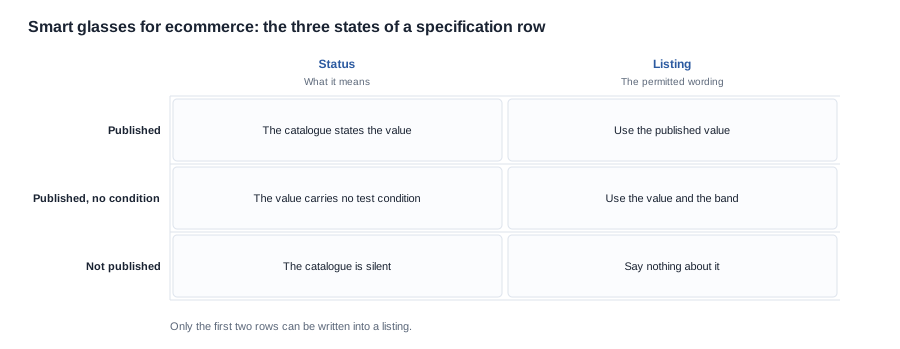
The matrix is the working part of this checklist. Read each row of a product specification and decide which state it is in, and the listing writes itself. The middle row is the one that causes the most damage, because a published value with no condition looks exactly like a published value and reads exactly like one, until a customer tests it and finds that the band has a floor and a ceiling and they were sold the ceiling.
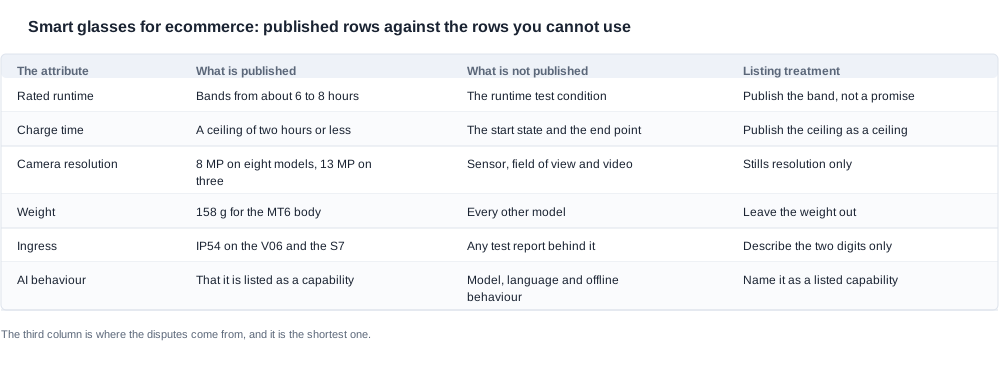
The table above sets the six attributes that most often go wrong, side by side. The third column is the shortest one, and that is the useful discovery: for most of what a seller wants to say about this product, the catalogue is silent, and the silence is the constraint rather than a gap in the seller's research.
The runtime. Published as a band, with no test condition. The listing treatment is to publish the band and not a promise. "Up to eight hours" is defensible as a rated figure; "eight hours of battery" is a claim the documentation does not support, because it removes the ceiling and then removes the rating.
The charge time. Published as a ceiling of two hours or less for every entry except the D17 and the ZH12, which publish about one hour, and published with no starting state and no end criterion. The treatment is to publish it as a ceiling, because the two-hour boundary is exactly where a listing written as "under two hours" becomes false.
The camera specification. The resolution class is published — 8 MP on the V06 and the V03, the V03 Pro and the MT6, and the CY05 and the CY03, and the KY06 and the MT5, and 13 MP on the L1 Pro and the S7, and the L2 Utral — and the sensor, the field of view, the video specification and the frame rate are not published for any of them. The treatment is stills resolution only. A listing that implies a video capability is a claim that has to be verified first, because a resolution figure describes stills and says nothing about moving images.
The weight. One published figure in the whole range: 158 grams for the MT6 glasses body, including the battery and the camera and excluding the foldable case. The treatment is to leave the weight out for every other model and not to reuse the figure as a category statement.
The ingress marking. Published on the V06 and the S7, as a designation, with no third-party test report behind it. The treatment is to describe what the two digits cover — a dust protection level and protection against splashing water — and to state that it is not immersion and not a guarantee in sustained rain. An over-claimed ingress rating is the fastest route to a listing suspension in this category.
The AI behaviour. AI is a listed capability on twenty of the catalogue's twenty-eight entries, and the model, the language list, the offline behaviour, the subscription position and the data location are not published across the range. The treatment is to name the capability as a listed capability and not to describe it as a working service. The feature side is at AI features.
The two attributes that decide the packaging and the price
Two more attributes are worth checking at the same time, because they change documents rather than sentences. The charging interface decides whether a cable is in the box, whether the case is the charging path, and whether the customer carries anything. The charging case decides the parcel, the freight band and the transit file, and it is published in four forms: 1400 mAh on the CY03 and the CY05, and the L1 Pro, a choice of 900 mAh or 1400 mAh on the L2 Utral, a 1200 mAh foldable case on the MT6, a case of unpublished capacity on the KY06 and the MT5, no charging-case row at all for the V03 and the V06, and the S7, and an explicit absence of a case for the V03 Pro. A listing that says "with charging case" against a device that ships without one is checked by the customer in the first ten seconds.
The rows a seller borrows, and why the borrow always fails
There is one practice that produces most of the disputes in this category, and it deserves naming because it looks like diligence rather than shortcut: copying the specification language from a competitor's listing. A new seller sees a competitor's page carrying a figure the catalogue does not publish — a field of view, a video resolution, a weight, a battery figure with a test condition attached — and treats it as a market standard rather than as another supplier's unpublished figure.
The borrow fails for three reasons, and they are worth understanding rather than merely avoiding. First, a competitor's figure may describe a different product in the same family: a weight is the clearest example, because a single figure of 158 grams in this catalogue belongs to one camera model with a foldable case and says nothing about any other. Second, a competitor's figure may be true of their build and false of yours, and the customer who compares the two listings will find the difference and assume the worse one. Third, and most seriously, a borrowed figure is a claim you cannot evidence, and in a dispute the only evidence that counts is a document you can produce.
The practical rule is short: a row you cannot evidence does not go on the page, and a competitor's page is not evidence. The substitute is not silence — it is a written request against the named model, or a sample that answers the question, or a listing that does not make the claim. A listing with four exact claims is stronger than a listing with nine claims of which five are borrowed, because the borrowed five will eventually be tested by a customer, and the cost of being wrong falls on the seller who wrote them.

The market and channel obligations behind the copy
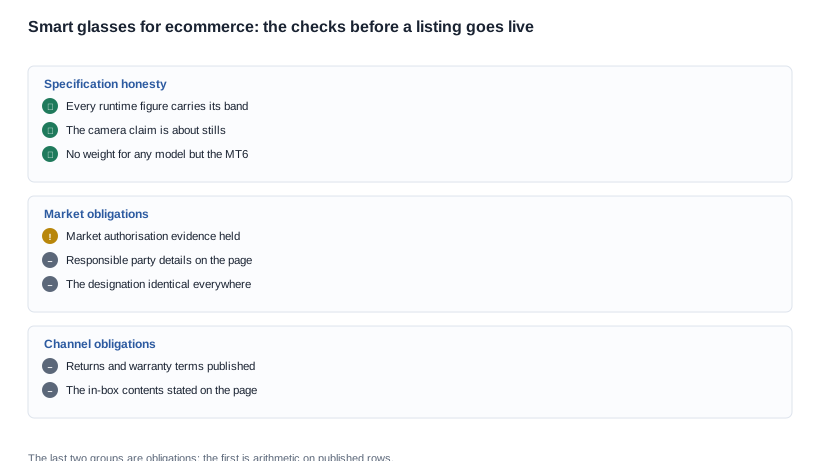
The checklist has three groups, and the second and third are obligations rather than arithmetic. That distinction matters because the first group is under the seller's control while the other two are not, and a seller who spends all their attention on the first will discover the second at the worst possible moment.
Market obligations. A Bluetooth device sold into the United States needs FCC authorisation, and the listing cannot be fulfilled without it. The European Union has its own conformity framework for radio equipment, including cybersecurity obligations attached to CE marking, and the Radio Equipment Directive (EU) 2014/53/EU is the instrument that governs radio equipment placed on that market. Separately, the general product safety regulation has applied since 13 December 2024, and it requires an EU-established responsible party whose details appear on the online product page — which means the product page itself is a compliance document, not just a sales page. The market side of the catalogue position is worth stating plainly: the catalogue carries a company-level export certification page whose content is images rather than text, the catalogue text contains no reference to CE, FCC or RoHS, and there is no per-model certification row anywhere. A per-model conformity position is therefore a document to request in writing against a named model. The compliance routes are at FCC, the EU and GPSR.
Model designation consistency. The designation on the listing, on the packaging artwork, on the product label and on the conformity documents has to be identical. This is administrative until the first customs query, at which point it is the entire defence. Watch for entries that carry an additional published label alongside the model name, because a listing that mixes the two designations creates a mismatch with the label on the unit.
Channel obligations. Publish the returns and warranty terms before you need them — a marketplace policy written after the first dispute is always worse than one written before, because it is written under pressure and it is read as a reaction. Publish the in-box contents on the product page, including the case option and the charging interface. And decide which return reasons you absorb and which you dispute, and make sure the dispute list matches what the listing actually promises. A seller who promises a runtime band and receives a complaint about a shorter day has promised it.

The two questions that prevent most disputes
The artwork is a compliance document, not a packaging decision
Once a market is chosen, three documents have to agree, and they are easy to treat as three separate jobs when they are one. The packaging artwork, the online product page and the product label must carry the same model designation, the same case statement and the same responsible-party details. They are produced by different people, on different schedules, by different suppliers, and they drift.
The drift is expensive in a specific way: a mismatch between the artwork and the unit in the parcel is not a customer-service problem, it is a misdescription problem, and the consequence is a return that has to be paid for twice — once as the refund and once as the lost customer. The prevention is procedural rather than creative. Freeze the model designation and the case statement before the artwork is released, write the bill of materials at the same time, and have the artwork approval reference all three documents by version. A version number on the artwork approval is worth more than a proofreading pass, because it makes the question "which document is current" answerable in one step.
There is a second consequence of treating the artwork as a compliance document: artwork is a per-market cost, and it is not a one-off. Adding a market after the first artwork has been printed means new artwork, a new approval and often a new minimum order quantity, and that is why the market decision belongs at the top of this checklist rather than at the bottom. The channel-side obligations are at solutions for distributors and retailers, and the packaging and shipping side is at logistics.
If time is short, two questions resolve the majority of listing disputes in this category, and they are asked before the listing is written rather than after the first dispute.
What exactly is in the box? Glasses, case if applicable, cable, charger, documentation. None of this is published for any model in the range, so it has to be confirmed per configuration before the copy is written. The answer determines three separate things: the product page, the packaging artwork and the parcel profile. And it determines the fourth thing that nobody thinks about — the transit file, because a configuration with a case is a different declared consignment from the same device without one. The requirements are at battery transport.
What happens if it does not work on the buyer's phone? Compatibility boundaries, the pairing sequence, the first-session steps and what support is provided are not published for any model, so they are entirely the seller's decision to make and to communicate. The honest version of this answer is to state the operating systems the product was actually tested on and to say that the product pairs over Bluetooth, rather than to imply a compatibility list that does not exist. A seller who writes a compatibility claim they cannot support will meet it as a refund request within a month.
Is the claim defensible? Four questions on the product page
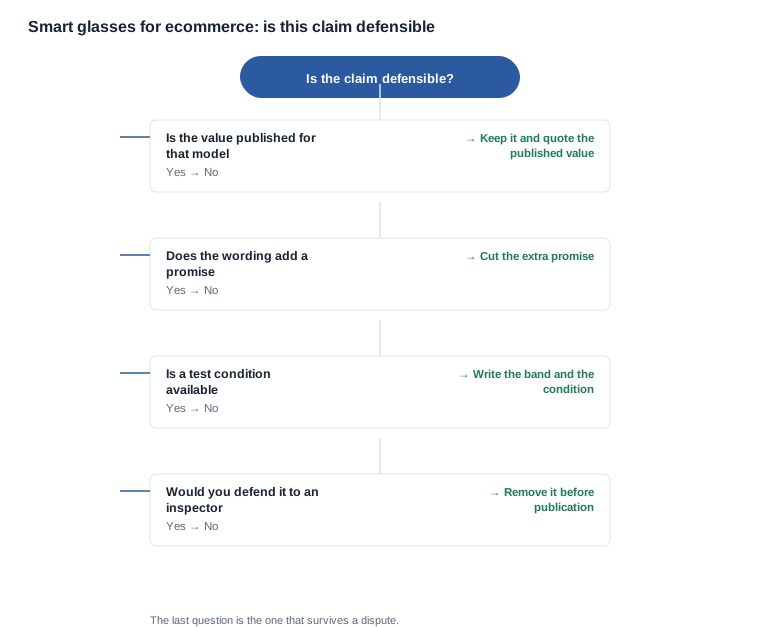
The four questions in the decision chart are the last filter before publication, and the last one is the one that survives a dispute. Is the value published for that model — if not, the claim goes, and asking for the figure is a separate action with a separate deadline. Does the wording add a promise beyond the row — if it does, the extra promise is cut even if the underlying figure is fine. Is a test condition available — if not, the value is written with its band and its model. And would you defend this sentence to an inspector of your marketplace — if not, remove it before publication rather than after the first complaint.
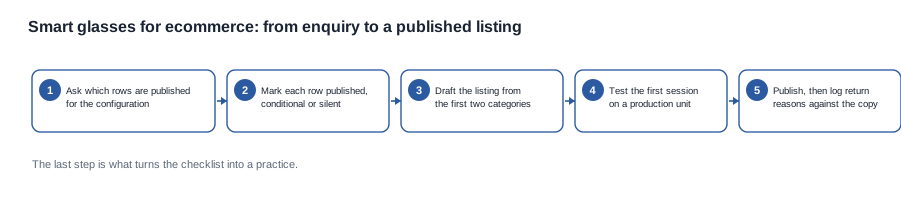
The two things worth doing even when the checklist is satisfied. The first is to test the first session on a production unit in the destination region, because the first-session procedure is not published and the only way to know whether the listing needs a setup instruction is to run it. The second is to read the product page as a customer who has already been disappointed by a similar product. Every sentence that would make that customer hesitate needs a condition attached or a deletion, and this is the only pass that catches the claims that are technically supported and practically misleading.
What we publish, and what that lets you build
The short answer: we will give you the published specification for any configuration and mark the gaps as gaps, because a listing built on acknowledged gaps is defensible and one built on assumed figures is not. The items on the checklist that buyers most often substitute a plausible value for are exactly the ones where the catalogue is silent, and each of them is discoverable by a customer with a product in hand.
What we publish. The cell capacity in catalogue form; the charge time as published; the runtime band; the charging interface where it is published; the Bluetooth version where it is published; the camera resolution class; the ingress marking and the two models that carry it; the charging case position in all four of its published forms; the structural features the catalogue records; the colour counts the catalogue lists; and the single published weight for the MT6 glasses body.
What we do not publish. Minimum order quantities, unit prices and lead times as fixed numbers on this site — all three are confirmed per enquiry, along with tooling, mould costs and any non-recurring engineering charge. We do not publish the sensor, the field of view, the video specification, the storage path, the lens material, the coating, the wind figures, the runtime test condition, the per-model weight except for the MT6, the per-model certification position, the bill of materials, or the warranty and returns terms. We will not fill any of those with an industry average, because a customer with a product in hand will find the error and the correction costs more than the question did.
What we will do. Tell you exactly which of the checklist items we can evidence for your configuration and which we cannot, and for the ones we can, give you the published value with the model it belongs to. The product families are at AI camera glasses, Bluetooth audio glasses and sport smart glasses. The channel-side obligations are at solutions for distributors and retailers, the document side at certification checklist, the packaging and shipping side at logistics, and the ingress reading at IP ratings. The scenario entry point is smart glasses for ecommerce, the purchase-order version of this list is at the ecommerce buying checklist, and the copy-side version is at ecommerce beginner mistakes.
What to send us. Send your target marketplaces and the configurations you plan to list, and we will tell you which published figures support your copy, which will need a condition, and which we cannot evidence.
Related reading
- Channel obligations — solutions for distributors and retailers, certification checklist
- Market routes — FCC, the EU, GPSR
- The purchase-order version — the ecommerce buying checklist
Tell us the marketplaces and the configurations you plan to list, and we will tell you which published figures support your copy and which we cannot evidence.


