
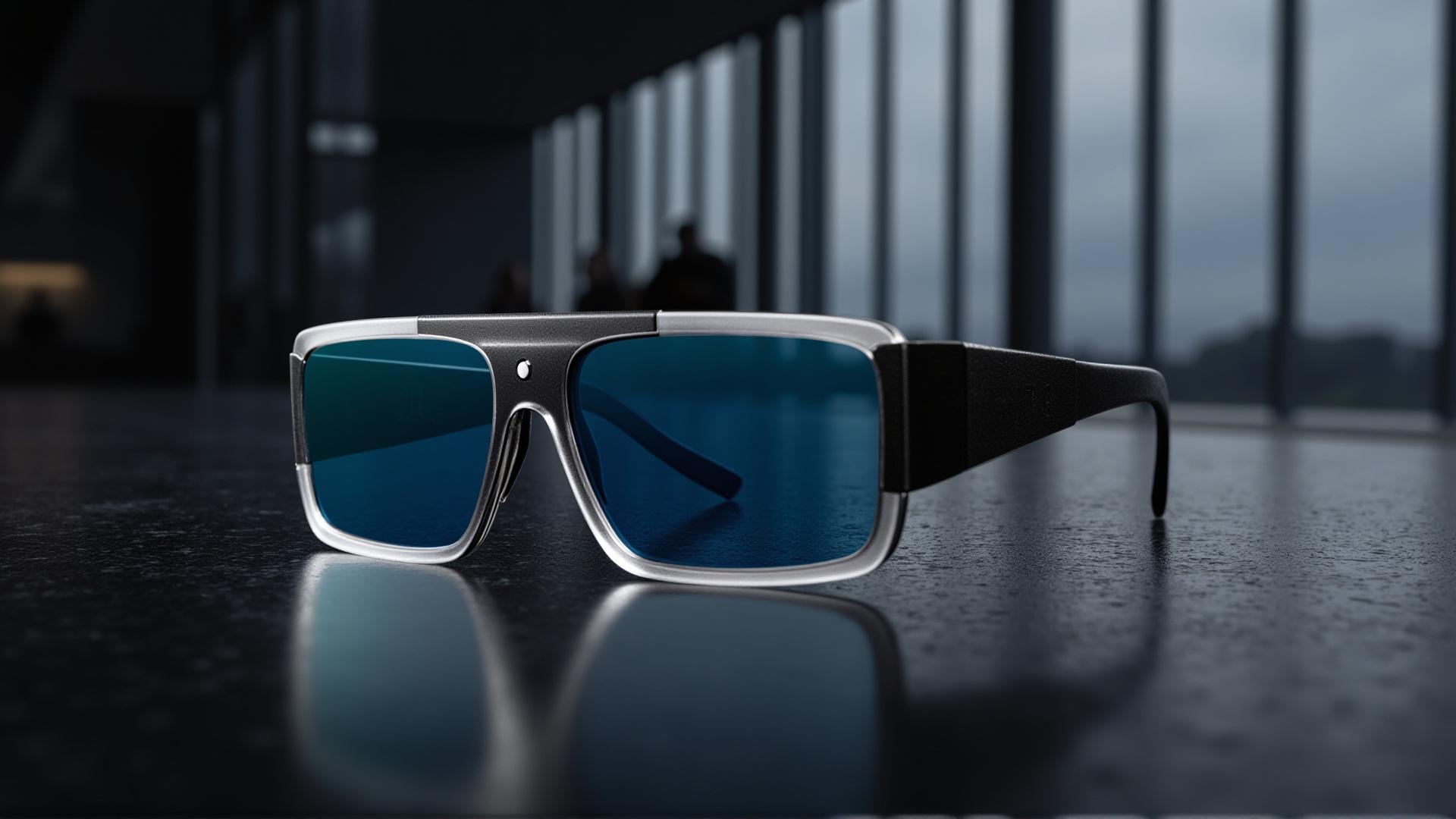
Smart glasses for ecommerce recommendations are not made on features. They are made on the gap between what the page promises and what the documentation can carry, and in this range that gap is very unevenly distributed across the catalogue. The recommendation below is therefore a claim-to-evidence decision: pick the tier whose obligations you can meet, then pick the model inside it whose published rows fit the price point, and never the other way round.
Smart glasses for ecommerce: which published tier a listing can actually carry
The buyer, the page and the one question the tier answers
The reader is a brand-side buyer, a channel buyer or an ecommerce operator with a storefront to fill and a supplier to brief. The situation is one of three: a single listing to launch, a second SKU to add beside an existing one, or a range to rebuild because the first attempt produced returns rather than sales. In all three the recommendation that matters is not "which model is best" but "which tier can this page promise without a promise it cannot keep".
That question has a specific shape in this category, and it is worth stating it precisely. The catalogue divides into a camera range, an audio range, a sport range, a children's range, and three further families — an AR model, an electrochromic lens model and a bone-conduction model — that are published without a model designation. Each family carries a different set of published rows and a different set of gaps. Recommending across them without checking the gaps is how a listing ends up promising something no document supports.
The fear underneath the enquiry is a return rate rather than a bad unit price. A listing that promises first-person video and delivers a product whose storage rule nobody has established produces a review that describes a fault. A listing that promises clear audio and is silent about the open-ear design produces a complaint about leakage. Neither of those is a manufacturing defect, and neither is fixed by the factory, which is why the recommendation has to be made before the copy exists.
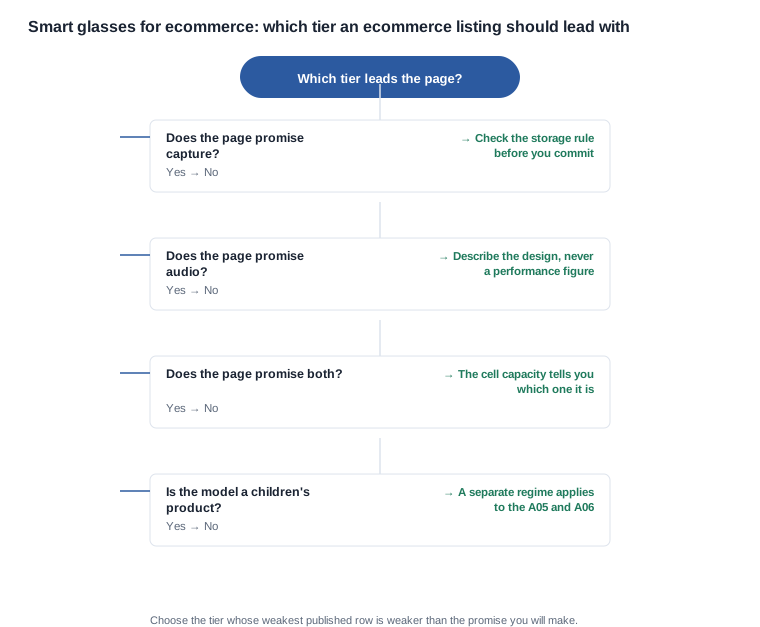
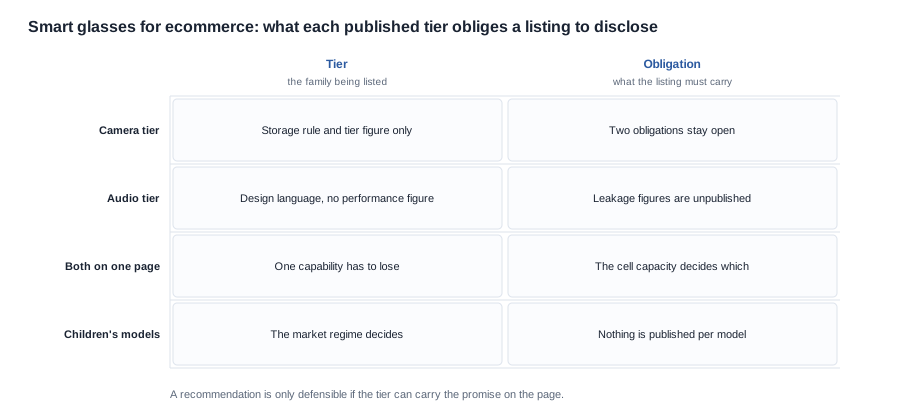
The rule that follows from this is the one that keeps the recommendation defensible: choose the tier whose weakest published row is weaker than the promise you are willing to make. That sounds obvious, but it is rarely applied, because the tier with the most attractive margin is rarely the tier with the best published coverage.
The camera range, and the three obligations it creates
The camera range is the commercially strongest of the four and the one with the most rows behind it: eleven models, split into an 8 MP tier and a 13 MP tier, with cell capacities running from 220 mAh to 290 mAh and a rated use between five and eight hours. The charge time is published as a ceiling of two hours or less on every camera model. Choosing to lead with capture therefore buys a genuinely differentiated proposition, and it also creates three specific obligations.
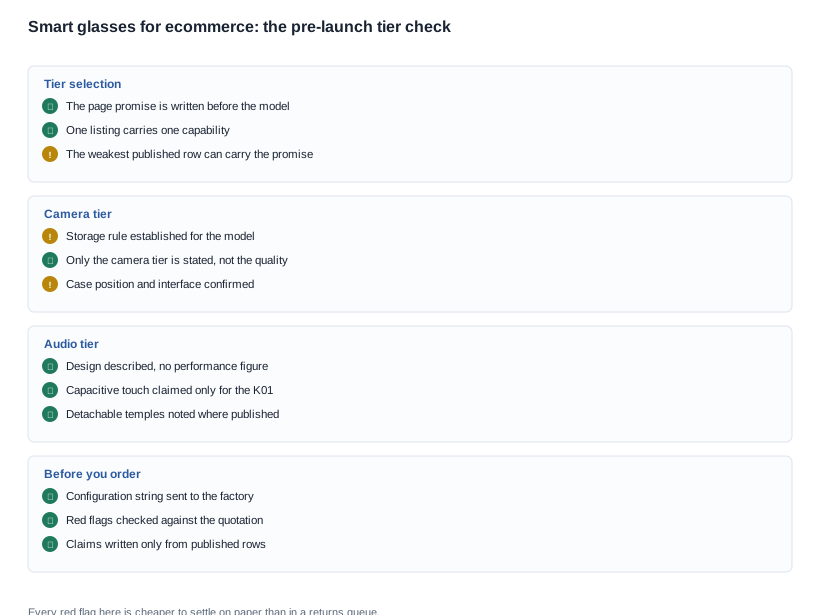
The first obligation is the storage rule. Storage capacity and overwrite behaviour are not published for any camera model. A customer whose recording stops mid-session describes the product as broken, and the cause is invisible from the outside. The recommendation a supplier can make is conditional: recommend this tier only if the storage rule is established in writing for the specific model, and ask for that rule before the copy is written rather than after the first complaint.
The second obligation is the capture specification. The catalogue publishes the camera tier and nothing else about image or video capability. Sensor model, field of view, video resolution, frame rate, stabilisation and low-light performance are all unpublished, which means a listing can say "8 MP" or "13 MP" and cannot say anything about the quality of what is captured. A page that promises usable video and delivers a stills-oriented sensor produces returns that look like defects and are actually expectation failures.
The third obligation is the charging case, and it is uneven in a way that changes the recommendation. Seven of the eleven camera models ship with a case. Five publish a capacity — the CY05 and the L1 Pro, and the CY03 — each at 1400 mAh, the L2 Utral at 900 mAh or 1400 mAh by configuration, and the MT6 at 1200 mAh in a foldable case. The KY06 and the MT5 arrive with a case whose capacity is not published. The catalogue publishes no charging-case row at all for the S7 and the V06, and the V03 Pro and the V03, and the in-box contents for those four have to be confirmed with the supplier rather than assumed from the pattern.
There is a further wrinkle in the camera tier that a recommendation has to respect. Four camera models publish no charging-method row at all — the CY03 and the MT6, and the L1 Pro and the CY05 — while the rest split between magnetic charging and Type-C. A listing that shows a cable for one of those four is a photograph the factory cannot fulfil, and the buyer who recommends the camera tier without checking which of the eleven models carries a published interface has not finished the recommendation.
Two models in the camera tier publish an ingress marking, the V06 and the S7, as a catalogue attribute with no third-party test report behind it, and both also publish a detachable inner frame. If the recommendation is to list either of them, the wording on the page has to be the designation and what its digits cover, never the word waterproof.
The audio range, and the one claim it cannot carry
The audio range is the second commercially meaningful tier, and it is the one with the most consistent published coverage: eight models. The K01 and the K02 publish Bluetooth V5.3 with a 90 mAh × 2 cell configuration; the D11 and the D12 publish Bluetooth V5.4 with a 100 mAh cell and a Type-C charging method; the LC-105 pair publishes Bluetooth V5.4 with a 55 mAh × 2 configuration; and the G07 and the YK12 publish Bluetooth V5.4 with the same 55 mAh × 2 configuration. Every one of the eight publishes a charge time of two hours or less.
The range also publishes genuine structural differentiators that make a recommendation possible rather than generic. The G07 publishes ultra-slim detachable temples and the YK12 publishes slim detachable temples, which is a fitting system rather than a cosmetic feature and makes a part-level replacement possible instead of a whole-device write-off. The D11 publishes a surround-sound feature, and the sport models publish surround sound alongside the remote capture control published on the D17 and the ZH12. No model in the range publishes a touch row — the K01 page publishes none and the K02 page publishes none — so a listing that gives the K01 and the K02 a capacitive-touch line is describing a feature neither of them publishes, and it has to come from the supplier instead.
The one claim the audio tier cannot carry is a performance claim about sound. The catalogue publishes the design and the cell and the Bluetooth version, and it does not publish leakage figures, output levels or any acoustic measurement. A page that says open-ear and then characterises the sound quality is making an assertion with no document behind it, and the honest form of the sentence — a description of the design rather than a claim about performance — is also the form with the lower return rate.
There is one further point about the audio tier that a recommendation should keep in view. Several of these models publish a doubled cell, which the catalogue expresses as a cell value and a count rather than a total. The correct thing to do in a specification table is to publish the catalogue form; a derived total may be used in analysis provided it is marked as a derived figure, because a buyer who publishes a bare total in a product page will be read as quoting an official capacity.
The three families published without a model designation
Three entries in the catalogue carry no model designation, and a recommendation has to decide what to do with them because they are not part of any tier.
The AR model publishes a 100 mAh cell, magnetic charging, a rated use of approximately eight hours and Bluetooth V5.4. The electrochromic lens model publishes a 100 mAh cell, magnetic charging, a rated use of approximately seven hours and Bluetooth V5.4. The bone-conduction model publishes a 200 mAh cell, a Type-C charging method and a rated use of approximately seven hours, with no Bluetooth version row.
Three points follow, and the first is the one that catches buyers out. The AR model and the electrochromic lens model publish the same cell capacity and the same charging method but different rated use, eight hours against seven, so a recommendation that rounds both to a single battery row is wrong in one direction. The bone-conduction model publishes no Bluetooth version, so it cannot be recommended into a listing that promises a connected device on the strength of the audio tier's published versions. And the electrochromic model publishes no camera tier at all, which makes it a lens proposition rather than a capture proposition, and it should be listed on that basis.
The second point is about what these three entries do not publish. The catalogue publishes no acoustic performance figure for the bone-conduction model, and we will not place a hearing-related claim on a page for it or for anything else in the range. The catalogue publishes no camera tier for the electrochromic model, so no capture language attaches to it. The catalogue publishes no field of view, display specification or brightness figure for the AR model, so a listing for it is a description of the configuration rather than a specification of what is seen.
The third point is practical. A buyer who wants one of these three has no model designation to quote, so the enquiry has to be made by description, and the supplier's answer has to name the model designation in the answer rather than in the question. That is a reasonable way to identify a configuration, but it is worth putting in the enquiry in a form that forces a specific answer, because a description is ambiguous in a way a designation never is. The criteria for choosing between them are therefore commercial rather than technical, and the route is set out at select by market.
The recommendation that fails: promising both capabilities in one listing
Most listings eventually try to lead with both capture and audio, because the customer seems to want both. It is the recommendation that fails most often, and the reason is arithmetic rather than editorial.
The battery tells you which capability a configuration is built for. The camera models carry cell capacities published between 220 mAh and 290 mAh. The audio models publish 100 mAh on the D11 and the D12, 90 mAh × 2 on the K01 and the K02, and 55 mAh × 2 on the LC-105 pair, the G07 and the YK12. Put those two groups side by side and the weight of the configuration is unambiguous: a camera model is built around a sensor, and an audio model is built around two smaller cells. A configuration cannot be optimised for both, and a page that leads with both is asking the customer to expect whichever the hardware is worse at.
There is a second reason the combined promise fails commercially, and it is about the photograph. A combined listing shows a camera and an audio product at once, which means the images have to promise a product that is not on the market. Buyers who carry a combined page usually end up with two listings that share photography, and the shared photography is the source of the mismatched specification claims that follow.
The workable alternative is not to abandon the second capability but to give it a separate page and let the customer choose. The trade-off is the cost of running two listings, and a buyer should price it before deciding: the artwork, the insert, the marketplace review and the documentation set are all per listing rather than per product. The recommendation a supplier can make is which configuration to lead with, and the evidence that supports it is the published cell configuration, not a market study.

Turning a recommendation into a configuration a supplier can price
A recommendation is only useful when it arrives as a configuration string that a factory can quote, and this is where most recommendations stop one step too early.

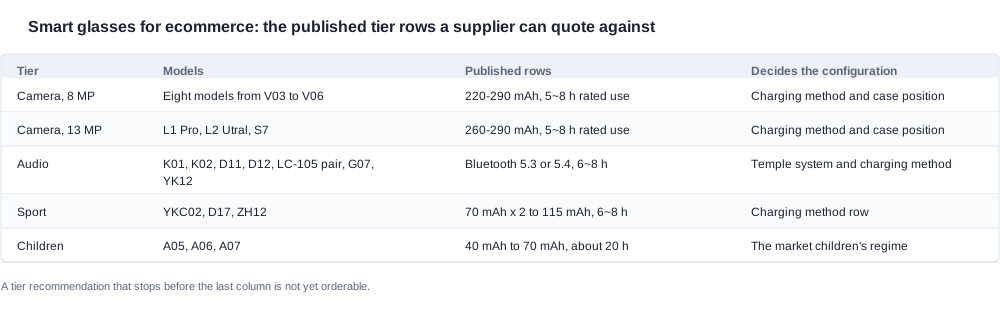
The table below is the tier-to-configuration map for this range. The last column is the part that decides whether the recommendation is orderable.
| Published tier | Models in the tier | Rows the tier publishes | What decides the orderable configuration |
|---|---|---|---|
| Camera, 8 MP | V03 Pro and KY06, MT6 and V03, and CY05 and CY03, and V06 and MT5 | 220-290 mAh, 5~8 h rated use, two hours or less to charge | The charging method row and the case position |
| Camera, 13 MP | L2 Utral and L1 Pro, and S7 | 290 mAh or 260 mAh, 5~8 h rated use, two hours or less to charge | The charging method row and the case position |
| Audio | LC-105-2 and D12, K02 and G07, D11 and LC-105-1, and K01 and YK12 | Bluetooth V5.3 or V5.4, 55-100 mAh cell forms, 6~8 h rated use | The temple system and the charging method row |
| Sport | YKC02, D17, ZH12 | 70 mAh × 2 to 115 mAh, 6~8 h rated use, two hours or less to charge | The charging method row |
| Children's | A05, A06, A07 | 40 mAh to 70 mAh, about twenty hours rated use, magnetic charging | The market's children's product regime |
The rows in the last column are where a recommendation becomes a quotation. A recommendation of "the 13 MP tier" does not tell a factory what to build; a recommendation of "the L2 Utral at the 1400 mAh case configuration" does. The four questions that close the gap are the charging method, the case position, the charging interface row, and the colour and logo arrangement.
Two questions to ask the supplier close most of the rest. The first is what the case position is for the model, given that four camera models publish no case row at all and two publish a case with no capacity. The second is what the charging method is for a model whose row is silent, since four camera models have no published interface. A buyer who has those two answers has a configuration a factory can quote and a page that can be written without a guess.
What changes between the first listing and the second
The tier decision holds; the copy does not. By the time a second order is placed, a channel has returns data, and the returns that dominate in this category are the expectation gap, the storage question and the sizing question. Each has a specific line that prevents it, and each is cheaper on the page than in the returns queue.
The other thing that changes is the competitive position. A channel that launched with one listing and adds a second usually finds that the two pages compete for the same search intent, unless the copy distinguishes them by use rather than by specification — which is the same discipline as the original tier decision, applied once more. A buyer who wants to assess this before writing the second page should run the comparison against the attributes a shopper can see, which is the approach set out in how to compare models.
A worked example: two listings on one storefront
Take an ecommerce operator with a fixed budget and two slots on the storefront. The first slot should carry the camera tier, because capture is the proposition that a competitor with a commodity product cannot replicate, and because the published 8 MP and 13 MP tiers are specific enough to state on a page. The second slot should carry the audio tier, where the published Bluetooth version, cell form and detachable temples give a shopper something concrete to compare.
Inside the camera slot, the choice between the 8 MP and the 13 MP tier is not free. The 13 MP tier gives a stronger headline number but the L1 Pro publishes no charging-method row, and the L2 Utral publishes Type-C with a case that is available in two capacities — so the configuration decision and the tier decision have to be taken together. Inside the audio slot, the G07 or the YK12 is the configuration to prefer if the channel has a wide size range, because the published detachable temples are a replacement route rather than a whole-device write-off.
The third decision is what the two pages do not say. Neither page states a leakage figure, a field of view, a video specification or a unit weight, because the catalogue publishes none of them. The pages instead state what is published and omit the rest, and the specification cards in both boxes repeat the same rows so that the evidence is in the customer's hand.
The standing we take on recommending a tier
It is worth being precise: we will recommend a tier when the published rows in that tier can carry the promise, and we will tell a buyer plainly when they cannot. That is not a narrow position: it means recommending the camera tier only for a model whose storage rule has been established, recommending the audio tier only with design language rather than performance language, and declining to recommend a combined listing.
What we will not do is fill a gap to make a recommendation tidier. We will not quote a unit weight for any model other than the MT6, whose whole-unit figure of 158 g covers the glasses body including its cell and camera and excludes the foldable case. We will not supply a field of view, a video specification, a camera sensor, a storage capacity, an acoustic performance figure or a runtime test condition. We will not state that any product is tested to IP54, because no test report is published behind that marking on the V06 or the S7. And we will not present a company-level export certification page as a per-model conformity status, because the catalogue contains no per-model certification row.
What we will do is take the price band, the platform, the market and the promise you intend to make, and return the tier that promise can be carried by, the configurations inside it that exist, the published rows that support each claim, and the rows that have to be obtained in writing before the copy is drafted. The product families are at AI camera glasses and Bluetooth audio glasses, the model-selection route is at choosing the right model, and the channel framework is at smart glasses for ecommerce.
Related reading
- The model-selection route behind this recommendation — choosing the right model
- The box contents that go with a tier — gear checklist
- The audio-only listing option — Bluetooth audio glasses
Tell us the price band, the platform and the promise you want the page to make, and we will tell you which published tier can carry it and which configurations exist inside that tier.


