
Smart glasses for ecommerce is a claim-set problem with a price attached, and it fails in a specific way: not with a defective unit, but with a unit that does not match the page it was bought from. An online channel compares the customer against a page, a delivered box and a set of neighbours on the same screen, and the page wins or loses that comparison on accuracy rather than on hardware. That makes the listing the specification, and it makes every unpublished figure a decision the buyer has to take before the artwork rather than after the first returns report.
Smart glasses for ecommerce: the listing carries claims and a price
The customer in an online channel checks the delivery against the page within a few minutes of opening the box. They compare the specification table against the product in their hand. They compare their unit against the units shown next to it. Every statement on the page that cannot be checked by a customer in that state is a liability, and the ones that can be checked are assets, because a customer who verifies a figure and finds it true becomes an advocate rather than a reviewer.
That gives an unusual priority order for a buyer. The certification badge matters commercially and cannot be evidenced. The pixel tier matters for the search and cannot be described as a quality figure. The charging method and the case inclusion matter for the comparison and are fully published. The charge time is published for every model in the range. And the runtime is published with no condition attached, which is the row most often inflated into something the delivery cannot back.
Three parties sit behind this, and they have different definitions of a good listing.
A brand owner is deciding which SKUs enter the range, what differentiates each of them, and what the price ladder is built on. The differentiator has to be a configuration difference with a cost attached, because a feature that cannot be quoted is a slogan.
A procurement manager is deciding which published rows are enough to write the listing against, and which evidence has to be collected from the supplier per model before the page goes live.
A channel buyer is deciding which claims the page will carry, and in an online channel the answer is narrower than in a dealer channel, because the page is the only description the customer will ever get and the comparison set is always one click away.
The commercial shape of the problem
An online channel in this category carries a specific cost structure, and the listing is where it is set. The returns rate is not an exception cost; it is the price of the claim set, deducted from margin on every unit that comes back. The review feed is the channel's only advertising that compounds, and a "not as described" review suppresses the listing rather than merely disappointing one customer. And the price ladder has to be defended against the customer's comparison, which means the difference between two SKUs has to be a difference the customer can see, hold or read — not a difference in a supplier's brochure.
A buyer who treats the listing as marketing rather than as specification gets all three of these costs anyway, and pays for them in customer acquisition instead of in listing discipline.
The badge a marketplace asks for and the catalogue cannot supply
Every buyer in this segment has the same conversation with a supplier, and it is about the certification badge. Marketplace buyers, retailers and channel partners all ask for CE, FCC and RoHS, because those are the marks their own quality process and their own listings require. They ask for the certificate numbers.
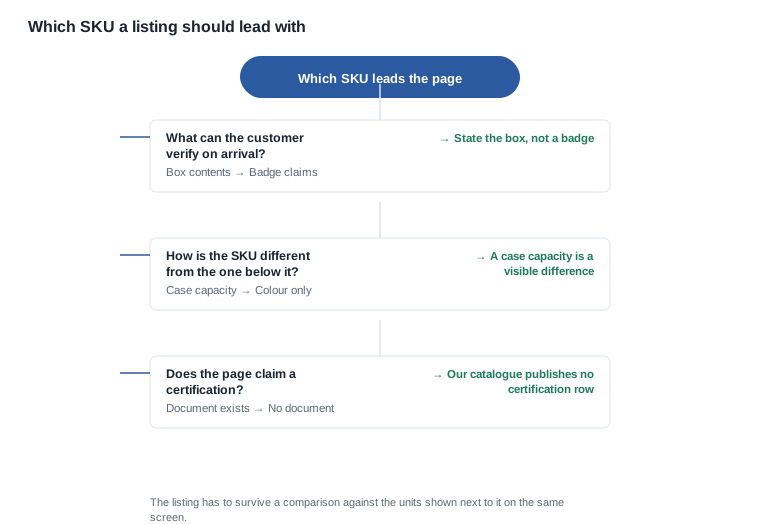
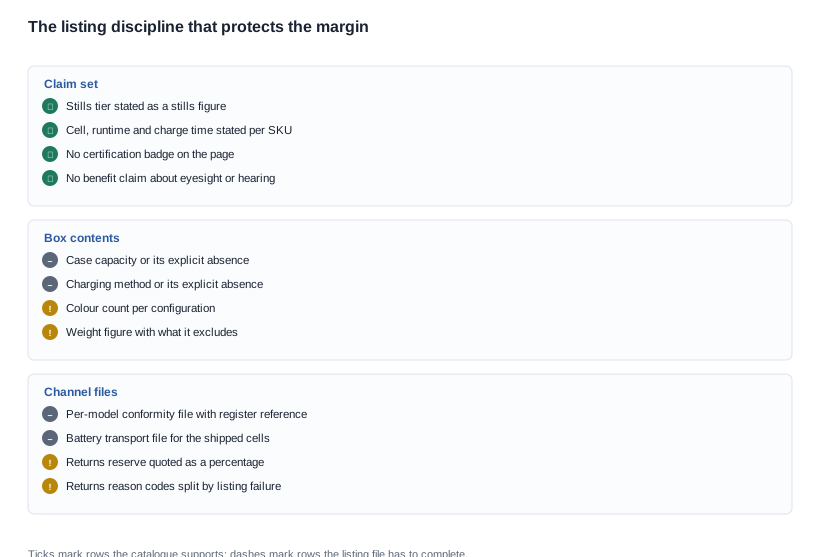
The correct answer from us is short and it does not require any interpretation: our catalogue publishes no per-model certification row, and the catalogue text contains no CE statement, no FCC statement and no RoHS statement at all. There is a single company-level export-certification page in the catalogue, and it is a set of design-patent certificates rather than a per-model conformity table. So no certification claim can be evidenced from anything we publish, and a listing that carries a certification badge has to be carrying a badge that its own documentation file does not support.
The commercial consequence is larger than it first appears. A certification badge on a listing is not just a page element; it is an assertion that a buyer, a customs authority and a consumer protection regulator can all act on. Removing it from the page removes a compliance exposure along with a marketing element, and what replaces it has to carry the weight. The replacement is not a badge but a documentation pack: the per-model conformity file, checked against the issuing body's public register, with the model designation and the exact configuration named on each certificate.
That is a better listing element than a badge for a second reason, which is that it is checkable. A buyer who publishes "conformity documentation available on request, scoped to your model" can be checked. A buyer who publishes a badge is asking to be taken on trust, and in a segment where the customer is comparing three nearly identical listings side by side, trust is the currency they are least willing to spend.
The same discipline applies to the claims that the catalogue cannot support in a market-facing context. The category contains children's models named as protective glasses, and a listing that turns that name into a benefit — anything about eyesight, hearing or development — is a claim the documentation cannot carry and, in many markets, a claim that falls under product-safety regulation rather than under marketing discretion. The defensible line is simple and worth stating once: name the published rows, describe the features in the words the catalogue uses, and leave every benefit claim out.

Building a SKU ladder that survives comparison
The most common ecommerce failure in this category is a price ladder whose rungs differ in ways the customer cannot verify. The catalogue makes that surprisingly easy to get wrong, because the natural ladder — the 8-megapixel tier against the 13-megapixel tier — looks like two products and is actually five.
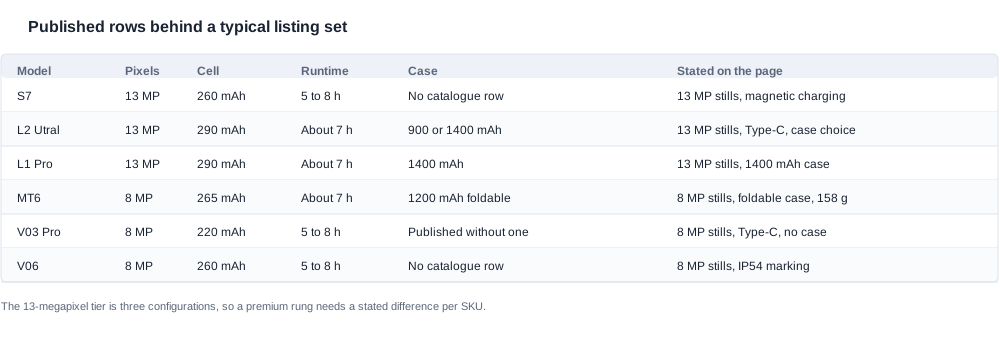
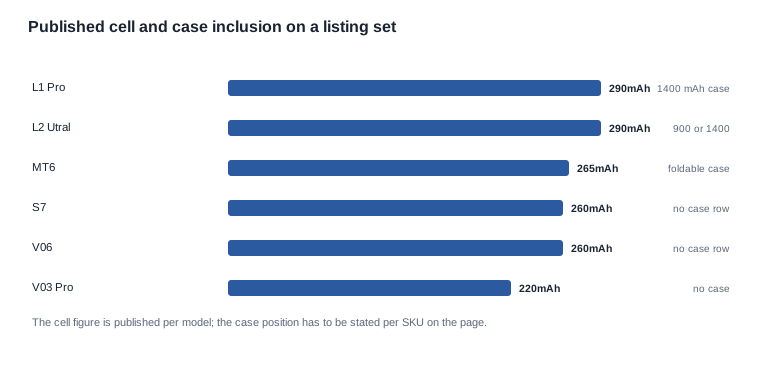
Three models publish 13 megapixels, and they are not variants of one another. The L1 Pro publishes a 290 mAh cell, about seven hours, a 1400 mAh case and no charging method row at all. The L2 Utral publishes the same cell and runtime, a Type-C charging interface, and a case offered at either 900 or 1400 mAh. The S7 publishes a 260 mAh cell, a five-to-eight-hour rated use, magnetic charging and no charging-case row at all. A premium tier built on "13 MP" and nothing else is a promise the customer cannot check, because the three configurations differ in what is in the box, how it is charged and how long it lasts.
The ladder that survives comparison is the one where each rung changes something the customer holds.
The entry rung is the configuration with the leanest published inclusion: the V03 Pro publishes 8 megapixels, a 220 mAh cell, a five-to-eight-hour rated use, a Type-C charging port, flexible temples, photochromic lenses, three published colours and no charging-case row in the catalogue. The differentiators are visible and holdable — a different charging interface from the tier above, a lens configuration, a colour count.
The standard rung is the 290 mAh platform with a published case capacity, which is the L1 Pro and the CY03, and the CY05. The differentiator is the box: a 1400 mAh case is something the customer can read on the packaging.
The premium rung is the L2 Utral, because it is the only configuration in the range that publishes both a higher stills tier and a case capacity as a choice, which makes it the only one that can carry two price points on a case capacity rather than on colour. It is also the only camera model with a published Type-C interface and a case, which lets a channel state the charging arrangement precisely.
The feature rung is the MT6, which publishes 8 megapixels, a 265 mAh cell, about seven hours, a 1200 mAh foldable case and the only published weight in the catalogue — 158 grams for the glasses body, including the cell and the camera and excluding the foldable case, whose own weight is not published. A page that quotes 158 grams has to say what the figure excludes, because a customer who weighs the foldable case as well will find a different number, and a "not as described" review follows.
What the box contains, and why it has to be stated per SKU
Four camera models publish a case capacity, at three different numbers. The L1 Pro and the CY05, and the CY03 publish 1400 mAh. The L2 Utral publishes a choice of 900 or 1400 mAh. The MT6 publishes a 1200 mAh foldable case. Two models publish that a case exists without publishing its capacity — the KY06 and the MT5. Four camera models have no charging-case row at all — the V03 Pro and the V06, and the V03 and the S7. And no audio or sport model publishes a case anywhere in the range.
That is ten different inclusion states across the camera tier, and an online page that says "case included" on one SKU and omits the line on the next one is a comparison failure waiting to happen. The customer's comparison is between adjacent SKUs on the same screen, so the box contents have to be stated per SKU, in the same order, in the same words, and they have to match the packaging artwork and the in-box insert exactly.
There is a second, less obvious box-contents issue. Four camera models publish a charging case capacity and no charging method at all — the L1 Pro and the CY03, and the MT6 and the CY05. A page that shows a case in the imagery and lists a charging method in the specification table is making a claim about how the device charges that the catalogue does not support, and the customer's first evening with the product is when that is discovered.
The same applies to the charge time. Every model in the range publishes a charge time, two hours or less except the D17 and the ZH12 at roughly one hour. But no start state and no termination criterion is published with any of them, so a page that says "fast charging" without the figure is making a comparative claim, and a page that says "charges in 2 hours" is making an absolute claim about a number whose conditions are undefined. The defensible form states the figure with the model name attached and adds nothing.
The one metric an ecommerce programme is judged on
For an online channel the metric that matters is the listing-match rate: the share of returned units that were returned because the delivery did not match the page. It is measurable from the returns reason codes, and it is the number that separates a listing that works from a listing that generates traffic and refunds.
The way to get it is unglamorous. Keep the reason codes structured, and keep them separate from the general dissatisfaction codes, so that "not as described", "different from the photograph" and "missing accessory" are counted as listing failures rather than as general returns. Then attribute each listing failure to the specific listing line it came from. A channel that does this for one quarter finds the two or three lines that generate most of the failures, and those lines are almost always the ones where a figure was stated without a condition or where the box contents were not stated per SKU.
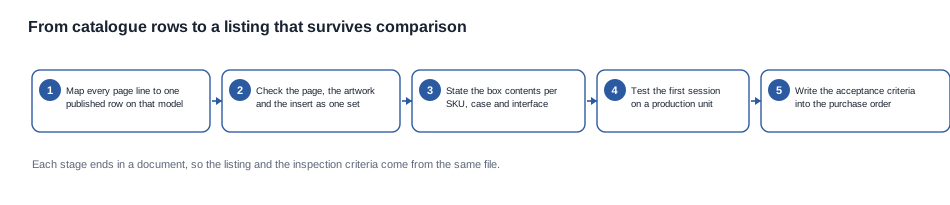
Five steps turn catalogue rows into a listing that survives comparison.
| Check | How it is read from the published row | The line it has to meet | What a soft answer looks like |
|---|---|---|---|
| Certification | No per-model row published anywhere | Documents obtained per model, or no badge | A badge with no number on the page |
| Stills tier | The pixel figure on the model's row | Named as a stills figure, not a quality claim | "HD camera" with the tier dropped |
| Runtime | The rated figure with its model name | Stated with no absolute-day implication | "All-day battery" |
| Box contents | The case and charging rows for that SKU | Stated per SKU, including absences | "Case included" on one SKU only |
| First session | The in-box list and the required steps | Documented and first in the box | An account or update the page omits |
| Listing match | The returns reason codes | Codes split by listing failure type | One undifferentiated returns bucket |
- Build the claim set per SKU, not per range. Every line on the page maps to one published row on that model's row, or to a supplier document obtained for that model. The completion standard is a mapping, not a copy.
- Check the page against the box. The specification table, the photography, the packaging artwork and the in-box insert read as one set. The completion standard is an artwork proof plus a physical sample opened as a customer would open it.
- State the box contents per SKU. Case capacity where the catalogue publishes one, charging method where the catalogue publishes one, the colour count where one is published, and a written confirmation from the supplier for every row the catalogue leaves silent. The completion standard is a per-SKU inclusion table in the listing file.
- Test the first session on a production unit. Everything that stops the customer in the first ten minutes is a return, and it is free to find before the shipment leaves. The completion standard is a documented first-session result.
- Write the acceptance criteria into the purchase order. The per-model conformity file, the battery transport file for the exact configuration, the runtime with its test condition, the per-model weight, and the incoming inspection criteria. A listing is only as good as the inspection behind it.
The documents to request before a deposit are the per-model conformity file with the register reference, the battery transport file for the cells and any case actually shipped, the model designation table, the per-model weight, the runtime with its test condition, the packaging artwork proof, and the agreed incoming inspection criteria. The compliance route is at certification checklist, the sample stage is at procurement samples, the battery requirement is at compliance battery transport, the clause language is at contract terms, and the commercial structure of a first order is at pricing. The camera family is at AI camera glasses, the scenario entry point is smart glasses for ecommerce, and the two companion articles are at ecommerce long-term use and measuring ecommerce results.
Four questions asked at the enquiry stage decide most of the shortlist. The model designation on the quotation, and what the published row for that model lists. What is in the box, exactly, for that configuration. Which conformity documents exist for that model and that configuration. What are the per-model weight and the runtime with its test condition.
Four commercial blocks carry particular weight in this segment. The returns reserve is the one that is almost never quoted, and in an online channel it is the price of the claim set rather than an exception cost, so it belongs in the quotation as an explicit percentage of unit price. The case minimum order quantity decides the ladder, because the case is the differentiator a customer can hold, and a case-led range cannot start small if the case carries a high minimum. Tooling and certification are quoted apart, because certification cost and lead time owe their size to the schedule and to whoever runs the test, and a buyer who cannot see the split cannot model the break-even volume against the returns reserve. The pilot is worth paying for, because a supplier who will run the first-session test on production units and supply the notes so a result can be re-judged converts a demonstration into an acceptance criterion, and in this segment the acceptance criterion is the listing itself.
We publish the resolution tiers as stills figures, the cell configurations, the rated runtimes, the charging methods, the charge times and the charging-case capacities and positions, the structural feature rows and the published colour counts exactly as the catalogue states them, and we publish the absence of a per-model certification, a video resolution, a frame rate, a field of view, a runtime test condition, a per-model weight beyond the MT6's 158 grams glasses body excluding its foldable case, and a charge-time start state and end point with the same prominence. We will not state that any product is CE, FCC or RoHS certified, we will not convert an 8-megapixel or 13-megapixel stills figure into a camera quality claim, and we will not present a rated runtime as a working-day guarantee.
What we will do is take the channel, the price ladder, the target markets, the number of SKUs and the target landed cost, and tell you which published rows apply to each configuration, which claims the documentation supports, which documentation has to be obtained per model, and which criteria belong in the purchase order.
What to send us. Send the channel, the number of SKUs, the price ladder, the target markets and the target landed cost, and we will return the claim set each configuration can carry, the per-SKU inclusion table, and the documents to request before the order.
Related reading
- The scenario entry point — smart glasses for ecommerce
- The camera family — AI camera glasses
- The companion case — ecommerce long-term use
- The measurement method — measuring ecommerce results
Tell us the channel, the number of SKUs and the price ladder, and we will return the claim set each configuration can carry and the documents to request.


