Smart glasses for ecommerce programmes fail at the box far more often than they fail at the specification. A storefront can be built on a configuration nobody can fulfil, photographed with a cable that is not in the carton, and shipped with a charging case that turns the freight file into a second compliance project. The gear checklist below is the one we would hand to a buyer before the packaging artwork is released: five areas, each with the specific item to settle, the specific row that decides it, and the claim it prevents.
Smart glasses for ecommerce: a packing checklist for the box before listing
Who is buying, and what the kit decision actually settles
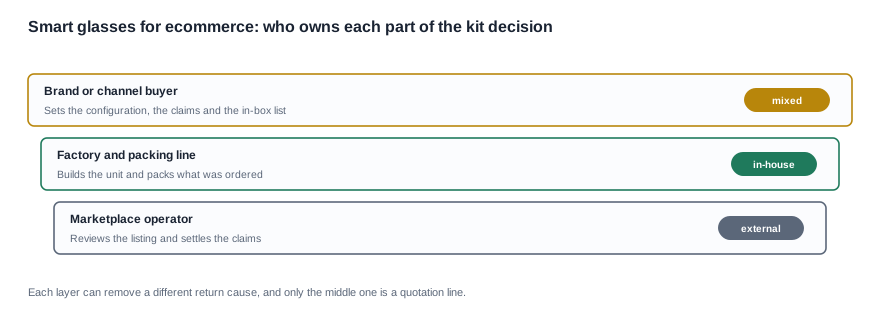
The reader is a brand-side buyer, a channel buyer or an ecommerce operator who has already chosen a model and is now costing the carton around it. The question in front of them is not "which product is best" — it is "what goes in the box, what stays in the warehouse, and what does the page promise about both". That question is worth more than it looks, because in this category the box is the last specification a buyer controls. The model, the cell capacity, the charging interface and the resolution tier are all fixed before the order is placed. The contents of the carton, the artwork, the insert and the accessory set are not, and they are the cheapest levers a buyer has over the return rate that follows.
The fear underneath the enquiry is specific and it is not a bad unit price. It is a customer who receives a product that does not match the photograph, opens a claim through the marketplace operator, and wins it — because in that structure the operator has no appetite for examining specification nuance and simply refunds the seller. A second and quieter fear is the freight file. A charging case is a second lithium cell. The moment a case enters the configuration, the shipment acquires a transport document that has to exist before the goods leave, and a buyer who discovers that at the border has already paid for a delay.
There is a third reason the kit decision comes before the listing: the listing is written from the box. Every photograph, every bullet point and every in-box claim is copied from what the factory actually packed. Get the box wrong and the listing is wrong on day one, in every market, in every language, and correcting it means re-shooting, re-translating and re-approving — which is why the gear checklist belongs at the start of the programme and not at the end of it.
Why two configurations of the same model cost different amounts
Our catalogue publishes electrical rows per model, and those rows are close together across the range. What separates one quotation from another is structural, and the structure is exactly what a kit decision negotiates. A magnetic model needs either a dock or a case to complete the charging loop; a Type-C model can be recharged from a cable the customer already owns. That single difference moves the bill of materials, the freight weight, the transit documentation and the price ladder, and it is why the interface question has to be answered before the contents question rather than with it.
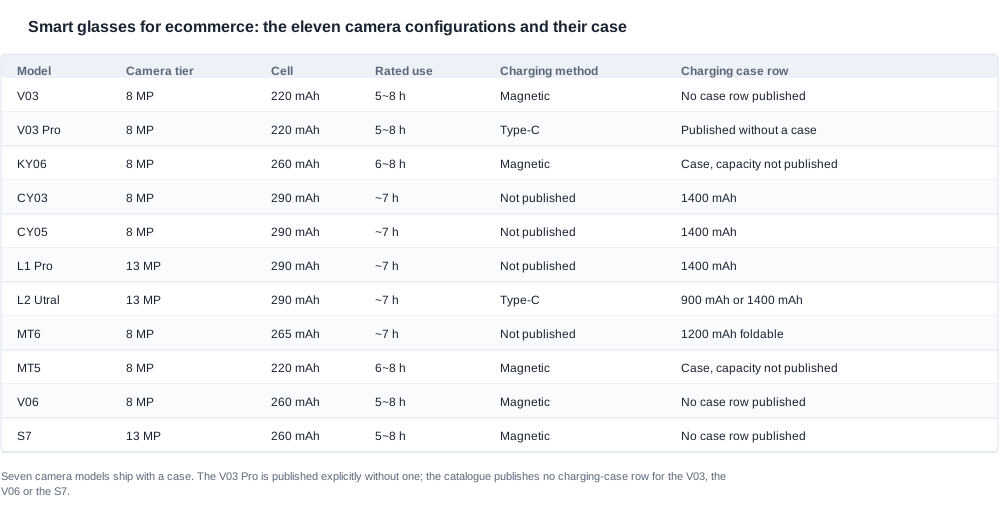
The second structural variable is the charging case itself, and here the range is unusually uneven. Published case capacities run at 1400 mAh on three camera models, at 900 mAh or 1400 mAh by configuration on a fourth, and at 1200 mAh on a fifth, whose case also folds. Two further camera models ship with a case whose capacity is not published, and the catalogue publishes no charging-case row at all for the remaining camera models — the S7 and the V06, and the V03 Pro and the V03, so their box contents are an open question. A buyer who reads "camera model with a case" as one line in a comparison table is reading a line that does not exist. It is seven camera models that ship with a case, and each of the seven carries a different position on capacity, and four of the eleven camera models carry no case row whatsoever.
The third variable is the insert and the accessory set, which is where most of the per-unit cost in a gear checklist actually sits, and where most of it is invisible on a quotation because it is priced as a consumable rather than as a specification. A cloth, a printed card and a cable are pennies. They are also the difference between a customer who can get the product working and a customer who files a fault claim, which in a marketplace channel is a difference between a review and a refund.

The eleven camera configurations and the case each one publishes
The table below is the working version of the camera-range kit table. Every row is a published configuration from our catalogue, and the last column is the row that decides what goes in the carton.
| Model | Camera tier | Cell capacity | Rated use | Charge time | Charging method | Charging case position in the catalogue |
|---|---|---|---|---|---|---|
| V03 | 8 MP | 220 mAh | 5~8 h | ≤2 h | Magnetic | No charging-case row published |
| V03 Pro | 8 MP | 220 mAh | 5~8 h | ≤2 h | Type C | No charging-case row published |
| KY06 | 8 MP | 260 mAh | 6~8 h | ≤2 h | Magnetic | Case included, capacity not published |
| CY03 | 8 MP | 290 mAh | ~7 h | ≤2 h | Not published | 1400 mAh |
| CY05 | 8 MP | 290 mAh | ~7 h | ≤2 h | Not published | 1400 mAh |
| L1 Pro | 13 MP | 290 mAh | ~7 h | ≤2 h | Not published | 1400 mAh |
| L2 Utral | 13 MP | 290 mAh | ~7 h | ≤2 h | Type C | 900 mAh or 1400 mAh by configuration |
| MT6 | 8 MP | 265 mAh | ~7 h | ≤2 h | Not published | 1200 mAh, foldable |
| MT5 | 8 MP | 220 mAh | 6~8 h | ≤2 h | Magnetic | Case included, capacity not published |
| V06 | 8 MP | 260 mAh | 5~8 h | ≤2 h | Magnetic | No charging-case row published |
| S7 | 13 MP | 260 mAh | 5~8 h | ≤2 h | Magnetic | No charging-case row published |
Reading a charging-case row that the catalogue does not publish
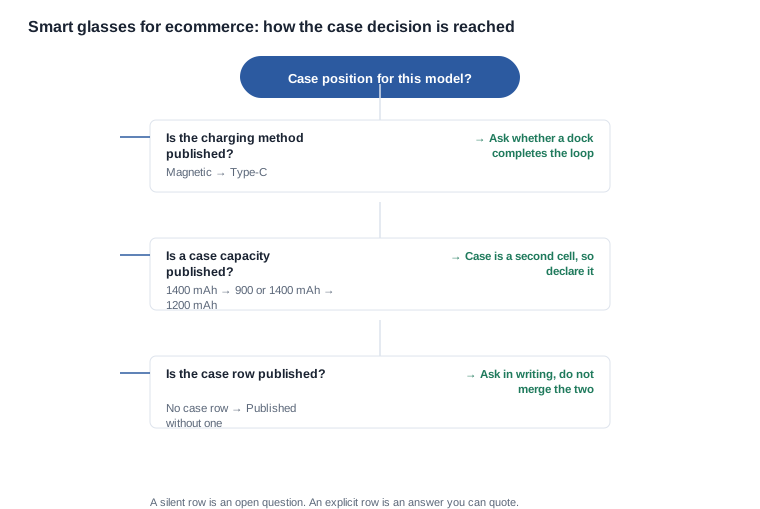
Six rows in that table carry no case capacity figure. Two of them — the KY06 and the MT5 — ship with a case, and the catalogue publishes the charging method for both as magnetic charging with a case, but no capacity figure. The other four — the S7 and the V03 Pro, and the V06 and the V03 — carry no charging-case row at all, which is a different statement: the catalogue is silent, not negative, and no model in the range is published with a row that says the carton contains no case.
That distinction is worth defending in writing, because "not published" and "none included" are different commercial positions and a buyer who merges them will quote a configuration the factory cannot build. A silent row means the buyer must ask; an explicit row means the answer is already given. Where the row is silent, the correct entry in a gear checklist is a question to the supplier, and the correct answer in a quotation is a sentence saying the position was requested and will be confirmed against the production unit, not a number invented from a sibling model.
The same reading discipline applies to the charging method column, and the six rows above are not the same set as the four below. Four camera models — the L1 Pro, the MT6 and the CY05, and the CY03 — publish no charging-method row at all. They publish a cell capacity, a charge time, a rated use and a case capacity, and nothing about how the unit is charged. Note what that does and does not mean: it does not mean the model has no case, because all four do publish a case capacity, and it does not mean the model charges magnetically, because nothing in the catalogue says so. It means the buyer has an open row and a specific question to put in the enquiry: what interface does this configuration present, and is a cable or a dock supplied with it.
The practical consequence for a gear checklist is that the cable line in the bill of materials is provisional for those four models. A cable included against a model whose interface is unpublished is a cable that may be wrong. That is a return, a review and a packaging reprint — and it is completely avoidable by asking one question in the first round of the enquiry.
Interface, cable and the in-box mismatch that becomes a claim
The interface split across the whole range is wide enough that "the cable in the box" is a per-model decision rather than a category decision. Seventeen of the twenty-eight models publish magnetic charging, seven publish Type C, and four publish no charging-method row. The Type-C models are the V03 Pro, the L2 Utral, the D11, the D12, the D17, the ZH12 and the bone-conduction model. The magnetic models include the AR model, the three children's models, the KY06 and the S7, and the V06 and the MT5, and the V03, the K01, the K02, the LC-105 pair, the G07, the YK12, the YKC02 and the electrochromic model.
The mismatch that generates claims is simple and it is entirely avoidable: the photograph shows a cable, the carton contains a different one, and the customer concludes the product is not as described. In a marketplace channel that claim usually resolves in the customer's favour without the specification being examined at all, because the operator's cheapest action is a refund. The fix costs nothing — photograph the interface that ships, and where a magnetic model is configured with a case, photograph the case.
There is a second interface decision hiding in the same place, and it is about what the customer is expected to own. A Type-C configuration can be recharged with equipment the customer already has, which means the cable can be treated as a consumable at a modest cost and the customer is never blocked. A magnetic configuration cannot, unless a dock or the case is supplied, which means the cable line becomes functionally part of the product rather than part of the packaging. Buyers who treat both lines identically end up with a magnetic listing whose customers discover on day one that they cannot charge it.

The accessory items that decide whether the product survives first contact
Three low-cost items earn their place in the box, and each of them prevents a specific, measurable failure.
- A quick-start card in the language of the destination market. Pairing is the first thing a customer attempts and the most common reason a first-time buyer concludes that a product is faulty. The card removes the need to find a website, and it is a printing line rather than a hardware line.
- A lens cloth and a contact-wipe item on the insert. A sleeve or a T-shirt is abrasive, and the damage is invisible at the moment it happens. This is the cheapest available reduction in the soft-image complaint that this category produces.
- A specification card carrying the published rows for that exact configuration. Model, camera tier, cell capacity, rated use, charge time, charging method and, where it exists, the case capacity. It converts the insert into the evidence that backs the listing, and it removes the need for the customer to compare two tabs.
The insert should also carry the gap sentence. For this range the camera sensor model, the field of view, the video specification, the storage behaviour and the per-model unit weight are not published for any of the eleven camera models, with the single exception of the whole-unit weight for the MT6, which the catalogue gives as 158 g for the glasses body including its cell and camera and excluding the foldable case. An insert that lists what the buyer can verify, and states plainly which rows the catalogue does not publish, is the cheapest insurance in the whole carton: it is the point at which a customer is told what they are and are not getting, in a form they keep.

The questions to put into the first enquiry
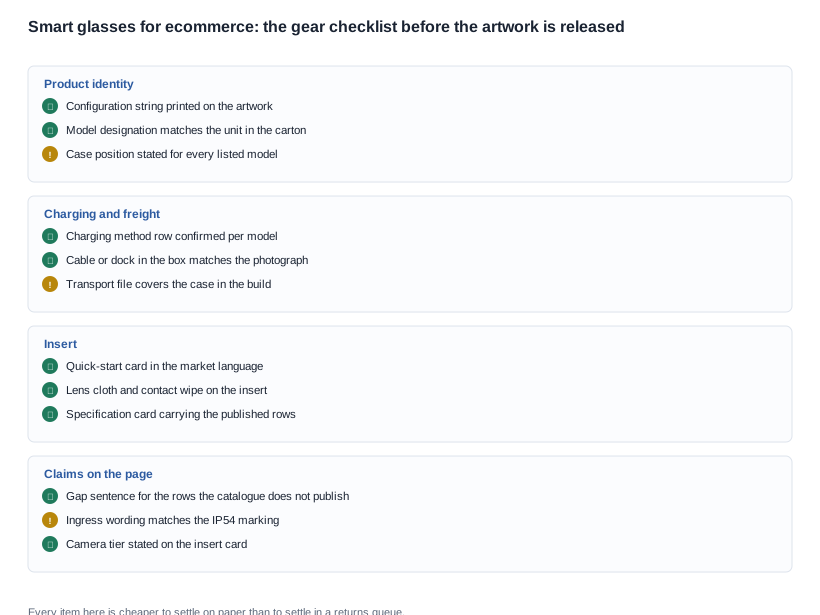
The verification for a gear decision is unusually practical, because almost everything in it can be held, counted or photographed. It runs in this order.
- Ask for the bill of materials per configuration, in writing. A verbal answer to "what is in the box" is not a bill of materials. It is the document the packing station, the freight forwarder and the returns desk all need, and it is the one that settles disagreements later.
- Ask for the charging interface per model, including the four models whose row is silent. The question to put is narrow: which interface does this configuration present, and does the box contain a cable or a dock for it.
- Ask for the case capacity for the configuration you are ordering, and for the case's own charging method. For the L2 Utral the two published capacities are a configuration choice rather than a feature, which means the artwork, the freight weight and the transit file all change with the selection.
- Ask whether the battery transport file covers the configuration with the case in it. The requirement is set out at battery transport, and a file that covers the bare device does not cover the device in its case. This is the item that is cheapest to settle in the quotation and most expensive to settle at the border.
- Ask for the ingress position in writing. The catalogue carries an IP54 marking on the V06 and the S7 as a published attribute with no third-party test report behind it, and publishes no ingress rating for the rest of the range. The digit reading is at IP ratings. An insert or a listing that says "waterproof" makes a claim the documentation cannot carry.
- Ask for the model designation table and the certificate register. The procedure is at certification checklist. A carton with a case, a wipe and a cable has three more objects to go wrong in transit than a bare device, and the designation is what makes a loss traceable.
- Ask for the artwork proof with the in-box list attached, before it is released to print. The mismatch between the packaging artwork and the listing is discovered at the point where it is most expensive to fix, which is after the print run.
- Run the returns check on the first shipment. The question is specific: of the units that came back, how many were returned for a missing accessory or a mismatch against the photograph, and how many of those had the item in the box. That ratio decides whether the consumable lines stay in the bill of materials for the second year.

What the kit can be negotiated on, and what cannot move
Some lines in a gear checklist are arithmetic and cannot be traded; others are packaging decisions and are the best remaining room in an ecommerce programme.
The arithmetic lines are the cell configuration, the charging interface and therefore the charge time, the camera tier, and the certification cost and lead time for the destination market. They are also the mould and tooling charges, which are amortised across the first order and quoted as a separate line rather than folded into the unit price. The battery transport documentation for the shipped configuration is in the same category. A buyer who negotiates these is negotiating something that is fixed by the design.
The packaging lines are where the value is, and they are worth more attention than the unit price discount that usually absorbs a buyer's negotiating time.
- Whether the case is in the carton or sold as a separate accessory. This is the largest single lever in the kit because it creates one price point or two, and it moves the artwork, the freight weight and the transit file together.
- The consumable quantities and their per-unit cost. A few cents each, and the highest-return line in the category. The quantity to negotiate is the quantity per device and the restock interval, not whether the items are included.
- Whether a protective film ships, and whether it is factory-applied. On a product where a scratch becomes a claim, a factory-applied film is usually the cheapest reduction in claims available anywhere in the bill of materials.
- Whether the supplier produces and reviews the insert artwork. The insert is what makes the consumables work, and a supplier who has not read it has not tested it.
- Colour and logo changes between runs. Cheap before the artwork is printed, expensive afterwards.
- Whether two configurations can sit on one purchase order, whether the order bands move, and whether a first delivery can go out in two lots against a staged payment. How much of the order is held at pilot quantity is usually where the widest commercial room sits, because that part is the supplier's own exposure.
A worked example: two camera configurations on one storefront
Take an ecommerce brand that has decided to run two listings from one platform: an entry camera model and a higher-tier camera model, in one market, sold through its own store plus one marketplace.
The first decision is the case, because the case is what separates the two price points. The entry model is taken as the V03, which publishes no charging-case row at all, so the question to the supplier is whether a case is available for that configuration and what it would carry. The higher-tier model is taken as the L2 Utral, which publishes a 900 mAh or 1400 mAh case by configuration and a Type-C charging interface, so the case line is a selection with a freight consequence rather than a question. The two listings therefore do not share a box: one is a bare device with a Type-C cable, the other is a device and a case that has to be declared as a second cell.
The second decision is the interface line, and it follows from the model selection rather than preceding it. The L2 Utral is Type-C, so the cable can be a modest consumable and the customer is never blocked without it. The V03's charging method is published as magnetic, so the buyer asks explicitly what the customer uses to charge it and whether a dock or the case is the answer. That single answer changes the in-box list for the entry listing, and it is the answer that keeps the photograph honest.
The third decision is the insert, and it is common to both listings because it is per model rather than per configuration: a quick-start card in the market language, a lens cloth and a contact-wipe item, and a specification card carrying the published rows for that model — including the rows the catalogue does not publish, stated as such. The gap sentence is on both inserts, which costs nothing and removes the category of return in which the customer expected a figure that no document supports.
The fourth decision is the freight file, and it is the one that must be closed before the purchase order rather than after it, because the L2 Utral's case is inside the configuration. The outcome is two listings at two price points, two different in-box lists, one common insert language, and a transport document that matches what is actually in the cartons.
What we publish about the kit, and what we will not invent
Concretely, a kit decision should be built from published configuration rows and from answers we can put in writing, and the gaps should be marked rather than filled. For this range that means we publish the camera tier, the cell capacities, the rated use, the charge time and the charging method per model, the case capacities where they are published, and the structural features that the catalogue records — the photochromic lens configuration and the flexible temples on the V03 Pro, the detachable inner frames on the V06 and the S7, the ultra-slim detachable temples on the G07, the slim detachable temples on the YK12, the remote capture control on the D17 and the ZH12. No touch row is published for any model, so a control surface is a question for the supplier rather than a published row.
What we do not publish, and will not estimate: the lens material, the coating, the hinge specification, the field of view, the video specification, the camera sensor model, the storage behaviour, the runtime test condition, the standby draw, the cycle life rating and the operating temperature range. The only weight figure in the whole catalogue is the 158 g whole-unit figure for the MT6 glasses body, which excludes its foldable case, and no frame weight is published for any model in the range. We will also not state that any product is tested to IP54, because no test report is published behind that marking on the V06 or the S7, and we will not extend it to the models where no rating is published at all.
What we will do: take the models you are comparing, the markets you intend to sell into and the price points you need, and tell you which configurations exist, what each one should carry in the carton, which published rows apply to it, and which questions have to be settled in writing before the purchase order. The product families are at AI camera glasses and Bluetooth audio glasses, the accessory line is at ecommerce accessories, and the scenario entry point is smart glasses for ecommerce.
Related reading
- The tier decision behind this checklist — choosing the right model
- The document set to request before launch — certification checklist
- The kit line items in detail — ecommerce accessories
Send the models, the markets and the price points, and we will return the in-box list each configuration should carry and the rows that are still open.