

Smart glasses for ecommerce have no published seasonality data, which is precisely why the seasonal decision has to be built from your own demand records rather than from a category forecast. What a factory can give you is the part of the calendar that sits on their side of it: which configurations exist, which rows constrain them, and where the lock dates fall. The rest — when the peak is, how deep the buffer should be, which configuration carries the season — is yours to establish.
Smart glasses for ecommerce: an order-by standard the calendar is judged on
Who is buying, and what the seasonal decision actually settles
The reader is a brand-side buyer, a channel buyer or an ecommerce operator planning a seasonal programme, and the decision in front of them has three parts. The first is when the units have to be in the fulfilment centre to cover the peak without a stockout. The second is which configuration carries the peak, because a configuration that is popular in one season and irrelevant in the next is a liability rather than an asset. The third is what happens if the season arrives early or late, which is the question the buffer exists to answer and which is almost never written down.
The fear underneath that enquiry is not a missed sale. It is a landed unit that arrives after the season has turned, sitting in a warehouse with a perishable proposition and no second chance. In a category where the documented cost of a wrong-configuration unit is the freight, the duty, the storage and the markdown, that is a materially worse outcome than a stockout.
What a seasonal decision is not is a market-sizing exercise. We publish no demand history, no sell-through rate, no seasonal index and no category forecast for any model, and a supplier who produces one is producing something the buyer cannot audit. The honest seasonal method is narrow and it works: use your own listing history to identify which configuration peaked in which window, then use the catalogue only to establish what can be ordered, what it takes to order it, and what happens when the plan changes.
Why the same configuration does not carry every season
The catalogue contains structural features that plausibly shift between seasons, and a buyer testing a seasonal hypothesis should look at these first because they are the only ones with a documented basis.
Variable light. The V03 Pro is published in a photochromic lens configuration, and the catalogue carries a separate electrochromic lens model that publishes a 100 mAh cell, magnetic charging, a rated use of approximately seven hours and Bluetooth V5.4, with no camera tier attached to it. A lens-tint proposition is a different seasonal exposure from a capture proposition, and the two should be held as separate configurations with separate histories rather than as one product with two angles.
Outdoor and sport. The V06 and the S7 are the two models publishing an IP54 marking, both with a detachable inner frame, and both with a 260 mAh cell, a rated use of five to eight hours and magnetic charging. The S7 publishes the 13 MP tier and the V06 the 8 MP tier. A configuration carrying an ingress marking is a different proposition from one without, and the marking itself is the reason a buyer might test it against an outdoor season.
Commuting and indoor audio. The eight audio models sit at the other end of the exposure range, with published cell configurations between 55 mAh × 2 and 100 mAh, Bluetooth V5.3 or V5.4 depending on the model, and a rated use between six and eight hours. Two of them publish detachable temples — the G07 as ultra-slim detachable and the YK12 as slim detachable — which is a fitting system and a replacement route at once.
None of these is a forecast, and none of them tells a buyer which season to stock. They are hypotheses to test against the seller's own listing history, and each one has a documented characteristic that makes it a distinguishable proposition rather than a variant.

What the published figures do to the calendar, and what they do not
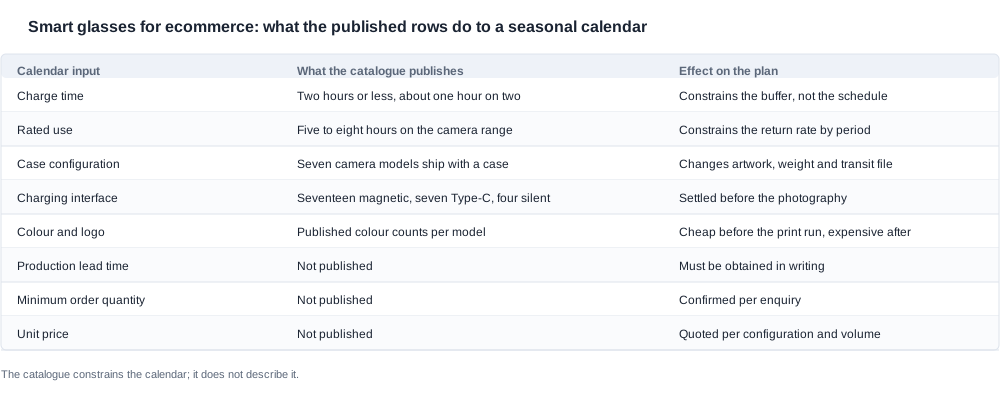
The published rows constrain the calendar in three ways and are silent in a fourth, and the silence is the one that matters.
The charge time constrains the buffer, not the schedule. Every model publishes a charge time, as a ceiling of two hours or less for twenty-six of them and approximately one hour for the D17 and the ZH12. That matters to a customer at the point of use and it does not appear on a seasonal calendar at all. A buyer who builds a delivery promise around the charge time is solving the wrong problem: what delays a seasonal programme is production, documentation, artwork approval, freight and customs, none of which the catalogue describes.
The rated use constrains the return rate, not the order date. A rated use between five and eight hours on the camera range, or around twenty hours on the children's models, published without a test condition, is a figure that will be tested by customers at their own volume level. A seasonal programme that lifts a configuration into a window where its returns behave differently is a real risk, and it is a reason to look at returns by configuration and by period rather than only at total units.
The case configuration constrains the freight file and the artwork lead time. Seven of the eleven camera models ship with a case. Five publish a capacity — the CY03 and the L1 Pro, and the CY05 — each at 1400 mAh, the L2 Utral at 900 mAh or 1400 mAh by configuration, and the MT6 at 1200 mAh in a foldable form. The KY06 and the MT5 are shipped with a charging case whose capacity is not published. The catalogue publishes no charging-case row for the V03 and the V03 Pro, and the S7 and the V06, and the case position for those four is an open item to close before the artwork is locked. The L2 Utral's two published capacities are a configuration choice rather than a feature, which means the case selection is a lead-time decision: each choice changes the artwork, the freight weight and the transit file together.
The silence is the lead time. The catalogue publishes no production lead time, no minimum order quantity, no unit price and no transit time. A seasonal calendar therefore cannot be assembled from catalogue data at all, and a buyer who asks a supplier for a seasonal plan without asking for the lead time in writing will get a plan with the constraint missing. The procedure for establishing it is at lead time, and the route for the minimum order question is at MOQ.

The configuration lock date and what moves after it
A seasonal programme has a lock date, and the date is earlier than most buyers assume because the artwork, the insert and the documentation are all downstream of the configuration.
The order of events runs like this. The configuration is chosen and the quantity is fixed, which is when the artwork can be finalised. The artwork has to be approved in every market language, and the insert has to be written against the published rows for that configuration. The documentation set for the market has to exist before the goods can be sold there. Only then does production start, and only then does the freight booking and the transit file get raised. Each of those steps has a lead time, and the ones in the middle are the ones that are forgotten because they sit outside the factory.
What moves after the lock is worth spelling out, because a buyer who changes a configuration in week three of a seasonal programme pays for it in at least four ways: new artwork and a print run, a new insert with a new set of published rows, a new transit file if the case configuration changed, and a new documentation check if the model changed. Some of those costs are trivial and one of them is not. The case configuration is the expensive one, because a case is a second lithium cell and a different case means a different freight weight and a different transit document.
The practical rule is therefore simple: the configuration lock and the artwork lock are separate dates, and the artwork lock is the earlier of the two for any configuration change that touches what is in the box. A buyer who treats them as one date discovers the difference as a print surcharge.

Peak risk: the popular configuration that is out of stock
The characteristic seasonal failure in this category is not a shortage of units. It is a shortage of the right configuration, discovered after the season has started, with the alternative being a substitute listing that does not carry the same claim.
There are four specific ways this happens, and each has a control.
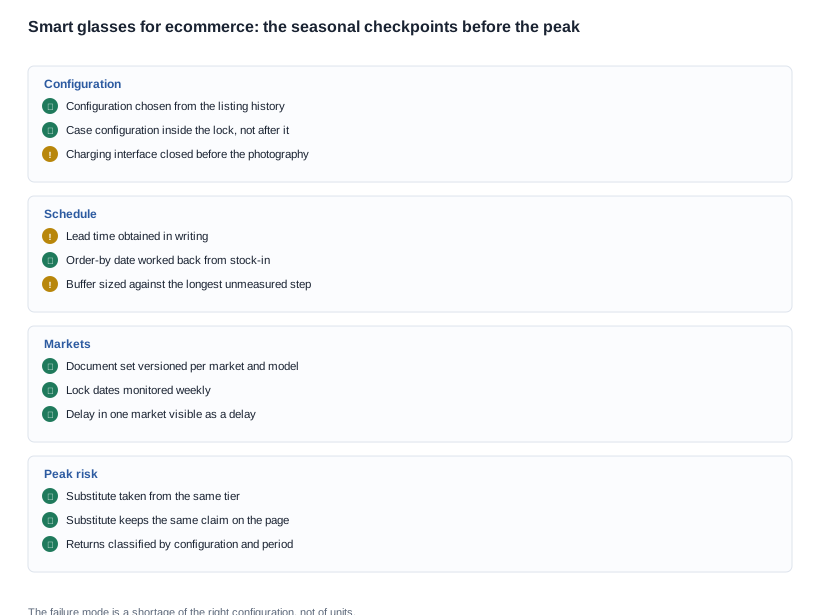
The case configuration is chosen later than the rest. A configuration that is selected for its case capacity after the artwork is released cannot be reordered into the same season without a new print run and a new transit file. The control is to treat the case selection as part of the lock, not as a final detail.
The charging interface is settled after the artwork. Four camera models publish no charging-method row at all, so a configuration among those four can be photographed with a cable the factory may not have supplied. The control is to close the interface question before the photography, and to hold the photography until it is closed.
The documentation set is per market and the season is global. A programme that is live in three markets at the same time needs three document sets, and one of them being late stops one market rather than all of them. The control is to keep the sets versioned per market and per model, so that a delay in one is visible as a delay rather than as a general blockage.
The buffer is decided by the peak and not by the supply chain. A buffer set by the historical peak is the wrong number when the season moves early. The control is to set the buffer against the supply chain's longest credible step, which is the step the buyer has not yet measured.
When the season arrives early or late
The buffer is the part of a seasonal plan that gets set by habit rather than by reasoning, and the habit is usually the previous year's peak. That number is wrong in a specific way: it is sized against a demand peak rather than against a supply chain, and the supply chain is what the buyer does not control.
The way to size a buffer without a forecast is to find the longest step the buyer has not yet measured. For a first seasonal programme, that step is almost always the documentation and artwork approval rather than the production itself, because the factory's steps are quoted and the buyer's steps are assumed. A buyer who has run one season has the measurement, and the buffer for the second season should be derived from it rather than copied from the peak.
The consequence of an early season and a late season are also different, and only one of them is a logistics problem. A late season is a stockout, and it is visible, expensive and recoverable: the order is already placed, the units are in transit, and the fix is expedited freight or a substituted configuration from the same tier. An early season is a storage problem, and it is invisible until the units sit in a warehouse past the point where the proposition still applies. The control for the early case is a dated review of the stock position rather than a buffer, because no amount of buffer prevents a season that arrives early.
What to ask the supplier about either case is narrow: what the latest date is at which an order can still land before the stock-in date, and what the cost is of a split delivery against that date. A supplier who answers both has told you where the buffer actually has to sit.

A worked example: one year, two peaks, two configurations
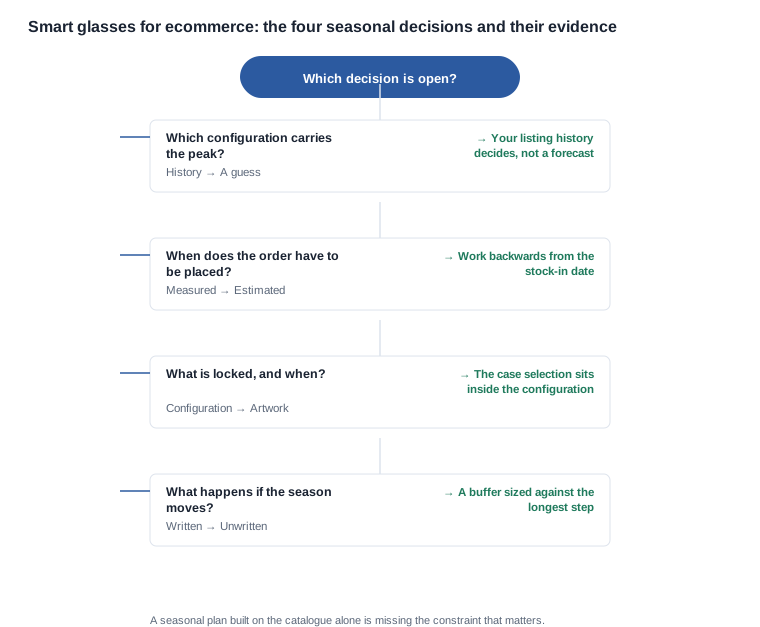
Take an ecommerce operator with two seasonal peaks and one production relationship. The first peak sits in the autumn window and the second in the spring window, and the operator's own listing history shows the autumn peak running on the camera tier and the spring peak running on the audio tier, with the lens-tint configuration under consideration for the spring window.
The first decision is which configuration carries which peak, and it is made from the listing history rather than from a forecast. The operator's autumn history is the camera tier, so the autumn configuration is selected from the camera range, and the selection is made with the case in mind: a configuration that ships with a published case capacity of 1400 mAh is chosen over one whose case capacity is not published, because the second is an open question at exactly the moment the operator wants to lock. The spring configuration is chosen from the audio range on the same basis, and the lens-tint configuration is deferred rather than stacked, because a third configuration multiplies the artwork and the documentation rather than adding to the peak.
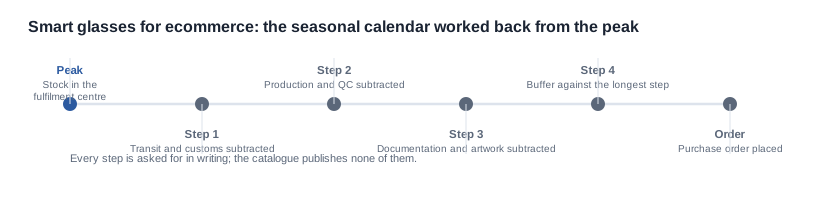
The second decision is the order-by date, and it is worked backwards rather than forwards. The operator starts from the date the stock has to be in the fulfilment centre, subtracts the transit and customs steps, subtracts production and quality control, subtracts documentation and artwork approval, and subtracts a buffer sized against the longest step the operator has not yet measured. Every one of those steps is asked for in writing; none of them is taken from the catalogue, because the catalogue publishes none of them.
The third decision is the lock structure. The configuration and the artwork lock are set before the season, with the case configuration inside the configuration lock, because the case is the part that changes the freight weight and the transit file. The documentation lock is set per market and per model, and it is the lock that the operator monitors weekly, because it is the one that stops a market rather than a shipment.
The fourth decision is the peak-risk rule, and it is written down in advance: if a configuration is unavailable, the operator substitutes with a second configuration already in the same tier rather than with a substitute from another tier, because the substitute that crosses a tier changes the claim on the page. The alternative — a substitute with a different case position or a different interface — creates the not-as-described claim that the seasonal peak is the worst possible moment to generate.
The fifth decision is the measurement after the season, which is the point at which the two peaks become comparable. Returns are classified by configuration and by period, and the configuration that carries the next season's peak is chosen from that distribution rather than from the units that moved fastest.
How we treat a seasonal calendar
Here, the catalogue's job in a seasonal programme is to tell a buyer what can be ordered and what constrains the order, and not to tell them when to order it. We publish the model designations and their rows — the camera tiers, the cell capacities, the charge times as a ceiling of two hours or less with approximately one hour on the D17 and the ZH12, the rated use per model, the charging interface per model, the case capacities where they are published, and the structural features that distinguish one configuration from another, including the photochromic lens configuration and flexible temples on the V03 Pro, the detachable inner frames on the V06 and the S7, the ultra-slim detachable temples on the G07, the slim detachable temples on the YK12, the remote capture control on the D17 and the ZH12, and the absence of any published touch row on every model.
We will also tell a buyer, configuration by configuration, which of their seasonal questions are answerable from the catalogue and which are not. The catalogue publishes no seasonality data, no sell-through rate, no lead time, no minimum order quantity and no unit price. The questions it cannot answer include when to order, how much to hold and what a seasonal plan will cost.
What we will not do is supply a seasonal forecast, a demand estimate or a sell-through figure for any model. We will not present a typical industry lead time as our own, and we will not quote a price for a season rather than for a configuration and a volume. We will also not fill a gap with a comparable figure: the catalogue publishes no per-model unit weight beyond the 158 g whole-unit figure for the MT6 glasses body, which excludes its foldable case, no operating temperature range, no runtime test condition and no storage behaviour, and a seasonal plan that needs those rows needs them obtained in writing.
What we will do is take the configurations you are considering, the peak windows and the markets, and return the published rows for each configuration, the case and interface position, the questions that have to be answered in writing to close the calendar, and the configuration that can be ordered for the volume you have in mind. The scenario entry point is smart glasses for ecommerce, the product families are at AI camera glasses and Bluetooth audio glasses, and the commercial structure of a first order is at pricing.
Related reading
- The order-by date and the constraints behind it — lead time
- The tier decision a seasonal configuration comes from — product recommendations
- The configuration string behind every quotation — gear checklist
Send the peak windows, the configurations you are considering and the markets, and we will tell you which rows constrain the calendar and which questions have to be answered in writing before you lock.


