
A classroom deployment needs four accessories and none of them is a product. That is worth stating plainly at the top, because the common failure in education channels is buying units and discovering in week three that the classroom could not administer them.
Smart glasses for education: the cost when the accessory list is wrong
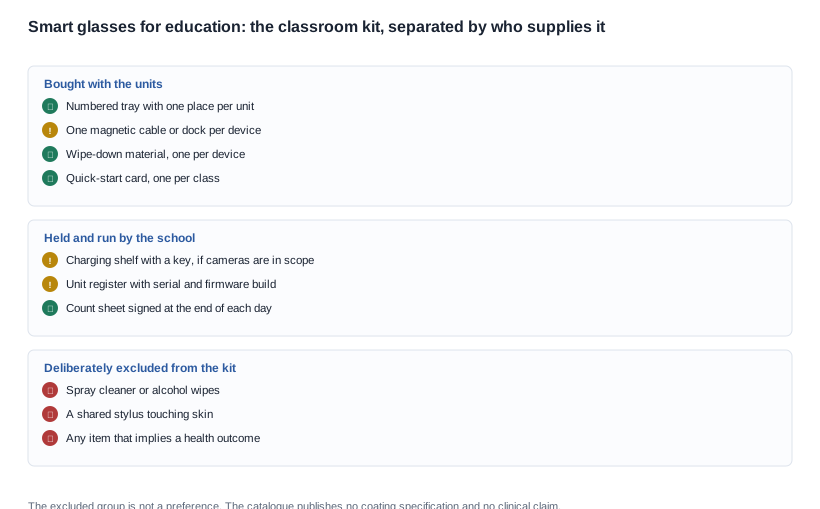
The conclusion first. In an education deployment the accessory list is not a nicety added to the unit price; it is the part of the bill of materials that determines whether the devices are used at all. Four items carry that weight: a numbered tray with a place per unit, one magnetic cable or dock per device, a wipe-down material per unit, and a printed quick-start card per class. Two of them cost almost nothing, one is capital equipment that scales with the fleet, and one is a print line that protects a week of adoption. A channel that quotes the accessory list as an afterthought is quoting a deployment that will stall in week three.
Who this is written for. The reader is a procurement officer or a channel buyer assembling a classroom or campus package for an education customer, or a brand-side product manager writing the kit into a proposal. The situation is usually a quote comparison: two suppliers have both quoted a device price, and the difference between them on the accessory list is larger than the difference on the unit. The fear underneath it is not that the device fails. It is that the customer accepts the units, the pilot looks like a procurement success, and then the deployment quietly stops being used because nothing in the package could be charged, counted or wiped.
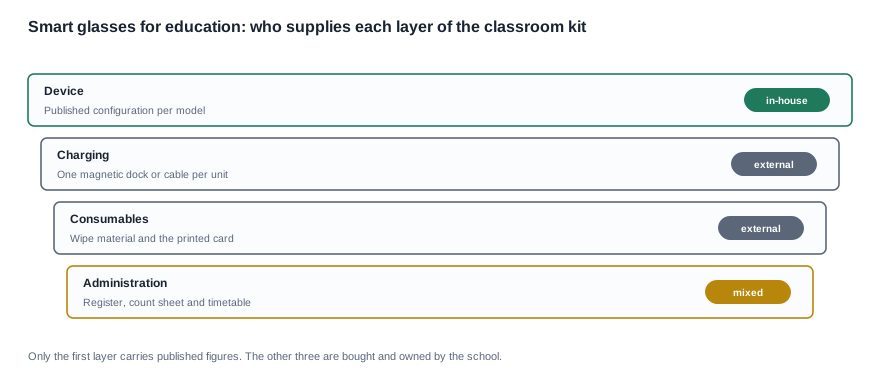
What the published figures do and do not settle. The published configuration for the children's range is specific. The A05 and the A06 publish a 40 mAh cell, a charge time of two hours or less, roughly twenty hours of rated use and magnetic charging. The A07 publishes Bluetooth V5.4, a 70 mAh cell, the same two-hour charge and the same rated use. The A05 and the A06 are published with identical parameters, and the catalogue itself records the difference between them as unconfirmed, which is a question to settle in writing before a kit is quoted. What the published data settles is the electrical behaviour of the devices. What it does not settle is the coating on the lens, the per-model unit weight, the ingress position — the IP54 marking appears only on the V06 and the S7, and on no model in the children's range — the data path, the recording indicator, the sizing information and the age position. The accessory list has to be built around those gaps rather than around a typical school kit.
The four accessories and the cost treatment each one gets
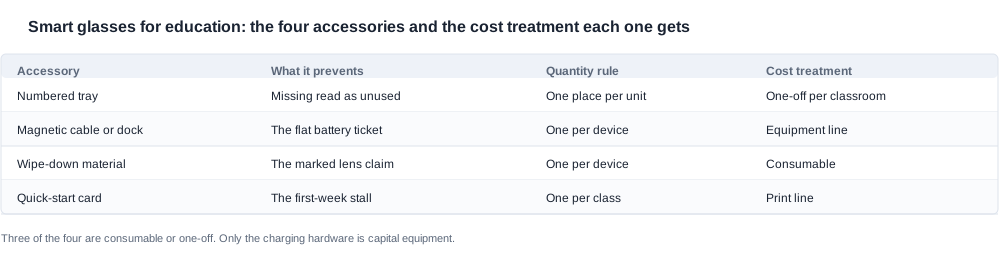
The four items behave differently enough that they cannot be treated as one line in a bill of materials. Separating them is the whole of the kit decision, and it is also where most of the avoidable cost sits.
| Accessory | What it prevents | Quantity rule | Cost treatment |
|---|---|---|---|
| Numbered tray | Missing read as unused | One place per unit | One-off per classroom |
| Magnetic cable or dock | The flat battery ticket | One per device | Equipment line |
| Wipe-down material | The marked lens claim | One per device | Consumable |
| Quick-start card | The first-week stall | One per class | Print line |
The numbered tray is the item that makes the deployment measurable. A box is a place to put devices; a tray with a place per unit is storage, charging position and count in one object. A five-minute weekly count is what distinguishes a low-adoption reading from a missing-unit reading, and that distinction is what tells a school whether its deployment is working. It also settles a governance question before it becomes an incident: a tray of devices that record, left open on a classroom shelf, is a policy problem, and the policy should be written before the tray goes there.
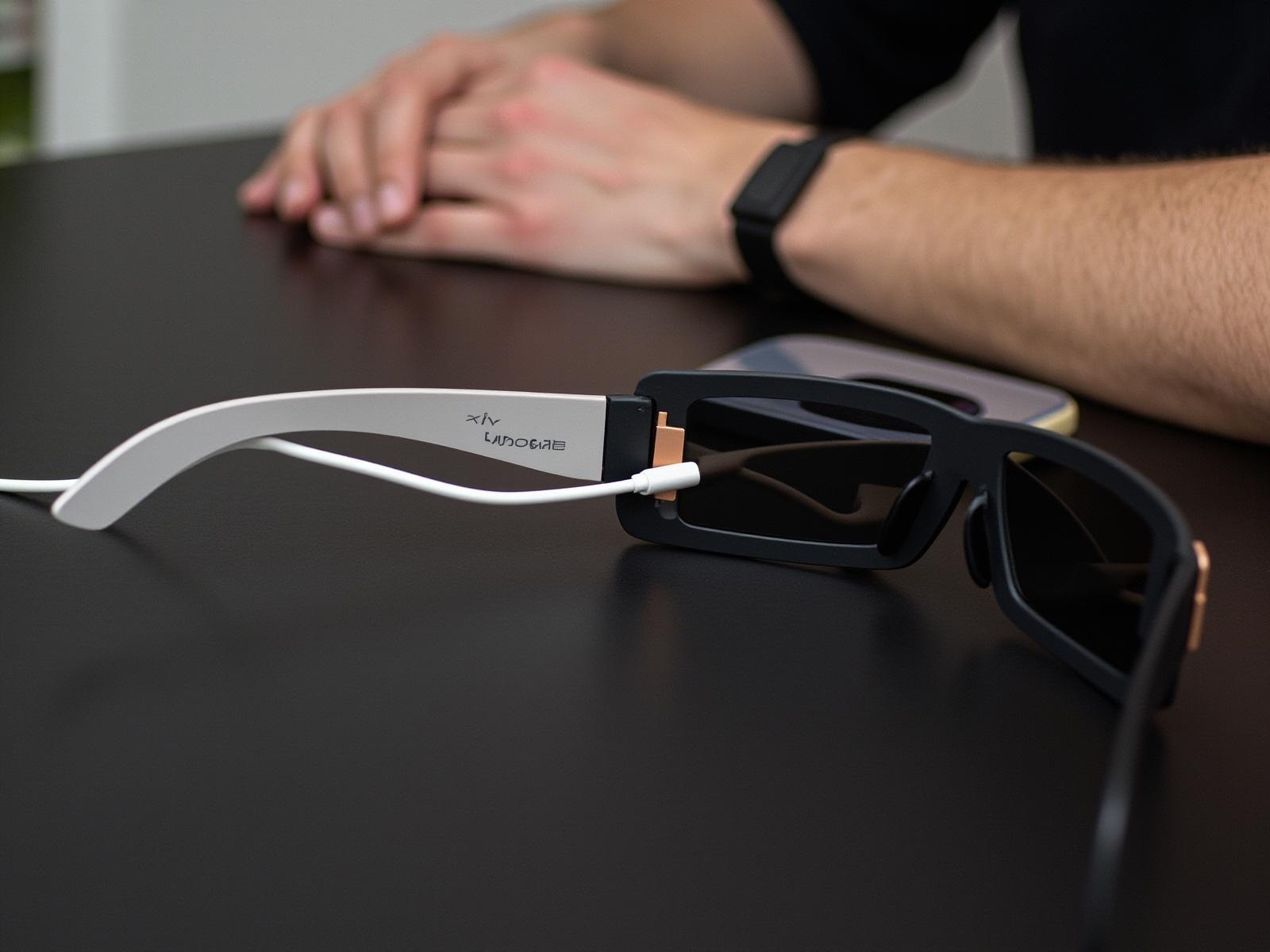
The charging hardware is the only capital line, and the quantity follows the interface. The children's range charges magnetically, which means each device needs its own magnetic cable or dock. One shared cable with a worn connector produces a support ticket that reads as a defective product, and a school that has under-provisioned charging will conclude that the product is unreliable rather than that the kit was short. The number to quote is the number of devices plus a small margin, and it should be a named line in the quotation rather than an assumption that the school already has sockets.
The wipe-down material is a per-unit consumable and it is the cheapest return reduction in the category. Shared devices handled by different people each day need a routine, and the routine needs an owner. The lens surface is the area people miss, because nobody thinks of it as a touch surface, and the catalogue publishes no coating specification for these models, which means the wipe instruction has to be restricted rather than permissive: a cloth, nothing sprayed, nothing shared. A per-unit consumable that costs a fraction of a unit price and removes a whole class of cosmetic claim is the highest-return line in the kit.
The quick-start card is the cheapest item with the largest effect. Connecting a device is the first thing a person attempts, and a class that cannot get past that spends its first week troubleshooting instead of evaluating. The card should carry three things: how to charge it, how to put it on, and what to do if it will not connect. It should be in the language the class actually uses, and nothing else belongs on it.
The quantity rules are negotiable and worth negotiating early. The consumable line is the one a buyer can set rather than accept: the quantity per device, the restock interval, and whether the item ships in the box or is issued on request. A fixed quantity per device makes the cost visible in the unit economics, which is easy to defend in a tender, and it also makes the cost a one-off that recurs. A restock interval suits a school running a long cycle better, and it is a conversation about the count sheet rather than about the device. Either way it is worth raising in the first round of an enquiry, because the answer moves the per-unit cost of the kit by more than the negotiation on the device price usually does.
The kit has its own lead time and its own minimum order quantity
An accessory list written after the device order inherits the device's schedule and then misses it. The four items have four different supply situations, and a buyer should quote them as separate lines with their own timings rather than folding them into one delivery date.
The printed card is the item with the longest lead time of the four and the one most often forgotten, because the artwork has to be approved by both the school and the brand, translated if the classroom language is not the one the card was drafted in, and then printed in a quantity that matches the class size. A card that arrives after the first week of the pilot has done nothing, because the routine it describes was already improvised without it. The numbered tray is a custom item with an artwork step of its own and a quantity per classroom rather than per device, so its ordering unit is different from the device ordering unit and the two have to be reconciled. The wipe-down material is a commodity consumable with the shortest lead time and a volume that scales with the device count, which makes it the line where a quantity error is cheapest to correct. The charging hardware is an equipment line, and equipment lines carry the longest lead time and the largest single-unit cost in the kit.
The commercial consequence is that the kit needs its own delivery date and its own approval path. A proposal that shows one date for everything will miss the card, and the card is the item that protects the first week.
Why magnetic charging sets the accessory count
The charging interface is the single published row that most changes the shape of an education kit, and it is worth being precise about what it does and does not determine. The A05, the A06 and the A07 all publish magnetic charging, with a charge time of two hours or less. That is a ceiling rather than a fixed duration, and it is a ceiling with no published starting state and no published end point, which means the two-hour figure cannot be turned into "charged and ready for the first lesson" without a test of your own. What it does determine is the physical kit: magnetic charging is a per-device accessory, so the accessory count is the device count.
The arithmetic a buyer should write into the quotation. Take the number of units in the classroom. Multiply by one cable or dock per unit. Add a margin of roughly ten per cent for the ones that get damaged or taken away, because a school that has under-provisioned charging will stop using the devices before it stops buying them. Then add the tray, the wipe material and the printed cards. That is the whole kit, and it is a page of work rather than a negotiation.
Where the interface changes the plan rather than the count. If a deployment includes camera models for staff rather than for students, the models in the camera range split into magnetic and Type-C configurations, and the Type-C models recharge from a cable most institutions already own. That reduces the accessory line for those units and adds a cable to the parcel instead. The L2 Utral and the V03 Pro publish Type-C; the KY06 and the V06, and the V03 and the MT5, and the S7 publish magnetic charging. Four camera models — the MT6, the L1 Pro and the CY05, and the CY03 — do not publish a charging method at all, which is a question to ask rather than a configuration to assume.
What must not go into the classroom kit
Three exclusions are not preferences, and each of them exists because the published material does not support the alternative.
No spray cleaner and no alcohol wipes. The catalogue publishes no coating specification for these models, so a solvent in a shared classroom is an unquantified interaction with an unquantified surface. The instruction has to be a wipe and nothing else, and the item that goes in the box has to be a wipe. A school that supplies its own cleaning products under a different brand has to be told to stop, in writing, before the kit ships rather than after a lens is marked.
No shared item that touches skin. A stylus, a headband, a strap pad or a face cushion that moves between users is a hygiene question that an institution will raise in its own right, and it is cheap to avoid by not supplying one. Individually assignable items only.
Nothing that implies a health outcome. This is the exclusion that most often breaks a proposal, because a school-facing document is where a vision or health claim appears by accident — in a brochure line, a parent letter or a sales deck. The catalogue lists a posture and distance detection function with a reminder on the A05 and the A06, and a lens-type electronic atomiser module. A reminder is a behaviour feature: something is detected and the wearer is prompted. It is not a myopia prevention claim and it is not a vision protection claim, and neither the factory nor the brand can evidence one. A proposal that says the product protects eyesight or reduces myopia creates an obligation for the school as well as for the brand, and no supplier should be helping build it. The full boundary is at medical boundary.

The routine that makes the accessories worth buying
The accessories are cheap; the routine is what makes them work, and the routine is the part a school has to own. It has four owners, and they do not have to be the same person: charging, the count, the wipe-down and the support escalation. A school that has named an owner for each of them is a school that can be asked for a deployment review; a school that has not will report a qualitative impression, and the channel will be unable to tell whether the problem was the product, the kit or the timetable.
The loop is short. Count the units against the register at the start of the day. Charge the fleet on the shelf, one device in each numbered place. Wipe the lens surface and the contacts as each unit comes back. Return each unit to its place and sign the count sheet. Read the count and the open tickets at the end of the week. That is the whole loop, and it takes less time than the interruption it prevents.

What the routine produces. A count of units returned against units issued, which is the only honest measure of loss in a shared deployment. A weekly read of the tickets, which is how the school discovers that a fault is a charging problem rather than a device problem. And an adoption figure measured in distinct users rather than sessions, because a single enthusiastic user can make a fleet look busy while the rest of the class has stopped. That metric point is the one worth arguing for early, and the deployment-side detail sits in long-term school use.
The seasonal item. A lithium cell left charged in a warm cupboard over a long break is the largest seasonal risk in a shared deployment, and a unit stored badly shows it in the first charge back. Store the units discharged, in a cool place, away from sun and heat, and log them out and back in. That single line in the storage plan is cheaper than the replacement cycle it prevents, and the cell life over years is not published for this range, so the replacement budget has to be an estimate the school agrees to rather than a figure anyone can quote.
What our published figures settle and what the school has to supply
We publish the configurations the education buyer orders from: the 40 mAh cells on the A05 and the A06 with magnetic charging, a charge time of two hours or less and rated use around twenty hours; the A07 at Bluetooth V5.4 with a 70 mAh cell and the same rated use; the charging interface per model; the presence of the posture and distance reminder on two of the three children's models; and the colour options. We also publish that the A05 and the A06 carry identical parameters and that the difference between them is unconfirmed, which is a two-minute question that protects three downstream decisions — the artwork, the listing and the model designation on any document the school has to file.
What we do not publish for this range is a certification position of any kind, a data path, a recording indicator specification, sizing data, an age position, a per-model unit weight, a coating specification and any ingress rating. The catalogue carries a company-level export certification page whose content is images rather than text, and the catalogue text contains no reference to CE, FCC or RoHS, and there is no per-model certification row anywhere. We will not fill a data-path or claims gap with a typical value, and we will not give a school a green light on a compliance question that only an adviser or the destination market can answer.
What the enquiry should contain. Six items, and each of them changes either the price or the date: the model and the exact configuration, the quantity per class and the number of classes, the classroom language for the printed card, the destination market, whether the deployment includes camera models for staff as well as the children's models for students, and the date by which the kit has to be on the shelf rather than in a warehouse. Send those and the answer can be specific about which accessory line carries the longest lead time, which line is a commodity consumable, and which line is a capital item that has to be ordered before the devices arrive.
What we cannot answer for the school is anything that belongs to the destination market or to the school's own governance: the conformity position for a given market, the data path for a device that records, and the recording indicator specification. The catalogue publishes no per-model certification row and no data flow for this range, and no accessory in the world substitutes for those documents. A kit that arrives complete and a deployment that is defensible are two different things, and the second one is settled before the kit is ordered.
What we will do is take the model, the quantity, the classroom layout and the destination, and tell you which configurations exist, what the kit should contain for each, and which documents have to be settled in writing before a pilot. The published configurations are at kids smart glasses, the fuller equipment list is in the gear checklist, and the deployment framework is at smart glasses for education.
Related reading
- What a deployment needs — the full checklist
- Long-term school use — what decides year one
- Kids smart glasses range — published configurations
Send the model, the quantity, the classroom layout and the destination, and we will return the kit each configuration should carry.


