

Smart glasses for education are a bill of materials before they are a product order. A school that takes a hundred units is buying a hundred units, a hundred charging positions, a hundred identification tags, a hygiene routine that somebody owns, and a document pack that names the model it covers. Any one of those five can be absent on the first morning, and the absent one decides whether the first lesson runs. The right question is therefore not which model to take — that question is narrow and the catalogue answers most of it — but what has to exist in the room when the teacher walks in, and then which of those items is configuration and which is consumable, because the two have different cost treatment, different lead-time behaviour and different failure modes. This page is written for the procurement officer or the brand manager who has to answer that, and it is deliberately narrow: it does not re-explain the models, and it does not try to settle the claim question, which belongs in the legal file.
Who this is for. The reader is buying for an institution rather than for themselves, which changes the shape of every decision. A parent buying one unit asks whether it works. A district buying two hundred asks whether it works on the day it is supposed to, who owns the charging, what happens when a unit is lost, and whether the paperwork survives a review. That reader is usually one person holding a spreadsheet, a budget code and a deadline set by somebody else's calendar, and the task in front of them is to produce a kit that can be received, counted, charged, labelled and accounted for at the end of the year. The fear that shapes the work is not that the product will fail; it is that the order will arrive complete on paper and unusable in the room.
What the channel context adds. In a school or campus channel, the buyer is usually a third party to the manufacture — a brand, a distributor or an education supplier — and the end user is a child in a room the buyer does not control. That distance is the reason a kit decision has to be written down. The specification the buyer holds and the configuration the teacher meets on day one are only the same thing if somebody wrote the link down and made it part of the order. The education application page covers the channel itself, and the kids smart glasses range lists the three models that sit inside it.
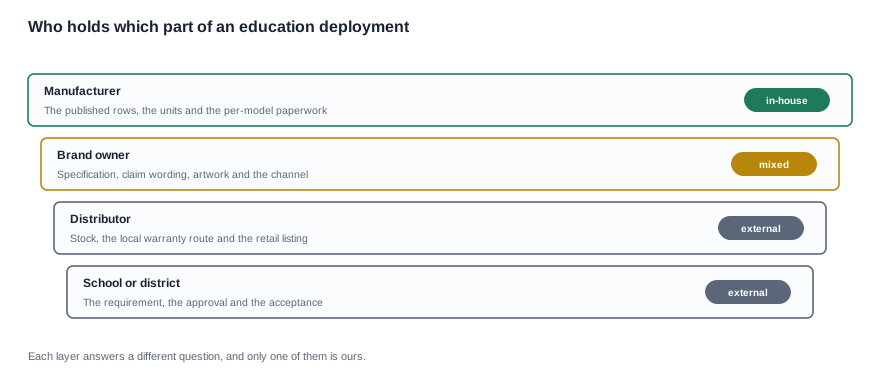
Smart glasses for education: what the three published rows decide about the kit
Everything in the kit descends from three published rows, and it is worth being precise about which three, because the catalogue publishes more than a buyer needs and less than a kit needs.
The catalogue publishes a magnetic charging interface on all three of the children's models. That single row is the most consequential line in the whole kit decision, because it converts the charging question from an interface question into a hardware-count question. There is no cable in the box to lose, there is no Type-C variant to split the fleet across, and every dock in the building is the same object. A buyer who reaches for a generic USB-C charging trolley has specified a fleet this catalogue cannot support.
The second row is the cell and the rated use. The A05 and the A06 publish a 40 mAh cell with a rated use of about twenty hours; the A07 publishes 70 mAh with the same rated use of about twenty hours and Bluetooth V5.4. The charge time published for all three is a ceiling of two hours or less, which is a laboratory figure rather than a promise about a charging window in a corridor. The row that matters for the kit is not the capacity itself but the implication: roughly twenty hours of rated use covers a teaching day with margin, so the kit does not need a mid-session recharge position, and it does need a nightly charging routine with somebody accountable for it. A deployment that treats twenty hours as continuous availability is designing for a duty cycle the catalogue does not describe.
The third row is the function that separates two of the models from the third. The A05 and the A06 publish a lens-based electronic fogging arrangement together with posture and viewing-distance detection, published by name only — the threshold, the delay, the false-positive rate and whether a parent can disable the arrangement are not published. The A07 publishes none of those rows. What this changes in the kit is the content of the instructions rather than the hardware: a model with a published detection function needs a setup card that tells the adult in the room what the reminder means and what to do about it, and a model without one needs a simpler card. The same box, two different pieces of paper.
What the catalogue does not publish for these three models, and therefore what the kit cannot be built from. The frame weight and the frame dimensions are not published for the A05, the A06 or the A07, and the only unit weight anywhere in the catalogue is 158 g for the MT6 glasses body, excluding its foldable case — a camera model, not a children's model, and not a reference point for anything in this tier. The ingress marking is not published for these three models either; the IP54 marking appears on the V06 and the S7 only, and no third-party test report is published behind that marking, so it cannot be transferred to the children's tier by analogy. The certification status is not published for any of the three, which is a gap rather than a negative statement: the catalogue carries a company-level export certification page with image content instead of text content, and it contains no per-model certification row, so the buyer cannot treat it as coverage for a named model. The lens material and the coating are not published, which is why the hygiene instruction has to be restrictive rather than permissive. And the Bluetooth version is published for the A07 only; the A05 and the A06 publish no radio version at all, which matters if the fleet is going to sit on a school network.
Why these gaps shape the kit rather than just the listing. A kit is a set of instructions and objects that reduce the number of ways the deployment can go wrong. Where the catalogue publishes a row, the kit can lean on it: the magnetic interface settles the dock count, the twenty-hour rated use settles the overnight routine, the published detection function settles the content of the setup card. Where the catalogue is silent, the kit has to substitute a decision the buyer makes and writes down, and the most common failure in this category is a buyer who substitutes a typical value instead. A weight nobody published does not become 35 g because that is what a child's frame usually weighs; it becomes a line in the kit list marked "to be requested from the supplier", because the sizing question is real and a guess is not an answer. The cost of that discipline is one email. The cost of skipping it is a return rate that nobody can explain.

The four kit groups and how each one is costed
The kit resolves into four groups, and the group a line falls into determines how it is priced, how long it takes and what happens when it goes wrong. Treating them as one list is the reason education deployments are quoted late and delivered wrong.
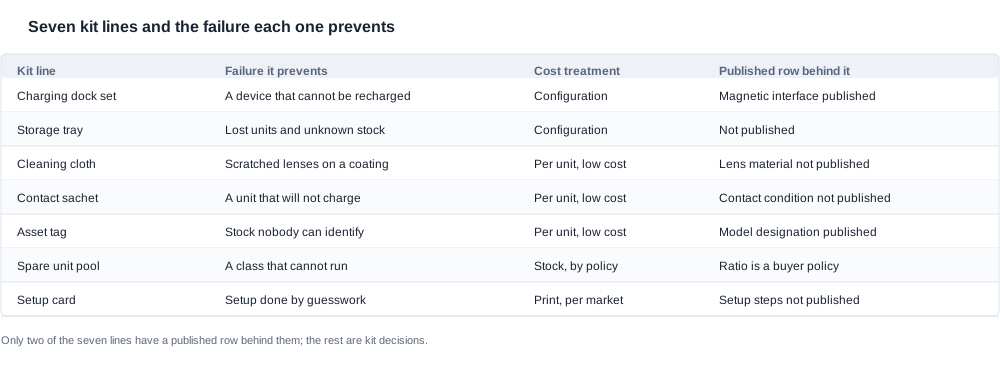
| Kit line | Failure it prevents | Cost treatment | Published row behind it |
|---|---|---|---|
| Charging dock set | A device that cannot be recharged | Configuration | Magnetic interface published |
| Storage tray | Lost units and unknown stock | Configuration | Not published |
| Cleaning cloth | Scratched lenses on a coating | Per unit, low cost | Lens material not published |
| Contact sachet | A unit that will not charge | Per unit, low cost | Contact condition not published |
| Asset tag | Stock nobody can identify | Per unit, low cost | Model designation published |
| Spare unit pool | A class that cannot run | Stock, by policy | Ratio is a buyer policy |
| Setup card | Setup done by guesswork | Print, per market | Setup steps not published |
The configuration group is what the quotation has to itemise. Docks and trays are not accessories in this category; they are configuration, because the count is derived from the timetable and the room plan rather than from the device count, and because a change in the plan changes the order. A buyer who asks for "the accessories" and receives a generic bundle has received an answer that cannot be checked, and the check that matters happens in the room on the first morning. Itemise the dock count and the tray count separately in the quotation, and note what each one is counted against. The accessories for the education channel page sets out the accessory scope for this range.
The consumable group is where the return rate is actually decided, and it is almost never negotiated. A cloth and a contact sachet are a few cents per unit, they sit in the packaging, and they do not change the freight weight. The reason they matter is that the two commonest avoidable outcomes in a children's fleet are a scratched lens and a unit that will not charge after a day's handling, and both are answered by an item that costs less than the postage to replace the unit. The instruction matters more than the item: a cloth that nobody is told to use is a per-unit cost with no return, so the setup card and the insert artwork have to name the item and the occasion. And because the lens material and the coating are not published, the instruction has to prohibit solvents rather than recommend a cleaner — a permissive instruction on an unpublished coating is a warranty claim that the documentation cannot carry.
The identification group is a control, not a label. An asset tag on every unit, carrying the model designation and a serial the school owns, is what makes an end-of-year inventory possible. Without it the school cannot answer a simple question: how many units are still in the building? A deployment without identification does not lose stock in a visible way; it loses it in an invisible way, and the first evidence is a budget line that no longer reconciles. The cost is one tag per unit and one register, and it is the cheapest control in the kit. The model designation matters on the tag rather than on the box, because the box is replaced and the unit is not.
The information group is a deliverable, and it should be in the purchase order. A setup card, a short user guide and a hygiene instruction are printed items with a lead time of their own and a version number, and the failure mode is a school receiving units with documentation written for a different model or a different market. The setup steps themselves are not published in the catalogue, so they have to come from the supplier and be versioned against the firmware they describe. Any change to the reminder behaviour on a published detection function changes the card, and a card that no longer matches the behaviour is worse than no card.
One line that must not be added by assumption: the charging case. The catalogue publishes no charging-case row for the A05, the A06 or the A07, which means the case question is open rather than closed. If a case is wanted, it is a separate question to the supplier, and a case is a second lithium cell with a transport file attached, so adding one late changes the packaging artwork, the declared shipping weight and the transit documentation together. The requirements for that file are set out at battery transport, and the decision belongs in the quotation rather than in the week before the shipment.
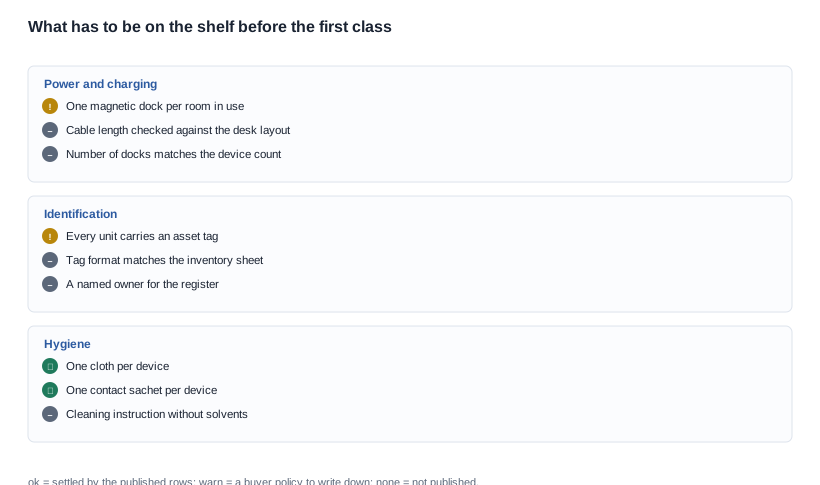
The checklist above is the version a buyer can hand to a receiving supervisor on the delivery date. It is deliberately short, because a receiving check that takes more than a few minutes per delivery stops being performed after the second one. Three of the lines are marked as not published in the catalogue, which is the honest position: the cable length, the tag format and the cleaning instruction are decisions the buyer and the supplier have to write down between them, not rows that arrive with the goods.
How the quantities are worked out before the order
Quantities in this kit are derived, not guessed, and the derivation is short enough to do on one page. The difficulty is that the obvious method — count the children — is the wrong method, because the constraint is the timetable and the room, not the roll.
The derivation, in the order it has to run:
- Count the units in simultaneous use. Read the timetable, not the roll, and take the peak figure for a single period.
- Count the rooms those units live in. A fleet fixed to a group has a room; a rotating fleet has a tray that follows the class.
- Count the charging positions. Docks follow the room plan and the peak simultaneous use, not the device count.
- Set the policy numbers. The spare pool and the consumable reorder interval are decisions with a name attached, not catalogue rows.
- Reconcile against the paperwork. Every kit line appears on the same sheet as the model designations the documents cover.
- Write the result into the order. A derived quantity that is not in the purchase order becomes an argument at the goods-in desk.
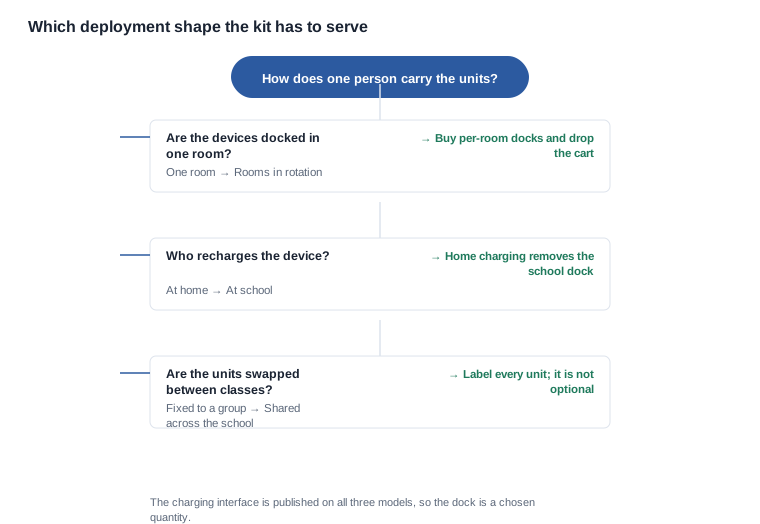
Start from the schedule, not the roll. A device that is used in three consecutive periods cannot be recharged between them, and with a rated use of about twenty hours it does not need to be. What it does need is a home at the end of the day, and the count of those homes is the count of devices. So the first number is the number of units in simultaneous use, which is the peak concurrent figure in the timetable, not the total enrolment. The second number is the number of rooms, because a dock set that follows the room rather than the device changes the whole logistics of a mobile deployment.
Then count the positions, not the units. Docks are counted against the timetable: how many units need to be charging at the same time, and where those units are stored between uses. If the fleet is fixed to a group and stored in a tray in that group's room, the dock count and the tray count are close to the device count. If the fleet rotates between rooms, the dock count collapses and the tray count rises, and a rotation also makes the identification group more important rather than less, because a unit that moves between rooms is a unit that gets lost. These two shapes produce different orders, and they produce different return and loss rates, which is why the decision belongs in the kit rather than in a later conversation.
Then apply the policy numbers, and write them down as policy. The spare pool is the one quantity in this kit with no basis in the catalogue at all. It is a policy choice: how many units the school is willing to hold to cover a broken unit, a missing unit and a unit in for repair. Its size is set by the school's own tolerance for a lesson that cannot run as planned, and it should be written as a decision with a name attached, because a spare ratio that nobody owns becomes a stock that is never reordered. The same applies to the replacement assumption in year two, which is a forecast rather than a fact and should be kept out of the first-year quantity entirely.
Then check the consumables against the same count. The cloth and the contact sachet are one per unit, and the restock interval is a consumption decision rather than a technical one. Where a fleet is cleaned daily, one per unit per term is a starting point and the reorder point has to be set; where it is cleaned weekly, one per unit covers a term comfortably. The point of writing this down before the order is that consumables bought against a wrong assumption do not fail visibly — they run out on a Tuesday, and the replacement cycle is then set by whoever notices.
Finally, reconcile the count against the document pack. Every unit, dock, tray, tag and spare has to appear in the same count sheet as the paperwork, because the paperwork is per model and the kit is per configuration. If the order contains three models, the dock and tray counts have to be split per model as well, since a magnetic dock that is physically the same across the fleet still has to be counted against each model's line for the acceptance check to work.
Where an education kit goes wrong after the signature
Six failures account for most of what goes wrong, and each of them has a symptom a buyer will recognise.
The kit inherited from another channel. A bill of materials copied from a retail or office deployment arrives with the wrong accessories, because the other channel's interface and the other channel's room plan are different. The symptom is a receipt where the dock count does not match the device count and nobody can say which is right. The root cause is that the kit was never derived from this timetable. The prevention is one page of derivation attached to the purchase order, so that the quantity has a reason a reader can check.
The consumables supplied without an instruction. A cloth and a sachet in the box, with nothing telling the adult in the room to use them. The symptom is a scratch claim in week two and a charge complaint in week three, both of which arrive as product faults. The root cause is that the insert artwork was treated as packaging rather than as an operating instruction. The prevention is to require the insert to name the item, the occasion and the solvent prohibition, and to have the supplier review it — a supplier who has read the artwork has tested the routine.
No identification on the units. The symptom is an end-of-year count that does not reconcile, followed by a budget discussion about how many devices were lost. The root cause is that the tag was treated as optional because it looks like a consumable. The prevention is a tag on every unit at receipt, not after the first loss, and a register that names its owner.
Docks without a power plan. The symptom is a device that will not charge in the second term because the room's sockets are on a different circuit, or because the cable length was never checked against the desk layout. The root cause is that the charging hardware was specified as an object rather than as a location. The prevention is to treat the socket layout as an input to the dock quantity and to confirm it before the order rather than at installation. Cable length and socket type are not published for any model in this range, which is exactly why they have to be checked in the room.
A case added late. The symptom is a packing and documentation change in the final fortnight, with artwork reprints and a transit file that has to be reissued. The root cause is that the case was treated as a free accessory until somebody asked whether it was a second lithium cell. The prevention is to answer the case question in the quotation stage, when it is still a configuration choice rather than a change.
The spare pool with no owner and no reorder point. The symptom is a lesson that cannot run as planned in the middle of the term, with an improvised substitute. The root cause is a quantity that was agreed as a number rather than as a stocked position with a reorder rule. The prevention is to put the spare pool on the same register as the assets, with a reorder point and a name.
One failure is a policy failure rather than a hardware one. When a deployment mixes models with published detection functions and models without them, the setup card becomes a per-model artefact, and a single card for the fleet will describe behaviour that one of the models does not have. The root cause is that the fleet was treated as one product. The prevention is to version the card per model and to check the printed stock against the model mix before it ships.
The terms that decide what the kit costs you
Some of the kit's cost is fixed by physics and by the testing regime, and some of it is genuinely open. Separating the two early is what makes a negotiation productive rather than circular.
Open and worth the time. The dock and tray quantities are open, because they follow the room plan and the timetable rather than any production constraint, and a buyer who has done the derivation can negotiate against it. Whether the dock is supplied in the box or sold as a separate accessory is open, and it is the largest single lever in the kit, because it moves the price ladder, the packaging artwork and the freight weight together. The consumable quantities and the reorder interval are open, and they are worth a few cents per unit. The asset tag format is open: a buyer who owns the tag format keeps the register under its own control, and a supplier-supplied tag ties the stock to the supplier's naming. The artwork round count is open, and each round costs a week. The share of units taken at a pilot tier rather than the full run tier is open and is where most of the commercial room sits, because it is the manufacturer's own risk exposure. The delivery split against the school calendar is open, and it is more valuable than a discount when the receiving window is narrow. The minimum order quantity for the accessory set and the question of whether two models can share a purchase order are open in the same way.
Fixed by the regime rather than by the negotiation. The certification cost and the elapsed time for it are set by the test body and the standard, and are incurred per model and per market; they are not a price that a larger order reduces. Tooling is a one-off that is usually amortised across the first order, so the useful question is over what volume it is amortised and what happens to it if the programme stops. The battery transport documentation for any configuration that includes a case is a requirement rather than a commercial variable. And the detection behaviour of the A05 and the A06 — the threshold, the delay and the false-positive rate — is a design parameter of the product, not a term of the agreement.
Our position. We publish the rows a buyer can order from and we will not fill the gaps with typical values. For this tier that means the cell capacities of 40 mAh and 70 mAh, the charge time of two hours or less, the rated use of about twenty hours, the magnetic charging interface, and the published functions on the A05 and the A06. We do not publish the frame weight, the frame dimensions, the ingress marking, the lens material, the certification status or the detection parameters for these models, and we would rather tell you that than quote a figure you cannot verify. We also will not present the IP54 marking on the V06 and the S7 as a test result, because no test report is published behind it, and we will not extend it to the children's tier where no marking is published at all. The minimum order quantity, the lead time and the payment structure are set out at minimum order quantity, lead time and payment terms, and the acceptance criteria for a first order belong at contract terms.
What to send this week. Send the room count, the timetable shape, the number of models in the fleet and the markets, and ask for the kit as a written bill of materials with the dock and tray quantities derived against your schedule rather than offered as a bundle. Then ask for the three rows the catalogue does not publish for this tier — the weight and dimensions with the measurement method, the certification position per model, and the detection parameters with units — so that the gaps in the kit are gaps on the record rather than assumptions in a spreadsheet. If you are still comparing models rather than kits, the selection logic is at how to choose smart glasses for education, and the charging plan that sits underneath the dock count is at how to charge smart glasses for education. Send us the schedule and the fleet, and we will tell you which kit lines our published rows already answer and which have to come from the supplier.


