

Smart glasses for education are judged in the first week and abandoned in the first term, and the second event is decided by four things that have almost nothing to do with the hardware. A school that keeps a fleet for a full academic year learns how charging is owned, how hygiene is handled, how consent is administered and how inventory is counted — and a deployment that gets those four right survives on published electrical rows that are not exceptional. A deployment that gets them wrong does not fail loudly; it fails as a device that is quietly put in a drawer, and the manufacturer never hears about it. This page is written for the buyer or the brand manager who wants the deployment to survive year one, and it treats the four routines as the actual deliverable and the hardware as the input.
Who this is for. The reader is a procurement officer or a programme lead who has already placed the order, or a brand owner who is deciding whether to place a second one. Their problem in year one is not selection. It is that the programme is administered by people whose day job is something else, and that the artefacts which keep it alive — a named owner, a written routine, a register, a claim sentence — cost nothing to produce and are routinely left out. The commercial question underneath is whether the fleet can be re-ordered at the same unit economics, and the answer is set by whether the deployment was designed as an operating routine or treated as a delivery. The education channel page covers the commercial context and the kids smart glasses range lists the three published models in this tier.
Smart glasses for education: because a year shows what the catalogue cannot
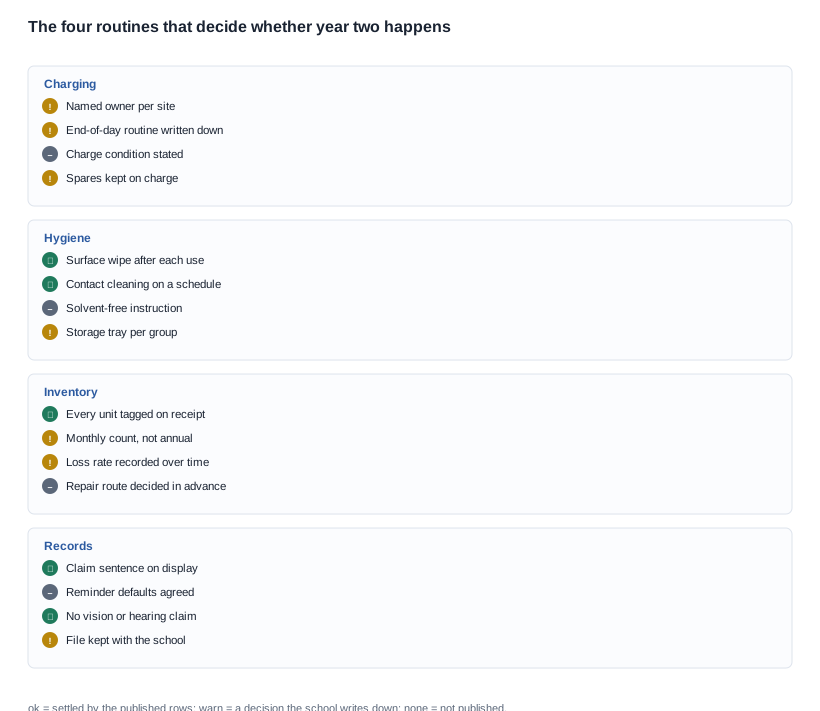
The four routines that decide whether a deployment survives its first academic year are the same four in every institution, and they are worth writing down as a list before the first term rather than discovering as the year runs:
- Charging ownership. Who places the units on charge at the end of the day, and who checks them in the morning.
- Hygiene routine. Who wipes the surfaces, on what interval, with which instruction, and where the cloths are kept.
- Consent and claim administration. Who approves the claim sentence, and where it is displayed for parents and staff.
- Inventory control. Who counts, how often, and what the loss rate is recorded against.
None of the four needs a purchase order, and each of them fails silently. The rest of this page sets out what the published rows settle, what they leave open, and what a buyer should verify, ask and negotiate before the second order.
What the published rows do and do not carry into year one
The catalogue publishes the electrical rows for the three children's models, and they are enough to plan a year. The A05 and the A06 publish a 40 mAh cell, a charge time of two hours or less, a rated use of about twenty hours, and a magnetic charging interface. The A07 publishes a 70 mAh cell with the same charge time and the same rated use, plus Bluetooth V5.4. Those are the rows a long-term plan can lean on.
Three published details matter more than the others when the horizon is a school year rather than a product launch. The first is that the magnetic interface is published on all three, so the charging hardware is a single fleet-wide object and the question becomes how many of them a building needs rather than which cable fits. The second is that the rated use of about twenty hours comfortably exceeds a teaching day, which means the fleet does not need an in-day recharge position and the entire charging problem becomes an overnight routine. The third is that the A05 and the A06 publish a lens-based electronic fogging arrangement together with posture and viewing-distance detection, while the A07 publishes neither — which means the deployment's setup routine differs by model, and a single instruction for the fleet will describe behaviour that one model does not have.
What the catalogue does not publish, and what a year-long plan therefore has to substitute. There is no cycle-life rating, no ageing curve, no operating temperature range, no charge retention data over time and no service-life statement for any model in this tier. The published charge time carries no starting state of charge and no termination criterion, so it is a laboratory result rather than a turnaround window, and it cannot be used to plan how long a unit sits on a dock before it is usable again. There is no published frame weight, no frame dimension and no size range, so the sizing question — which is the one that determines whether a child keeps using the unit — has no number behind it at all. And there is no published ingress marking for these three models; the IP54 marking in the catalogue appears on the V06 and the S7 only, with no third-party test report published behind it, and it cannot be carried across to this tier by analogy.
Why this is the right way round. A year-long plan that assumes the catalogue will fill in the gaps later is a plan that fails in the third term, because the gaps are only closed by something that takes time: a supplier answer, a sample test, a family trial, a document. The four routines below are the ones a buyer can put in place in the first fortnight and keep in place for a year, and each of them converts an unpublished row into an operational decision that someone owns.
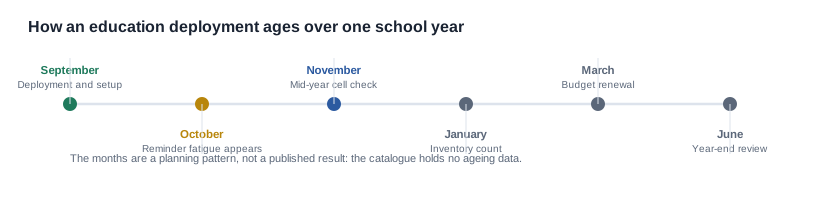
The months above are a planning pattern rather than a published result, and the reason to publish it is that it names the moments when a decision has to be taken by somebody. The one that catches most deployments out is the mid-year cell check: it is the first occasion on which the difference between a cell that has aged and a cell that was never fully charged becomes visible, and by that point the replacement units have usually already been budgeted for the following year.
The charging routine that has to belong to somebody
Charging is the routine that decides whether a fleet works, and in most deployments it has no owner. The published rows make it look trivial: a magnetic interface, a charge time of two hours or less, and a rated use of about twenty hours, which is more than a school day and comfortably more than a long teaching block. The arithmetic works. The failure is not the arithmetic; it is that nobody has been made responsible for the last ten minutes of the day, and that is where the fleet actually loses its charge.
What has to be decided, and by whom. Three decisions, each with a name against it. First, where the units live at the end of the day — a tray per group, a trolley by the door, a cabinet in the office — because the answer determines the dock count and the label count. Second, who puts the units on charge, and at what time, and what happens when that person is absent. Third, what happens to a unit that is found flat in the morning, which is a routing decision rather than a technical one: it either goes into the spare pool, or it goes onto the dock and is checked at the end of the week, and the choice has to be written down because the second option quietly shrinks the pool.
The spare pool is the part that is usually missing. A fleet with no spare units has no answer to a broken unit, a missing unit or a unit that will not charge, and the answer in practice is a child without a device for the week. The pool is a policy rather than a catalogue row: it is a number the school chooses, a place it is kept, and a rule for what returns a unit to the pool. What makes it work is that the spares are charged on the same routine as the fleet. An uncharged spare is not a spare; it is a unit that will be discovered as flat on the day it is needed.
The instruction has to state a condition, not a duration. The published charge time of two hours or less is a laboratory result without a stated starting state of charge or a termination criterion, which means it cannot be turned into "leave it on the dock for two hours and it is ready". The publishable instruction is the behavioural one: the unit goes on charge at the end of the day and is checked in the morning, and any unit that is still flat after that is a fault rather than a delay. That rule is cheap, is testable, and produces a number a school can act on.

The hygiene routine that decides the return rate
Hygiene is the second routine, and it is the one that determines the return rate more directly than any other factor in a children's deployment. Two outcomes account for most of the avoidable returns in this tier: a scratched lens, and a unit that will not charge because the contacts are dirty. Both are answered by an item that costs a few cents per unit, and both are made worse by an instruction that is too permissive.
The published gap is the reason the instruction has to be restrictive. The lens material and the coating are not published for the A05, the A06 or the A07, so nothing is known about what will damage a surface. A permissive instruction — use any cleaner, use the cloth you have — becomes a warranty claim that the documentation cannot carry, and it arrives as a claim against the product rather than against the habit that caused it. The defensible instruction names a solvent-free cloth, prohibits household glass products, and states plainly that the lens specification is not published. The contact sachet works the same way: a charged contact that has been handled is the most likely cause of a unit that will not charge, and a sachet resolves it in seconds at a cost that is a rounding error against the unit price.
The routine has to attach to a moment that already exists. An instruction on an insert is read once and then forgotten; a routine attached to the end of the lesson or the end of the day is followed. That is a design decision about the deployment rather than about the product, and it is the reason a school should be asked to name the moment rather than be handed a leaflet. Where the fleet is used by several groups, the moment is per group, and the wipe and the sachet belong to the group rather than to the room.
Hygiene is also where the claim boundary has to be repeated. The published functions on two of the three models detect a position and a distance and remind. That is a reminder function and it is described in those terms. A classroom conversation about eyesight, and a parent's expectation about what a device that detects a viewing distance is supposed to do, are the two places where the claim drifts, and a school programme that never repeats the boundary in the setup card will have it repeated by somebody else instead.
The inventory that makes the loss rate visible
An education deployment without an inventory does not lose stock visibly; it loses it invisibly, and the first evidence is a budget line that no longer reconciles. The register is a small piece of work and it is the difference between a loss rate that can be managed and a loss rate that can only be argued about.
The unit has to be identifiable. Every unit needs a tag that carries the model designation and a serial the school owns, because the box is replaced and the unit is not. Without a tag, the count at the end of the year is an estimate, and an estimate cannot be turned into a replacement order. The model designation belongs on the tag for the same reason it belongs on the paperwork: it is the string that connects the physical unit to the document that covers it.
The count has to be frequent enough to be a control. An annual count tells you what happened last year. A monthly count tells you which month the losses happened in, and the month is the whole of the diagnosis. A count that is scheduled rather than triggered also survives the departure of the person who set it up, which is the normal reason a good register dies.
The loss rate is a procurement number, not an administrative one. Once the loss rate is a recorded rate rather than an anecdote, it can be compared against the spare pool policy, it can be priced into the second-year order, and it can be set as an acceptance criterion with a supplier. A supplier who is given a written loss-rate target behaves differently from one who is given a return address. The warranty and returns position for this channel is set out at warranty and returns, and the equipment-management view is at equipment management for retail and education.
The year-end review that decides whether there is a year two
The question at the end of the first year is not whether to order the same units again. It is whether the deployment is a programme or a pilot that has not been closed, and the four answers below settle it.
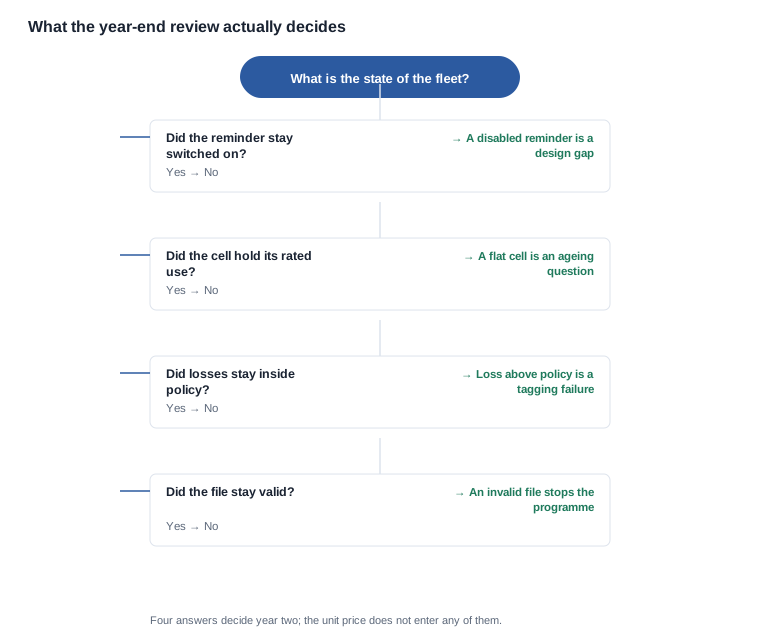
The first answer is about the reminder, not the device. If the published detection functions are still switched on at the end of the year, the reminder was tolerable to the people who live with it, which is the only durability test that matters for a published function. If it was switched off, that is a design and default-settings problem rather than a product failure, and the supplier conversation is about the default threshold and the alert format — neither of which is published — rather than about a warranty claim. A deployment where the reminder was switched off in week three and nobody noticed is a deployment that will not be renewed, and the evidence is sitting in the classrooms rather than in a return figure.
The second answer is about the cell, and it needs a comparison rather than an opinion. A unit that no longer holds a useful charge after a year is a cell-ageing question, and the honest position is that the catalogue publishes no cycle-life rating and no ageing data, so a buyer cannot predict the curve and can only measure it. The measurement is simple: compare the end-of-day behaviour of a first-year unit with a new unit of the same model on the same routine, and record the difference as a rate. That rate, measured on the school's own fleet, is worth more than any figure a supplier can quote without a test, and it is the number that sets the replacement assumption for year two.
The third answer is about losses, and it is the cheapest one to get right. If the loss rate stayed inside the policy, the identification routine is working and year two is a straight re-order. If it did not, the cause is almost always the count frequency rather than the tag format, and the fix is a monthly count rather than a new register. The fourth answer is about the file. If the documentation pack is still valid — the certificates still current, the standards still on the edition the file was prepared against, the claim sentence still the one the listing uses — the programme can continue. If it is not, the deployment cannot continue in that market, and that is a compliance stop rather than a commercial one. The requirement to keep records current is set out at children's product compliance record keeping.
The commercial decision follows from the four answers. If the reminder survived, the cell held, the losses stayed inside policy and the file is valid, then the second order is a re-order and the negotiating position is a better one than the first, because the school can now state a measured loss rate, a measured cell behaviour and a measured reminder acceptance rather than an intention. If any of the four failed, the useful question is which one, because the remedy differs completely for each: a reminder that was switched off needs a default-settings discussion; a cell that aged needs a replacement schedule; a loss rate that ran away needs an identification routine; an invalid file needs a documentation project. Treating all four as "the product was not good enough" is the mistake that turns a year-two programme into a cancellation.
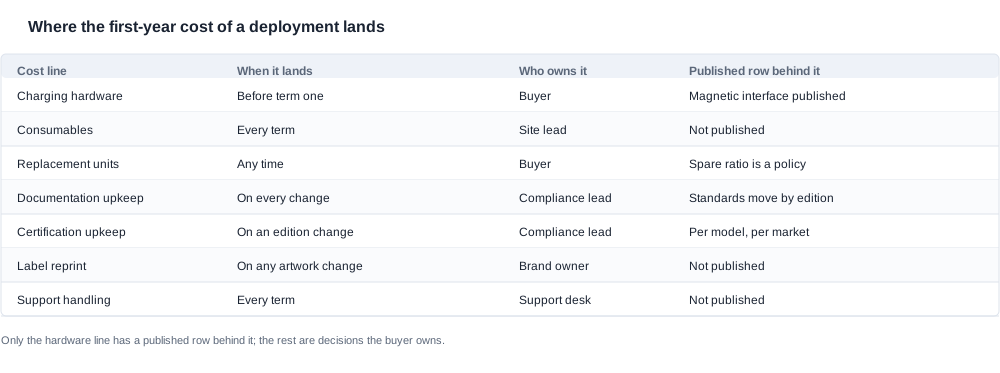
Our position. We publish the rows a buyer can plan a year with: the 40 mAh and 70 mAh cells, a charge time of two hours or less, a rated use of about twenty hours, the magnetic charging interface, Bluetooth V5.4 on the A07, and the published functions on the A05 and the A06. We do not publish a cycle-life rating, an ageing curve, a charge retention figure over time, an operating temperature range, a frame weight, a frame dimension, a size range, an ingress marking for this tier, or the detection thresholds and false-positive rates — and we will not estimate any of them, because a year-long plan built on an estimated ageing curve fails in the term it was supposed to save. We also make no vision, health, eye-protection or hearing claim for any model in any market.
The questions to ask the supplier before the second term. These are the questions that close the gaps the catalogue leaves, and they are worth sending as a list rather than as a conversation, because the answers arrive in writing:
- What is the per-model certification status, and what are the certificate numbers? The catalogue has no per-model certification row, so this has to come from the supplier's own file.
- What are the detection thresholds, the delay and the false-positive rate on the A05 and the A06? The function is published by name; its parameters are not.
- What is the frame weight and the frame dimension, and by what method were they measured? No size range is published for this tier, and sizing is what determines whether a child keeps using the unit.
- What is the charge time measured from, and to what end condition? The published figure of two hours or less carries no starting state of charge and no termination criterion.
- What is the agreed defect rate, the warranty response time and the re-order lead time? These are the three numbers that decide the total cost of a second year.
- What is the position on the reminder defaults, and what notice is given before a firmware change? The defaults are the product the school actually approved.
What to do next. Write the four routines down and name an owner for each before the second term starts, because the cheapest year-one intervention available to a buyer is a piece of paper and the most expensive is a fleet that is quietly abandoned. Then run the mid-year cell comparison on a small sample and keep the result, since that measurement is the one that will set the year-two order. If you want the selection logic before the routines, it is at how to choose smart glasses for education, and the charging plan underneath the routine is at how to charge smart glasses for education. Send us the model list, the fleet size and the number of sites, and we will tell you which of the four routines our published rows already answer, which need a sample test from the supplier, and which have to be closed by your own measurement.


