

Smart glasses for education are bought into a calendar that the supplier does not control, and the calendar is the single largest source of cost in this category that does not appear on a quotation. A school has a term structure, an examination period, a budget cycle that closes in the summer, a break where the building is quiet and a set of staff who leave in July and are replaced in September. Every one of those facts has a commercial consequence for a deployment, and a buyer who plans the order against the supplier's production calendar rather than against the school calendar will discover the mismatch on the day the first delivery is supposed to arrive. This page treats the school year as the production plan, and it does so on the published rows: the catalogue publishes enough about these three models to plan a seasonal programme, and it publishes nothing about the season itself, so the season has to come from the buyer.
Who this is for. The reader is a buyer placing a first order into an education programme, a channel partner scheduling a rollout across several customers, or a brand manager planning a year's order book. The task in front of them is to fit a manufacturing and documentation programme into somebody else's year, which means two calendars have to be reconciled: the supplier's, which has production slots and a certification lead time, and the school's, which has terms. The mistake this page is written to prevent is the one that costs most — the order that arrives in the last week of the summer break, sits in a cupboard because nobody has the authority to accept delivery, and misses the first term entirely. The education channel page covers the commercial context and the kids smart glasses range lists the three models.
Smart glasses for education: the cost when the delivery misses the term
A school year is not a smooth twelve months, and the shape of it decides where an order can physically land. The calendar below is a planning pattern rather than a set of dates — the actual dates come from the school, and the whole point of this page is that the buyer should be the one holding them.
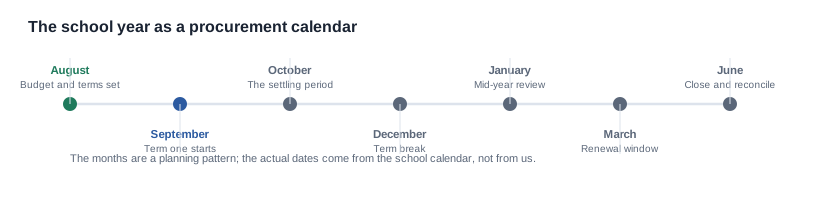
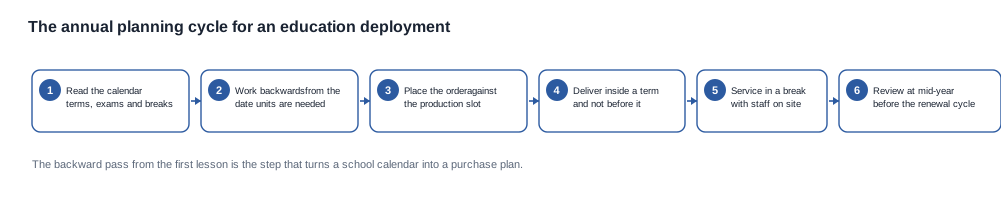
The term start is the only date that really matters, and it moves backwards. For an institution deployment, the date the units have to be in the room is the first lesson of the first term, not the date the order is signed. Working backwards from that date gives the sequence: the documentation file has to be complete before the order can be placed, the order has to be placed early enough for the production slot and the freight, and the delivery has to be scheduled inside the first fortnight of term so that receiving, tagging and the setup briefing all happen while the staff are still in the settling period rather than in the middle of teaching. A buyer who works forward from the order date will arrive at the wrong date every time, because the constraints between the two dates are not evenly distributed.
The settling period is the cheapest pilot window and the most wasted one. In the first weeks of a term, the adults are attentive and the novelty is high, and both of those make a pilot easy to start and easy to judge optimistically. The risk is that the pilot is judged in week two and renewed on that basis. The better use of the settling period is measurement rather than enthusiasm: it is the window in which the setup card is tested, the reminder frequency is agreed, the sizing sample is run across a range of children and the charge routine is established. Those four tasks are much better done in the settling period than in the middle of a term, and they are what the mid-year review will be based on.
The examination period is a blackout, and it should be planned as one. No institutional buyer will welcome a device evaluation during an examination window, and no classroom will give a pilot the attention it needs to produce usable evidence. The examination period is also the period in which the staff who would run the pilot are unavailable. A delivery that lands two weeks before an examination period therefore produces no evidence and consumes the goodwill; a delivery that lands two weeks after one starts with a clean run.
The break is the service window, and the only one there will be. The term break is when a building is quiet, when staff are not teaching, and when a maintenance visit can happen without a class. It is also when the units are away from the children, which makes it the natural moment to inspect, re-tag, count and rotate units. A deployment that treats the break as downtime is wasting the one scheduled opportunity in the year to do the work that the routine depends on.
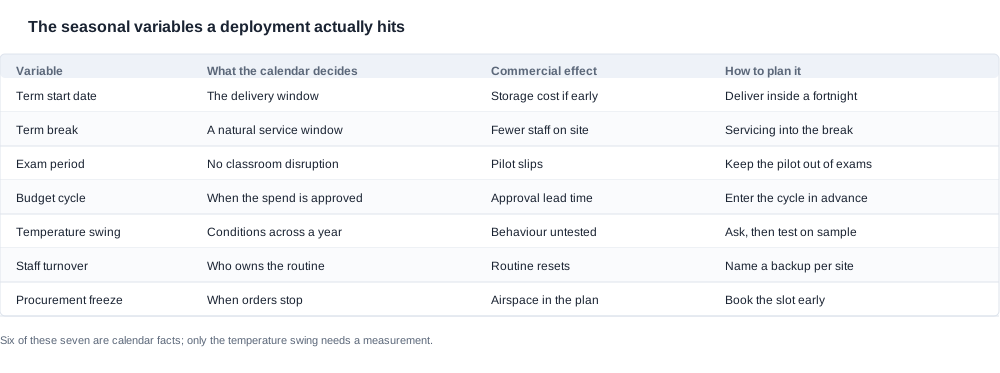

The seasonal variables a deployment actually hits
Seven variables run through the year, and six of them are calendar facts that the buyer already holds. Only one needs a measurement, and it is the one that is easiest to forget because it does not appear on any calendar.
- The temperature swing. No operating temperature range is published for any model in the range, which means the behaviour of these devices in a warm classroom in one part of the year and a cool one in another is not characterised anywhere. This is the one seasonal variable that needs a test, and the test is easy: leave a unit in the environment it will actually be used in, across the range the building reaches, and record the behaviour — whether the cell behaves the same, whether the reminder still fires at the same interval, whether the display or the audio output changes. A buyer who asks for the range and finds that none is published should say so to the school in the deployment note rather than leaving the assumption unstated.
- The staff turnover. The person who owns the charging routine in September is not the person who owns it in January, and the routine is the thing most likely to be lost between them. The seasonal version of the tag and register discipline is therefore a handover item: the register, the routine and the claim sentence have to be handed over at the point when the owner changes, and the handover should be written rather than conversational. A programme that survives a turnover has documented routines; a programme that does not has habits.
- The budget cycle. Institutional budgets are set a long way ahead of the spending, and the cycle in which a buyer enters determines whether the order can be placed at all. Entering the cycle early — with a request that has a model, a quantity and a total cost attached — is materially different from asking for the same thing in the month when the money is already committed. A buyer's request that arrives without a documented basis is harder to approve, and a seasonal plan that does not account for the approval lead time will find that the money exists but the approval does not.
- The procurement freeze. Many institutions stop ordering at the end of a financial period for reasons of administration rather than policy. A freeze that lands on the production slot a buyer wanted turns a seasonal plan into a missed term, and the recovery cost is higher than the cost of booking a different slot in the first place.
- The delivery timing itself. Delivering before term starts has a cost that does not appear on a quotation: the units sit in a room that is not yet in use, the receiving authority may not be in place, and the documentation has to be accepted by somebody before the first lesson. Delivering inside the first fortnight solves all three, and it is a scheduling decision rather than a freight decision.
- The mid-year review window. The point at which the renewal conversation happens is set by the budget cycle rather than by the deployment, so the evidence has to be assembled before the money is discussed rather than during it. A renewal case that reaches the budget meeting without a measured loss rate and a measured reminder acceptance result is a case made of opinion.
- The year-end close. Every programme owes a final count, a final charge check and a final documentation review before the year closes, and this is the one seasonal task that cannot be delegated to the incoming term because the incoming term has its own inventory on day one.
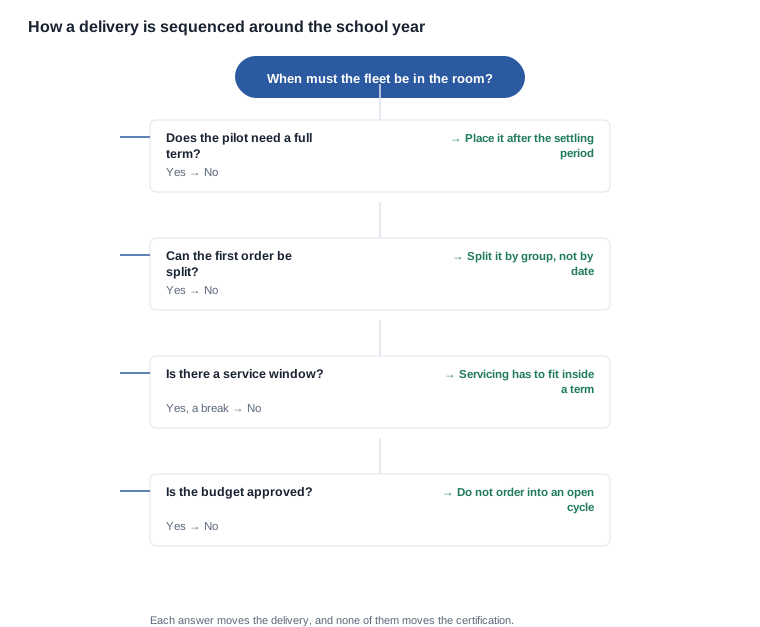

How to place a pilot so that it lands inside a teaching term
The pilot is where a seasonal mistake becomes visible, because a pilot that starts in the wrong month does not merely start badly — it produces no evidence, and the programme then has to restart in the next available window, which may be the following academic year.
The rule that governs placement. A pilot needs a continuous stretch of teaching time long enough to produce evidence about the routine, which means it needs to start early enough in a term and finish before the next examination period. The minimum stretch is set by the evidence you want: a reminder that people switch off in week three needs at least three weeks of continuous use to detect it, and a charging routine needs long enough for the ownership to change hands. A pilot that starts in the last fortnight of a term produces evidence about enthusiasm rather than about the routine.
Splitting the first order is usually the right commercial answer. A first order for a pilot tier, split by group across two dates inside the same settling period, lets the buyer collect the evidence and correct the configuration before the rest of the fleet is ordered. The split is also what makes the second order quotable: the quantities measured in the pilot become the quantities in the rollout, which is a far stronger basis than a forecast.
The evidence the pilot has to produce, and the season it has to be produced in. Four items: the reminder acceptance result, the sizing result across a range of children, the charging routine with a named owner, and the loss rate from at least one count. All four need continuous teaching time to be worth anything, which is why the settling period is the right window and the examination period is not.
What a pilot that ran in the wrong window looks like from the outside. It produces a report. The report contains positive observations from the first fortnight, no measurement of the reminder acceptance because there was no time, no sizing result because the sample was drawn from one class, and no loss rate because the count did not happen. The deployment is then presented as a success on the basis of the positive observations, and the next request is for a larger rollout. What has actually happened is that the organisation has confused an impression with a result, and the first genuinely hard evidence — the false-positive rate, the sizing spread, the loss rate — will arrive after the rollout has already been paid for. Placing the pilot in a window where those four measurements can actually be taken is the cheapest risk reduction available in this category, and it costs nothing but calendar discipline.
The seasonal question of who signs off the pilot. A pilot that ends in the last two weeks of a term is usually signed off by whoever is still available, which is rarely the person who will run it. The result is a sign-off from someone with no evidence and no stake, which is worse than no sign-off because it produces a document that says the deployment was evaluated. The scheduling rule that follows is simple: the evaluation should happen while the people who ran the pilot are still in post, which usually means evaluating in the middle of a term rather than at its end, and reviewing the results at the mid-year point rather than at the year-end one.
The commercial terms that fit a school-year rhythm
The terms a buyer negotiates have a seasonal dimension, and the dimension is mostly about timing rather than about price. A delivery schedule that matches the school year is worth more to an institutional buyer than a small unit-price concession, and it is also easier to agree because it costs the supplier less than the price concession does.
Terms that a school calendar makes negotiable. The delivery split, because the buyer has a real reason to want it and the supplier has a real reason to grant it: splitting the first order reduces the supplier's exposure on a first run and gives the buyer the pilot data. The payment structure, because an institution's money moves on its own cycle and a structure tied to delivery and acceptance rather than to order date is worth negotiating for. The servicing and inspection window, because the term break is the only window in the year when a site visit can happen without disrupting a lesson. And the consumable restock interval, because a term boundary is a natural replenishment point and a quarterly schedule is easier to administer than a monthly one.
Terms that a school calendar makes urgent. The first-lot lead time, because it determines whether a term is reachable. The delivery window, because a slot that ends before term starts is worth less than a slightly later slot. And the position on the documentation file, because a certificate that expires or a standard edition that changes between two deliveries can stop the second one — and the seasonality makes that risk worse, since a programme that spans a long break spans more of a file's life.
Terms that the calendar does not change. The certification cost and its elapsed time follow the test body, not the school year. Tooling is a one-off that is amortised across the first order. The battery transport documentation follows the cell. And the detection behaviour of the A05 and the A06 is a design parameter rather than a seasonal variable, however convenient a season would be.
Where the seasonal argument gets weak. A buyer should be careful not to overreach with the calendar. The year does not shorten a certification lead time, and a supplier that agrees to a delivery date it cannot hold creates a worse failure than a later honest date. The seasonal argument is strongest where it is genuinely about the buyer's situation — a split delivery, a break-window service visit, a payment structure that follows the institution's cash cycle — and weakest where it asks the supplier to move a constraint that is not theirs.
The seasonal risk that comes from the document rather than the hardware. A programme that runs across a long break spans more of a file's life than a programme that runs inside one term, and there are three ways a file decays across a year. A certificate can expire inside the programme, in which case the units on the shelf stop being compliant while the deployment continues. A standard's edition can change, in which case the file was prepared against a superseded edition and a retest becomes necessary. And a document can simply go out of date because the model was changed without the paperwork being reissued — the change-control clause is what catches that one, and a seasonal programme is exactly the kind of programme in which a change happens during a quiet period and nobody notices it happened. The seasonal version of the answer is a review date: put the document review in the same calendar as the mid-year review, so the file is checked at the moment when somebody is already looking at the deployment rather than in a quiet month nobody looks at anything.
The seasonal risk that comes from the people. The staffing change at the end of an academic year is the point at which an undocumented programme becomes an orphan. The charging owner leaves, the register stays in a drawer, the setup card is on the desk of someone who has also left, and the new cohort inherits a set of units with no routine attached to them. The seasonal mitigation is unglamorous and it is the same in every year: the routine, the register and the claim sentence are handed over in writing at the point of the staffing change, and the handover is an item on the closing checklist for the year rather than something that happens if anybody remembers. A deployment that plans for the handover will look slightly over-prepared in the middle of the year, and it will be running in January.
Our position. We publish the rows that let a buyer plan a seasonal programme: the 40 mAh and 70 mAh cells, a charge time of two hours or less, a rated use of about twenty hours, the magnetic charging interface, Bluetooth V5.4 on the A07, and the published functions on the A05 and the A06. We do not publish the operating temperature range, the cycle-life rating, the frame weight, the frame dimensions, the size range, the ingress marking for this tier, the detection parameters or the certification status per model, and we will not estimate them for a seasonal plan any more than for any other plan. We make no vision, health, eye-protection or hearing claim for any product in any market.
What to send us to plan a year
A seasonal plan starts with a document rather than with a quantity, and the document is short: the school calendar, the model, the quantity, and the date the units have to be in the room. Everything else follows from those four items.
What we do with them. We work backwards from the required date, separate the programme into the part that must start now — the document request, the sample test, the artwork approval — and the part that can wait until the file is complete, and we tell you which production slot the order is aiming at and what the realistic delivery window is. Where the calendar cannot be met, we say so and say what would have to change: a different date, a smaller first delivery, or a different scope. Where the programme can meet it comfortably, we will say that too, because a buyer who is told the date is safe can stop planning around it and start planning the pilot.
The three numbers to bring. The date the units have to be in the room, the budget cycle the spend has to land in, and the examination period the deployment has to avoid. Those three are what turn a request into a plan; everything else — the model, the quantity, the markets — is what the plan is built out of.
The lead-time and payment structure are set out at lead time, payment terms and logistics, the seasonal variant of the buying checklist is at education buying checklist, and the annual planning view for this range is at equipment management for retail and education.


