

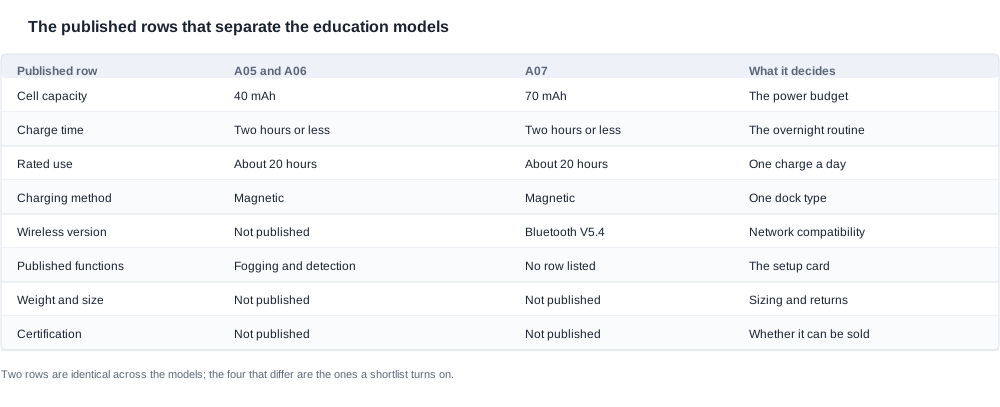
Smart glasses for education come down to one model for most programmes, and the choice between the two published children's protection models cannot be made from the catalogue at all. The A05 and the A06 publish identical rows, so a buyer who compares them on specifications is comparing two copies of the same page and will conclude nothing. The A07 is a different product rather than a better one: it publishes a Bluetooth version and a larger cell, it publishes no detection or fogging rows, and it serves a different lesson. The shortlist therefore usually ends with one model, sometimes two, and the work is not in the comparison but in the disqualification — working out which models cannot serve the use case, and then pricing what each survivor costs in documentation rather than in unit price. This page is written for the buyer who has to make that shortlist and defend it, and it states plainly where the catalogue answers the question and where it does not.
Who this is for. The reader is a product manager, a channel buyer or a brand owner opening a new line in the education channel, who needs a defensible shortlist rather than a ranking. Their position is usually awkward in a specific way: there is a stakeholder who wants the audio model and a stakeholder who wants the reminder functions, the budget supports one model rather than three, and nobody has yet costed the documentation per model — which is the number that actually decides a three-model programme. The failure this page is written to prevent is a shortlist of three models that passes a specification review and stalls in a compliance review. The education channel page sets out the commercial context and the kids smart glasses range lists the models.
Smart glasses for education: the shortlist is one model, and occasionally two
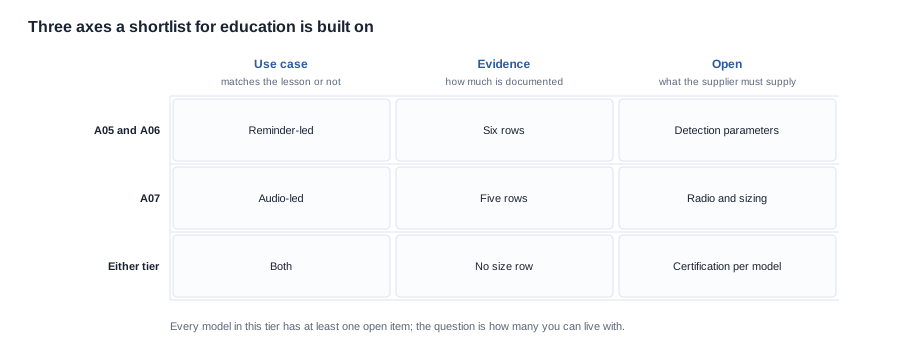
The useful output of a selection exercise is not a ranking of the models in the range; it is a shortlist of one or two models with the function that justifies each one, the rows that are published for it, the rows that remain open, and the per-model document cost. Most education programmes in this category end with exactly one model, because the cost of the conformity file, the labelling set and the artwork does not fall as the order grows and is charged per model and per market. Where two models survive, it is usually because two different lessons are being served by the same fleet rather than because a range is being offered as a range. Everything below is written to get a buyer from three candidate models to that shortlist, and to make the removal of a model defensible rather than arbitrary.

What the A05 and the A06 cannot tell you apart
Two of the three models in this tier publish exactly the same rows. The A05 and the A06 each publish a 40 mAh cell, a charge time of two hours or less, a rated use of about twenty hours, a magnetic charging interface, a lens-based electronic fogging arrangement, and posture and viewing-distance detection. The difference between them is not published anywhere in the catalogue, which means it has to come as a written answer from the supplier, and until it does, the two are interchangeable for every purpose except the SKU count.
Why this matters commercially rather than technically. A buyer who cannot distinguish two models has three options, and only two of them are reasonable. The first is to treat them as one model and pick one, which halves the per-model documentation cost immediately. The second is to carry both and explain the difference in the channel, which is a legitimate commercial strategy but only if the difference is real and describable. The third — carrying both because they look different in a photograph — is the trap, because the difference then has to be described in listing copy that cannot be supported by any published row, and the description is where the claim problem starts. A difference that cannot be stated in a sentence cannot be sold to an institutional buyer either.
The question to ask, and the answer to require. The supplier should state, in one line and in writing, what distinguishes the A05 from the A06 — the mechanical difference, the optical difference, the firmware difference or the simply none. If the answer is that they are the same product under two designations, that is a usable answer, and it is a better one than a sentence that hedges. If the answer involves an optical or firmware difference, that difference is exactly the thing the setup card has to describe and the acceptance inspection has to verify, so it converts directly into two more pieces of work that have to be scheduled. Either way the answer belongs in writing before the artwork is approved.
What the rows do settle for both of them. The magnetic interface means the charging hardware is one fleet-wide object. The rated use of about twenty hours means a single overnight charge covers a teaching day, so the deployment does not need in-day recharge positions. The published functions mean the setup card has content — what the reminder is, what it sounds like, what to do about it — and that content is different from the A07's card, which has no detection function to describe. And the published gaps are the same for both: no weight, no dimensions, no size range, no ingress marking, no certification row, no radio version, no detection parameters.
The A07 is a different product rather than a better one
The A07 publishes a 70 mAh cell, the same charge time of two hours or less, the same rated use of about twenty hours, the same magnetic charging interface, and Bluetooth V5.4. It publishes no fogging arrangement row and no posture or viewing-distance detection row. Read on its own, that makes the A07 the better-specified model: it has a radio version, it has more cell, and it has fewer functions to get wrong.
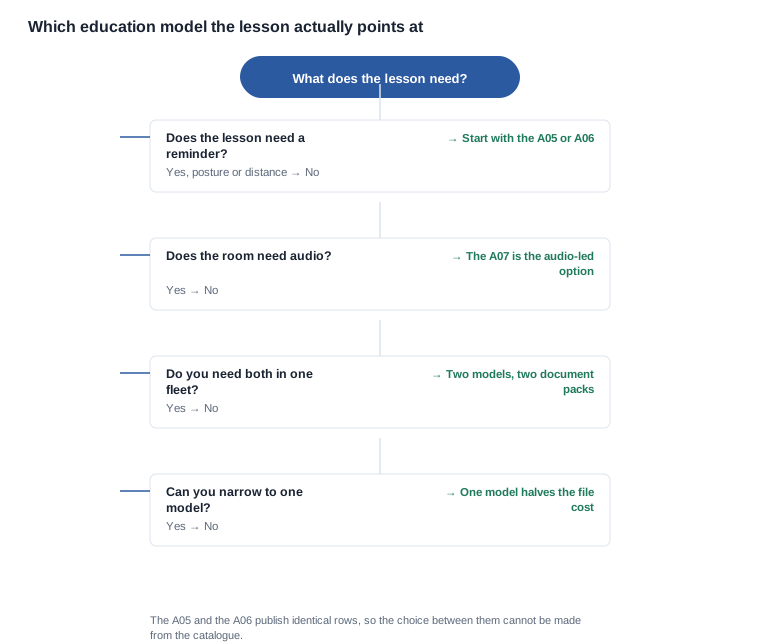
Read in the context of an education channel, it makes the A07 a different product for a different buyer. Its published rows describe an audio device with a long rated use, which is what a language lab, an assisted-listening programme or a school with a heavy in-day schedule needs. Its rows do not describe a device that detects a position and reminds, and that is a deliberate scope rather than a weaker specification. The trade-off a buyer should evaluate is not "more cell against less cell" but "which lesson is this fleet in" — and the answer determines which of the two document packs the buyer has to assemble, because a model with a published detection function needs a setup card, an acceptance criterion for the reminder behaviour and a false-positive measurement, while a model without one needs none of those three.
The A07 and the A05 or A06 are not two tiers of the same thing. Presenting them as a good, better and best ladder is the most common mistake in this channel, and it fails in the institutional sale for a reason that has nothing to do with the product: an education buyer is not buying a better device, they are buying a device that does a specific job, and the job is described by the lesson rather than by the range.
What the audio-led buyer actually needs from a supplier. A buyer specifying the A07 is usually buying for a room where the device is used continuously across a session — a listening exercise, a language task, a guided walk-through — and the questions in that conversation are about the radio, the cell and the charging routine rather than about a reminder. Three of those questions have published answers and two do not. The published ones are the charge time of two hours or less, the rated use of about twenty hours and the magnetic interface, which together are enough to plan an overnight charge and a single dock type. The open ones are the radio version for the other two models and the sizing, neither of which is published. That asymmetry matters in a specific way for a channel buyer: the A07 can be specified and quoted today, whereas a fleet that mixes it with a detection model has to be specified with a written answer on the radio version of the second model before the order can be placed.

The disqualifiers that remove a model before the shortlist exists
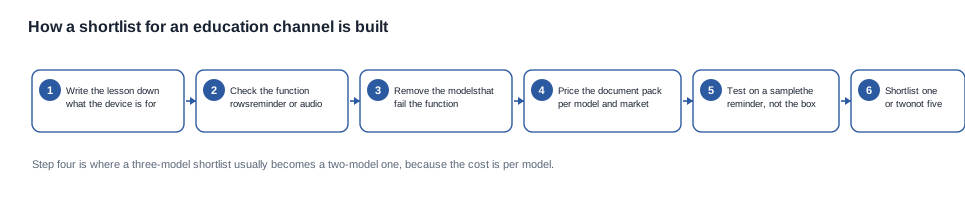
A shortlist built by comparing attributes tends to end up with every model on it, because every model passes every attribute comparison and the differences are all modest. The efficient method is to remove models first. Four disqualifiers do most of the work, and each one is testable before a sample order is placed.
- The function disqualifier. If the deployment needs posture or viewing-distance reminders, the A07 is out, because it publishes no row for either function. If the deployment is audio-led with no reminder requirement, the A05 and the A06 are out on the same logic. This single test removes one model from almost every programme and it costs one line of the use-case brief.
- The document disqualifier. The per-model cost of the conformity file, the claim wording and the market list is a fixed cost per model, and it does not fall when the order is large. A buyer with one market and a tight budget is better served by one model than by three, and this is the point at which a shortlist is usually cut.
- The evidence disqualifier. Any model whose key published row the deployment depends on is a row the supplier has not published is a model whose acceptance cannot be written. The detection parameters on the A05 and the A06 are the clearest example: the function is published by name, so the buyer will be asked about it, and the parameters that would let a buyer test it are not published.
- The compatibility disqualifier. The A07 publishes Bluetooth V5.4 and the other two publish no radio version at all. In a school with an existing managed network, an unpublished radio version is not a detail; it is the difference between a fleet that joins the network and a fleet that does not.
The disqualifier that is not a product question but disqualifies the programme. If the deployment's proposition depends on an eyesight, vision, eye-protection or hearing outcome, no model in this tier should be shortlisted, because none of them publishes a parameter that supports that claim and none of them is a clinical device. That is not a reason to pick a different model within the range; it is a reason to leave the category. A buyer who discovers this after the artwork is printed has paid for the discovery.
The fifth disqualifier is the supply chain's own. A model is not shortlistable if the buyer cannot answer three questions about getting it into a building: what the lead time is for the first lot, what the minimum order quantity is for the configuration, and what the payment structure looks like against an acceptance inspection. These are ordinary commercial questions and they are set out at lead time, minimum order quantity and payment terms, but they disqualify models in a way that is easy to miss because the disqualification is about the programme rather than about the device. A model with a twelve-week first-lot lead time into a school year that starts in September is not a better model, it is a model that misses the year. The practical version of the test is to run the candidate list backwards from the date the fleet has to be in the room, and to remove any model whose lead time does not fit rather than to hope it compresses.

What the model choice does to the rest of the programme
The model decision is cheap and its consequences are not, because each model carries a different set of downstream obligations. Naming them before the shortlist is agreed is what stops a programme from being approved on the unit price and then stopped by a document.
One model means one file, one claim sentence and one setup card. The per-model cost of the conformity file, the labelling set and the artwork does not scale down with volume, so a one-model programme carries one instance of each fixed cost. A three-model programme carries three, and carries the additional obligation of keeping three claims, three manuals and three sets of labels aligned with three sets of published rows.
Two models mean two setup cards and a stock discipline. Where the A05 or the A06 is deployed alongside the A07, the cards differ because the functions differ, and the inventory has to keep the two distinguishable. That is a tag, a bin and a register, and it is more work than the price difference between the two configurations.
The published functions create an acceptance criterion that does not exist for a plain audio device. A model with published detection behaviour needs a stated pass condition for the reminder — what counts as a correct trigger, how quickly it fires, what happens on a repeated trigger — and that criterion has to be written before the shipment because it is the standard a return will be judged against. The catalogue publishes the function name and none of the parameters, so the criterion has to come from the supplier's own test data or from a sample the buyer runs.
The charging fleet is shared, and that is the one place where the models help each other. All three publish a magnetic interface, which means a single dock type serves a mixed fleet and the dock count is not multiplied by the number of models. In a channel where most programmes are single-model, this is a minor benefit; in a distributor's channel, where several education customers with different models share a warehouse, it is a genuine saving and it is worth pricing.
What the shortlist should not be based on. The unit price is not a selection criterion that survives contact with the programme, because the published differences between these models are in function and in documentation rather than in the electronics, and the electronics are the cheap part. Neither is the photograph, the packaging or the presence of a Bluetooth version on the box, because a radio version only matters when the network does. And it is not the number of functions: a fleet with two published functions and no acceptance criteria for either is worse than a fleet with one published function and a written criterion for it.
What a shortlist document looks like, and why it is worth the page. The document that survives an institutional review is short and has six columns: the model designation as published, the function that justifies including it, the rows the catalogue publishes for it, the rows that remain open, the per-model document cost, and the acceptance criterion for anything published as a function. Six columns and one row per surviving model, with the disqualifications and the reason for each one recorded underneath. The reason it works is that it converts a comparison into a position. A reviewer can disagree with a position; a reviewer cannot do much with a ranking, because a ranking invites the question of why the first place was not the second, and that question has no answer in the catalogue.
The document also does something a quotation cannot: it prices the programme honestly. The per-model document cost is the number that a buyer is usually missing, and it changes the answer more often than the unit price does. Three models across two markets is six document sets, six labelling sets, six claim sentences and six acceptance criteria, against a single SKU per model on the shelf. A buyer who has only seen the unit price will read a three-model shortlist as a wider choice; a buyer who has seen the per-model cost will read it as six times the compliance workload for the same electronics. The certification checklist page is where the document side is set out, and procurement pricing is where the commercial side of the same decision sits.
How to get a shortlist you can sign
The output of a selection exercise should be a document with a number in it, not a ranking. A shortlist of one or two models, with the function that justifies each one, the rows that are published for it, the rows that remain open, the per-model document cost and the acceptance criterion for anything published as a function is a document that can be signed and circulated, and it survives a review that a ranking does not.
The five questions that close the gaps in the catalogue. These are worth sending as a list, per model, before a sample order is placed:
- What distinguishes the A05 from the A06, in one line, and can the answer be used in listing copy?
- What are the detection thresholds, the delay and the false-positive rate on the A05 and the A06, and can they be written as an acceptance criterion with a unit?
- What is the frame weight, the frame dimension and the size range, and by what method were they measured?
- What is the certification position per model and per market, with the certificate numbers, the issuing bodies and the validity dates?
- What is the radio version on the A05 and the A06, and is it the same generation as the V5.4 published for the A07?
What to send us. Send the use case in two sentences, the destination markets, the fleet size, and the budget band for the first order, and we will tell you which models the published rows support for that use case, which model we would drop and why, which rows will have to come from a supplier rather than from the catalogue, and where the cost of the programme actually sits. We will also say plainly when the answer is that a model in this range is the wrong answer — the audio model when the lesson needs a reminder, or any model in this tier when the proposition rests on a clinical outcome. The selection logic behind this page is set out in more detail at how to choose smart glasses for education, the model-specific rows are on the A05, A06 and A07 pages, and the comparison of models across the range is at how to compare models.


