

Smart glasses for education selection is a compliance question that has to be answered before it is a product question, and the order matters because the compliance answer can remove models from the shortlist. A school buyer is not asking what the device does; they are asking whether it may lawfully be supplied to children in their market, whether it can be labelled and traced, and whether the school can manage it in a classroom. Our catalogue publishes the electrical rows for every model and it publishes no per-model certification row for any of them, including the three children's models. That is not a gap in the range, it is the actual state of the evidence, and it means the first task in a school file is a request for documents rather than a comparison of specifications. This page is written for the brand product manager, the channel partner and the school-facing buyer building an education line, and it presents the selection as a sequence rather than a shortlist.
Smart glasses for education: a compliance boundary, not a feature list
Who is buying, and what the school will ask first
A school or institutional buyer is running a procurement process, and the first document they ask for is not a specification sheet. It is a set of conformity files that covers the specific model, the specific market and the specific age group. Their exposure is a process that stalls, because the supplier's response is a catalogue page rather than a certificate.
A brand product manager in education is deciding what to put in a school-facing range, and the decision is bounded by what can be evidenced. Their exposure is a range that has to be withdrawn or re-labelled after a school has already bought it, which is the most expensive kind of correction in this category because the packaging is already printed.
A channel partner supplying schools is often the party who has to hold the documents. Their exposure is carrying the compliance risk for a buyer who never sees the factory, and their only protection is a written file that names the model, the market and the batch.
The order of the questions is the same in all three cases. What is the market. What is the age group. What does the device capture. Then, and only then, the electrical rows.
The state of the evidence, stated plainly
The catalogue carries a company-level certification page with a set of appearance-design patent certificate images on it. The text of the range carries no conformity mark of any kind, and it carries no per-model row that would let a reader conclude that a particular model is certified for a particular market. There is also no unit weight for any of the three children's models, and no ingress marking on any of them.
That means four separate requests have to go to the factory before an education tender can be answered, and a buyer who expects the catalogue to settle them will discover the gap late. The first is the children's product conformity evidence for the destination market — the European framework runs through EN 71 and the US framework through ASTM F963 and the consumer product rules, and a buyer has to know which framework the school file will be written against. The second is the chemical compliance file covering the materials that a child will touch. The third is the market-access file for the destination, including the declarations, the traceability information and the market-surveillance contact that has to appear on the packaging. The fourth is the per-model weight, which is the row a school asks about for a seven-year-old and which the range does not carry.
The supporting material for the legal side of an education deployment is at education legal considerations, and the model-level shortlist that follows these decisions is at education product recommendations.
The three children's models, and the rows a school can rely on
What the A05, the A06 and the A07 publish
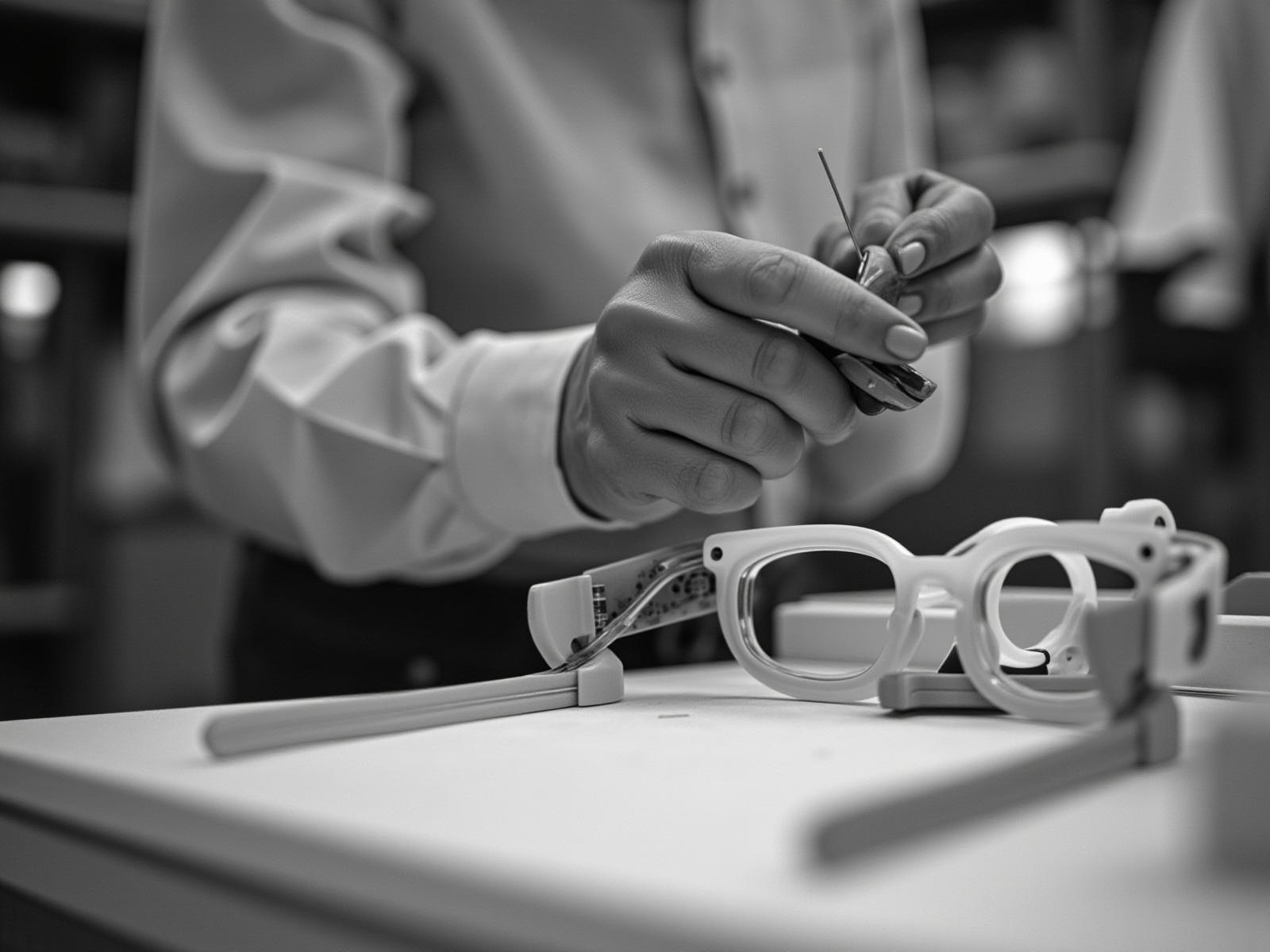
The table at the top of this page is the working version. Three models in the catalogue are published as children's devices. The A05 and the A06 carry a 40 mAh cell, publish a runtime of about 20 hours, charge magnetically in two hours or less, and publish no Bluetooth version. The A07 carries a 70 mAh cell, publishes the same runtime band and the same magnetic charge time, and publishes Bluetooth 5.4. None of the three publishes an ingress marking, so none of them can carry a rain or splash claim in school material, and none of them publishes a weight.
The 70 mAh figure on the A07 is worth one line of care, because there is another 70 mAh in the range with a different structure. The A07 is a single 70 mAh cell. The YKC02 sport model is 70 mAh across two cells. The catalogue publishes the cell figure and the cell count separately, and a school specification that merges them into a single number has converted a derived figure into an apparent catalogue claim. It matters here more than in most categories, because the same specification is often reused for an adult comparison model in the same programme.
The runtime band is the row that makes these devices practical for a school, and it is much larger than the camera models' bands. Around 20 hours on a magnetic charge means a shared classroom set can be issued for a week on one charge, with a charging tray returning the units at the end of the week rather than every evening. That is a genuinely different operating model from a camera model at around seven hours, which needs a nightly tray cycle and a named person in charge of it. The decision about which family to put in the school file is therefore partly a decision about the school's charging discipline.
Where the camera models change the question
Eleven camera models in the range publish a resolution class — eight models at eight megapixels, and the S7 and the L1 Pro, and the L2 Utral at thirteen. For an education deployment, a camera changes the question rather than adding a feature, because a device that captures in a classroom creates images of children, and the school will have a data-protection position to answer before it has a specification question.
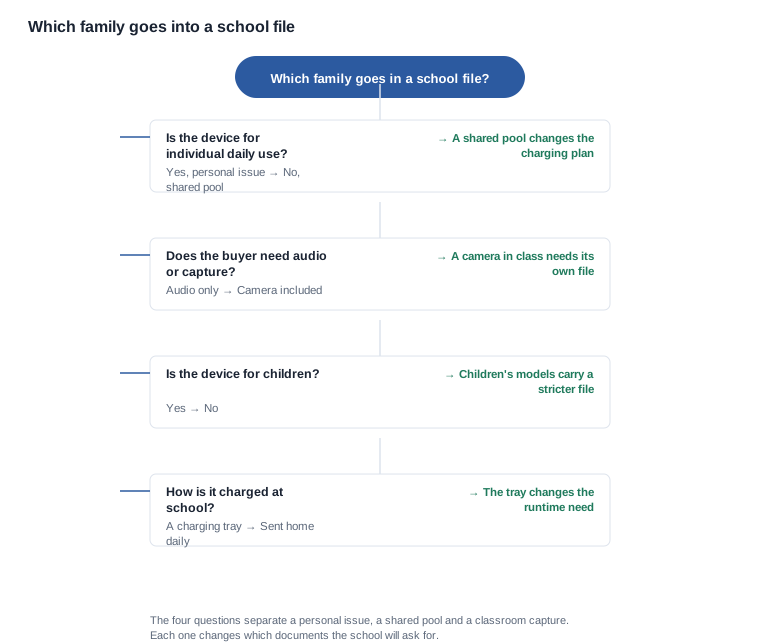
The decision tree below is the way through this. It separates a personal issue from a shared pool, audio from capture, children from adults, and a charging tray from a daily send-home, and each answer changes which documents the school will ask for.
Two of the camera rows are relevant to a school file specifically. The S7 is one of only two models in the entire range carrying an IP54 ingress marking, and the other is the V06, which means a camera option for a school does exist with a documented marking — although the marking covers splashing water and a dust protection level rather than immersion, and no test report behind it is published. The second row is the transport question: a school set that includes a charging case is carrying a second lithium item, and the transport documentation has to cover it.
What the school administers once the devices arrive
The selection decides which model goes into the file, and the file decides which model arrives in a box. What arrives is administered by people who were not in the procurement conversation, and the terms of that administration are worth settling before the order rather than discovering them in week one.
The charging arrangement is a tray, not a charger. A school set is a shared pool, and the pool's cycle is set by the runtime band rather than by the charging method. On the three children's models, with a published runtime of around 20 hours on a magnetic charge, a weekly cycle works: the tray sits in a cupboard, the units return to it at the end of the week, and the tray itself runs on the building's supply. On the camera models, with a band of around seven hours or a 5 to 8 hour range, the cycle has to be nightly, which means a named member of staff, a daily count and a location where the tray is not accessible to students. The catalogue's charge time of two hours or less means the tray itself is never the constraint; the discipline around it is.
The device-to-child assignment is a policy, not a feature. For a personally issued set, the school has to decide how a unit is identified, how it is returned, what happens when it is not returned, and whether the unit carries the child's name in any way the packaging makes possible. For a shared pool, the equivalent policy is the daily count against a checkout list. Neither policy is a technical question, and both are easier to settle in the contract than in the term.
The labelling is compliance content. Traceable supplier identification, the model designation, the batch or lot identification, the market-surveillance contact and the safety information are all packaging content, not marketing content. A school file that specifies the models should specify the labelling as well, because the packaging is printed once and a correction after printing is a reprint.
The lithium in the set needs a disposal position. Every unit in a school set is a lithium item, and a set that includes a charging case contains more than one cell per case. Schools and their facilities contractors will ask where the batteries go at the end of the set's life and who moves them. That is a transport and end-of-life question rather than a product question, but it attaches to the order and it is easier to answer with a written position than with an assurance.

How to answer a school file
Closing an education selection
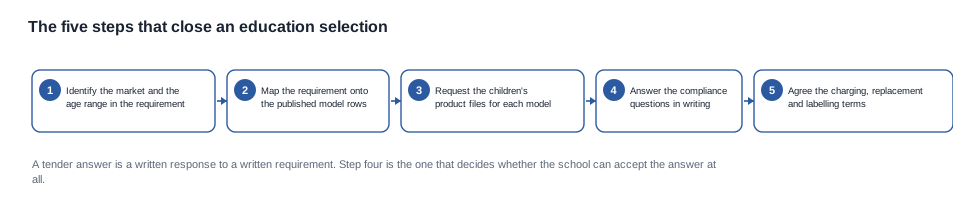
- Identify the requirement. Write down the market, the age range, whether the device is personally issued or shared, and whether it captures. The completion standard is a written requirement sheet, because a school tender cannot be answered against a product description.
- Map it to the rows. Match the requirement to the published rows and note, model by model, what the catalogue does not carry. The completion standard is a shortlist in which each model has its published rows and its named gaps.
- Request the files. Ask for the children's product conformity evidence per model, the chemical compliance file, the market-access file for each destination, and the per-model weight. The completion standard is a written answer per item, with the model named on each.
- Answer the compliance questions in writing. Where the answer is a boundary rather than a file — a medical or vision benefit claim, a wet-weather claim, a weight statement — say so in writing, in the language the school will read. The completion standard is a written statement that no prohibited claim appears in the school-facing material.
- Agree the operating terms. Settle the charging arrangement, the replacement and loan terms for a shared pool, the labelling and traceability content, and the delivery slot that lands before the term starts. The completion standard is an agreed schedule with a named owner at the school.
The compliance gate, run before the tender is answered
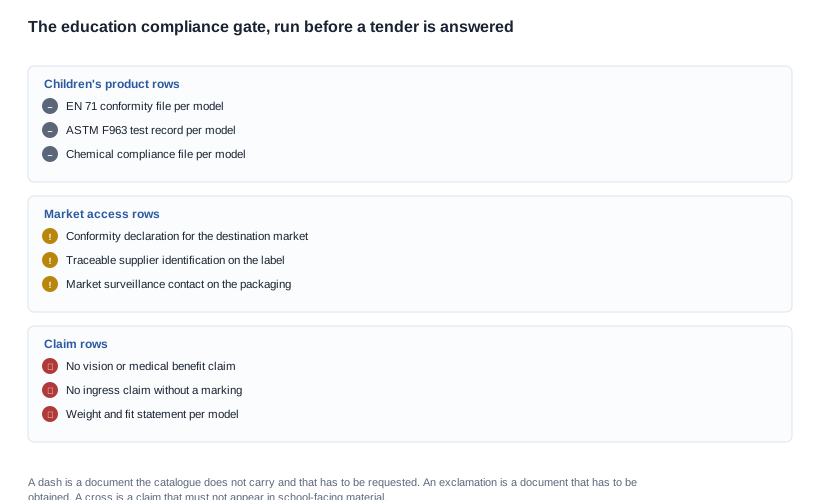
Three groups, and the third is the one most lists get wrong. The children's product rows are the files the school will ask for and the catalogue does not carry; they are the request list and they sit on the critical path. The market access rows are the declarations, the traceability information and the packaging contact, which are per destination rather than per model and therefore multiply with the number of markets in the programme.
The claim rows are the prohibited lines. No vision or medical benefit claim may appear in school-facing material: the regulatory position on medical devices is a hard boundary in this category, and a catalogue name that includes the word "protective" must not be turned into a claim about preventing myopia or treating vision. No ingress claim may appear without a marking behind it, and no children's model in the range carries one. No weight or fit statement may appear for a model whose weight has not been returned, which is currently every children's model in the range.
The school-facing material around these decisions is set out at education template, and the scenario entry point is education.
Where the evidence has to land in the school calendar
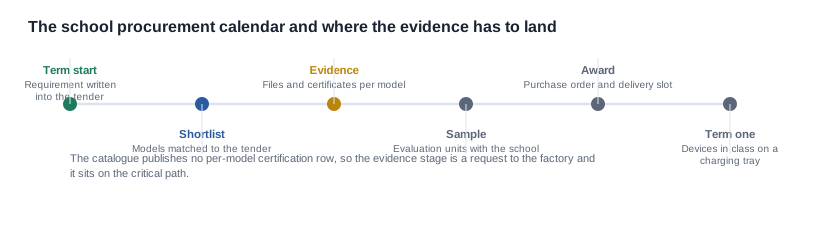
School procurement runs on a calendar the supplier does not control, and the evidence stage is the part that gets missed because it depends on a third party. A requirement written into a tender at the start of a term is usually answered within weeks, and the conformity files for a model that has never been put through that framework take considerably longer than a written answer from the factory. A buyer who treats the documentation as a formality discovers the critical path at the wrong end of it.
Two practical consequences follow. First, request the children's product files for the models under consideration before the shortlist is narrowed, not after, so that the shortlist is not built on a model whose file will not arrive in time. Second, keep a second model on the list whose file is already in hand — for most programmes that is a model the factory has already documented for that market, and asking which models those are is the single most valuable question in the first email.

Where education selections fail
The catalogue was treated as the compliance file. The symptom is a school that receives the product and asks for documents the supplier cannot produce. The root cause is that the range's company-level certification page was read as a per-model statement. Prevention is the request list, issued at the start.
A vision claim entered the school material. The symptom is material withdrawn from a school after review. The root cause is that a catalogue name containing "protective" was turned into a benefit statement. Prevention is the written boundary in step four and the claim row in the gate.
A weight was quoted for a children's model. The symptom is a fit or comfort complaint that has no catalogue basis to answer. The root cause is that the range publishes one weight and it belongs to a camera model. Prevention is to publish only a returned figure.
The charging plan assumed a nightly tray. The symptom is a classroom set that runs flat mid-morning. The root cause is that the camera models' runtime band and the children's models' band are two different operating models and only one of them was planned for. Prevention is to choose the family first and size the tray cycle to it.
The camera question was answered by the specification. The symptom is a data-protection objection at the school, raised after the order. The root cause is that capture in a classroom was treated as a feature rather than as a compliance question. Prevention is to put it in step one.
The evidence missed the term calendar. The symptom is a delivery that lands after the school has already started. The root cause is that the documentation stage was planned as a formality on a supplier-controlled schedule rather than on the school's calendar. Prevention is to request early and to keep a documented model on the shortlist.
| Education failure | Root cause | Preventive action |
|---|---|---|
| School asks for documents that do not exist | Company page read as a per-model file | Issue the request list at the start |
| School material withdrawn after review | Catalogue name turned into a claim | Written boundary in step four |
| Weight quoted with no catalogue basis | One published weight, on a camera model | Publish only returned figures |
| Set runs flat mid-morning | Nightly tray assumed for both families | Choose the family, then size the cycle |
| Data objection raised after the order | Capture treated as a feature | Put it in step one |
| Delivery lands after term starts | Evidence planned off the supplier schedule | Request early, keep a documented model ready |
What we publish about education selection, and what we will not claim
Concretely, an education selection is a compliance exercise with a product decision inside it, and the honest position is to publish the electrical rows and to say plainly which documents the catalogue does not carry. We publish the cell configuration, the runtime band, the charge time, the charging method and the Bluetooth version where the catalogue has them — so the A05 and the A06 at 40 mAh and about 20 hours with a magnetic charge, and the A07 at 70 mAh and about 20 hours with a magnetic charge and Bluetooth 5.4. We publish the charging-case row and capacity for the camera models, and we publish the IP54 ingress marking on the V06 and the S7 as a catalogue attribute.
What we will not do is publish a certification status, a conformity file reference or a test report for any model, because the catalogue carries no per-model certification row and the text of the range contains no conformity mark. We will not publish a children's product conformity claim for the A05, the A06 or the A07, and we will not present the catalogue's company-level certification page as evidence that any model is certified for a market. We will not publish a weight for any children's model, an ingress claim for a model that does not carry a marking, a Bluetooth version for a model whose row is absent, or a vision, medical or myopia-prevention benefit for any product.
What we will do is take the market, the age range, the issue model, whether the device captures, the volume and the school calendar, and tell you which published rows apply, which documents have to be requested, which claims have to stay out of the school-facing material, and which model in the range already has documents for that market. The scenario entry point is education.
What to send us next. Send the destination market, the age range, the number of units, whether the device is personally issued or shared, whether it captures, and the date the school needs delivery. We will return the compliance request list, the published rows for each shortlisted model, the claims to keep out of the material, and the operating terms worth putting in the quote.
Related reading
- The model shortlist — education product recommendations
- The legal framing — education legal considerations
- The school-facing material — education template
- Where this scenario begins — education
Tell us the market, the age range and the school calendar, and we will tell you which documents have to be requested and which claims have to stay out of the material.


