

Smart glasses for education have two kinds of safety question, and confusing them is the most expensive mistake in this channel. One is the question of whether the product is safe: what it is made of, whether a small part can be released, what happens when it is charged unattended, whether it can be used near water. The other is the question of whether anything may be said about it: whether a device that detects a viewing distance may be described as protecting a child's eyesight. The first question is answered by documents and by tests that a buyer can commission. The second is answered by a boundary that no document moves. For the three models in the children's tier, the honest position is that the published specification settles very little of the first question and none of the second, and that the entire safety case has to be assembled from the supplier and from sample testing before the first shipment. This page sets out which safety attributes are published, which are open, and who has to close each one.
Who this is for. The reader is a procurement officer, a quality manager or a brand manager who has to sign an acceptance criterion for a product that will be used by children in a building they do not control. Their accountability is specific: if a unit fails a safety requirement, they will be asked which document said it was acceptable, and the honest answer is usually that no document said anything. The failure this page is written to prevent is a programme that passes a specification review and then meets a safety review — from a school, a district, a retailer or a marketplace — with nothing behind it. The education channel page covers the commercial context, and the kids smart glasses range lists the three models in this tier.
Smart glasses for education: the failure it prevents in a safety claim
The first safety question is whether the product is safe — what it is made of, whether a part can be released, what happens when it is charged unattended, whether it belongs near water. The second is whether anything may be said about it — whether a device that detects a viewing distance may be described as protecting a child's eyesight. The first is answered by documents and by tests a buyer can commission; the second is answered by a boundary that no document moves. For the three models in the children's tier the published specification settles very little of the first question and none of the second, which means the safety case has to be assembled from the supplier and from sample testing before the first shipment rather than after the first review.
What is actually published about the safety of these models
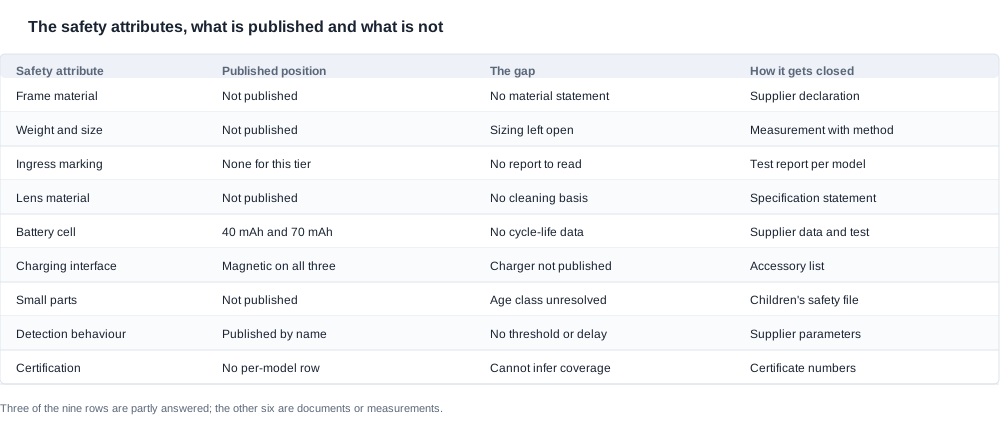
The catalogue publishes a good deal about the electrical design of these models and very little about their safety characteristics. That split is worth stating precisely, because a buyer who reads the published rows and concludes the safety file exists has mistaken a specification for a conformity assessment.
What is published. The A05 and the A06 publish a 40 mAh cell, a charge time of two hours or less, a rated use of about twenty hours, a magnetic charging interface, a lens-based electronic fogging arrangement, and posture and viewing-distance detection. The A07 publishes a 70 mAh cell, the same charge time, the same rated use, the same magnetic interface and Bluetooth V5.4. Those rows describe a device: how it is powered, how it is replenished, how long it runs, and what two of the three models are for. They are enough to design a charging routine and to write a setup instruction.
What is not published, safety-wise. The frame material is not published for any of the three. The frame weight, the frame dimensions and the size range are not published, which means the sizing question that determines whether a child can use the device safely is answered by nobody in advance. The ingress marking is not published for these three models; the IP54 marking in the catalogue appears on the V06 and the S7 only, and no third-party test report is published behind that marking, so it cannot be carried across. The lens material and the coating are not published, so no cleaning instruction can be permissive. There is no cycle-life rating and no ageing data for the cells, no operating temperature range, and no statement about whether the magnetic charger is supplied, what it is rated at, or what happens when a unit is left on a dock overnight. And the certification position per model is not published: the catalogue carries a company-level export certification page whose content is images rather than text, contains no reference to CE, FCC or RoHS, and has no per-model certification row anywhere.
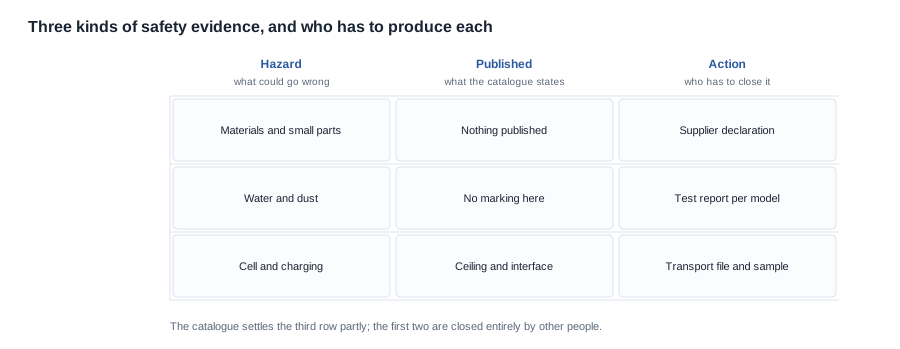
Why the absence of a published ingress marking matters more here than elsewhere. A device used by a child in a classroom is exposed to water from a drink, from a hand that has just been washed, and from cleaning routines. "Not published" is not "not rated" and it is not "waterproof" — it means the buyer has no document either way. The consequence is a rule that is easy to state and expensive to get wrong: until a test report exists for the exact model, no material may suggest water resistance, and the training material has to say so plainly rather than leaving a silence that a reader fills in optimistically.
The one published weight in the whole catalogue is not in this tier. The catalogue publishes 158 g for the MT6 glasses body, excluding its foldable case. That figure is a camera model and it belongs to no children's model, so it cannot be used as a reference point for this tier, and a listing or a specification sheet that reaches for it is borrowing a number from a different product. The same discipline applies to every other row that exists elsewhere in the range: the published Bluetooth V5.4 on the A07 says nothing about the radio in the A05 or the A06, and the published cell capacities on the camera models say nothing about this tier's charging behaviour.
Why the borrowed number is the most dangerous one. A figure pulled from another model in the same catalogue is harder to catch than an invented one, because it is real, it is ours, and it is about a smart glasses product. A specification sheet that quotes 158 g for a children's model passes a casual review, survives a supplier's own catalogue check and is still wrong in the way that matters, because the number was measured on a camera model with a different battery and a different frame. The same applies to the IP54 marking on the V06 and the S7 and to the cell capacities published on the camera models. The rule that prevents all of these is short: every number in an education specification sheet has to carry the model designation it belongs to, and a number without one does not go in the document.
The five safety questions an institutional buyer will ask
Institutional buyers ask the same five questions in a different order from a retailer, and the order tells you how to prepare. The retailer asks what it costs and what it does. The institution asks, in this sequence:
- Who is responsible for it. In every destination market there is a named party responsible for the product's conformity, and it is either the importer, the brand or the manufacturer. A buyer who has not established which one is them is the party by default, and the answer has to appear on the paperwork and in the purchase order.
- What happens when it fails. This is the acceptance question, and in a tier where the detection functions are published by name and the parameters behind them are not, it is the hardest of the five to answer well. What is a defect? Is a unit that will not charge a defect, a sizing problem or a handling problem? What is the pass condition for the reminder behaviour? Without written criteria, each return becomes a negotiation and each negotiation becomes a precedent.
- What it is made of. The frame material, the lens material and the surface treatment are not published, which means the answer is a supplier declaration rather than a catalogue row. This is where the children's product frameworks bite hardest: the frameworks applicable in Europe include EN 71, and in the United States ASTM F963 and the Consumer Product Safety Improvement Act apply, and these are separate from radio approval and separate from CE marking. A product derived from an adult platform does not inherit the adult product's file.
- How it is proven. A certificate number, an issuing body, a standard name with its edition and a validity date, per model designation, and then a lookup in the issuing body's public register. A number that cannot be found is not a certificate, and this check takes minutes and catches the most common real defect in a file — a certificate that belongs to a different product in the same family.
- What may be said about it. The answer is bounded and it does not change with the market. A device that detects a posture or a viewing distance and issues a reminder may be described as doing that. It may not be described as protecting eyesight, improving vision, preventing myopia or supporting hearing, because no published parameter relates to those outcomes and because such a description would place it inside a clinical framework it was not built for. In the United States the marker for that framework is 21 CFR 800.30.
The order matters for a practical reason. The first and third questions have answers that are documents with an elapsed time, and the fourth is a check that depends on the third. So the file work runs first even though the acceptance criteria are what the buyer is asked for most often. A buyer who answers the acceptance question in week one and the document question in week eight has produced criteria that cannot be evidenced, which is worse than producing them late.
How the safety gaps get closed
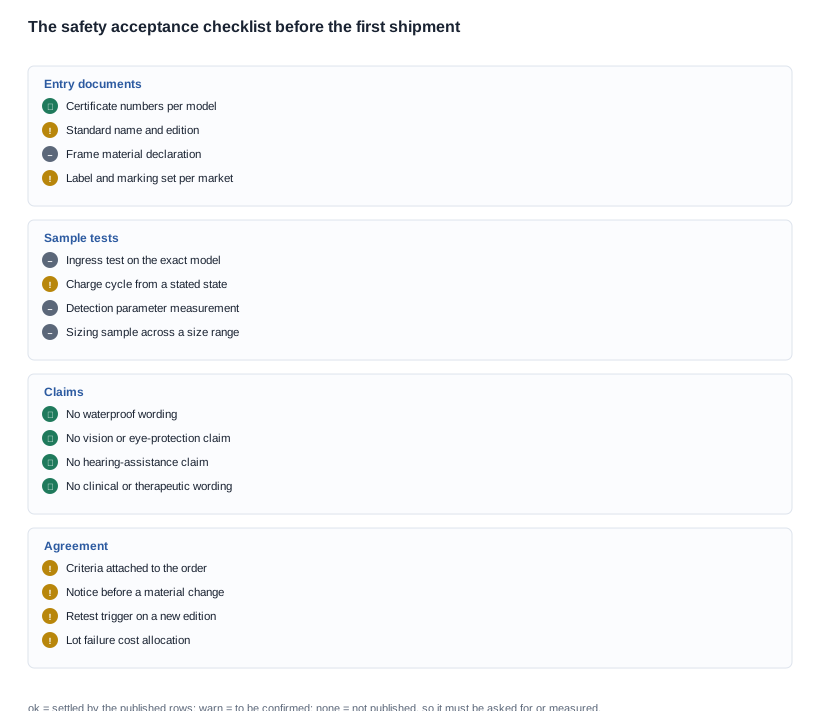
Six steps turn an open safety question into a purchase standard. The order matters more than the content, because two of the six are long-lead activities that cannot be compressed at the end of a programme.

Step one is the classification, and it sets the size of everything after it. Establish, per destination market, which frameworks apply to a product of this type sold for use by children, and whether the intended age range brings it into the toys regime. Two of the three models are named as protection glasses for children in the catalogue, and the age classification is not published for them, so it has to be asked rather than assumed. The answer determines the document set, the labelling set, the elapsed time and the cost, and it is the step most often skipped because it feels like a formality.
Step two is the document request, per model. Standard name with edition, certificate number, issuing body, validity dates, frame material declaration, lens and coating statement, charger specification, and the battery transport file for the fitted cell. The transport file is a separate regime from the toy safety file and follows the model wherever it goes, and the requirements are set out at battery transport.
Step three is the parameter request, with units and conditions. For the A05 and the A06: the detection threshold, the delay, the behaviour on a repeated trigger, the alert format and the false-positive rate. For all three: the charger rating, the charging temperature range, the cycle-life expectation and the operating temperature range. A threshold expressed as a number with a unit can be tested on a sample and written into an acceptance criterion; a threshold expressed as a quality cannot be tested at all.
Step four is the sample test, which is the only step the buyer fully controls. On a sample of the exact model and configuration, measure what has to be measured: the charge cycle from a stated state of charge to a stated end condition, the behaviour on repeated reminders in a real room, the sizing across a range of children's head sizes with the measurement method recorded, and the surface behaviour under the cleaning routine that will actually be used. The cost is a unit and a week; the output is a set of numbers that a supplier cannot dispute because the buyer produced them.
Step five is the acceptance criteria, written as numbers with methods. This is where a safety argument becomes a purchase standard. A criterion that names the test, the condition, the number and the pass mark can be applied by an incoming inspection inspector. A criterion that says "safe" or "meets the standard" can be applied by anybody, which means it settles nothing.
Step six is putting the criteria in the order, attached to the lot. Criteria that live in an email are not binding; criteria attached to a purchase order and to an acceptance inspection are. The clause language is at contract terms, and the incoming-inspection side is covered by quality consistency.
Where a safety claim outruns the documentation
Three claims cause the trouble in this category, and each has a specific fix rather than a warning.
A waterproof claim. The catalogue publishes an IP54 marking on the V06 and the S7, with no third-party test report published behind it, and publishes no ingress marking at all for the three models in the children's tier. The marking, where it exists, covers splashing water and a dust protection level; it does not cover immersion or a sustained downpour, and it does not exist for this tier. The fix is to describe water exposure as a limitation in the training material and to say nothing about water resistance in the listing.
A safety or protection claim on the box. The English product name of the two detection models uses the word protection, and that word has to be handled carefully: it describes the product category in the catalogue, it does not describe a certified safety performance, and it does not describe a clinical outcome. The fix is to keep the name as the catalogue states it and to keep the claim sentence separate and narrow — the device detects a posture or a viewing distance and it reminds.
A durable or rugged claim. No impact rating, no drop rating, no scratch-resistance claim and no cycle-life rating is published for these models, so any such claim has nothing behind it. The fix is to drop it and to buy the protection instead: a solvent-free cloth per unit, a contact sachet per unit, and a storage tray per group, which are the three items that actually reduce the returns a durability claim would otherwise be asked for.
An unattended-charging claim. This is the fourth claim, and it is the one most often implied without ever being written. Nothing is published about the charger that comes with these models, about the charging temperature range, about what happens when a unit is left on a dock for a long period, or about whether the magnetic contact is safe to leave engaged overnight in a classroom where a teacher has locked the room. A published charge time of two hours or less says nothing about the behaviour of a unit that has been on a dock for twelve hours, and it carries no starting state of charge and no termination criterion. The fix is not to make a claim but to write a rule: the units go on charge at the end of the day, they come off in the morning, and the class does not charge a unit left in a tray during a break. That rule is a school policy rather than a product specification, and writing it costs nothing.
The general form of all four. In each case the claim outruns the documentation because the documentation is thin in a particular direction: water, robustness, clinical effect and thermal behaviour are all unstated, and all four are the sort of thing a listing reaches for because they are the words customers search on. The remedy is the same in every case — replace the claim with the instruction. A solvent-free cloth instruction reduces returns more reliably than a scratch-resistance claim, a charge-and-overnight rule removes the question entirely, and a narrow claim sentence protects the listing without reducing demand.
What we publish about safety, and what we will not claim
Here, we publish the rows a buyer can verify and we do not fill the safety gaps with typical values, and we would rather a buyer knows which questions we cannot answer than discovers them in a school's safety review.
What we publish for this tier: the cell capacities of 40 mAh and 70 mAh, the charge time of two hours or less, the rated use of about twenty hours, the magnetic charging interface, Bluetooth V5.4 on the A07, and the published functions on the A05 and the A06 — a lens-based electronic fogging arrangement and posture and viewing-distance detection, named without parameters. What we do not publish and will not estimate: the frame material, the frame weight, the frame dimensions, the size range, the ingress marking for this tier, the lens material, the coating, the cycle-life rating, the operating temperature range, the charger specification, the detection thresholds, the delays, the false-positive rate, the alert format, and the certification status per model. We will not state that any model in our range is certified to CE, FCC, RoHS or any other regime, because the catalogue text contains no such reference and there is no per-model certification row. And we make no vision, health, eye-protection, hearing-assistance or clinical claim for any product in any market.
What we will do is tell you which safety rows our published specification already answers, which have to come from a supplier document, and which have to be measured on a sample by the buyer. Send us the models, the destination markets, the intended age range and the deployment context, and we will say which of the six steps above is already closed for you, which is on the critical path, and where the answer is that the deployment should not go ahead until it is. The children's product framework is at child product, the boundary on clinical claims is at medical boundary, and the requirement to keep records current is at children's product compliance record keeping.


