

Smart glasses for education do not need a template because a deployment is complicated. They need one because a deployment is decided in a dozen separate conversations that never end up in the same place, and because the questions that are answered in the first week are the ones that determine whether the programme is still running in the second year. A template for an education deployment is not a form. It is the acceptance record, the kit list, the claim position and the measurement plan in one document, and its purpose is to make sure that the unit price is not the only thing that survives from the quotation to the review. This page sets out the nine sections of the template, what each section holds, who fills it and what "complete" means for each one, and then it sets out the order in which they have to be filled and the milestones the document has to survive.
Who this is for. The reader is a procurement officer, a brand manager or a channel buyer who has to deploy into a school, a training centre or an education retail programme and who has to leave behind something a colleague can pick up. The failure this template is designed to prevent is specific: the deployment runs on what the first person knew, that person leaves, and the replacement inherits a fleet of devices with no claim position, no kit list, no acceptance criteria and no record of what the devices were supposed to do. The education channel page covers the commercial context, and the kids smart glasses range lists the three models the template's device section has to cover.
Smart glasses for education: the header fields that set the scope
A deployment template is not a form. The first section is short and it is the section that stops everything else from drifting. Nine header fields, none of them a blank cell:
- The model designation as published, so that every later section refers to the same string the units carry.
- The quantity, split between the units in simultaneous use and the spare units, because those two numbers have different purposes.
- The destination markets, which decide the document set and therefore the elapsed time.
- The date the units have to be in the room, which is the constraint the whole plan works backwards from.
- The date the budget cycle closes, which decides when the request has to enter the approval process.
- The number of sites, which turns one kit list into several and tells you whether the register and the routine are per site or per fleet.
- The customer type, which decides which set of requirements the sections that follow have to satisfy.
- The language of every printed resource, per market, which is a production input and not a translation afterthought.
- The name of the person who owns the document, which is the field that makes the template survive a handover.
Why the model designation has to be the published string. The A05, the A06 and the A07 are three separate models, and the A05 and the A06 publish identical rows, which makes them easy to conflate and dangerous to conflate in a document. The designation string that appears in the template has to be the string on the unit, the string in the purchase order and the string that the documents name, character for character, because that string is what connects a physical object to the paperwork that covers it. A template that says "the kids model" in one section and a designation in another has already lost the argument it was built to settle.
Why the dates are in the header rather than in a schedule. A date that lives in a schedule is a date that can be moved without anybody noticing that the programme moved with it. Putting the required-in-the-room date and the budget cycle date in the header turns the calendar into a constraint on the whole document: the delivery plan, the certification sequence, the artwork rounds and the pilot window all have to fit between them, and the first thing a reviewer checks is whether they can. The number of sites matters for the same reason — it is what turns one kit list into several, and it is what tells you whether the register and the routine are per site or per fleet.
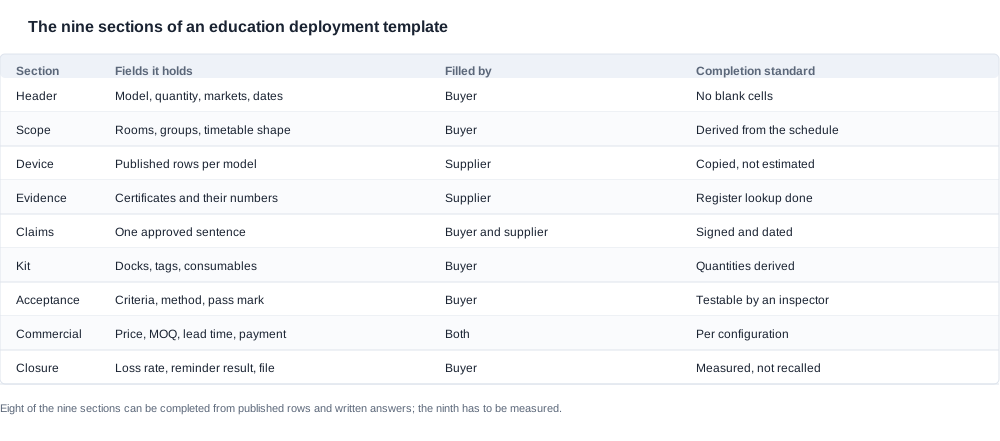
The customer type field is the one most often left out and the one that changes the most. A parent, a school, a district and a retail programme are four different customers with four different sets of requirements, and the same model goes to all four. A parent's requirement is largely about the claim and the support route; a school's is about the setup, the routine and the file; a district's is about the document set and the acceptance criteria; a retail programme's is about the listing, the pack contents and the bill of materials. Recording the customer type in the header means the sections that follow can be filled for one kind of customer rather than for all four at once.

The evidence fields and their completion standard
The evidence section is where the template does the work that a specification sheet cannot, because it separates what is published from what is claimed.
The device fields are copied, never estimated. The A05 and the A06 publish a 40 mAh cell, a charge time of two hours or less, a rated use of about twenty hours, a magnetic charging interface, a lens-based electronic fogging arrangement, and posture and viewing-distance detection. The A07 publishes a 70 mAh cell, the same charge time, the same rated use, the same magnetic interface and Bluetooth V5.4. Those rows are copied into the template with the model designation beside them, and the completion standard is a copy rather than a paraphrase, because a paraphrase is where a ceiling becomes a typical value and where "two hours or less" becomes "two hours".
The gap fields are mandatory, and a gap is not a failure. The frame weight, the frame dimensions, the size range, the ingress marking for this tier, the lens material, the coating, the operating temperature range, the cycle-life rating, the detection thresholds, the delays, the false-positive rate, the alert format, the radio version for the A05 and the A06, and the certification status per model are all not published. Each one appears in the template as a named gap with the route to close it — a supplier document, a sample test, or a buyer's own measurement — and the completion standard is that every gap has a route and an owner. A gap with a route is a task; a gap filled with a typical value is a defect waiting to be found.
The certificate fields are verified, not filed. A certificate number, an issuing body, a standard name with its edition, a validity date and the model designations it covers, each looked up in the issuing body's public register. The catalogue carries a company-level export certification page whose content is images rather than text, contains no reference to CE, FCC or RoHS, and has no per-model certification row anywhere, so a file that is merely filed is a file that has never been checked. The completion standard for this field is a completed lookup, and the check takes minutes.
The claim field is one sentence and it is signed. One line that says what the device does — for the two models with published detection functions, that it detects a posture or a viewing distance and it reminds — signed by the person who owns the listing and by the person who will answer a school's legal team, and dated against the artwork version it governs. Nothing about eyesight, vision, eye protection or hearing appears in that sentence, because no published row supports one and because such a statement would place the product in a clinical framework it was not built for.
The commercial fields that follow from the scope
The commercial section is the part of the template that most often gets filled last and most often gets filled wrong, because it is usually written against the unit price instead of against the total cost of the configuration.
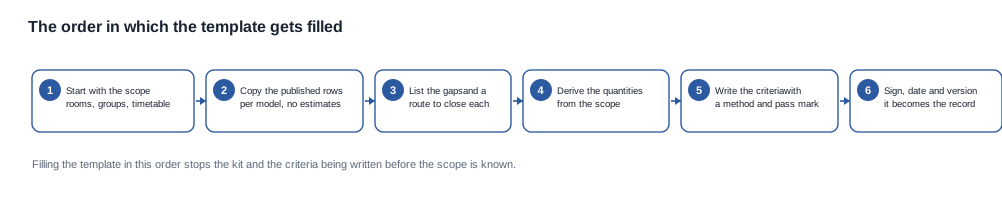
The scope section comes before the commercial section, and the order matters. The kit quantities, the dock count, the tag count, the consumable quantity, the spare pool and the servicing window are all derived from the timetable and the room plan. The price fields — unit price, minimum order quantity, tooling, lead time, payment structure, the certification line, the delivery split and the freight terms — are then filled against those derived quantities. A template that starts at the price produces a quotation for a kit nobody derived, and the kit is then fitted to the price.
The fields that have to be per configuration rather than per model. The bill of materials, the pack contents list, the artwork version and the delivery terms are configuration-level, not model-level. A configuration in this category means the model, the language set, the labelling set, the accessory set and the documentation set together, and a quotation that states one price against three models is a quotation against a configuration nobody defined.
The fields that are policy rather than a supplier quote. The spare pool, the loss rate target, the restock interval, the servicing window and the consumable quantity per unit are all decisions the buyer makes and the supplier can only quote against. Putting them in the template means the quote comes back with a number for each rather than with a bundle, and it means the year-two order has something to be compared with.
What belongs in the commercial section and is usually missing. The cost of the consumables and the tags per unit, the servicing and inspection window, the consumable restock interval, and the documentation review that follows any change of model, firmware, standard edition or claim sentence. Those four are running costs of the deployment rather than costs of the order, and a template that omits them produces a first-year quote that looks cheaper than the second-year reality.

The acceptance fields that close the order
The acceptance section is what converts the template from a description of the deployment into a document that can settle a dispute, and it is the section that decides whether the deployment survives its own first term.
A criterion is only a criterion if it names a test, a condition and a pass mark. "The device detects posture correctly" is not a criterion. "In a room of ordinary daylight, with the unit at the position described in the setup card, a deliberate forward lean of more than the distance stated in the supplier's parameter sheet produces a reminder within the stated delay, in eight out of ten trials" is a criterion. It is longer, it is written once, and it can be applied by an incoming inspection inspector or by a teacher, which is what makes it a criterion rather than an aspiration. The catalogue publishes the existence of the detection function and none of its parameters, so the criterion has to come from the supplier's parameter sheet or from a sample test the buyer runs.
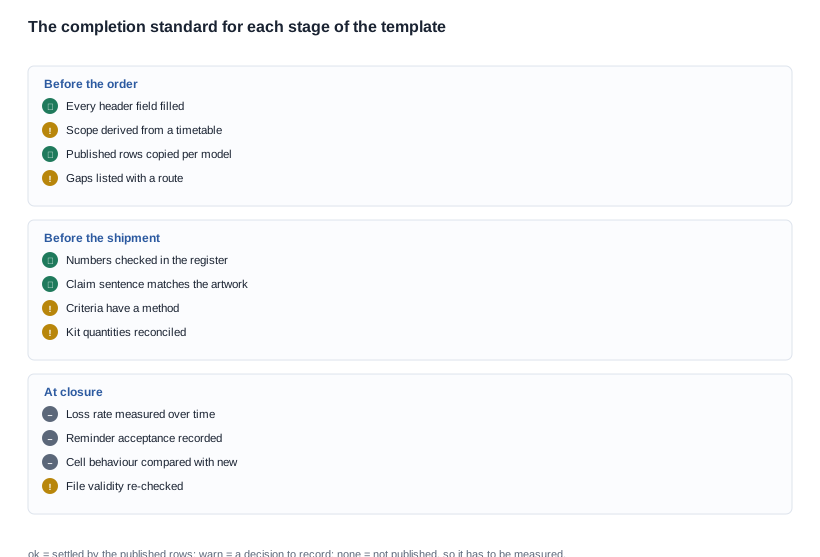
The other acceptance fields, and what each one settles. The charging criterion — units on charge at the end of the day and usable in the morning — settles the routine. The sizing criterion, measured across a range of children's head sizes with the method recorded, settles the fit and therefore the return rate. The hygiene criterion settles the scratch and no-charge problems. The documentation criterion — the file is complete, the numbers are in the register, the claim sentence matches the artwork — settles whether the lot is acceptable at all. And the loss criterion, a measured rate rather than an anecdote, settles the year-two quantity.
The closure fields are the ones that are missing in most deployments. The loss rate over time, the reminder acceptance result, the cell behaviour compared against a new unit, and the state of the documentation file at the end of the period. All four have to be measured, and none can be measured in the first week. That is why the template has a closure section rather than ending at the shipment: a document that closes at the shipment produces a positive report and no evidence, and a document that closes at the end of the period produces the four numbers a rollout decision needs.

The fields nobody fills, and why they are the ones that matter
Three sections of this template are routinely left empty in a real deployment, and they are the three that decide whether the programme is still running in the second year. Each of them is empty for the same reason: it is the only section that requires a measurement rather than a copy.
The closure section is empty because it can only be filled at the end of a period, and by then the attention has moved to the next order. It holds the loss rate measured over time, the reminder acceptance result, the cell behaviour compared against a new unit, and the state of the documentation file. All four are measurable, none is measurable in the first week, and all four are what a rollout decision is made on.
The gap section is empty because a gap is uncomfortable in a document that other people read. Naming fifteen unpublished facts in a template that goes to a supplier and a school feels like an admission, and it is the opposite: a template that lists its gaps is the only document in the deployment that tells the reader which statements are backed by evidence and which are not. The alternative is a template with no gaps in it, which is a template with invented numbers in it.
The acceptance section is empty because writing a criterion is harder than writing a description, and because a description can be checked by reading while a criterion has to be applied. The template's job is to make the harder version the default, which is why the completion standard for every criterion is that it names a test, a condition and a pass mark.
The three empty sections are also the three that are hardest to reconstruct. A lost unit cannot be counted after the fact, a reminder acceptance result cannot be recreated once the fleet has moved on, and a cell behaviour comparison cannot be produced from a unit that has already been replaced. That asymmetry is the argument for the template: the measurements are cheap while the deployment is running and impossible afterwards. The metrics that the template exists to capture are the same ones the education buying checklist asks for before the order, and the long-run version of the same discipline is covered in the equipment management article.
How to run the template across a pilot and then a rollout
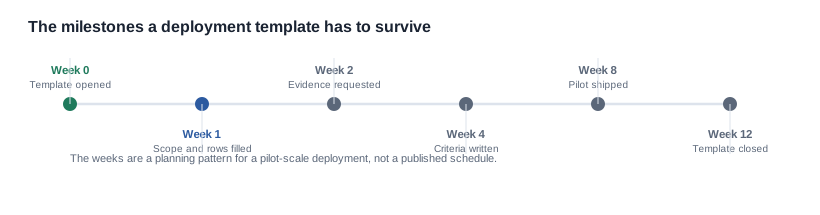
The template is used twice, and the second use is the one that turns a pilot into a programme. Running it once is a form; running it twice is a control.
The pilot run. The pilot fills the header, the scope, the device, the evidence, the claim, the kit and the commercial sections, and leaves the acceptance criteria written but not yet exercised. What it produces at the end is the closure section: the four measured numbers, plus whatever the acceptance criteria revealed when they were actually applied to a real fleet. The output is a template with a second set of entries in it, and that second set is what the rollout quote is built on.
The rollout run. The rollout copies the template, keeps the scope and the device and the evidence sections as they were if nothing has changed, replaces the quantities with the ones the pilot measured, and keeps the acceptance criteria exactly as they were, because the point of a criterion is that it does not move when the volume does. What changes is the closure section, which is opened again for the rollout period. A buyer who changes the acceptance criteria between a pilot and a rollout has quietly removed the only evidence that the rollout is performing, and a buyer who changes the scope without re-deriving the quantities has bought a kit for a deployment that no longer exists.
The review cycle. The template is reviewed at the same moment as the deployment is reviewed, not on its own anniversary. The review checks three things: that the gap list has shrunk, that the closure numbers have been measured, and that the criteria still describe the product being shipped. That last check is the one that catches a firmware change that moved a default threshold, and it is the reason the change-control clause exists.
What the template does not do. It does not replace the document file, the conformity assessment, the purchase order or the inspection record. It sits above them and holds the link between them, which is the only place the link is usually kept. A deployment without it keeps the link in a person's memory, and that is not a system.
Our position. We publish the rows that fill the device section of this template: the 40 mAh and 70 mAh cells, a charge time of two hours or less, a rated use of about twenty hours, the magnetic charging interface, Bluetooth V5.4 on the A07, and the published functions on the A05 and the A06. We do not publish the detection thresholds, the delays, the false-positive rate, the alert format, the frame weight, the frame dimensions, the size range, the ingress marking for this tier, the lens material, the operating temperature range, the cycle-life rating or the certification status per model, and we will not fill a template field with an estimate on a buyer's behalf — a filled field that cannot be verified is worse than an open one. We also make no vision, health, eye-protection or hearing claim for any product in any market.
What to send us. Send the header fields, and we will return the device section filled from the published rows, the gap section filled with the route to close each gap, and a marked-up scope and kit section showing what the timetable implies for the quantities. We will also tell you where the template asks for something we cannot supply, rather than producing a plausible line for it. The commercial terms behind the fields are set out at pricing, minimum order quantity and lead time, the acceptance side is at quality consistency, and the same structure as a buying list is at education buying checklist.


