Two field deployments, built from the pattern rather than from any named customer, and the difference between them was four documents and a fortnight of work. This is a hypothetical scenario rather than a client project: the configurations, the team sizes and the constraints are constructed to isolate the variable that matters, which is not the hardware. Both deployments could have been supplied from the same catalogue with the same published rows. One ran. The other did not.
That is the whole argument of this article, and it is worth stating at the top because it runs against how field-work purchasing is usually framed. The hardware selection in this category is the easy part: the published rows narrow the field quickly, the camera models and the audio models separate on whether the job needs a record, and the charging interface follows from the model. The deployment variables are the hard part, and they are almost entirely undocumented, which means they are almost entirely owned by the buyer.
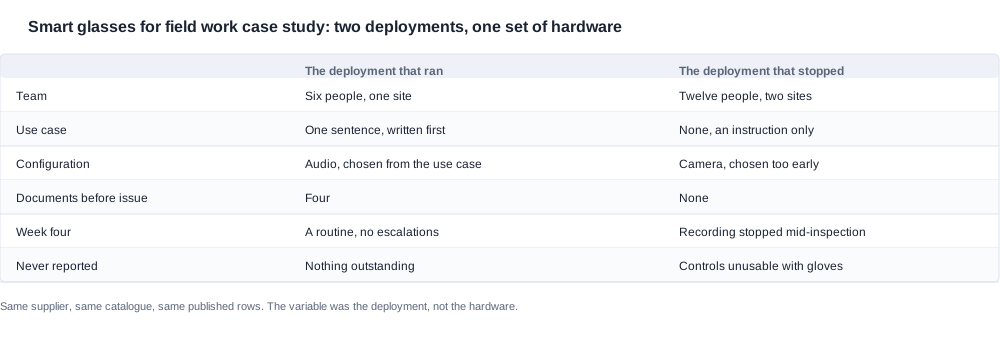
Smart glasses for field work case study: two deployments, one set of hardware
What the two deployments had in common
They shared a supplier, a catalogue, a purchase order format and a time window. Both were bought by a buyer who had chosen the configuration before writing down what the deployment was for, which is the most common sequence in the category and is the root of the difference between them.
They also shared a hardware reality. Both crews worked outdoors, both worked near metal and dust, neither had mains power at the point of use, and both ran eight-hour shifts with the device active for most of them. On the published rows those conditions would have pointed at the same shortlist: a camera model if a record was needed, an audio model if it was not, and a case if the shift ran past the published band.
What separated them
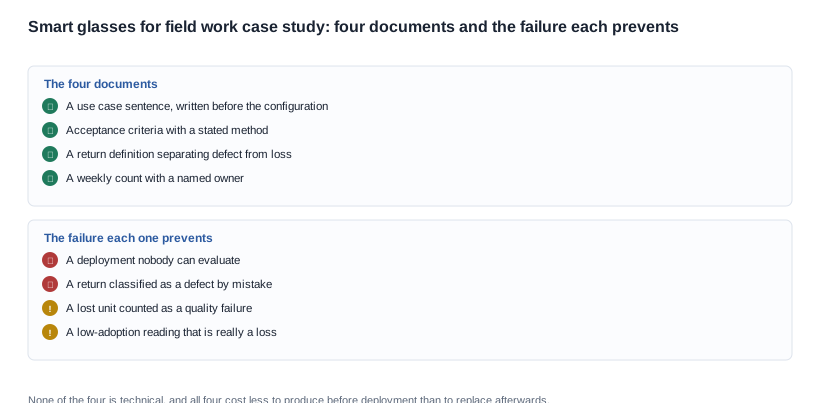
The deployment that ran had four documents that the other one did not, and all four existed before the first unit was issued rather than after the first problem. A use case written in a single sentence. An acceptance criteria sheet with a stated method. A return definition that separated a defect from a lost unit. And a weekly count with a named owner.
None of the four is technical, and all four are free to produce. That is the finding worth carrying out of this article, because the instinct in a failed deployment is to go back and choose a different product, and in this pattern the product was not the variable.

The deployment that worked
The use case, in one sentence
A maintenance team of six, one use case written in a sentence: documenting equipment condition at the point of inspection rather than afterwards. Audio configurations, because nobody on that team was recording — the value was hands-free calls and a hands-free note, and the record was still being taken with the paper process.
The sentence matters more than it looks. A use case that fits in a line is a use case that can be evaluated, and "the team stopped mentioning the product" is a measurable outcome in a way that "adopted the new process" is not. It also decided the configuration. If nobody is recording, a camera model is a more expensive device that does less of the job, and choosing the audio tier was a consequence of the sentence rather than a preference.
What the published rows contributed to this one
The configuration was chosen from the use case, and the published rows made the choice narrow. The audio tier is eight models: the YK12 and the D12, the G07 and the K01, the D11 and the LC-105-1, and the LC-105-2 and the K02. On endurance they separate into two groups. The K01 and the K02 publish two 90 mAh cells and about eight hours of rated use, and the LC-105 pair publishes two 55 mAh cells and about eight hours. The D11 and the D12 publish a single 100 mAh cell and about seven hours, and the G07 and the YK12 publish two 55 mAh cells and about six hours.
An eight-hour shift with the device active for most of it points at the eight-hour group rather than the six-hour group, and that is a much smaller decision than it sounds, because the difference between the two groups is where the unit sits when it is put down. No touch row is published for any model, so the temple control is a question for the supplier on every entry, while the G07 and the YK12 publish slim or detachable temples, and that row is a reason to look at a specific model rather than at the tier as a whole.
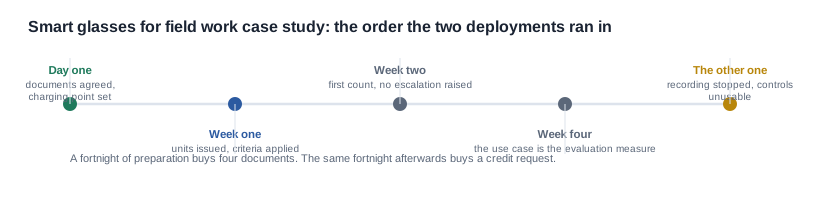
The charging point mattered more than the choice of model. The catalogue publishes no case capacity for the audio models, so there is no published reserve for these units, and the end-of-shift charge is the only published way to restore charge. A team that has to plug six units in at the end of a shift needs that plug point to exist from the first evening, and the deployment that ran established it on day one while the other established it when somebody asked for it in week three.
The four decisions, and when they were made
The charging point was established on day one rather than in week three, which meant the six units had somewhere to go at the end of a shift from the first evening. The acceptance criteria sheet was agreed before the first unit was issued, so a received unit had something to pass rather than something to be judged against after the fact. The return definition distinguished a defect from a lost unit, so the two numbers did not get mixed. And the weekly count was five minutes of somebody's time with a named owner.
The sequence is the point. Each of those four decisions was cheap before deployment and expensive after it, and a deployment that produced them all in week four has already paid for them in escalation.
The deployment that did not
What was actually asked for
A twelve-person team across two sites, camera configurations, no written use case. The instruction given was "use them for site surveys and any documentation you need".
That instruction contains a configuration and no requirement, and it is the reason the two deployments diverged. With no stated use case, the recording requirement is undefined, the storage behaviour is undefined, the weather exposure is undefined and the acceptance criteria are undefined, and a buyer in that position cannot evaluate the deployment even if it runs perfectly.
What the camera tier would have required the buyer to ask
The camera tier is eleven models, and the resolution split is specific: eight models publish 8 MP — the V03 Pro and the V06, the MT6 and the V03, and the KY06 and the MT5, and the CY03 and the CY05 — and three publish 13 MP, the S7 and the L1 Pro, and the L2 Utral. That is the whole of the published camera data, and the second deployment had chosen a camera tier without knowing which of those two classes it needed.
The rows that would have decided the deployment are the ones the catalogue does not carry. Storage capacity, overwrite behaviour, video resolution, frame rate, the field of view, the sensor model and the low-light behaviour are not published for any camera model, and every one of them bears on a recording that has to survive an inspection. The case position would also have mattered: five camera models publish a case capacity, two publish a case with no capacity stated, and four publish no case row at all — the V03 Pro and the V03, and the V06 and the S7 — so a twelve-person team would have needed to know, per model, whether a reserve existed.
Two questions in the request for quotation would have closed most of this. What happens when the store fills — does the unit stop, warn or overwrite — and what is the capacity. And how long does a recording continue under the load the job applies. Neither is a published row, which is exactly why they are questions rather than specifications, and why the answer has to be put in the acceptance criteria sheet.
The first failure, four weeks in
It ran for four weeks and produced a return rate concentrated on one cause: recording that stopped partway through an inspection. Storage capacity and overwrite behaviour are not published in our documentation, nobody had asked for them, and the team had assumed a recording device holds a recording.
Note the shape of this failure. The unit did not malfunction. It behaved as a camera with a finite store and no published rule about what happens when the store fills, and the crew's assumption was the wrong one. The commercial consequence is worse than the technical one, because every affected unit arrives as a return that is classified as a defect, and the classification is arguable. The argument then consumes the supplier relationship instead of the five minutes it would have taken to ask one question before ordering.
The second failure, never reported
Controls. Gloves at one site, a capacitive temple control that no published row describes, and a record button that needed a bare fingertip. Nobody reported it as a fault; they simply stopped recording, and the evidence of the inspection went back to the previous method.
No touch row is published for any model in our catalogue, so the control surface has to be established with the supplier before it can be relied on. That is a documentation position, and it is the kind of gap that only becomes visible when someone asks what the control surface physically is. A failure that is never reported is the most expensive kind of failure for a buyer, because it does not appear in the return rate, it does not appear in the support queue, and it appears only as a deployment that quietly reverted to the old process.

The four documents, and what each one prevented
| The document | What it prevents | The failure it would have caught | Cost to produce |
|---|---|---|---|
| A use case sentence | A deployment that cannot be evaluated | A configuration chosen before the requirement | An afternoon |
| Acceptance criteria with a method | A return classified as a defect when it is a specification mismatch | Every recording that stopped mid-inspection | A page |
| A return definition | A lost unit investigated as a quality failure | A unit in a van turning the return rate into a defect rate | Half a page |
| A weekly count | A low-adoption reading when the real cause is a unit in a van | The same, seen a month later than it needed to be | Five minutes a week |
A use case sentence prevents a deployment that cannot be evaluated, because nobody can say whether it succeeded. In the second deployment there was no sentence, so the only available measure was whether people used the devices, and usage in the first week of any deployment is high for reasons that have nothing to do with the product.
Acceptance criteria with methods prevent a return classified as a defect when it is a specification mismatch. In the second deployment every recording that stopped would have been arguable, and the argument would have consumed the relationship. A method matters here: "recording is continuous for the length of an inspection" is a testable criterion, while "recording works properly" is not a criterion at all.
A return definition prevents a lost unit being investigated as a quality failure. The two numbers have different causes, different owners and different remedies, and merging them is how a defect rate becomes a number that nobody can explain and nobody can act on.
A weekly count prevents a "low adoption" reading when the real cause is a unit in a van. The count is five minutes and it is the only mechanism in the whole set that catches a loss before the month-end reconciliation does.
None of the four is technical, and all four were absent from the second deployment.

What the fortnight actually bought
Why a document beats a conversation
Each of the four was worth writing down for one reason: a document is retrievable by the next person, and a conversation is not. In a deployment that involves a client, a supplier, a team leader and an operations manager, the number of people who were in the room where a decision was taken is not the number of people who will act on it. A charging point established verbally on a site visit becomes a charging point nobody has budgeted for. A return definition agreed over a call becomes a return definition each side remembers differently.
The written version has a second property that matters more than retrieval, which is that it can be signed. An acceptance criteria sheet that the supplier has agreed is a shared reference; the same sheet sent unilaterally is a set of expectations. In the failed deployment, the criteria that would have separated a specification mismatch from a hardware fault existed only in the buyer's head, which is why every affected recording was arguable.
The cost of each failure, in the deployment's own currency
The cost of a field-work failure is measured in shifts, and a shift is the unit the client actually loses. The first deployment's recording failure would have cost one shift per affected inspection for as long as it went unaddressed, and the second deployment's control failure cost something the buyer never saw: a reversion to the previous documentation method across a site, which is a productivity loss with no ticket attached to it.
The comparison that matters is the one a buyer can defend in a quarterly review. A fortnight of preparation produces four documents, a quotation that can be compared against another supplier's, and an acceptance criteria sheet that the supplier signed. The same fortnight spent after the first failed week produces a credit request, a supplier investigation, and a specification that has already shipped.
What we would do differently if we ran it again
Scoping to the audio tier would have been wrong for a documentation team, so the change would be narrower: ask for the storage row before ordering, and test the controls with gloves on day one rather than discovering both in week four.
The other change is smaller and larger: write the use case sentence before choosing the configuration rather than after. Both deployments had a configuration chosen first and a purpose inferred afterwards, and in one case that produced a product that could not do the job it was bought for.
The decision sequence, restated as a checklist
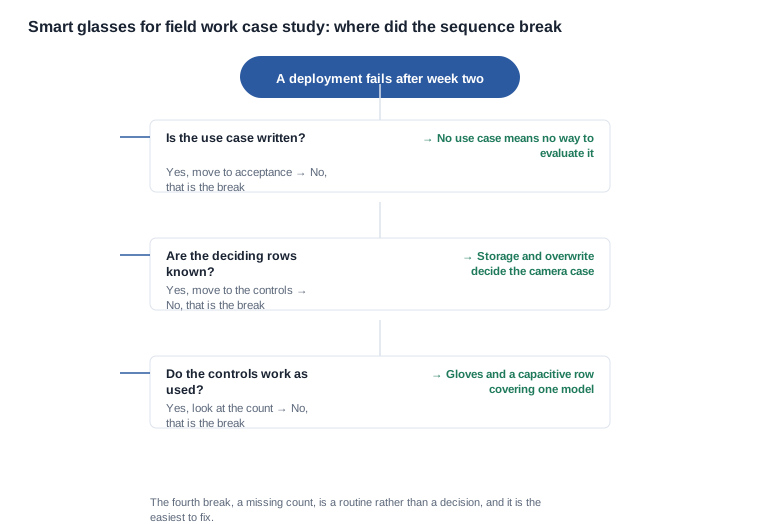
If the second deployment had run the sequence in a different order, the outcome changes at three points and not at the fourth. Write the use case sentence, because it decides the configuration and makes the deployment evaluable. Ask for the two rows that decide the camera case — storage behaviour and overwrite behaviour — because they are the difference between a working recording and a missing one. And test the control surface under the conditions the crew works in, because no touch row is published for any model and the question is therefore a physical one.
The fourth point, the weekly count, is not a decision at all. It is a five-minute routine that any deployment can adopt on the first Monday, and its absence in one of these two deployments is the most easily fixed failure in the set.
What we publish, and where our answers stop
We will tell you which rows a configuration can evidence and which it cannot, and we will say plainly when a row decides a deployment and is not published. Storage capacity, overwrite behaviour, video resolution, frame rate, the field of view, the sensor model, the acoustic pickup figures and the frame weight for every model except the MT6 are all not published in our documentation, and a field deployment whose deciding row is one of those needs that answered by someone who has measured it.
Where the weight is published, it is published for one model only: 158 g for the MT6 whole unit, including its battery and camera and excluding its foldable charging case. We will not carry that figure across to a model it does not describe, and we will not quote a typical weight for the rest of the range.
We will also not reconstruct the two deployments above as customer projects. They are constructed to isolate a variable, and a constructed example presented as a real reference is worth less than no example at all.
What we will do with your own scenario is the same operation. Send the team size, the shift pattern, the use case in one sentence and the two rows you are least able to answer, and we will return the configuration the published rows support, the questions that have to be asked before the order rather than after it, and the four documents as a list with the failure each one prevents. The commercial structure of a first order is at pricing and the sample route is at the samples page, and a sample order is the cheapest way to close the two rows that no catalogue carries.
For the deployment framework, see smart glasses for field work. The four stages are set out at how to set up, the protocol is at how to test, and the criteria side is at quality consistency.
Related reading
- How to set up — the four stages
- Testing before ordering — the protocol
- Quality consistency — what the criteria are for
Send the team size, the shift pattern and the use case in one sentence, and we will tell you which configuration the published rows support and which rows the deployment still has to measure.