Smart glasses for field work: the setting where the shift plans the tool
Field work is the only application in this catalogue where the unit of purchase is not a person but a shift. A buyer specifying smart glasses for field work is not choosing a product for an audience; they are sizing a tool pool against a roster, and the number that decides the order is the number of hours between two charging points on a site that may not have a socket in the right place. That reframes the whole question. The published catalogue rows are unusually well suited to it — charge time for every model, rated runtime for every model, cell configuration for every model — and they are only useful if the buyer treats them as shift-planning inputs rather than as features to be quoted upward.
The rule that follows is that the swap pool is decided before the device. Almost every site deployment in this category is specified the other way round: a model is chosen from a shortlist, a quantity is divided by the number of technicians, and the charging problem is discovered in the second week when the devices are all flat at the same time. The published charge times make the pool straightforward to size, because every model in the range charges in two hours or less, and only the D17 and the ZH12 publish roughly one hour, and that difference is the single largest lever on how many devices a site needs to keep in circulation.
The reader, the deployment, and what a site actually needs
The reader is a procurement manager, a facilities or operations manager, or a service company's fleet lead, buying on behalf of technicians and engineers who will be on a roof, in a plant, on a survey route or inside a customer's building. The decision is how many devices the site needs, which configuration covers a shift, what the replacement route looks like when a device is lost on a rural site, and how the pool is charged. The risk being managed is the one a procurement manager recognises immediately: an idle fleet, or a fleet that is empty by the middle of every shift, and a replacement request that cannot be answered within the window the site has planned around.
That risk is a scheduling risk, not a quality risk, and it is why the charge time matters more in this application than any other published row except the runtime itself.
The published rows that a site can plan on
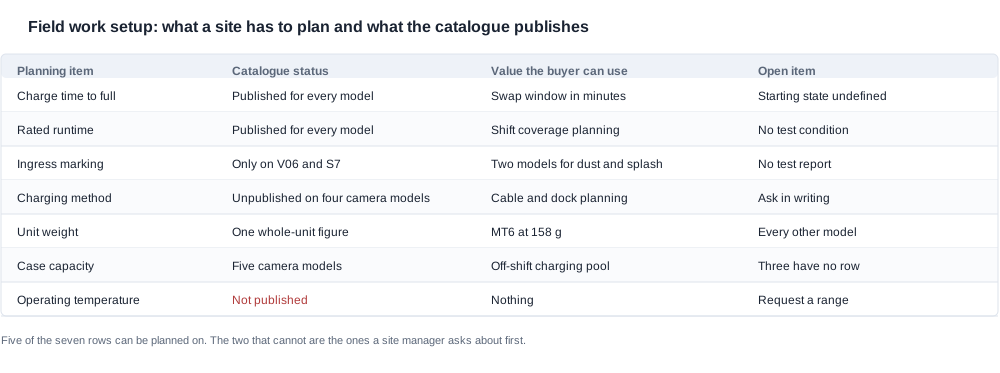
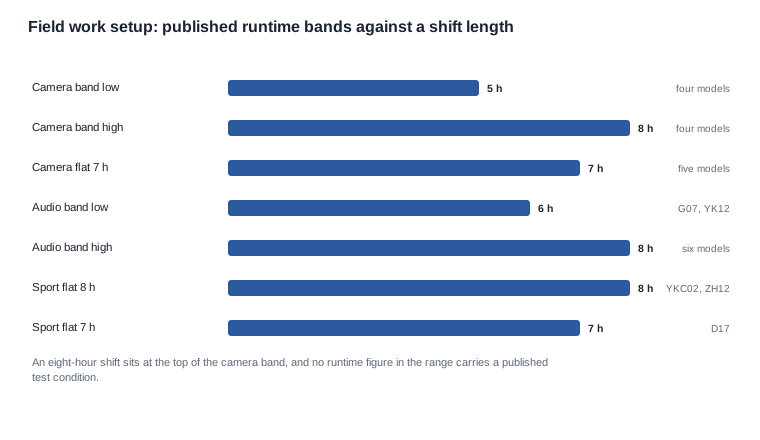
Four rows are published for every model in the range and are enough to size a deployment. The charge time is two hours or less on twenty-six models and roughly one hour on the D17 and the ZH12; what it does not include is a starting state or a termination criterion, so it tells a fleet planner how long a device takes to refill but not how much of the charge is delivered in the first hour. The rated runtime is published for every model and sits in bands that differ by tier: the camera tier publishes 5 to 8 hours on the V06 and the S7, and the V03 Pro and the V03, 6 to 8 hours on the KY06 and the MT5, and about 7 hours on the MT6 and the CY03, and the L1 Pro and the L2 Utral, and the CY05; the audio tier publishes about 8 hours on the K01, the K02 and the LC-105 pair and about 6 hours on the G07 and the YK12; the sport tier publishes about 8 hours on the YKC02 and the ZH12 and about 7 hours on the D17. The cell configuration is published in the catalogue's own form, as a single cell or a cell count, so a planner can compare architectures without converting anything. And the charging method is published for twenty-four of the twenty-eight models, which is enough to plan a cable and a dock strategy for almost any configuration a site would choose.
Two things a fleet planner needs are not published. The operating temperature range is not published for any model, which is the first question at a plant and the first question at a survey route in a hot climate. The unit weight is not published for any model apart from the MT6's 158 g whole-unit figure, and a device that stays on a technician's head for a full shift is judged on weight by the people carrying it whether or not the buyer asks about it.
The three site conditions that decide the configuration
Three physical conditions separate a field-work deployment from a desk deployment, and in each one the catalogue is either specific or silent in a way that has to be handled deliberately rather than by assumption.
Dust, water and the two models that carry a marking
Of the twenty-eight models in the range, two carry an ingress marking: the V06 and the S7, both camera models, both marked IP54, which covers splashing water and a dust protection level and does not cover immersion or a sustained downpour. No third-party test report is published behind that marking, so it can be stated as a catalogue attribute and not as a test result. The remaining twenty-six models have no ingress marking at all, which is not the same as a mark of zero — it is the absence of a published statement, and a buyer who wants a dust-and-water statement for a plant has to request one in writing for the exact model.
That leaves a practical shortlist structure. Where the site is dusty, wet or both, the V06 and the S7 are the two models whose documentation supports a statement, and they publish a 260 mAh cell, magnetic charging, a charge time of two hours or less and a rated runtime band of 5 to 8 hours, with the V06 at an 8 MP resolution class and the S7 at 13 MP. Where the site is dry and the work is not weather-exposed, the audio tier's eight models are the lower-power option, and the sport tier's three models publish 115 mAh on the D17 and 100 mAh on the ZH12 with Type-C charging and roughly one hour of charge time, which is the best pool arithmetic in the range.
Temperature, impact and the rows nobody publishes
The catalogue publishes no operating temperature range, no drop rating, no impact data and no cycle life rating for any model. On a working site those are the rows that decide whether a device survives, and a buyer who is told nothing about them will assume the equipment is more robust than the documentation supports.
There are three ways to handle that honestly, and they are all procurement actions rather than marketing ones. Ask the supplier for the operating range and the impact position in writing, per model. Restrict the deployment to conditions the published rows can carry — a device that is only used indoors, or only used in a temperature band the site's own records can bound. Or design the deployment so that a device failure is cheap: a higher spare ratio, a shorter service window, and a swap pool that can absorb an in-service failure without a technician going home.
Weight, and why the single published figure is not a fleet figure
The catalogue publishes exactly one weight: 158 g for the MT6 whole unit, which includes its 265 mAh battery and its camera and excludes its foldable 1200 mAh charging case. That figure is useful and it is not a fleet number, for three reasons. It is one model. It is the whole unit and not the frame, so no bare frame weight exists for any model in the range. And it excludes the case, which is exactly the part a technician carries as well. For a fleet of several hundred devices, the weight question is therefore a supplier request and not a catalogue lookup, and the answer belongs in the site acceptance file.
Building the deployment: the swap pool before the device
The structure of a site deployment is a circulation problem, and the catalogue gives enough to solve it. This is the part of the article that differs most from the other application scenarios, because the correct order of decisions is unusual: the pool is sized before the model is chosen, the model is chosen from the shift, and the service terms are settled before the purchase order rather than after the first failure.
The order in which the setup has to be built
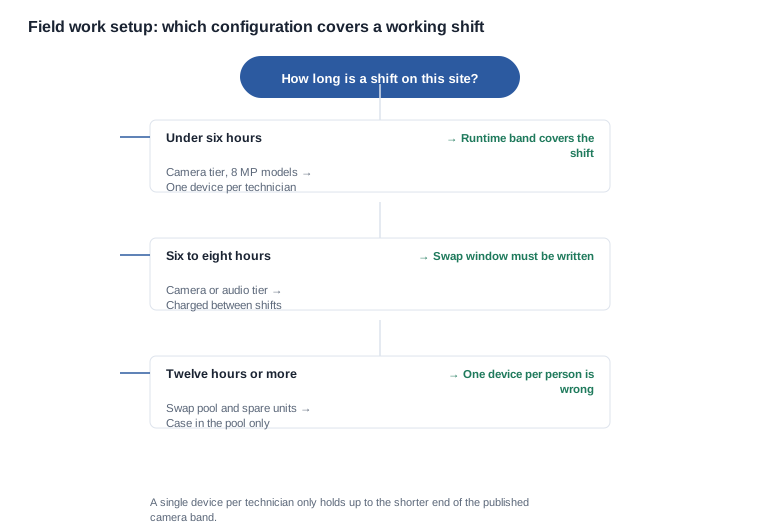
First, map the shift and the charging points. Not the shift length in hours, but where a device can physically be charged and who is responsible for it. A site with a secure charging room can run a smaller pool than a site where each technician charges at a vehicle, and the second is the more common case.
Second, choose the tier from the shift. A shift under six hours is inside the published camera band at its lower end, so the camera tier works with one device per technician. A shift of six to eight hours sits at the upper end of the band, and the published charge time then has to be written into the rota as a swap rather than assumed. A shift of twelve hours or more cannot be covered by one device per person on any published camera figure, and the deployment has to be a pool.
Third, size the pool against the charge time. Every model charges in two hours or less, and the D17 and the ZH12 publish roughly one hour. That ratio is the whole arithmetic: a two-hour charge time means a device returns to circulation after one interval, and a one-hour charge time means two devices return inside the same interval. It is the cheapest way to reduce the fleet quantity in this category, and it is a specification decision rather than a purchase decision.
Fourth, agree the service route. The spare ratio, the replacement window, and who authorises a swap. On a remote site the replacement window is the binding term, because a device lost on a Tuesday is a hole in the roster until Friday, and a roster hole on a survey route is a missed appointment.
What a fleet buyer needs that a consumer buyer does not
Four things appear in a fleet purchase and in no consumer purchase. An asset register, which means the model designation printed on the unit has to map to a serial number and to a technician, and that is a reason to require the model designation table as a document. A charging pool specification, which fixes the pool quantity, the location, the cables and the dock type, and which depends on the charging method row for each model in the pool, where the catalogue publishes one. A service window and a spare ratio, which together decide whether a device failure is an inconvenience or an outage. And a rollout plan across sites, which usually means a pilot at one site before the others, which is cheaper than discovering a problem at every site at once.

How a field-work configuration is verified before it reaches a site
Verification here has a site-shaped output: acceptance criteria that a site supervisor can apply to a device in a drawer, rather than a laboratory report. A fleet of several hundred devices will be checked by people who did not negotiate the purchase, so the criteria have to be written as observable tests with a pass line and a fail line, and they have to be short enough to be used.
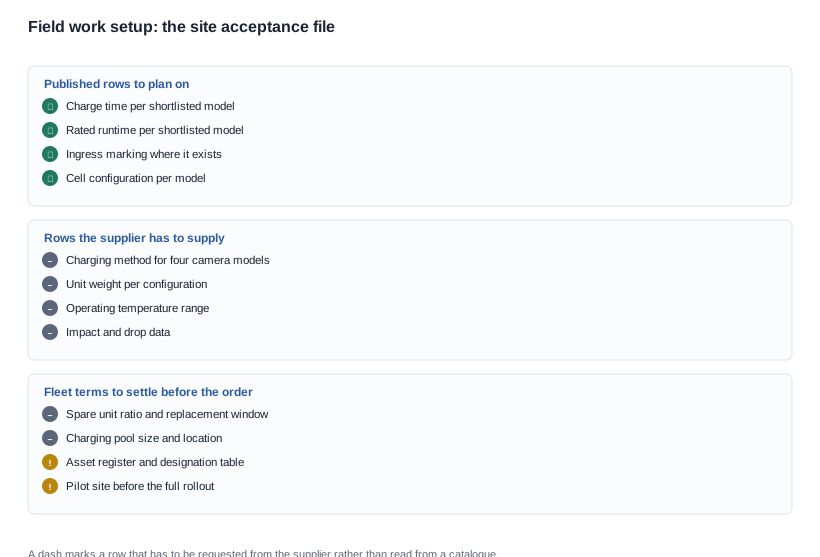
The site verification set and its completion standard
Five checks, each ending in a written artefact.
The first is a configuration match: the model designation on the unit, the cell configuration, the charging method and the case status, against the catalogue rows and the purchase order. The second is a charge-cycle measurement on two units from the same batch, from a stated starting state, with the measured figure compared against the published charge time rather than against the supplier's claim. The third is a shift simulation: the unit is used for the declared shift length under the site's own duty cycle, and the result is recorded against the published runtime band, not against the best published figure. The fourth is a pool rehearsal: the swap pool is run as it would be on a real shift, and the number of devices that are simultaneously flat is recorded — that number is the real pool size, whatever the calculation said. The fifth is a weight measurement of the packed device with its case, which the catalogue publishes for no configuration.
The fourth check is the one that changes the order size, and it is the one most buyers skip because it feels like a formality. A pool that is 20 per cent short on the rehearsal day is a pool that is 20 per cent short every day, and the shortfall shows up as technicians working without a device.
Documents to request before a field-work order
Eight documents, in the order they constrain each other. The catalogue rows for every model in the pool, on one sheet. The charging method confirmed in writing for the four camera models where the catalogue publishes none: the CY03, the CY05, the L1 Pro and the MT6. The charge time and runtime with the conditions attached, where the supplier has them. The unit weight and the operating temperature range per configuration, both unpublished. The battery transport documentation for the exact configuration including any case, since a case is a second lithium cell and the requirement is set out at battery transport. The model designation table and the certificate register, so every number can be checked in the issuing body's public register — and the certification questions are set out at certification checklist. And the agreement terms covering the spare ratio, the replacement window, the service scope and the pilot site.
The safety framing for this application belongs in the same file rather than in a separate discussion, and the adjacent material is at field work safety considerations. The charging procedure for the field case is at how to charge smart glasses for field work, and the shortlist is at field work product recommendations. The market-entry requirement for consumer products placed on the European market is at gpsr, and it applies to the units themselves rather than to the deployment. The clause language is at contract terms and the commercial structure is at pricing.

Where field-work setups go wrong, and which terms stay open
The failures in a site deployment are ordinary and repetitive, and they are all scheduling failures dressed up as equipment failures. The terms that stay open are concentrated in the same places, which is convenient for a buyer who knows where to look.
Failure modes on a working site
A pool that is too small from day one. The symptom is a technician without a device every Tuesday afternoon. The root cause is that the pool was sized by dividing headcount by one and the charge time was never used as an input. The prevention is the pool rehearsal, and the arithmetic of the published charge time.
A device that dies mid-shift and has no answer. The symptom is an outage that lasts until the next site visit. The root cause is that the replacement window was never written into the agreement. The prevention is to settle the service window with the order.
A site claim the catalogue cannot support. The symptom is a customer who expected a dust-rated device and received an unmarked one. The root cause is that the ingress marking was generalised from the V06 and the S7 to the whole range. The prevention is to publish the marking per model, or to state that the range is unmarked.
A temperature failure in a summer site. The symptom is a device that shuts down in the afternoon. The root cause is that no operating temperature range is published for any model. The prevention is to request the range in writing, and to plan the pool against the site's own temperature records.
A device nobody can identify. The symptom is an asset register with gaps and a warranty claim that cannot be tied to a batch. The root cause is that the model designation table was never agreed. The prevention is to require it, and to make the designation on the unit a site acceptance criterion.
A rollout that reached every site before the pilot finished. The symptom is a fleet-wide issue discovered in week one of the full rollout. The root cause is that the pilot was treated as a formality rather than as the evidence for the scale order. The prevention is to make the pilot's criteria the scale order's criteria.
The commercial room on a fleet order
The model architecture is fixed, and so is certification cost and lead time in character. Tooling is fixed in substance, quoted separately, and negotiable in timing and in the amortisation base.
The room in a fleet order is in the service and the schedule. Whether the supplier will provide a spare unit ratio at a pilot or service tier, and whether the spare units carry the same warranty period as the deployed units, decides whether the site runs a pool or runs a queue. Whether the charging pool is supplied as part of the configuration, and whether the pool is quoted per unit or per site, changes the landed cost of the deployment more than any unit price adjustment will. Whether the replacement window can be written as a number of days with a dispatch method attached, is the term that turns an outage into an inconvenience. Whether the rollout is staged by site against a pilot first, is the cheapest way to bound the risk of a configuration that does not work in a real environment. Whether the supplier will measure the charge cycle on production units and provide the result, converts the pool sizing from arithmetic into evidence. The minimum order quantity per configuration and whether two configurations can share one purchase order while keeping distinct model designations. Payment terms and whether the first delivery is split against a staged payment, which for a fleet is the difference between a contained first-order problem and a site-wide one. And the documentation timetable — the per-model rows, the transport file and the certification scope — which is the term that decides whether the deployment lands before the season or after it.
A worked example. Assume a service company rolling out across four sites, with eight-hour shifts, no fixed charging room at two of the sites, and a survey team that drives between them. The first move is the shift mapping, and it produces two different configurations rather than one: a fixed-site group on a six-to-eight-hour shift, and a mobile group that charges at a vehicle. The second move is the model assignment, and the two fixed-site groups take the V06 and the S7 because those are the two models whose documentation supports a dust-and-splash statement, at an 8 MP and a 13 MP resolution class respectively, with magnetic charging and a two-hour-or-less charge time. The mobile group takes the D17 or the ZH12, because their roughly one-hour charge time is what makes a vehicle-charged rotation practical, and because their Type-C interface means one cable serves the phone and the device. The third move is the pool sizing, which uses the published charge time as the input rather than the headcount, and the rehearsal confirms the calculated figure before the order. The fourth move is the service terms, with a spare ratio, a replacement window in days and a dispatch method, all written into the agreement. The fifth move is the rollout, staged from one fixed site as the pilot, with the acceptance criteria written before it starts and read against it afterwards. The result is a fleet whose pool size is evidence-based, whose documentation is per model, and whose first failure has an answer.
What a field-work buyer can hold us to
The working rule we apply: we publish the rows a site can plan on and we do not publish the rows we do not hold. That means the cell configuration, the charging interface where the catalogue publishes it, the rated runtime, the resolution class, the charge time, the case capacities on the five camera models where they are published, the ingress marking on the V06 and the S7 stated as a catalogue attribute with its scope, and the 158 g whole-unit weight on the MT6 with the exclusion of its foldable case stated alongside it.
What we do not publish and will not estimate: the operating temperature range, the impact and drop data, the cycle life rating, the standby draw, the runtime test condition, the unit weight apart from the MT6, the pack gross weight, the sensor, the field of view, the video specification, the storage and overwrite behaviour, the capture latency, the defect rate and yield, and the charging method on the CY03 and the L1 Pro, and the CY05 and the MT6. Nothing we publish shows a model tested to IP54, because the catalogue carries no test report behind that marking, and a demonstration is not a result we will present as one.
What we will do is take the sites, the shift lengths, the roster, the charging conditions, the volume and the rollout window, and tell you which published rows apply to which model, how the pool should be sized from the published charge time, which rows have to be requested per model, and which terms belong in the agreement before the first order.
What to send us next. Send the site count, the shift lengths, the roster per shift, where charging happens, the volume and the rollout window, and we will return the configuration split with the published rows for each model, the pool sizing worked from the published charge times, the list of rows the supplier has to supply, and the agreement terms to settle before the purchase order.
Related reading
- The scenario's starting point — smart glasses for field work
- The shortlist — field work product recommendations
- The safety framing — field work safety considerations
- The charging procedure — how to charge smart glasses for field work
Tell us the shift lengths and the charging conditions, and we will return the configuration split and the pool sizing.