

The long-term use of smart glasses for field work is decided in the first purchase order, and most of what a fleet needs in year two cannot be obtained in year two at any price. The catalogue publishes what the hardware is — cell capacity, charge time, charging interface, rated runtime, radio version, resolution class, case capacities, the ingress marking on the two models that carry it. It publishes nothing about failure rates, warranty periods, spare-part availability, firmware support or end of life. A buyer who plans a three-year field programme on the published rows alone will discover in year two that the operational half of the programme has no published source, and the only remedy is a contract term negotiated before the first shipment.
Smart glasses for field work: the lifecycle is a contract problem, not a product problem
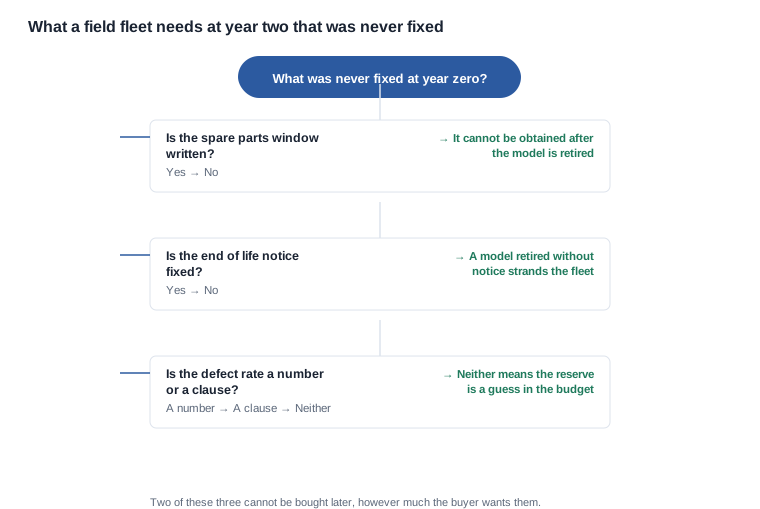
The conclusion. Three clauses decide whether a multi-year field programme works, and all three must be agreed at the order because none of them can be bought afterwards. The first is the spare-parts availability window, the length of time the supplier will supply a part for a model they have sold. The second is the end of life notice period, the advance warning a brand owner gets before a model is retired. The third is the defect rate and its remedy, which is what converts a returns reserve from a guess in the budget into a number. A buyer who has those three in the order and a defect log running from day one can model the second and third years from their own records. A buyer without them is planning a three-year fleet on the published specification of a device and calling the difference a supply problem.
Who this is for and what they are solving. The reader is a brand owner, a channel buyer or an integrator whose customers deploy equipment in the field for years rather than months. Their problem is rarely the first order. It is the second, the third and the renewal, and the specific anxiety is that the supplier who sold the device is no longer there when the fleet needs replacing, or has changed the model, or has quietly stopped answering. That anxiety is not paranoia. It is the ordinary outcome of a device category with a short catalogue and a thin aftermarket, and the defence against it is written into the first order rather than negotiated in the third year.
The asymmetry that drives everything. A product catalogue is written to describe a current product, so it is complete about the present and silent about the future. That is not a flaw in the catalogue; it is what a catalogue is. The consequence for a multi-year programme is that the buyer's own records have to supply the future-facing half — the failure rate, the degradation curve, the consumable consumption rate, the actual rate of loss — and those records only exist if they start before the deployment does. This is the point most often missed: the long-term use plan is not a document produced in year two, it is a log started in month one.
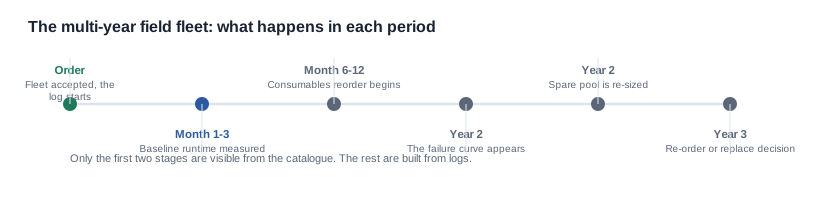
What changes across a three-year programme
Three periods, each with a different set of unknowns, and each with a different action.
- Year one — acceptance, baseline measurement, first consumables reorder. The unknowns are the supplier's quality and the buyer's own process. The action is to start three logs: runtime, failures, consumable consumption.
- Year two — the failure curve becomes visible, the spare pool has to be re-sized, and warranty claims are being settled against wording that was agreed before any claim existed. The action is to convert the logs into a reserve, and to know in advance which clauses make the reserve payable.
- Year three — the renewal or replacement decision, against whatever the supplier's product position has become. The action is to have either a last-time-buy window or a documented migration path, because without one the renewal is a hostage negotiation.
What the published rows settle, and what only your records can settle
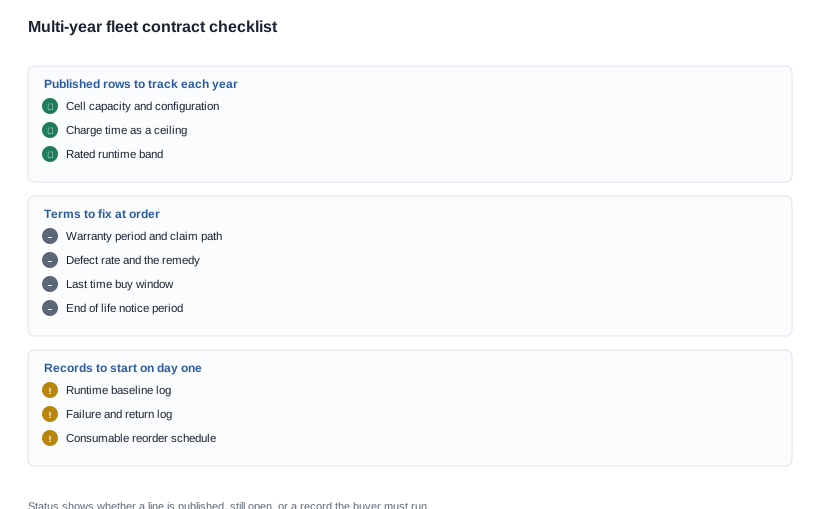
The rows that are published and stay published
The specification half of a long-term plan is in good shape. For every model in the range the catalogue publishes a cell capacity or configuration, a charge time, a rated runtime and, on most models, a charging method. The camera models publish a resolution class, and five of them publish a case capacity. The connected models publish a radio version. Two models carry an IP54 marking as a catalogue attribute, and one model carries a published whole-unit weight.
These rows do not age badly, and they are the right basis for a replacement comparison in year three, because a replacement has to be compared against the model it replaces. The comparison is only meaningful if it is made on the same published rows, which is why a buyer who kept the original specification file has an advantage over one who kept a photograph of a box.
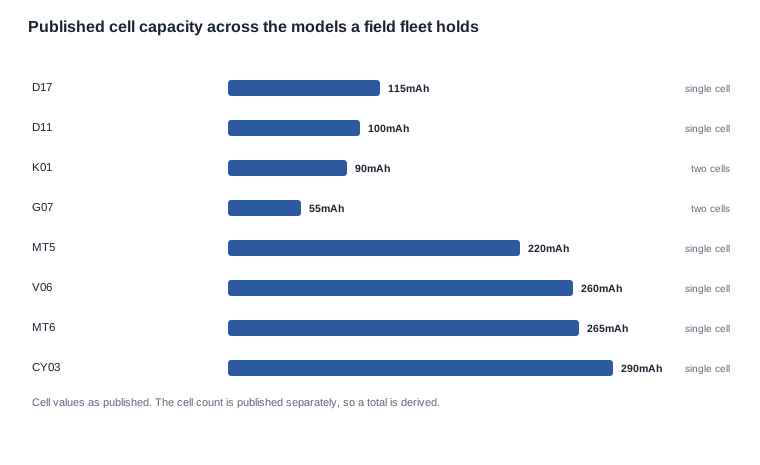
One caution on the cell figures. The audio range publishes cells as a per-cell value with a count attached — 55mAh2 on the G07 and the LC-105-2, and the YK12 and the LC-105-1, 90mAh2 on the K01 and the K02, and a single 100mAh on the D11 and the D12 — while the camera range publishes single cells from 220 mAh on the V03 and the V03 Pro to 290 mAh on the L1 Pro and the CY05, and the L2 Utral and the CY03, with the MT6 at 265 mAh, the KY06 and the S7, and the V06 — each at 260 mAh and the MT5 at 220 mAh. A capacity comparison across the range that mixes the two notations compares a published cell value against a published cell value, which is meaningless. The figure that is comparable is the total the device carries, and that total is a derived value that has to be labelled as derived wherever it is used.
The rows that will never be published
This is the list a multi-year plan has to build without, and naming it plainly is more useful than an estimate:
- Cycle life rating for the cells, and any cell life figure over time
- Standby draw, and the current consumption of a device that is issued and not used for a week
- Hinge life, and the number of open-and-close cycles a frame survives
- Firmware support horizon, and the period over which a model receives updates
- Defect rate, return rate, and any failure distribution by model
- Warranty period, return window, claim path, and the freight allocation on a claim
- Operating temperature range, storage conditions between uses, and drop or shock tolerance
- Spare-parts availability period, end of life notice period, and last-time-buy terms
- Price protection, price escalation, and any published price tier
None of these is unusual to be absent from a product catalogue. Together they are most of what a three-year programme needs, which is why the long-term use plan is a contract document that happens to have a product catalogue attached to it.
The three clauses that cannot be bought later
The spare-parts availability window
For a device with a detachable inner frame, the difference between a serviceable fleet and a disposable one is a single clause. The V06 and the S7 publish a detachable inner frame, and the G07 publishes an ultra-slim detachable temple. Those are the models where a part can be replaced instead of a device, and a buyer who has a fleet of them needs to know for how long the part will be available. A window of two years and a window of ten years describe completely different fleet economics, and the answer determines whether a spare-parts pool is a buying decision or a hope.
Ask for the window in writing, in years, for a named model, and ask what happens to the window if the model is retired. The red flag is a clause that says the supplier will support the model while it is in production, because that is a clause that disappears on the day the model is retired, which is precisely the moment the buyer needs it.
The end of life notice period
The second clause protects against the same failure from the other direction. A brand owner with a fleet of eighty devices and a renewal in the third year needs enough notice to reorder, re-certify, re-list and re-deploy, and a re-deployment of a camera-equipped model involves a site, a policy and possibly a consultation. A notice period measured in months is a working term; a notice period expressed as a good-faith intention is not a term at all.
The question is simple and the answer is worth more than it looks: how much notice, in writing, to whom, and by what route. A supplier who cannot state a number has not decided to support the model, and a buyer who accepts that at the order stage will find out at the worst possible moment.
The defect rate and its remedy
The third clause converts an estimate into a commitment. A returns reserve is normally a percentage of the order value, chosen by convention rather than by evidence. A supplier willing to state a defect rate, or a first-year failure rate with a remedy attached, changes the buyer's position on three things at once: the reserve, the spare device pool, and the price. This is also the clause that is hardest to obtain from a supplier who has no data, which is an honest signal in itself. A supplier running a defect log can quote a rate; a supplier that cannot may still be an excellent manufacturer, but the buyer then has to fund the uncertainty, and should price it that way rather than assume it away.
The trade-offs are real and worth naming. A supplier that commits to a defect rate takes on risk and will reflect it in the price. A buyer that wants a lower price is usually asking the supplier to carry the risk without a number, and the bill arrives later. Which side of that line a buyer sits on is a commercial decision, but it should be made knowingly, with the reserve sized for the case where the rate is unknown, and with the clause still requested — because the request itself is what prompts a supplier to gather the data.

Building the three records that make year two predictable
The records are the buyer's substitute for the figures the catalogue does not carry, and all three have to start before the deployment does.
The runtime baseline log. Record the runtime of each device in the mode the deployment uses, at acceptance, and then at a fixed interval. Over a fleet and a year, this produces the degradation curve that nobody publishes: whether the published band holds, whether it falls from the upper end toward the lower end, and how quickly. It also produces the operational number a site manager needs, which is the time available on one charge in the conditions the work actually happens in. The published figures give the envelope — a band of five to eight hours on the V03 Pro and the V06, and the V03 and the S7, six to eight on the KY06 and the MT5, around seven on the L2 Utral and the L1 Pro, and the MT6 and the CY05, and the CY03 — and the log tells the buyer where inside that band the fleet actually sits.
The failure and return log. Record every device that comes back, with the symptom, the elapsed time in service, the environment and the accessory configuration. Without it, the defect rate is a supplier's opinion, and the only way for the buyer to find out whether a fleet is healthy is to run the numbers. It also feeds the spare pool sizing directly, because the pool requirement is a function of the failure rate and the repair cycle time, and the repair cycle time is a contractual term that the log will show the buyer is missing.
The consumable consumption log. Record the leads consumed, the cloths, the wipes and the cases replaced, per device per period. These are the recurring lines of a field programme, and they are the lines that are cut first when a budget is squeezed, which is how a fleet ends up without charging leads and a site manager ends up blaming the hardware.

Turning the multi-year plan into order terms
A long-term plan becomes real when it is a line in a purchase order or an annex to it. The working set below is ordered by the sequence in which a buyer typically needs them, not by importance.
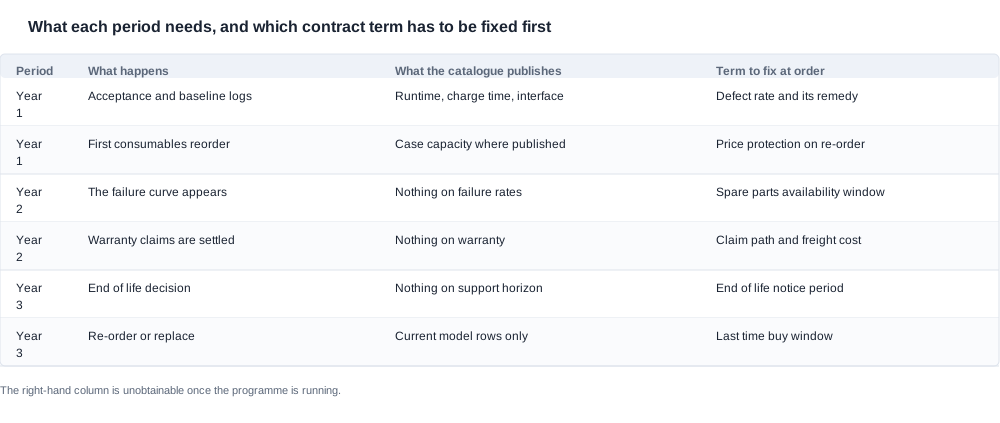
| Period | What happens | What the catalogue publishes | Term to fix at order |
|---|---|---|---|
| Year 1 | Acceptance and baseline logs | Runtime, charge time, interface | Defect rate and its remedy |
| Year 1 | First consumables reorder | Case capacity where published | Price protection on re-order |
| Year 2 | The failure curve appears | Nothing on failure rates | Spare-parts availability window |
| Year 2 | Warranty claims are settled | Nothing on warranty | Claim path and freight cost |
| Year 3 | End of life decision | Nothing on support horizon | End of life notice period |
| Year 3 | Re-order or replace | Current model rows only | Last time buy window |
Four more terms complete the set, and each of them is standard, and each of them is more valuable in a three-year programme than in a one-off order. The warranty period needs to be stated in months and needs to name the accessories that travel with the device, because a case issued per device doubles the claimable population. The return window needs to be long enough to cover the site's own reporting cycle, which is often longer than the buyer's own and is set by the site's operations rather than by the purchase order. The claim path needs a named route and a freight rule, because a claim that has to be argued is a claim that gets written off. And the tooling and customisation terms need ownership stated, because a model with a custom lens or a custom package is a model a new supplier may not be able to reproduce at all, which is a much larger long-term risk than the device failing.

The negotiation order that works is this: configuration and the published rows first, because they are facts and there is nothing to negotiate; then the documentation the destination market requires; then the lifecycle clauses, which is the part that is hardest to obtain and easiest to lose by asking late; then price. Buyers frequently reverse this and negotiate price first, which is understandable and produces a worse outcome, because a lower unit price bought without a spare-parts window is a worse deal than a slightly higher one bought with it.
Two things are worth asking explicitly because they are often assumed rather than agreed. The first is whether the supplier will support a re-order of the same configuration at a later date, and on what terms — this is the question behind the last-time-buy window, and it is the one that decides whether year three is a procurement exercise or a negotiation. The second is whether the published rows for the model will still be the rows quoted, which is a question about specification continuity. A buyer who has kept the original file and the original annex is in a strong position on both, and that strength is entirely a result of having written the records down in year one.
One further point belongs here because it is the cheapest clause in the whole set. A multi-year programme should name the person who owns the file. Not the department, and not the role — a named person who is responsible for re-ordering before the consumables run out, for re-running the compliance file when the certificate changes, and for starting the renewal conversation in the third year rather than in the fourth. Most multi-year programmes fail on the absence of an owner rather than on the absence of a term, because a term nobody is responsible for is a term nobody enforces, and the failure surfaces as an avoidable stockout or an avoidable lapse. Naming the owner costs one line in the order and removes a whole category of problem that no technical specification can address.
Where our position stops, and what we will do instead
Here, the published rows and the future-facing contract terms are different things, and a buyer who confuses them has a procurement problem rather than a product problem. We publish the cell capacity or configuration, the charging interface where the catalogue states it, the charge time as a ceiling, the rated runtime, the radio version where it is published, the resolution class on the camera models, the case capacity and case status where they are published, the detachable part terms, the remote control terms, the ingress marking on the two models that carry it stated as a catalogue attribute, and the 158 g whole-unit weight for the MT6.
We do not publish cycle life, standby draw, hinge life, a firmware support horizon, a defect rate, a warranty period, a return window, a spare-parts availability window, an end of life notice period, or any price. We would rather tell a buyer that a number is not published than quote a typical figure that cannot be traced to a document, because in a three-year programme a guess that is wrong in year two is a budget that is wrong in year three, and a budget that is wrong is discovered by the finance team rather than by the buyer. The maintenance side of the same subject is at maintaining smart glasses for field work, and the claim terms are set out at warranty and returns for field work.
What we will do is take a fleet size, a deployment profile, a shift pattern and a market, and return the configuration, the published rows that support it, the models in the range that publish a serviceable part where the fleet needs one, and the clauses we can write into an order. The camera models that would sit in a multi-year fleet are at AI camera glasses, and the scenario entry point is the field work application page.


