

Smart glasses for field work: the condition the exposure envelope has to hold
Smart glasses for field work are the one application in this catalogue where the most important maintenance document is a contract clause rather than an insert. A technician's device spends its life in the places a specification sheet is least able to describe: on a roof, in a plant room, in a van on a hot afternoon, in a pocket with dust and grit in it, in the hand of someone wearing gloves. Against that, the catalogue publishes an ingress marking on exactly two of the eleven camera models, the V06 and the S7; it publishes no operating temperature range, no vibration rating, no drop figure, no lens material, no coating and no frame weight for any model; and it publishes a runtime and a charge time for every one. The result is a gap that only a buyer can close, and closing it is a procurement act: define the exposure envelope the deployment actually operates in, work out which parts of it the published rows cover, and put the rest into a service level with an interval, a scope and a named owner.
That is why field work is not a tips article. The failure does not arrive as a scratched lens; it arrives as a warranty boundary argument — a unit that was in the rain, or on a roof in June, or in a van in July, and a supplier who points at a catalogue that never claimed any of those conditions. The maintenance programme is the set of documents that settles those arguments before they start: the exposure definition, the service interval expressed in service hours, the technician's scope, the warranty boundary, and the record that shows what the unit actually did.
Who this is for and what is being bought. The reader is a brand buyer, a channel buyer, a service manager or a solutions provider assembling a device programme for field work — utilities, facilities, surveying, inspection, repair and commissioning teams — and the task is to specify the service regime, the technician's kit and the contractual boundaries that the deployment depends on. The risk being managed is a replacement rate that has no agreed cause, and the operational cost that follows from a device that is out of service for a week because nobody could decide who was responsible for it.
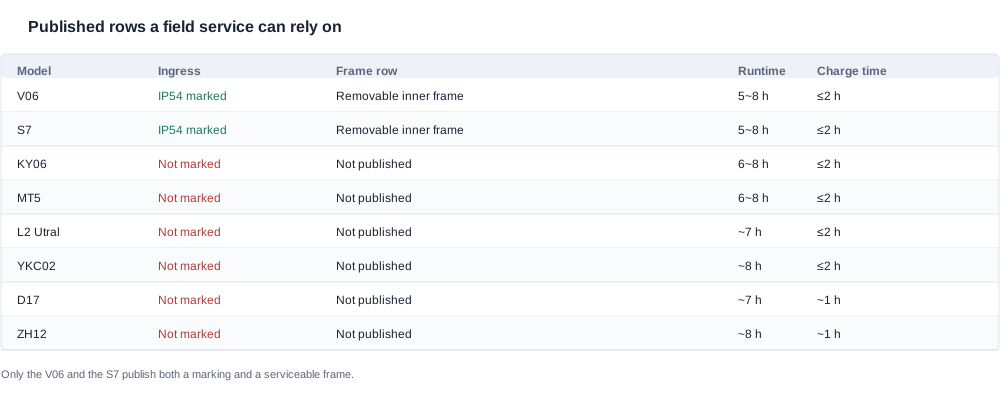
The published rows a field service can rely on.
| Model | Ingress | Frame row | Runtime | Charge time |
|---|---|---|---|---|
| V06 | IP54 marked | Removable inner frame | 5~8 h | 2h or less |
| S7 | IP54 marked | Removable inner frame | 5~8 h | 2h or less |
| KY06 | Not marked | Not published | 6~8 h | 2h or less |
| MT5 | Not marked | Not published | 6~8 h | 2h or less |
| L2 Utral | Not marked | Not published | ~7 h | 2h or less |
| YKC02 | Not marked | Not published | ~8 h | 2h or less |
| D17 | Not marked | Not published | ~7 h | ~1 h |
| ZH12 | Not marked | Not published | ~8 h | ~1 h |
What this table decides and what it refuses to decide. It decides which models can carry a water-exposure sentence — two of them — and which models publish a frame architecture a technician can work on, which is again those two. It decides the recharge arithmetic: the D17 and the ZH12 publish a roughly one-hour charge time, which fits a shift break, while the models at two hours or less fit an overnight. And it refuses to decide the temperature question, the vibration question and the drop question, because those rows do not exist. A buyer who wants a device for a roof in summer has to write the envelope and ask the supplier what it will stand behind.
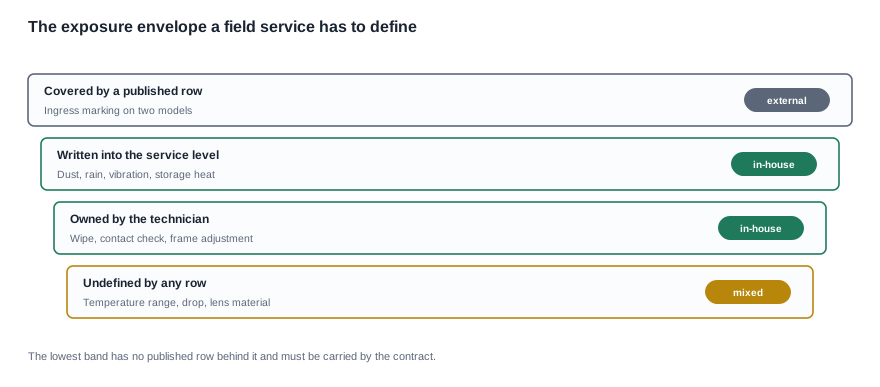
What the exposure envelope contains, and why the catalogue cannot fill it
Water, which is published on two models and nowhere else. The V06 and the S7 carry an IP54 marking, and no third-party test report sits behind it. The marking covers a dust protection level and splashing water; it does not cover immersion or a sustained downpour. For a field service, that is a usable sentence — a technician working in rain can say the device is rated to IP54 — but only for those two designations, and only if the marketing copy quotes the digit rather than the word. The other nine camera models carry no marking at all, which means a deployment that says "weather resistant" as a range claim is claiming something the catalogue does not support. The digit reading is at IP ratings.
Temperature, which is published nowhere. The catalogue publishes no operating temperature range for any model, and field work is a temperature application: a van interior, a roof deck, a plant room, a winter survey. A device stored in a vehicle at 60 degrees is outside every published envelope because there is no published envelope. The honest procurement position is that the envelope has to be written by the user and offered to the supplier for comment, and the warranty boundary has to state whether it covers the envelope the buyer defined. That is an uncomfortable conversation to have after a summer failure and a comfortable one to have during the quotation.
Dust, grit and vibration, which are published nowhere. A device in a dust environment has no published particle rating, and a device in a van on a rough road has no published vibration figure. Both exposures produce the same symptom — an intermittent unit, a unit that will not charge, a unit whose output is intermittently wrong — and both are outside any published row. The control is the service regime: an inspection at a defined interval, a wipe item in the technician's kit, and a unit that is withdrawn on the first intermittent symptom rather than run until it fails completely.
The frame, which is published on two models and is the most useful row in this table for field work. The V06 and the S7 publish a removable inner frame. A technician can change that part at the depot in minutes; a fixed frame means the whole unit is withdrawn. Across a service organisation that is the difference between a spare-parts line and a replacement line, and it is worth more in a field deployment than any feature name, because the cost of a withdrawn device is the technician's day rather than the unit's price.
The charge time, which decides the recharge point. The charge time of two hours or less published on most models fits an overnight recharge at the depot. The roughly one-hour charge time published on the D17 and the ZH12 fits a shift break and is the reason a site crew can keep going without returning to the vehicle. Both are Type C models, which also means the fleet needs one cable type rather than a dock per position.
The custody of the device between crews, which is a service design question. A device handed from one crew to another is a device with two service histories, and the record has to follow it. In practice that means a service log attached to the unit, not to a person, and an inspection that happens at the handover rather than at a fixed calendar date, because a crew's exposure depends on the sites it visited rather than on the month.
Setting the service interval in hours of work rather than in months
The interval below is written for a service organisation with a depot, a technician and a fleet.
- Write the exposure envelope first, as a document: the sites, the surfaces, the weather, the temperature range the device will actually see, the transport and storage conditions, and the handling conditions. Every later question is answered against this document, and a supplier can comment on it in a way it cannot comment on a general requirement.
- Mark which parts of the envelope the published rows cover, and which parts they do not. The gap is not a reason to reject the range; it is the reason the service level needs to be specific.
- Set the interval in service hours or in site visits, because exposure follows work rather than the calendar. A technician who has been on three roof sites has had a different week from one who has been in an office.
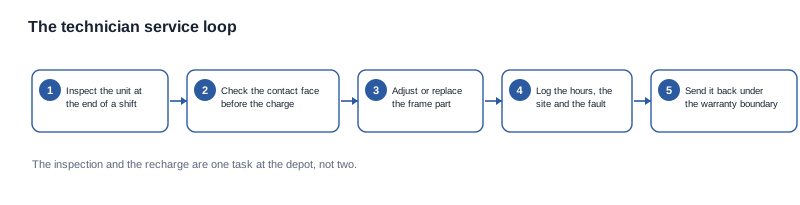
- Define the technician's scope in writing: what they inspect, what they wipe, what they adjust, what they replace from the spares stock, and what they escalate. A technician with an undefined scope will do what is convenient, which is rarely what the contract intended.
- Fix the inspection moment at the end of a shift, when the device is back at the depot or the vehicle, and make it the same moment as the charge. The inspection and the recharge are one task, not two.
- Hold a spares stock at the depot for the models with a serviceable frame part, and set a reorder interval that a technician can rely on. A part that has to be ordered is a device that stays withdrawn.
- Withdraw a unit on the first intermittent symptom, and record it as withdrawn rather than as failed. That distinction is what lets the service organisation see whether a pattern exists, and it is the difference between a warranty claim and a service observation.
- Keep the service log with the unit, and log the hours, the sites and the symptoms. Without that log, the warranty conversation becomes an argument about memory.
- Request the battery transport documentation for the configuration being shipped and for any return movement of a faulty unit, because a returned device is a cell in transit. The requirement is set out at battery transport.
- Check the certificate register entries for the designations the fleet handles, at certification checklist, and confirm the sample unit used to test the regime is the production configuration.
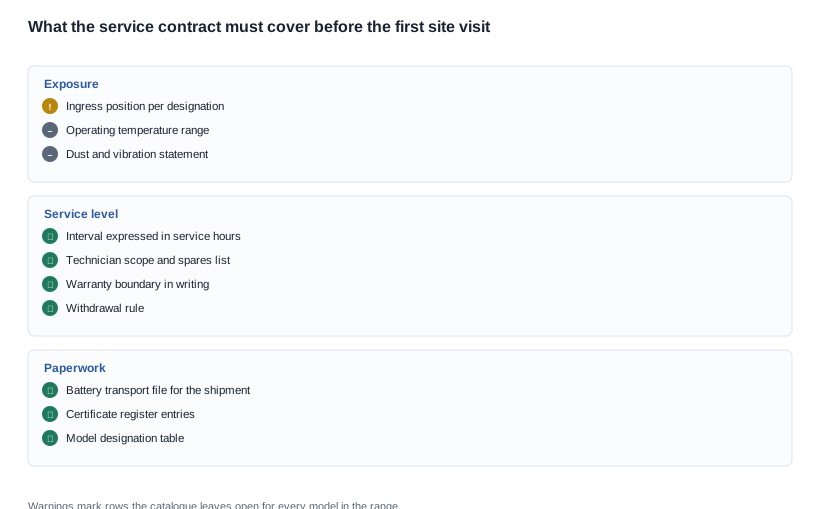
The checklist a field order should not be signed without. The written exposure envelope, the map from the envelope to the published rows, the interval expressed in service hours, the technician scope, the spares list and the reorder interval, the withdrawal rule, the warranty boundary, the service log format, the battery transport file for the shipment and for returns, the certificate register, and the incoming inspection criteria. Look for the clause language at contract terms and for the commercial structure of a first order at pricing. The warranty and returns treatment is at warranty and returns, the upstream selection is at choosing the right model for field work, the lens-surface detail is at how to clean lenses, the charging plan is at charging for field work and the published endurance rows are at battery life.
A field service programme built from the published rows
Take a utilities inspection contractor running 45 devices across six crews, working substations, plant rooms and overhead line sites, with one shared depot and a supervisor who wants a replacement number that is explained rather than merely reported. The first step is the exposure envelope, written as a document: dust in the plant rooms, rain on the overhead sites, a van that sits in the yard in summer, and gloves on the overhead work. The second step is the map from that envelope to the published rows, and it is short: the two models with the IP54 marking and the removable inner frame cover the rain exposure and the field-replaceable part, and nothing in the catalogue covers the temperature or the dust or the vibration. The third step is therefore the service level, written to cover what the rows do not — an interval expressed in site visits rather than months, a technician scope that names the inspection and the wipe and the frame adjustment, and a warranty boundary that says explicitly whether the envelope the buyer defined is covered. The fourth step is the recharge point: the Type C models with the roughly one-hour charge time let a crew recharge at the site rather than return to the vehicle, which is what makes the interval workable. The fifth step is the spares stock at the depot for the two models with a serviceable frame part, with a reorder interval a technician can rely on. The sixth step is the service log, carried with the unit and logging the sites and the hours, so the supervisor's replacement number can be broken down by cause — withdrawn on an intermittent symptom, withdrawn on a failed part, withdrawn on damage. The seventh step is the paperwork, with the certificate register checked rather than assumed and the battery transport file covering both the outbound shipment and the movement of faulty units back to the depot. The result is a programme whose cost is explained line by line, a replacement number with causes attached, and an exposure definition that a supplier can be held to.

The field-work failures that arrive as a warranty boundary argument
A range claim that no model carries. The deployment note says the devices are weather resistant, and only two carry a marking. The symptom is a damaged unit after a wet site and a supplier who points at the catalogue. The root cause is a range claim built on two model-level attributes. The prevention is a per-designation claim sheet, signed, with the digit in it.
A device stored in a vehicle through the summer. The unit is out of its envelope, because no envelope is published. The symptom is a device that will not switch on after a warm week. The root cause is a claim the catalogue does not make. The prevention is a written storage instruction and a supplier asked to state what it will stand behind.
An intermittent unit run until it fails completely. The device drops out occasionally and the technician keeps using it. The symptom is a total failure with no early warning. The root cause is no withdrawal rule. The prevention is the withdrawal rule and the service log that makes the pattern visible.
A frame written off instead of a part replaced. The two models with a removable inner frame are retired for a damaged frame part. The symptom is a capital line where a spare-parts line was expected. The root cause is no spares stock at the depot. The prevention is a stock list and a reorder interval.
A technician with an undefined scope. The technician does what is convenient at the depot. The symptom is inconsistent treatment across crews and an inspection that sometimes checks the lens and sometimes does not. The root cause is an undefined technician scope. The prevention is a written scope, which costs nothing and settles everything.
A service log kept on a spreadsheet that nobody reconciles. The hours and the sites exist but the replacement rate cannot be attributed to a cause. The symptom is a review meeting with no conclusion. The root cause is no agreed use for the log. The prevention is to define the one number the log exists to produce.
A failed unit returned without the right paperwork. The faulty device goes back to the depot and then to the supplier as a cell in transit without the right document. The symptom is a delay in the warranty credit. The root cause is that the return movement was never requested separately. The prevention is a transport file that covers the return direction.
A handover with no record. The device moves from one crew to another and its history stops. The symptom is a fault that cannot be attributed to a site or a condition. The root cause is no log attached to the unit. The prevention is the log, kept with the device rather than with the person.

Where a field order has room to move and where it does not
The elements of a field order that are fixed before the price conversation. The ingress position, because it belongs to the catalogue and cannot be widened by agreement. The cell configuration and the runtime ceiling. The charge time. The frame architecture, once the replaceable-part decision is taken. The certification cost and its lead time. Tooling, which is amortised across the first order and does not sit inside the unit price.
The elements where the commercial room sits, in the order a field buyer should spend it.
- The spares and consumables package. A wipe material, a contact treatment and a small stock of the serviceable frame parts are the cheapest inputs in the field programme and the ones that determine whether a withdrawn device returns to service the same day or stays in a drawer. Negotiate the quantity and the lead time, not whether it is included.
- Whether the supplier writes the technician scope and the service log format. A supplier who has run field programmes will produce both, and that saves the buyer a week of designing a regime the crews have to accept.
- The warranty boundary, negotiated explicitly against the buyer's own exposure envelope. This is the single most valuable clause in a field order, and it costs nothing to ask for before the order and a great deal to ask for after a failure.
- The share of units taken at a pilot tier. For a field programme the pilot is one crew over one month, and it produces the exposure and failure data that the service level is built on.
- Minimum order quantity tiers, and whether a replacement order for a withdrawn unit can be raised on the run tier rather than waiting for the next batch. For a fleet that is the difference between a serviceable device and a stored one.
- Splitting the first delivery into two dates against a staged payment, which for a service organisation usually maps onto the first crews and the rest, and which lets the envelope be revised with real data before the larger order.
- The training and onboarding package. A technician who has not handled the device will generate avoidable service events, and a supplier who provides the training is removing a cost that would otherwise appear as a defect rate.
- The trade-off between a marked model and a longer-rated model, recorded as a decision with a cost, because the buyer will have to justify it to an operations manager who has seen the invoice.
What we will substantiate for a field-work programme, and what we will not
We publish the rows a field buyer can order from: the rated runtime, the cell capacity, the charge time, the charging interface where the catalogue publishes one, the charging-case capacity where it appears, the pixel class on the camera models, the ingress marking where it appears, and the frame architecture where it appears. We publish the absence of an operating temperature range, of a vibration rating, of a drop figure, of a lens material, of a coating, of a frame weight for most models and of a third-party report behind the ingress marking with the same prominence as the rows themselves.
What we will not do is state that any product is tested to IP54, and we will not extend the marking to the models that do not carry it. We will not invent an operating range, a particle rating or a vibration figure to fill the envelope, because a field service that designs its service level against a figure we made up will discover the figure at the worst moment. We will not quote the one weight figure in our catalogue as a field-work figure — it belongs to the MT6, a camera model with a 1200 mAh folding case, it is the weight of the glasses body including its battery and camera and excluding the case, and the case weight is not published. And we will not promise a service interval that the published rows do not support.
What we will do is take the sites, the exposure, the crew structure, the depot, the price band and the volumes, and return the models whose published rows cover the exposure, the service level the remaining exposure requires, the technician scope, the spares and consumables, and the documents to settle in writing before a purchase order is raised.
Send us next. Send the sites, the exposure the devices actually see, the number of crews and devices, the depot arrangement, the price band and the volumes, and we will return the service level with the envelope mapped against the published rows. The scenario entry point is smart glasses for field work.
Related reading
- The opening point of the scenario — smart glasses for field work
- The model families — AI camera glasses and sport smart glasses
- The upstream selection — choosing the right model for field work
- The warranty and returns treatment — warranty and returns
Send the sites and the exposure the devices actually see, and we will return the service level with the envelope mapped against the published rows.


