

Real-world experience is the only source of the field data this category does not publish, and it is also the least structured. The catalogue states the cell configuration, the charging interface where it is published, the rated runtime, the charge time, the resolution class on the camera models, the case capacity and status where they are published, the detachable parts, the ingress marking on two models, and one weight. It states no frame material, no lens material, no coating, no hinge specification, no field of view, no video format, no storage behaviour, no operating temperature range, no cycle life rating, no standby draw, no acoustic figures and no frame weight for any model other than the MT6. A site is the only place those rows get filled. The problem is that a site reports in sentences, and a procurement file needs thresholds.
Smart glasses for field work: field reports are raw material, not evidence
The conclusion. Field reports from a customer site should be treated as raw material for a specification, not as evidence about the product, and the distinction is worth a whole procedure. A report that arrives with the model code, the configuration, the elapsed time in service, the environment, the mode and the symptom in the operator's own words can be converted into a specification line or a written request with a named method. A report that arrives without them is a signal that something is wrong, not a finding that something is broken. Buyers who treat the two alike end up either chasing an anecdote through a supplier's quality department or discarding a genuine pattern because it arrived as a complaint rather than as a report.
Who this is for and what they are solving. The reader is a brand owner, a channel buyer or an integrator whose customers are already running equipment in the field. The specific situation is that reports are arriving — through a channel partner, through a customer service inbox, through a site manager — and they are accumulating without a shape. Somebody has to decide what to do with them, and the default decision is to treat each one as an individual complaint. That default is wrong in both directions: it wastes a supplier's engineering attention on isolated cases, and it loses the one recurring signal that would have changed the specification.
Why the gap between the catalogue and the site is not going to close. The rows the catalogue does not publish are not withheld as a marketing decision; they are the rows that require a test method, a defined condition and a sample population, and none of those three exists on a product page. A frame material would have to be named against a part number. An operating temperature range would have to state the storage condition, the humidity and the duration. A cycle life rating would have to state the charge profile, the temperature and the end-point. The only practical route to those numbers is a structured test, and a structured test needs a structured input — which is what the intake form is for.
The three ways field feedback goes wrong
These three failure modes account for most of the value lost in this category, and they are worth distinguishing because each has a different remedy.
- The anecdote as a specification. One report becomes a requirement in the next order file. The remedy is a volume rule: a symptom becomes a specification line when it recurs on the same model, not when it arrives once.
- The confirmation bias in the channel. Only the loud failures get reported. The remedy is to ask for what worked as well as what failed, and to treat a quiet channel as an unknown sample rather than as a good result.
- The non-diagnosable report. "It stopped working" carries no symptom, no mode, no duration and no environment, and it cannot be reproduced, so it cannot be triaged. The remedy is a fixed intake form and a rule that an incomplete report is logged and returned, not filed.
The intake form: what a report has to carry
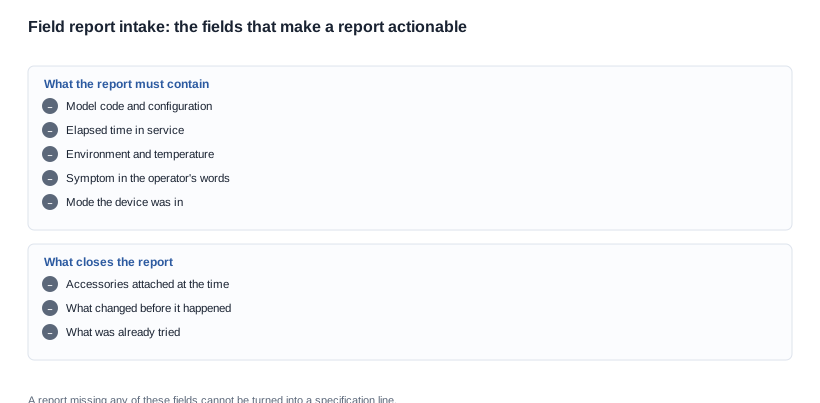
Nine fields, and the list is short enough that a site manager can complete it in a minute over the phone. The form's purpose is to make the report diagnosable, not to make it complete, and the difference matters: a report that is complete enough to triage is worth acting on immediately, and a report that is perfect but arrives in three weeks is worth much less.
- Model code and configuration — the model, the colour, the case configuration and the interface. The catalogue publishes the interface for most models and not for four camera models, so the configuration line is what disambiguates a report about charging.
- Elapsed time in service — how long the device had been in use before the event. A report in the first hour and a report after eight months point at different things, and neither points at the same thing as the second week.
- Environment — the site description in the reporter's words, including whether it was wet, dusty, hot, cold or exposed, and whether the device was under head protection.
- Mode — what the device was doing: recording, idle, charging, connected. This is the field that is most often missing and the one that decides whether a report can be compared against a published runtime.
- Symptom in the operator's words — recorded verbatim, because a translated or paraphrased symptom loses the detail that distinguishes a charging fault from a connectivity fault.
- Accessories attached at the time — case, remote, inner frame, retention method, and which lead was used.
- What changed immediately before — a shift, a temperature drop, a fall, a new site, a new task, a firmware or configuration change.
- What was already tried — the attempts that did not work, so the supplier does not repeat them.
- The evidence — a photograph of the screen, a written note of the behaviour, a return or a swap, and the serial reference on the unit.
Two of these nine fields are the ones that make the report usable, and they are the two that are always missing: the elapsed time in service and the mode. A report with both can be triaged against the published rows in minutes. A report without them can only be logged.
Triaging a report: four destinations
Every report that arrives goes to one of four places, and the triage rule is the same for all of them. The decision chart below is the route.
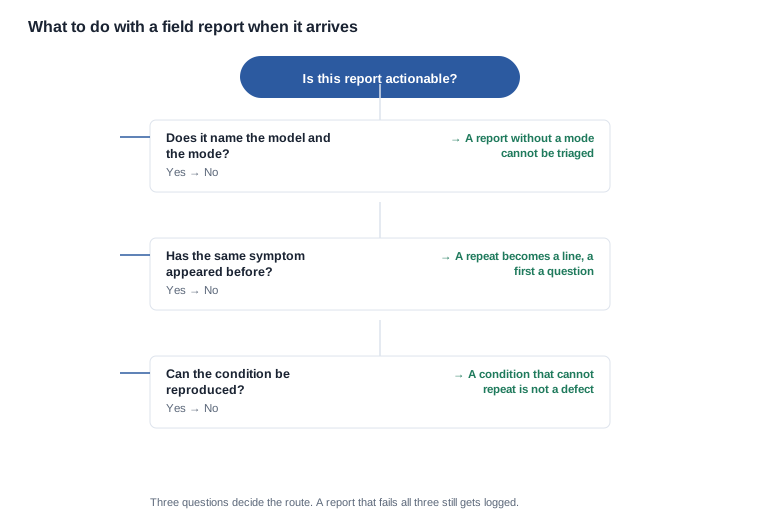
Actionable now. The report names the model, the mode, the symptom and the elapsed time, and the symptom is one the published rows can explain. The example is a charging failure on a model whose catalogue row gives a charge time but no starting state: the report either confirms a published figure or identifies that the figure is not being met, and both outcomes are useful. The action is a line in the returns log with the model, the symptom and the duration, and a note in the specification if the failure rate becomes significant.
A written request to the supplier. The symptom points at a row the catalogue does not publish, so the answer cannot come from a catalogue and must come from a document. The examples are a weight complaint, where the catalogue publishes a weight for one model only; a case complaint, where the case capacity is published for five camera models but the charging method is not published for four of them; an ingress complaint, where the marking is a catalogue attribute with no test report behind it; and a connectivity complaint on a camera model, where no radio version is published at all. The action is a request with a named method, not a complaint with an expectation attached.
A sample test. The symptom is about something physical that only the device in the hand can settle: the retention method, the mounting, the hinge behaviour, the contact points against the head, the acoustic behaviour of an open-ear configuration, or the behaviour under the site's own head protection. The action is a written test script, so that the result is a number rather than an opinion.
Logged and closed. The report is incomplete and cannot be triaged, or the symptom is a one-off with no pattern behind it. The action is to log it, to ask for the missing fields, and to keep the count. A report that is closed without being answered is still evidence about the reporting process, and a low rate of actionable reports is a signal that the form is not being used rather than a signal that the product is fine.
Turning a pattern into a specification line
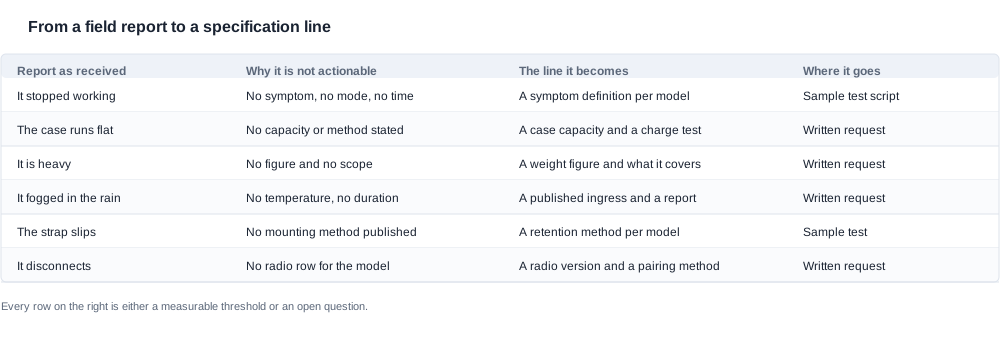
The step that decides the value of the whole procedure is the conversion. A pattern is a group of reports with the same symptom on the same model under the same conditions. A specification line is a criterion with a measurable threshold and a named method. The table above shows six common report shapes and the line each one becomes.
The volume rule. How many reports make a pattern is a commercial decision rather than a technical one, and it should be written down before the reports start arriving, because after they arrive the rule is set by whichever complaint is loudest. A workable approach is to fix the threshold at order time, to review the log at a fixed interval against that threshold, and to keep the log even when the threshold is not met. The value of the log before the threshold is met is that it establishes a baseline, and a baseline is what makes a later spike legible.
What the pattern feeds. This is where the procedure stops being a customer service exercise. The same log produces three commercial outputs, and each of them is a number the buyer needs and the catalogue does not provide: the failure rate for the model, which belongs in the returns reserve and in the defect-rate clause; the rate at which each published row is being missed, which is the first evidence that a published figure is optimistic; and the accessory failure rate, which is usually the highest number in the log and almost never the one the fleet plan budgeted for. A programme that runs this log for a year has a replacement forecast that a programme without it does not.
The supplier feedback loop. A report that reaches a supplier with a method attached is worth many times one that arrives as a complaint, and the difference shows up in the quality response: a defect rate with a mode and an environment attached can be reproduced on a bench, while a complaint that says "it stopped working" starts a conversation about which unit is being discussed. The practical measure of a good feedback loop is simple and worth watching: the proportion of reports that the supplier answers with a measured response rather than with an acknowledgement.

The blind spot in every field report
One category of information never appears in a field report, and a buyer should know it is missing rather than assume the absence means the problem is absent. The catalogue publishes no cycle life rating, no standby draw, and no storage condition between uses, which means that degradation between deployments is a phenomenon nobody is watching. A device that spends a week in a vehicle in a hot climate and is then brought back into service has been through a condition the published rows do not cover, and no report will ever be generated for it, because nothing looks wrong until the runtime no longer reaches the shift.
The way to see it is not to wait for a report. It is to build the observation into the acceptance routine: measure the runtime of each device at acceptance, then at a fixed interval, in the mode the deployment uses. The published bands are the reference — five to eight hours on the V06 and the S7, and the V03 and the V03 Pro, six to eight on the KY06 and the MT5, around seven on the MT6 and the CY03, and the L2 Utral and the L1 Pro, and the CY05, and around six to eight hours across the connected models — and the observation is whether a device drifts toward the bottom of its band. A device that drifts is the early signal, and it arrives months before a complaint would.

The commercial terms of a feedback loop
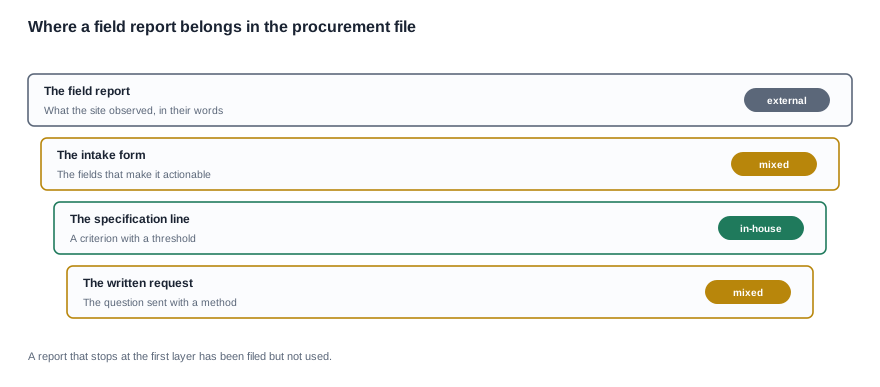
A feedback loop is an operating arrangement, and operating arrangements cost money and have to be bought. A buyer who assumes that reports will keep arriving in a usable form will find the log thinning after the first month, and the reason will be that nobody at the site was given the time or the incentive to complete a form. The commercial terms are what keep it alive, and there are four worth negotiating explicitly rather than assuming.
The reporting obligation and its owner. The clause should name who completes the report, who checks it, and what happens to a report that arrives incomplete. A channel partner selling through to a customer cannot be the owner of the report quality, because the report is written by the person at the site. The owner belongs on the customer side, and the buyer's obligation is to supply the form and to make returning an incomplete report a normal and expected event rather than a confrontation.
The supplier's response obligation. This is the clause most often left out and the one that determines whether the loop produces anything. A useful formulation commits the supplier to acknowledge a report within a stated period, to state whether the report can be reproduced, and where it can be reproduced, to give a measured response rather than an acknowledgement, and to feed a recurring pattern back into the specification. The criteria are simple: the response has to name a method, and the recurring pattern has to change a document. A supplier who will do that is a supplier who is building the buyer's field rows, and a supplier who will not is telling the buyer that the gap will stay open.
The quality improvement and the cost split. When a pattern turns out to be a design or a specification issue, someone pays for the fix, and the clause should say how. Three structures are common and each of them suits a different situation: a unit-cost change negotiated as a one-off, an engineering change absorbed by the supplier, or a cost-sharing arrangement across the fleet. The trade-off is straightforward. A buyer that absorbs the cost of every change carries the risk of a supplier with no incentive to find the problem. A buyer that insists on a per-change negotiation gets a slower loop and a longer conversation. What should not happen is the version where the question is raised, answered, and then never paid for, because that is what turns a supplier's quality team into a cost centre that stops answering.
The defect rate and the evidence behind it. The log produces a failure rate over time, and the clause that settles the returns reserve should be tied to that rate rather than to a fixed percentage chosen by convention. The questions to ask before you order are how the rate is defined, what counts as a failure, who counts it, and over what population and what period. This is a negotiation about the definition of a number, and a definition agreed at the order is worth more than a rate renegotiated later, because the renegotiation happens with the buyer needing the number and the supplier needing the payment.
The total cost of the whole arrangement is rarely the form and is almost always the delay. A report that is triaged the same week can still be a specification line before the next order; a report triaged a quarter later can only be a lesson. That is the argument for funding the process properly rather than treating it as a service overhead, and it is a stronger argument than it sounds, because the alternative is paying for the same lesson at a higher price later. The failure modes worth watching are a channel that reports only failures and never successes, a log that is kept but never read against the published rows, and a form that grows so long that sites stop completing it. A short form read often beats a complete form read once.
Reading a field report against the published rows
Stated plainly: a field report is a piece of information about a device in a specific condition, and it becomes useful when the condition is attached to it. We publish the rows that describe the device — the cell configuration, the charging interface where the catalogue states it, the charge time as a ceiling, the rated runtime, the radio version where it is published, the resolution class on the camera models, the case capacity and case status where they are published, the detachable part terms, the remote control terms, the ingress marking on the two models that carry it, and the 158 g whole-unit weight for the MT6. We do not publish frame and lens materials, the coating, the hinge specification, the field of view, the video specification, the storage behaviour, the operating temperature range, the cycle life rating, the standby draw, the acoustic figures, or the weight of any other model, and a field report is frequently the only way those rows ever get filled.
What we will do with a report is read it against the published rows for that model, tell you which of the three it can be — a confirmed fault, a gap that needs a written answer, or a physical question that needs a sample — and convert it into a question with a method where that is possible. What we will not do is treat a single report as a finding, or supply a typical figure for a row the report has not yet earned. Send us the reports with the model code, the configuration, the elapsed time and the mode, and we will return the triage for each one. The camera models that generate most field reports are at AI camera glasses, the handling side of a report is covered at maintaining smart glasses for field work, the comparable problem in another scenario is at common problems for security deployments, and the scenario entry point is the field work application page.


