

The same six problems appear in almost every security deployment of smart glasses, and none of them are exotic: a battery that was never on charge, a recording made in light the lens cannot handle, a unit taken off after twenty minutes, a missing file, a device that will not connect on site, and a legal team that stops the pilot. This is a smart glasses for security smart glasses common problems guide written as a walkthrough of a deployment that goes wrong in stages, because the problems arrive in a sequence and each one causes the next. The composite scenario below contains no customer, no client name and no order from any real account.
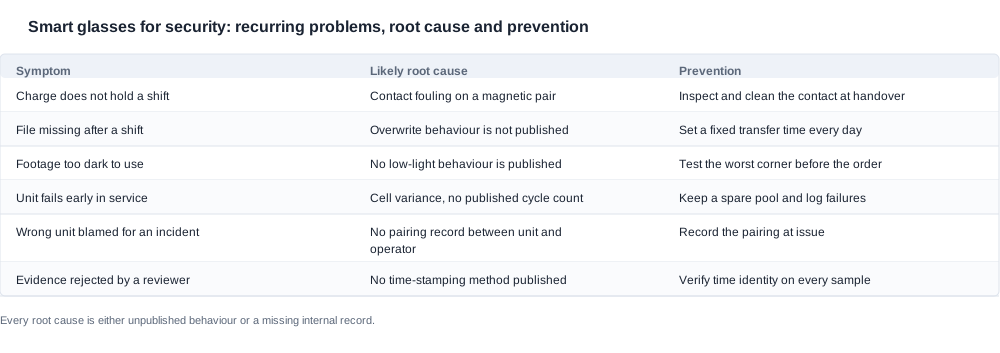
Smart glasses for security: the failures that come back every quarter
A property management company wants 60 units for a mix of static gate posts and mobile patrols across three sites, mostly outdoors, with day and night shifts. The buyer has a spec sheet, a budget and a launch date, but no written acceptance criteria, no stated duty cycle per post, and no answer from their own compliance team about recording in public areas.
The walkthrough below follows the six problems through that composite deployment in the order they surface. The point of the order is that a procurement team buying 60 units without acceptance criteria is not making six independent risks. It is making one decision — to defer the specification — that generates all six in sequence, and each one costs more than the last because it arrives after units are in the field.
Problem one: the unit died mid-shift
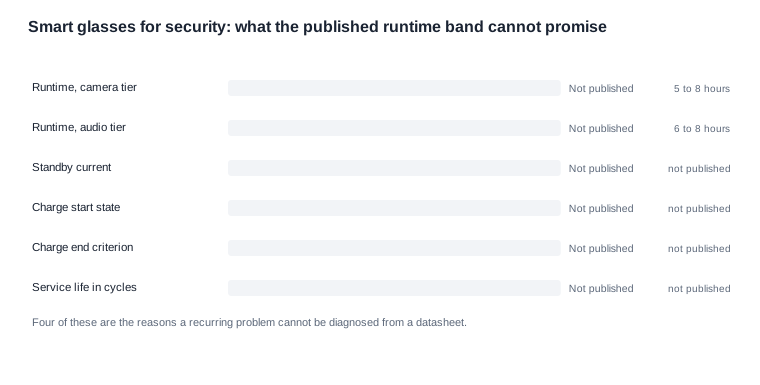
The published runtime figures in this catalogue run from about 6 hours on the 55 mAh per side audio models to about 8 hours on the 100 mAh per side platforms, with the camera models in a similar band of 5 to 8 hours. A twelve-hour static post cannot be served by a single charge of any of them, and the specification should have said so before the order.
The failure is rarely the cell. It is a case that was left at the desk, a unit swapped in without being put on charge, and a roster that treats the device as though it has a full shift of power. The fix is on the buyer's side: a written charging roster, a spare pool sized to the number of units in transit or in the workshop, and a shift model that matches the published figure. The model-selection route is at field work model selection and the constraint list is at the security deployment guide.
There is a purchasing decision hiding inside this problem, and it is the one most often skipped. The fix is not a bigger battery — the catalogue's cell capacities are fixed per model — it is the choice of a model that publishes a charging-case capacity. Five camera models do: the L1 Pro and the CY03, and the CY05 — each at 1400 mAh, the L2 Utral at 900 or 1400 mAh, and the MT6 at 1200 mAh in a foldable case. Two publish that a case exists without publishing its capacity, which are the KY06 and the MT5. Three have no case row at all, which are the V03 and the S7, and the V06. One has no charging-case row, which is the V03 Pro. A buyer who specified the fleet before establishing the case position bought a fleet that may not be able to cover a twelve-hour post at all.
Problem two: the recording is unusable
The published camera figure is a resolution — 8 MP or 13 MP — and resolution says nothing about how a camera behaves at night. Field of view, sensor part number, aperture, video resolution and frame rate are all marked Not published for every camera model, which means a buyer choosing a night-shift camera is choosing without the data that would inform the choice.
There is one honest way to proceed, and it is a sample rather than a document. Take a unit to the site at the hour of the night shift, point it at the actual conditions, and record the actual material the security team needs — a gate, a vehicle, a face at twenty metres. If the result is unusable, that is a finding worth having before 60 units are ordered.
The commercial point is that this sample test has to be written into the purchase order as an acceptance criterion, otherwise the supplier has met the specification and the buyer has no remedy. What the criterion should say is not "the footage must be good" but something a test can pass or fail: a named location, a named hour, a named subject distance, and a named reviewer from the buyer's own operations team.
The question to ask the supplier before the order is narrower than it appears. It is not "can you improve the low light", because the catalogue publishes no low-light figure that could be improved against, and the answer to a request to improve an unpublished figure is a promise rather than a specification. The useful question is what the published documentation says about the capture behaviour of that exact model, so that the buyer knows which of the deployment's requirements are supported by the documentation and which are supported only by a test. A supplier who answers that question honestly has told the buyer exactly where the risk sits, and the shortlist criteria can then exclude the models whose behaviour cannot be established at all.
Problem three: the unit comes off after twenty minutes
This is the one that quietly ends every pilot. A device that is uncomfortable is removed within the hour, and a device that is not used generates no data, which is then interpreted as the operator not needing it. The cause is weight and fit, and the catalogue publishes a unit weight for exactly one model, at 158 g for the MT6 glasses body including the cell and the camera, excluding the foldable case, whose own weight is not published. For everything else it is Not published, and no amount of specification reading will tell a buyer whether a twelve-hour user will cope.
The only answer is a fit test with the actual people, on the actual shift, for a real day, and it has to be a procurement activity rather than a courtesy. The completion standard is a written result from each of the intended users, and the acceptance criterion is a threshold on that result rather than an opinion. A deployment whose purchase order says nothing about weight and fit will get a fleet that is used for an hour a day, and the fleet will be judged as successful because there is no data to contradict it.
Problem four: the footage is missing
Sometimes the recording happened and the file is gone. Storage capacity, file format, overwrite behaviour and whether a companion application uploads to a service are all marked Not published for every camera model. The requirement therefore has to be written: how long is footage retained, where does it live, and who can retrieve it.
A security team that assumes footage is on a corporate server, when the device is in fact storing locally, has a problem at the moment they need the recording rather than at the moment they buy the device. The procurement remedy is a question in the request for quotation, answered in writing against a model designation, and the answer becomes an acceptance criterion in the order. The transfer route is at the security test guide and the configuration side is at security product recommendations.
Problem five: it will not connect on site
A unit that will not connect is usually a unit on a different application build from the one the site was set up with. In a mixed fleet this appears as a handful of units that work and several that do not, and it reads as a hardware fault. Freezing the application build at the order, and agreeing how the supplier tells you when a component or a build changes, removes the category entirely.
The commercial clause that fixes it is small and specific: a build freeze at the order, a written change-notice commitment with a notice period, and a stated position on who bears the cost of a build change the buyer has to absorb. This is the kind of clause that is easier to obtain before the order than after the first field failure, and the second half of it — who pays — is the half that is usually left out.
Problem six: legal asked us to stop
Recording in public areas, recording staff, and workplace monitoring are governed by rules that differ by jurisdiction and by employer policy. A pilot that starts before that question is answered gets stopped, and everything before the stop is wasted. The compliance question is not a product question and we cannot answer it for a buyer, but it must be answered before the pilot rather than after it.
The sequencing rule that prevents this failure is simple and is worth putting in the deployment plan as a gate rather than as a task: no units are issued to operators until the compliance answer is in writing for the specific sites in scope. Not the general jurisdiction, the specific sites — because a site with a public thoroughfare and a site with a private yard attract different questions, and a general answer covers neither precisely.

The log that turns a complaint into a claim
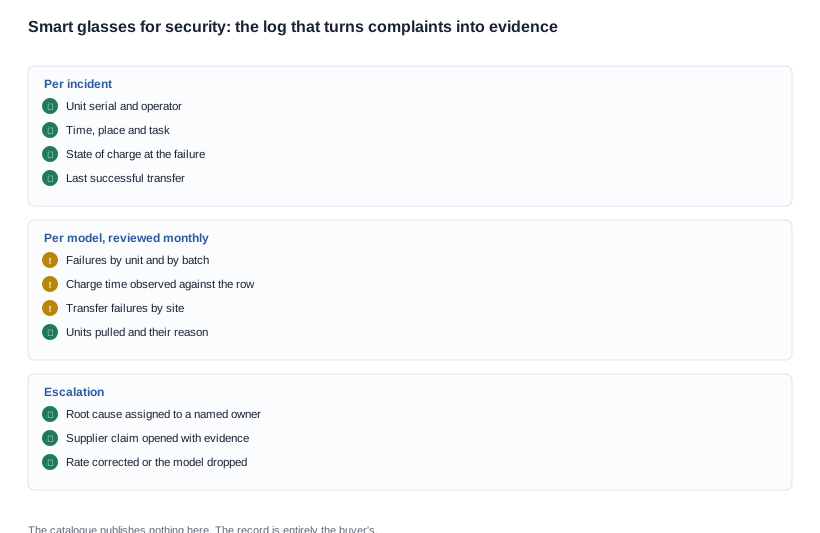
The six problems above all arrive at the buyer as complaints, and a complaint is not evidence. What converts a complaint into something a supplier can act on — or into something the buyer's own operations team can fix — is a structured record, and the structure matters more than the volume of it.
Six fields, captured at the moment of the failure rather than afterwards, turn most of these problems into a diagnosis. The unit serial or the unit reference from the buyer's own labelling. The operator, and the date and the time. The state of charge at the moment of the failure. The last successful transfer. Whether the unit had been on the bench that day. And what the operator was doing at the time.
Those six fields separate causes that look identical from the operator's side. A flat battery with a low state of charge at failure and no bench record that day is a roster problem. A flat battery with a full charge at failure on a verified contact is a cell or contact problem. A missing file with a successful transfer recorded twenty minutes earlier is an overwrite problem, which is an undocumented behaviour rather than a defect. Each of those three leads somewhere different, and without the six fields the buyer is running the same generic troubleshooting script on all three.
The escalation rule that follows is worth writing into the operating procedure, because the alternative is the failure mode this article is about. A unit returns to the supplier only when it deviates from a published row, and everything else returns to the buyer's own operations team for correction. That rule stops a warranty stream from being diluted by operational issues, and it is what lets the buyer make a claim when a claim is warranted.
There is a second rule about frequency that a procurement team should set before the first failure rather than after it. A single occurrence is an incident. A repeated occurrence on the same model across different units and different sites is a signal about the model, and it is the point at which the shortlist criteria need to be re-applied to the configuration already in the field. That re-application is a procurement decision, not a service decision, and the two are often confused.
Why the battery is almost never the cause
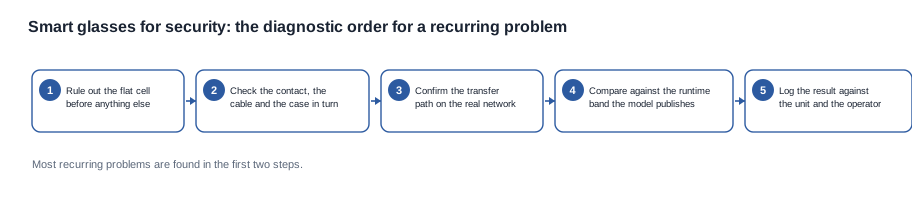
It is worth separating the genuine hardware causes from the operational ones, because a buyer who sends three units back for a fault that was a contact or a roster problem has paid for a repair it did not need and has not fixed the cause.
The cell is rarely the first thing to check. Four published gaps make the cell impossible to diagnose from documentation: no starting state of charge, no end-of-charge criterion, no standby current and no service life in cycles. The charge time is published — two hours or less on 26 of the 28 catalogue models, approximately one hour on the D17 and the ZH12 — but a charge time without a start state and an end criterion cannot be turned into a swap interval or a diagnostic threshold. A buyer who treats "it charges in two hours" as a usable number is reading a ceiling as a measurement.
The contact comes before the cell. On the magnetic configurations, a fouled contact produces an intermittent charge that presents to the operator as a flat battery, and the difference between the two causes is a ten-second inspection. That is also why a deployment with a mixed fleet needs contact inspection at every handover rather than weekly: the mixed fleet puts magnetic and Type-C units through the same bench, and the two fail differently.
The roster comes before both. A unit swapped in without being put on charge looks identical to a failed unit from the operator's side. The written charging roster is the only thing that separates the two, and it is a document the buyer writes.
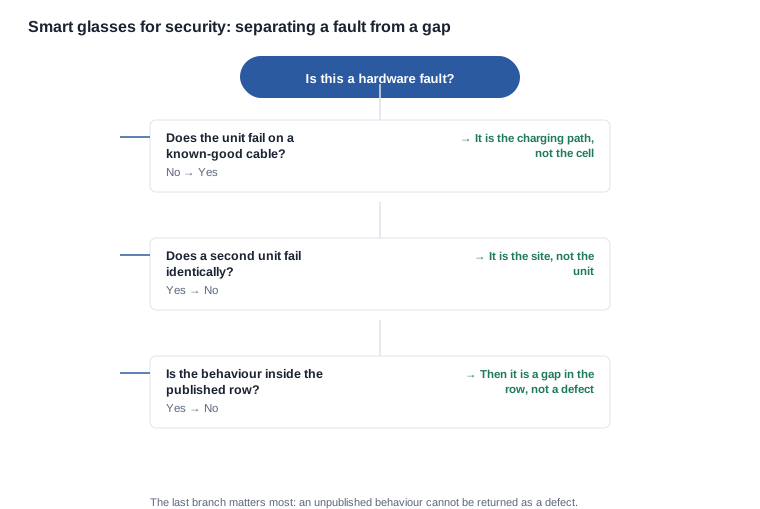
What actually indicates a cell problem is a unit that charges to the expected state on a verified contact and then discharges early, consistently, across more than one cycle. That is a genuine finding, and it is the one that supports a warranty claim. Everything short of that is an operational finding, and the distinction is worth writing into the escalation procedure so that warranty claims are not diluted by operational issues.

Separating a fault from an undocumented behaviour
This is the distinction that decides whether a return is processed, and it is the one a buyer cannot resolve from the catalogue because the catalogue publishes the behaviour for almost nothing.
A fault is a deviation from a published row. The catalogue publishes a cell capacity, a charge time, a rated runtime and, for most models, a charging method. A unit that cannot reach its published charge time on a verified contact and cable is a fault against a published figure, and it is claimable. A unit that will not do something the catalogue says nothing about — will not record continuously, will not retain footage for a stated period, will not behave in a dim corridor — is not a fault at all. It is an undocumented behaviour, and it cannot be returned as a defect because no specification was broken.
That distinction has a commercial consequence that buyers routinely discover late. A supplier's warranty covers conformity to the published row. An expectation formed from a demonstration, a marketing phrase or a category convention is not part of the published row, and a claim built on it is likely to be declined. The prevention is unglamorous: write the expectation into the order as an acceptance criterion before the purchase, or accept that it is not covered.
The same logic applies to ingress. The IP54 marking appears on the V06 and the S7 only, with no third-party test report number behind it, and it covers dust ingress limited and protection against splashing water rather than sustained rain or immersion. A unit that fails in sustained rain is not a defect against a published claim on any model; on the ten camera models with no published ingress marking, there was no claim to fail.

Diagnosing without a specification to diagnose against
The hardest part of diagnosis in this category is that the specification a diagnostic needs often does not exist. A buyer with a camera fault can compare against a published cell capacity. A buyer with a footage problem has nothing to compare against, because no storage capacity, file format or overwrite behaviour is published for any model.
The practical substitute is a reference unit. One known-good unit of the same model and configuration, kept at the bench and not issued to operators, gives the buyer a working baseline for the transfer time, the file format, the recording behaviour in a given light and the charge behaviour. The reference unit converts undocumented behaviour into a comparative observation, which is enough to decide whether a second unit is faulty or whether the programme's expectations are wrong.
That reference unit is also the cheapest defect tool available in this category, and it belongs in the purchase order as a delivered item. A supplier who ships one reference unit with the fleet has made a small concession that removes an entire category of dispute, because from that point the buyer is comparing units rather than asserting that something should be possible.
The boundary of what we will support
To put it plainly — we publish the per-model configuration facts a security deployment turns on: resolution, cell capacity, charging interface, the charging-case options and positions, and the rated runtime with its stated caveat. We mark as Not published the frame weight of every model except one published at 158 g, the sensor part numbers, the field of view, the video specifications, the storage behaviour, the ingress test report numbers and the certification numbers.
We will not describe any platform in this catalogue as recognising a person, detecting an intrusion or raising an alert. Those capabilities are not documented in our source material, and a security product sold on that basis carries a liability the factory cannot carry for you. We will also not present a company-level capability as a per-model certification, because the catalogue contains no per-model certification row.
Send us the site profile, the shift pattern, the unit count and the destination market, and we will tell you which models fit the published constraints, which parameters we cannot evidence, and which of the six problems you are most likely to hit.
Related reading
- The camera and audio range — AI camera glasses range
- Choosing a model for field work — field work model selection
- The deployment framework — security deployment guide
- The configuration side — security product recommendations
Send the site profile, the shift pattern, the unit count and the destination market, and we will tell you which models fit the published constraints and which of the six problems you are most likely to hit.


