

What to expect from smart glasses for field work is a set of constraints rather than a set of features, and the published data describes the constraints rather than the features. A field deployment is not one device on one person; it is a number of units issued to a number of people across a number of shifts, returned dirty, charged in a vehicle or a store room, and re-issued. The published rows settle the hardware. Everything that decides whether the deployment works — the sizing on a working face, the weight of a unit on a long shift, the charge point at the end of the shift, the contamination that turns a charged unit into a flat battery — is a process question that a specification sheet cannot answer.
Smart glasses for field work: the shift is the product
The unit is a component of a system, and the system is what is being bought. A field deployment has four moving parts: the device, the power plan that keeps it working across a shift, the routine that returns it to service dirty, and the documentation that lets the customer put it on site at all. Every one of the four is decided before the first shipment, and three of the four are invisible in a specification sheet. The result is that two suppliers quoting the same model can differ by a wide margin, and the difference is in the parts of the delivery that the model comparison never covered.
Who this is for. The reader is a brand owner or a channel buyer supplying industrial, utility, construction or inspection teams, or a solution integrator building a packaged deployment on top of hardware. The task in front of them is a sourcing decision with a fleet dimension: the unit price is a small part of the cost, and the operating cost of the deployment is the part that shows up eighteen months later. The fear behind it is specific and quiet — a device that works on the sample, is issued to twenty people, and comes back as a set of returns that nobody can classify, because the issue sheet recorded nothing about the state it was issued in.
Where the cost actually sits. Four lines, and they move independently. The unit price and the landed cost of getting it to the site. The kit: the case, the charging point, the storage, the spare units. The compliance and documentation cost, which for an industrial customer is a file rather than a product. And the support cost, which in a field deployment is per device per shift rather than per order. A deployment that is quoted on the first line alone will look cheap and cost more than one quoted on all four.
Why two quotations for a field configuration differ so widely. The published rows are close together across the range, so they cannot explain the gap. The gap comes from four configuration choices made before the first unit exists: whether a charging case is in the box, which case capacity is ordered, whether the interface is a magnetic contact or a Type-C socket, and whether the deployment carries spare units in the field or returns them to a store. Each of the four moves the bill of materials, the declared shipping weight, the transit documentation and the site logistics at the same time.

Seven published rows and the gap behind each
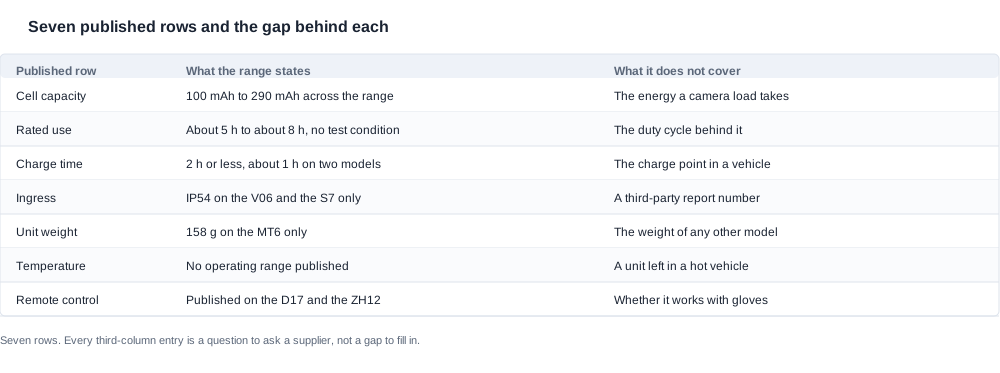
The table below is the honest base for a field-work shortlist. Seven published rows, what the range states for each, and — in the third column — the question the row does not answer. The chart below it is the case-capacity picture, which is the power plan for a shift rather than an accessory decision.
| Published row | What the range states | What it does not cover |
|---|---|---|
| Cell capacity | 100 mAh to 290 mAh across the range | The energy a camera load takes |
| Rated use | About 5 h to about 8 h, no test condition | The duty cycle behind it |
| Charge time | 2 h or less, about 1 h on two models | The charge point in a vehicle |
| Ingress | IP54 on the V06 and the S7 only | A third-party report number |
| Unit weight | 158 g on the MT6 only | The weight of any other model |
| Temperature | No operating range published | A unit left in a hot vehicle |
| Remote control | Published on the D17 and the ZH12 | Whether it works with gloves |
The models a field shortlist usually contains. The V06 publishes an 8-megapixel camera, a 260 mAh cell, a charge time of two hours or less, a rated use band of five to eight hours, a magnetic interface, a catalogue-marked IP54, an ergonomic frame, a detachable inner frame and four colours. The S7 publishes a 13-megapixel camera, a 260 mAh cell, the same band, the same magnetic interface, a catalogue IP54 marking, a detachable inner frame and a remote shutter. The YKC02 publishes Bluetooth 5.4, 70 mAh per temple, about eight hours of rated use and a magnetic interface. The D17 and the ZH12 publish a charge time of about one hour over Type-C, about seven and about eight hours of rated use respectively, and remote capture control.
Two corrections a field buyer needs to have in hand. First, the IP54 marking appears on two models in the whole catalogue — the V06 and the S7 — and it is a catalogue attribute with no third-party test report published behind it. It is not a range-wide attribute, and it is not published for the YKC02, the D17 or the ZH12. Second, the single published unit weight in the catalogue is 158 g, and that is the weight of the MT6 glasses body including the 265 mAh cell and the camera, excluding the 1200 mAh foldable charging case. The MT6 is a camera model, not a field-work model, so it cannot be quoted as a field figure. No field model publishes a weight at all.
The case is the power plan, and it has three different answers. The catalogue publishes a 1400 mAh case on the CY03 and the L1 Pro, and the CY05, a choice of 900 or 1400 mAh on the L2 Utral, and a 1200 mAh foldable case on the MT6. The KY06 and the MT5 are shown with a charging case whose capacity is not published. The V03 and the S7, and the V06 and the V03 Pro have no charging-case row in the catalogue at all. A shift plan built on "the case" is built on three different specifications, and two of those three states have to be requested in writing rather than read off a page.
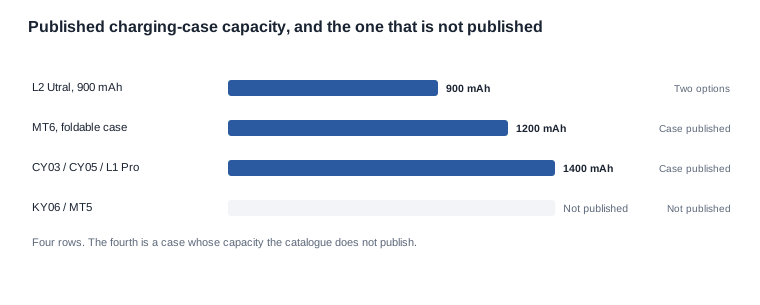
The chart above is the capacity side of that answer set, and it has four rows for a reason: three published capacities and one position the catalogue does not publish. The four models with no charging-case row do not appear on it at all, because there is nothing to plot for them, and a chart that showed a zero there would be a claim the catalogue does not support.
What is published nowhere in this range, and therefore cannot be used to select anything. The field of view, the video format, the frame rate, the stabilisation behaviour, the storage capacity and the clip limit, the runtime test condition, the standby draw, the cycle life rating, the operating temperature range, the lens material and coating, the hinge specification, and the per-model unit weight for every model except the MT6. A shortlist decision that depends on any of those rows is a decision with no data behind it, and a buyer who has to make one anyway should write down that fact rather than substitute a typical value.
Which rows are decision rows, and which are context. For a field deployment, the charge ceiling, the case capacity, the ingress marking and the presence of remote capture control are decision rows — they change what goes into the site. The runtime band, the cell capacity and the sensor class are context rows: they tell you what class of device you are buying and how it will be used, but they do not change the site logistics. A buyer who treats every published row as a decision row ends up with a long evaluation and a short answer.

The issue and return routine that decides the operating cost
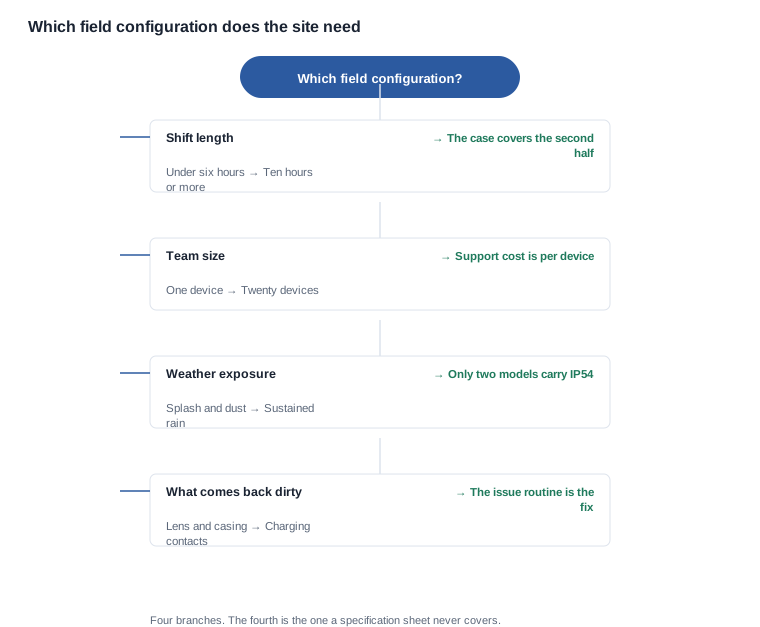
The failure mechanism that causes most field returns is not the hardware. It is a contaminated charging contact presenting as a flat battery. A unit that came back dirty, went onto the dock, and did not charge looks identical to a unit with a worn cell — and a support process that starts by asking about the cell will keep asking about the cell, because the symptom is the same and the question is easier. The routine below is what breaks that loop, and it is a process, not a product feature.

- Issue one device per person against a roster, with the unit serial recorded. The roster is what turns "a device came back" into a cause. Without it, a return is an anecdote; with it, it is a rate per person per model, and the difference is worth the ten minutes it takes to write down.
- Record the charge state and the contact condition at issue and at return. Two readings, one at each end of the shift. The pair turns a flat battery into a diagnosable event: a unit that left full and returned flat with dirty contacts is a contamination event, and a unit that left at half charge and returned flat is a charge-point event. Neither reading is useful alone.
- Service the charging contacts and the lens before the unit goes back on charge. The residue that causes the flat-battery symptom is removed at the point where the symptom appears, not at the point where it is noticed. This step is cheap and it is the one most often skipped, because the consequence is invisible on the day and expensive three months later.
- Log every return by cause: flat battery, scratched lens, contact contamination. Classified from what was observed at return, not from the sentence the person gave. The classification is the only thing that turns a returns pile into a trend, and the trend is what tells you whether the problem is the device, the site or the routine.
- Settle the acceptance criteria before the first shipment, not after it. The incoming inspection criteria, the packaging standard, the labelling set and the documentation pack are all things a supplier can agree in advance, and they are what stops the returns desk from becoming the arbiter of every dispute. The route is at quality consistency and the clause language at contract terms.
The other two things nobody expects. The first is that the support load is the real product: a device issued to twenty people raises questions that the published material does not answer, and the material to have ready before the first shift rather than during it is at the field work support resources. The second is that the battery will be blamed for things that are not the battery — a contaminated contact, a case that was not seated, a unit left in a hot vehicle all present as a flat battery, and a support process that opens with the cell will keep opening with the cell. The alternative diagnostic order is at the field work troubleshooting article.
The verification sequence, in the order it should happen. Ask for the bill of materials per configuration with the case row attached, because the case is four different catalogue answers. Ask for the battery transport documentation for the configuration, because a case in the box is a second lithium cell that has to be declared; the requirement is at battery transport. Ask for the ingress position in writing for the models you intend to list, and treat an IP54 marking and a test report as two different things; the digit reading is at IP ratings. Ask for the per-model unit weight, or for a written statement that it is not published. Ask for the runtime figures with their test conditions, per model, because a shift claim has to be defensible against your own measurement. And confirm the model designation table, then check every certificate number in the issuing body's public register; the procedure is at certification checklist, and it matters here because our catalogue carries no per-model certification row at all — the export certification page is a page of images, ten patent certificates, eight appearance-design patents and two utility-model patents, and the catalogue text contains no reference to CE, to FCC or to RoHS.

What a team deployment costs to support
Support cost scales with devices, not with orders. One unit issued to one person is a conversation. Twenty units issued to twenty people is a queue, and the queue is worked by whoever on site has the least to do. That is the recurring line in a field deployment, and it is the one that a unit price cannot see. The questions to ask a supplier are narrow: who answers, in what language, within what window, what the site is expected to do first, and what a replacement unit costs and how long it takes to arrive.
The spare-unit decision is a support decision. Whether the deployment carries a spare on site or returns a failed unit to a store changes the support model completely, and it changes the shipped weight, the shipping frequency and the freight cost at the same time. The case decision feeds straight into it: a configuration with a case in the box has more energy on site, which means fewer units returning flat because they could not be charged between shifts.
What is fixed and what is open. Fixed before the negotiation: the cell capacity, the charge ceiling, the rated runtime band, the charging interface where it is published, the IP54 marking and the two models that carry it, the certification cost and lead time, the tooling cost amortised across the first order, and the battery transport documentation. Open, and worth the negotiation time: whether the case is in the box, which case capacity is ordered, the spare-unit ratio, the packaging standard for field transport, the insert contents including any contact-maintenance item, the payment structure, the shipment split, the warranty length and terms, the replacement unit lead time, and the minimum order quantity tier.
A worked example, written as a scenario. Take an industrial services contractor who has decided to trial a camera model on one inspection team of twelve people across three shifts. The first decision is the interface, because it settles the site: taking the Type-C route, the unit recharges from a cable the site already owns, and the case becomes an optional accessory rather than a component of the box, which removes a second lithium cell from the transit file for that configuration. The second decision is the case capacity, and here the published answers force the question — a 1400 mAh case, a 900 mAh configuration or a 1200 mAh foldable case are three different power plans, and one of the camera models on the shortlist ships with a case whose capacity is not published at all, so that figure has to be requested before the shift plan is drawn. The third decision is the routine: a roster at issue, charge state and contact condition recorded at both ends, a maintenance step before the unit goes back on the dock, returns classified by observed cause, and acceptance criteria agreed before the first shipment. The outcome is a twelve-device trial whose returns can be explained, a support cost that can be forecast, and a configuration whose every row can be traced to a published figure or a document the supplier signed.
Where our published rows stop for a field work buyer
The working rule we apply: field work is a segment where the published data tells you the constraints and the sample tells you the product, and buying on the specification alone is how teams end up with a device that works and is not carried. We publish the charge times, the rated use figures, the charging interfaces and the cell capacities where they are published, the case capacities where they are published, the remote capture control on the D17 and the ZH12, the detachable inner frames on the V06 and the S7, the ultra-slim detachable temples on the G07, the slim detachable temples on the YK12, the colour options, and the catalogue IP54 marking on the V06 and the S7.
We do not publish the per-model unit weight beyond the single 158 g whole-unit figure for the MT6, the operating temperature range, the field of view, the video specification, the stabilisation behaviour, the storage capacity, the runtime test condition, the standby draw, the cycle life rating, the lens material or the coating, the per-model certification status, or the ingress test report numbers. We will also not state that any product in our range is tested to IP54, because no test report is published behind that marking, and we will not extend the marking to any model beyond the two that carry it. We will not write a defence, a protection or a performance claim into a customer's material, and we will not estimate a figure the buyer would then have to defend.
What to send us next. Send the environment, the shift length, the team size, whether the site has a charge point and where it is, and the destination market. We will say which published rows cover the models you are considering, which case configurations exist, which documents have to be settled before the first shipment, and which questions are most likely to be tested first on a unit that has been in the field for a month. The sport range lists the published model data, the site assessment is at the field work checklist, and the scenario entry point is smart glasses for field work.
Related reading
- Where this scenario begins — smart glasses for field work
- The product line — sport smart glasses
- The site assessment — field work checklist
- The support material — field work support resources
Tell us the environment, the shift length and the team size, and we will tell you which published rows apply and which questions a deployment has to settle before the first shift.


