
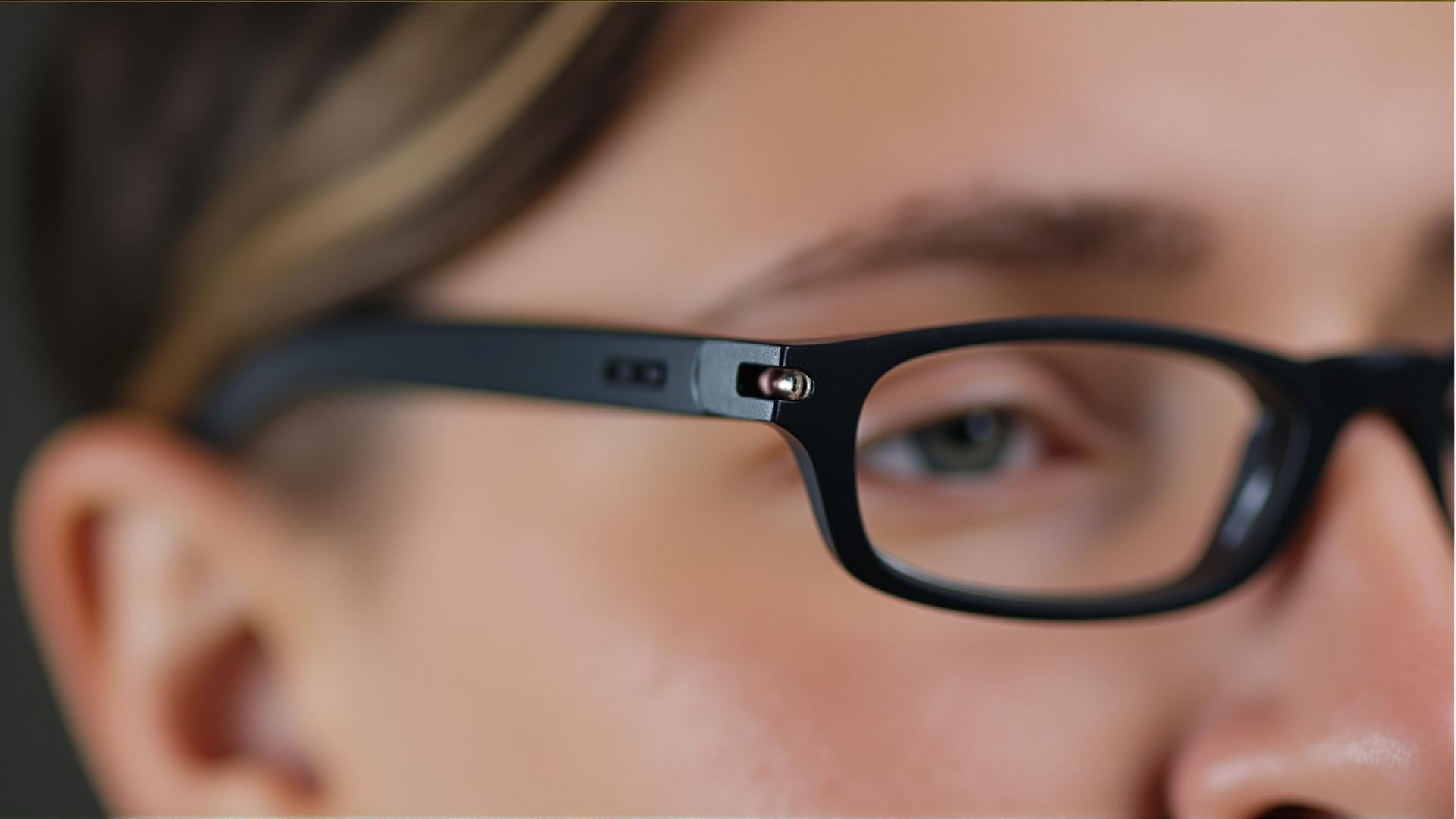
Smart glasses for kids parenting is, for a channel buyer, less a product decision than a contents-of-the-box decision, and the accessory set is where that becomes obvious. A parents channel does not ship a device to a parent; it ships a device, the way to power it, the way to keep the lens usable, a set of instructions that somebody has to write, and a set of statements about what the product does that the parent will act on. Four of those five things are acquired separately from the device, and three of them are where the commercial exposure of this category actually sits.
Smart glasses for kids parenting: the insert is where the claim is made
The printed insert is the least technical item in the box and the one that decides whether the channel is exposed. A catalogue page is read once, by a buyer, in a hurry. An insert is read by a parent at the moment of a decision, in front of a child, and it is the document that a claim, a complaint or a market authority will be tested against. Everything the channel asserts in a listing has to be consistent with it, and everything the supplier publishes has to be consistent with both.
That gives the insert three layers, and the layers are owned by different parties. The first layer is the product facts — the cell capacity, the charge time, the rated endurance, the charging method, the radio version, the published feature set for that specific model. Those are fixed by the catalogue and the channel does not have latitude over them, only the obligation to reproduce them accurately. The second layer is the use conditions: what has to be true for the product's published behaviour to be what it is — the charging routine, the posture and distance conditions the catalogue illustrates for the A05 and the A06, the fact that the A07 is a Bluetooth model, and the limits the catalogue does not publish. The third layer is the claims, and this is the only layer the channel writes from scratch, and therefore the only layer where a mistake becomes a liability.
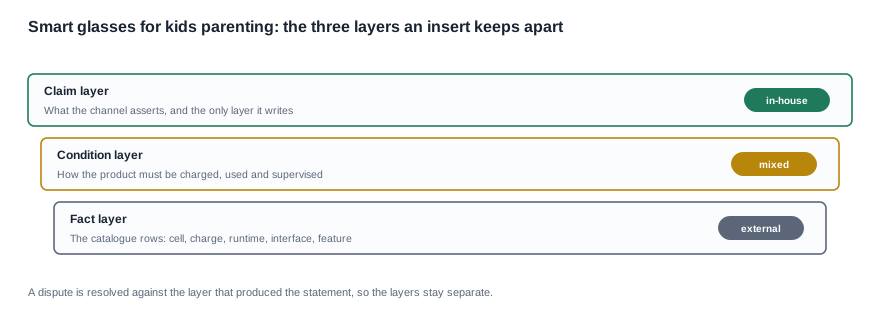
The ordering matters when a problem arrives. A dispute about a product fact is resolved against the catalogue, and the channel loses because the insert was wrong. A dispute about a use condition is resolved against what the channel told the parent to do, and the channel loses because the instruction was incomplete. A dispute about a claim is resolved against what the channel asserted, and the channel loses because it asserted something the supplier never published. In all three cases the insert is the document in the room, which is why it should be drafted by the channel rather than accepted from the supplier as a fixed item.
There is one more reason the insert carries weight in this particular category. The published range for children's devices is narrow. The A05 and the A06 publish a 40 mAh cell, a charge time of two hours or less, roughly twenty hours of rated use, a magnetic charging interface, a lens-type electronic fogging arrangement, and posture and distance detection. The A07 publishes a 70 mAh cell, the same charge ceiling, the same rated endurance, magnetic charging and Bluetooth 5.4. Everything else — the frame material, the lens material, the coating, the weight, the age grade, the ingress position, the certification status — is not published for any of the three. The insert therefore has to do a great deal with very little, and the temptation to fill the silence with reassurance is exactly what creates the exposure.

What the three published children's models can put in a box
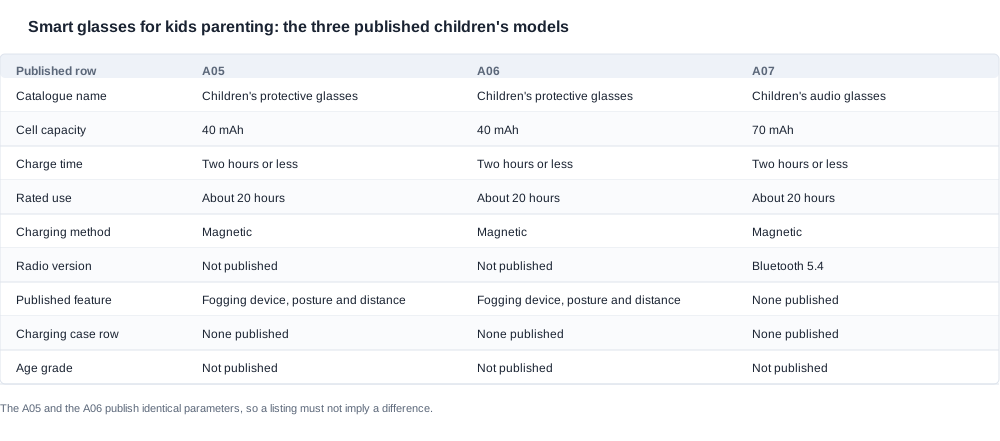
There are three children's models in the catalogue, and two of them publish identical parameters. That fact is the single most useful thing a channel buyer can know before writing a listing, because it determines whether a three-model range is a three-model range or a two-model range with a duplicate entry.
| Published row | A05 | A06 | A07 |
|---|---|---|---|
| Catalogue name | A05 children's smart protective glasses | A06 children's smart protective glasses | A07 children's smart audio glasses |
| Cell capacity | 40 mAh | 40 mAh | 70 mAh |
| Charge time | Two hours or less | Two hours or less | Two hours or less |
| Rated use | About 20 hours | About 20 hours | About 20 hours |
| Charging method | Magnetic | Magnetic | Magnetic |
| Radio version | Not published | Not published | Bluetooth 5.4 |
| Published feature | Lens-type electronic fogging device, posture and distance detection | Lens-type electronic fogging device, posture and distance detection | None published beyond the electrical rows |
| Charging case row | None published | None published | None published |
| Age grade | Not published | Not published | Not published |
The A05 and the A06 publish identical parameters and the difference between them is not confirmed. A channel that lists them as two variants implies a distinction it cannot evidence, and a parent who buys the A06 because the listing implies it is better than the A05 has a complaint that is entirely reasonable. The safe treatment is either to list one model, or to list both with the published rows identical and the difference explicitly unstated, and to route the question of what actually differs back to the supplier in writing.
The A07 is a different product, not a better version of the same one. It publishes a larger cell, a radio version, and no fogging arrangement and no posture or distance detection. An insert set that reuses the A05 and the A06 artwork for the A07 — a very common shortcut when three SKUs share a box — makes a false statement about the product in the parent's hands, and it is a false statement about the specific behaviour a parent is most likely to be relying on.
The naming is a designation, not a specification. The catalogue's own product names for the A05 and the A06 translate as children's smart protective glasses. That is the catalogue's designation for the product, and it is what the listing has to use in order to match the goods. It is not a published performance specification, and it cannot be expanded into a statement about what the product does for the eyes. The catalogue text contains no medical reference and no reference to myopia, and the insert must not create one that the supplier never made.

The accessory list and why each line is a decision
The accessories a parents channel has to acquire are the same in number for all three models but not in composition, and each line is a decision rather than a line on a packing list.
The charging path. All three models publish magnetic charging, which is the one accessory decision with a hard commercial consequence. Magnetic charging means either a proprietary dock that ships in the box and has to be replaced when lost, or a cable with a magnetic end that has to be sourced separately. The catalogue publishes the charging method but does not publish what ships in the box, so this is a question to ask rather than a line to plan. The channel that answers it early can put a replacement dock into the consumables range and make money on it; the channel that answers it late discovers it after the first wave of returns. The interface options are set out at charging solutions.
The cleaning item. The lens material and the coating are not published for any of the three models, which means the cleaning instruction has to be restrictive and specific rather than open. A wipe that is safe on an unpublished coating is not something a channel can assume, and the item that goes in the box should be one whose own documentation says what it is safe on. This is also the accessory most likely to be treated as a giveaway, which is a mistake: on a product where a scratched lens ends the product's usefulness, the cleaning item is the cheapest available reduction in the return rate.
The spare or the pool. Whether a spare device or a spare lens goes into the box is a channel decision with a cost attached, and it depends on the published endurance. All three models publish roughly twenty hours of rated use, and the A05 and the A06 publish a 40 mAh cell against the A07's 70 mAh. A channel that puts a spare in the box is pricing insurance against a failure mode it has not measured, and a channel that does not is choosing to absorb a return instead. Neither is wrong, but the decision belongs in the unit economics rather than in the packaging artist's brief.
The case. The catalogue publishes no charging case row for the A05, the A06 or the A07 — which is an unpublished row rather than a stated absence, and the distinction matters. A channel that lists a case in the box without confirming it with the supplier is shipping a promise about an accessory the published record does not cover. If a case is to be an accessory in this range, it has to be requested for the specific model and confirmed in writing, and a case is also a second cell with its own shipping documentation.
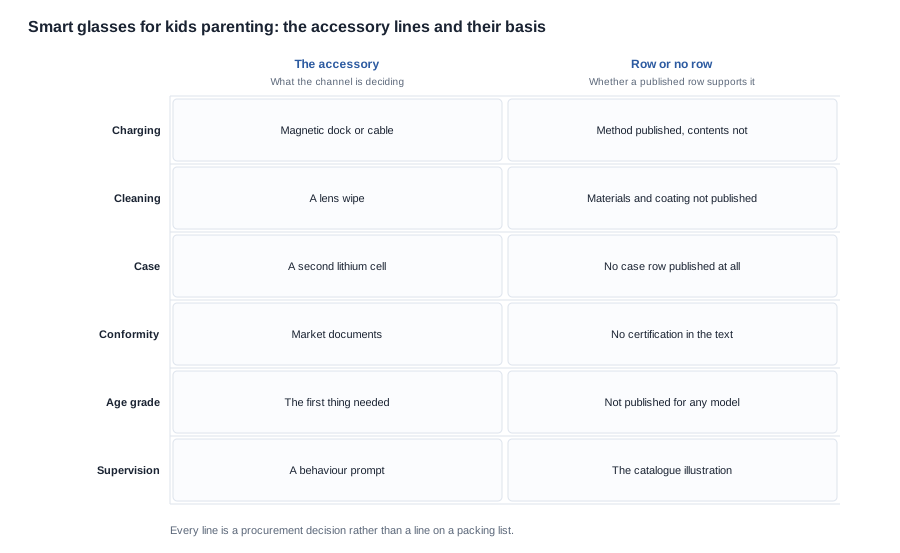
The conformity and labelling material. Nothing in the catalogue's text names a certification for any of the three models, and there is no per-model certification row. Whatever the destination market requires has to be established for the model and the configuration in writing, before a listing goes live rather than after a shipment is held. The requirement list is at the certification checklist and the child-product route is at child product compliance.
The age-grade statement. No age grade is published for any of the three models, and an age grade is the first thing a parents channel needs and the thing the published record is least able to supply. It has to be requested as a written position for the model, and until it is, the listing and the insert cannot state one.
The supervision and usage material. A product that detects posture and distance and responds visually is generating a behavioural prompt, and the insert has to say what the device does, when the prompt appears, and what the adult is expected to do about it. The published position is the catalogue's own illustration: a clear lens under correct posture and distance, a fogged lens under incorrect posture and distance. Everything beyond that illustration has to be written by the channel and approved before it ships.
The accessories channel as a business line. Every line on this list can be sold again, and the channel that treats them as consumables rather than as gifts learns something useful in the first quarter. A cleaning item is consumed at a rate the channel sets and can measure from the returns data. A replacement magnetic dock is bought when one is lost, and the loss rate is a channel metric rather than a supplier one. The trade-off to check before the range launches is that a generous accessory set lowers the return rate and raises the shipped cost, while a thin set does the opposite — and the number that settles it is the first-quarter returns breakdown, which is measured on the first shipment and not before it.

The claims that do not survive a printed insert
Five claim patterns are common in this category and each of them fails against the published record. A channel that writes them into a listing discovers the problem at the worst possible moment, which is when a parent acts on the claim.
The vision-benefit claim. There is no medical claim, no myopia claim and no eyesight-outcome claim in the published catalogue, and the range's published feature is a fogging arrangement keyed to posture and distance detection. An insert that says the product protects the eyes, relieves eye strain, or prevents the development of a refractive condition states something no supplier has published, and it is the kind of statement that attracts both a regulator and a parent's lawyer.
The waterproof claim. No ingress marking is published for any of the three children's models, so there is nothing to qualify and nothing to footnote. The statement "water resistant" is unsupported in either direction.
The endurance claim. The published figure is about twenty hours of rated use, and it is a rating rather than a measured result for a particular household. The insert should say what the figure is and what it is not, because a parent who reads "twenty hours" as "all day, every day, for a week" will return the product. The published figure also carries no test condition, which means the channel cannot say how it was measured either.
The charge-time claim. Two hours or less is a ceiling. An insert that says "charges in two hours" has converted a ceiling into a promise, and the difference is exactly the case the published record cannot cover, because the catalogue publishes no starting state and no end point for the charge.
The connected-product claim. The A07 publishes Bluetooth 5.4 and nothing else about its radio behaviour. The catalogue publishes no app row and no firmware row for any model, and no data-handling statement. An insert or listing that implies an account, a companion application, a data policy or a firmware update pathway is stating a product that has not been described. This is the claim most likely to be made by accident, because a Bluetooth product invites a connected-product story that the published record does not support.
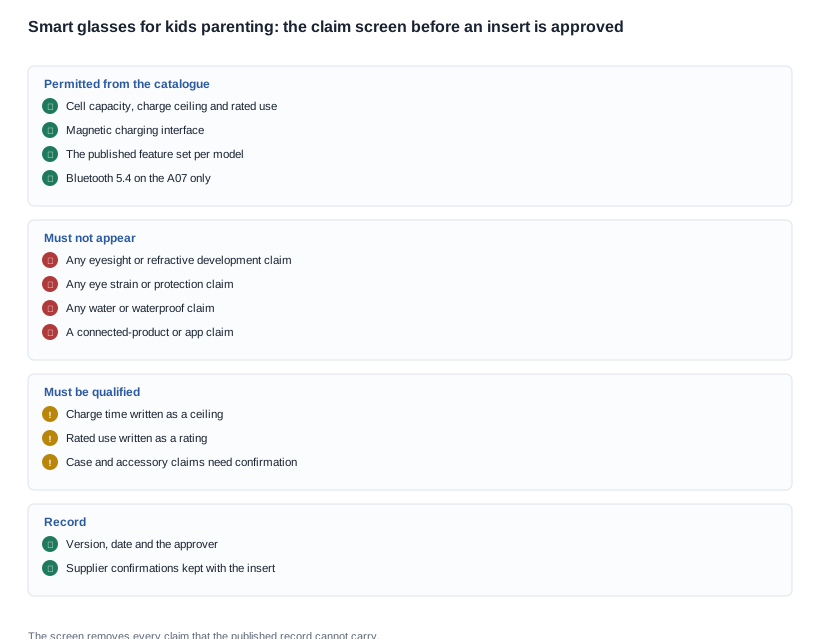
Building the insert as a document the channel controls
The insert should be treated as a controlled document with an owner, a version and an approval record, because in this category it is the document that will be examined. The sequence that works is short.
- Pull the published rows for each model into a single sheet, one row per model, and mark every row that is not published as not published. For these three models the sheet has fifteen rows, of which the charging method, the cell capacity, the charge time and the rated use are populated for all three, the radio version is populated for one, the published feature set is populated for two, and the case, the age grade, the weight, the materials and the certification are empty.
- Separate the shared artwork from the model-specific artwork. The A05 and the A06 can share a body, because their published parameters are identical. The A07 cannot share it, because it publishes a different cell, a radio version, and no fogging or detection feature.
- Write the claims layer from a permitted list, not from a description. A permitted list is short: the published rows, the published feature set, the instruction to charge within the published ceiling, the supervision instruction for the A05 and the A06, and the note that the A07 is a Bluetooth model. Anything that is not on the list needs a supplier confirmation attached to it before it can be written.
- Run the medical and the water screen before approval. Any statement about eyesight, refractive development, strain or water has to be removed. In this range the screen removes every one of them, because nothing in the published catalogue supports any of them.
- Record the version, the date and the person who approved it, and keep the supplier confirmations with it. When a model row changes, the insert is revised — and the approval record is what shows the insert matched the goods on the day they shipped.
What we will and will not put in writing. We publish the electrical rows for every model and the published feature set — the 40 mAh cell, the two-hour-or-less charge ceiling, the roughly twenty-hour rated use, the magnetic charging interface, the lens-type electronic fogging arrangement and the posture and distance detection on the A05 and the A06, and the Bluetooth 5.4 on the A07. We do not publish an age grade, a frame or lens material, a coating, a weight, an ingress position, a charging case for these three models, or any certification reference, and we would rather tell a channel that than have the channel promise it. We will confirm, per model, what ships in the box, what is available as a separate accessory, and which claims a written supplier position supports. Send us the market, the channel, the three models you intend to list and the accessory list you have drafted, and we will return the rows that can be stated, the rows that cannot, and the specific claims to remove before the insert is printed. The product family is at kids smart glasses, the individual models are at the A05, the A06 and the A07, and the scenario entry point is smart glasses for parenting.

The criteria a channel should apply before it approves an insert. Every statement has a published row behind it or a written supplier confirmation attached to it. The shared artwork is used only between the two models whose published parameters are identical. Every claim that concerns eyesight, strain, refractive development or water has been removed, because nothing in the published record supports any of them. Every product fact that is not published is marked as not published rather than filled with an estimate. And the approval record names the version, the date and the person responsible, so that a later change to a catalogue row triggers a revision instead of a contradiction. Those five criteria are the ones worth asking a supplier to work against, and they are what a channel's own audit should check before the first shipment rather than after the first complaint.
Related reading
- The point where the scenario starts — smart glasses for parenting
- Which family this is — kids smart glasses
- The gate before the order — a buying checklist for a parents channel
- The claim boundary — child product compliance
Send us the market, the channel and the accessory list you have drafted, and we will mark every line that a published row can carry and every line that cannot.


