
Smart glasses for kids parenting needs a small kit, and the finding behind this checklist is that most of the kit is not the product. Five items matter around a children's model, three of which are consumed or used by an adult rather than by the child, and one of which is not an object at all: a decision about what the product is and where the data goes. That decision has to be made before the purchase, because the four physical items only work once it has been made. A kit that arrives without it generates exactly the return that none of the other four items prevents.
Smart glasses for kids parenting: what a channel owner needs from the kit
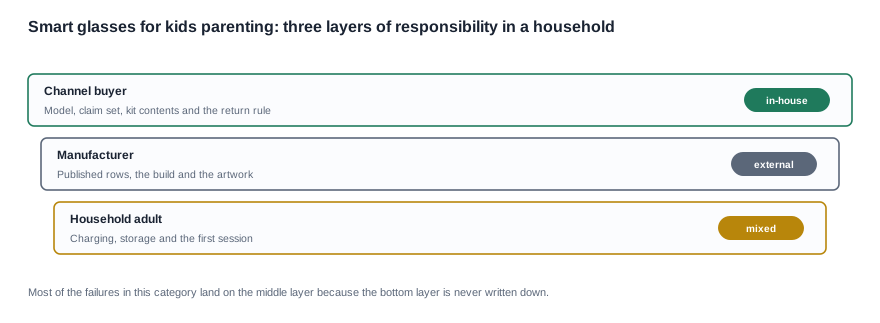
The reader behind this checklist is a brand-side buyer, a channel buyer or an e-commerce seller who is either comparing quotations or opening a new programme. The situation is a specification to settle, a box to fill, and a support script to write, and the fear underneath it is predictable: a per-unit cost nobody costed, a second lithium cell nobody declared for transport, or a household that receives the product and quietly stops using it in the third week. None of those three is a hardware fault, and all three are decided at the point where the kit is assembled.
The published rows the kit has to work around
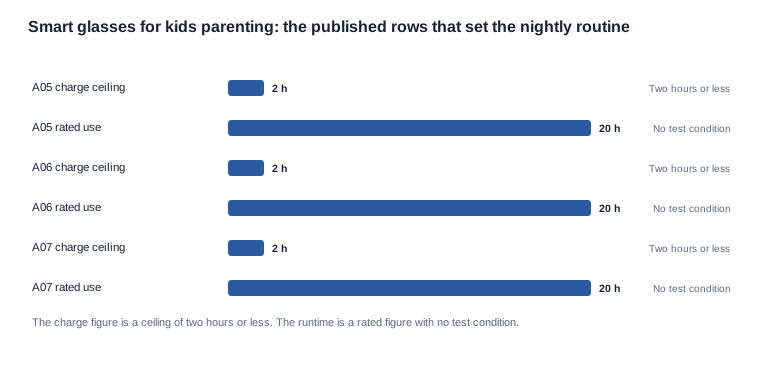
Three models exist in our children's line, and the kit decisions follow directly from what they publish. The A05 and the A06 each publish a 40 mAh cell, a charge time of two hours or less, roughly twenty hours of rated use, a magnetic charging interface, a lens-type electronic atomiser, and posture and distance detection. The A07 publishes a 70 mAh cell, the same charge ceiling of two hours or less, roughly twenty hours of rated use, magnetic charging, and Bluetooth V5.4, with no atomiser row and no detection row.
The A05 and the A06 publish identical parameters and the difference between them is not published. Colour and packaging customisation are available. App and firmware customisation is recorded as awaiting verification. The certification position is not provided for any of the three, and frame weight and frame size are not published.
Why the kit is a procurement decision rather than a packing decision
A bill of materials is normally a cost calculation, and in this category it is a risk calculation as well. A charging case, where one exists, is a second lithium cell and therefore a second transport obligation rather than a simple accessory. A printed insert is a per-unit print cost and, at the same time, the only channel through which a household receives the routine that makes a magnetic interface work. A contact-wiping item is a consumable of a few cents and, at the same time, the cheapest available reduction of the false fault that reads as a battery problem.
The consequence is that the kit cannot be assembled last. If it is assembled last, the manufacturer supplies a generic box and the buyer discovers that the two controls that matter most, the charging routine and the claim set, are absent. Assembling it first, as a set of decisions with costs attached, turns four of the five items into a line item with a known unit cost and one of them into a document request.

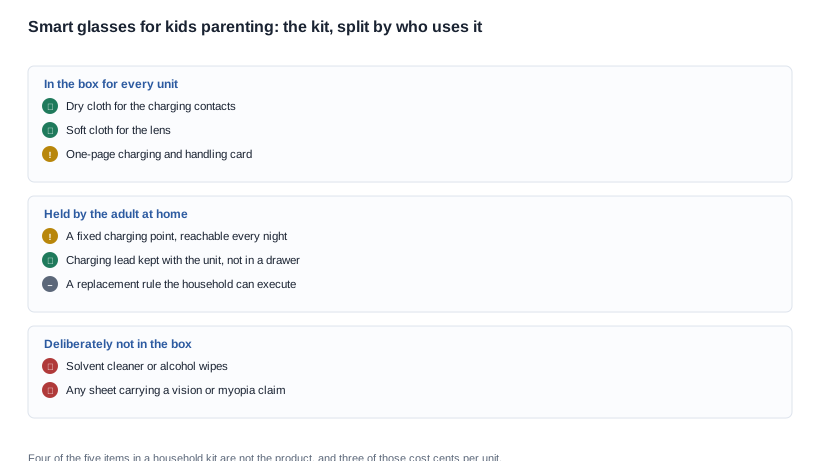
The order of the flow above is the order that matters. The model is fixed first because the interface and the cell follow from it. The adult's nightly action is decided second because it determines whether the unit is still in the household a month later. The consumables are added third and only against a known failure mode. The insert is checked against the permitted claim set fourth, and the configuration string is recorded on the box fifth, because that string is what makes a return traceable to a build.

Four physical items and the failure each one prevents
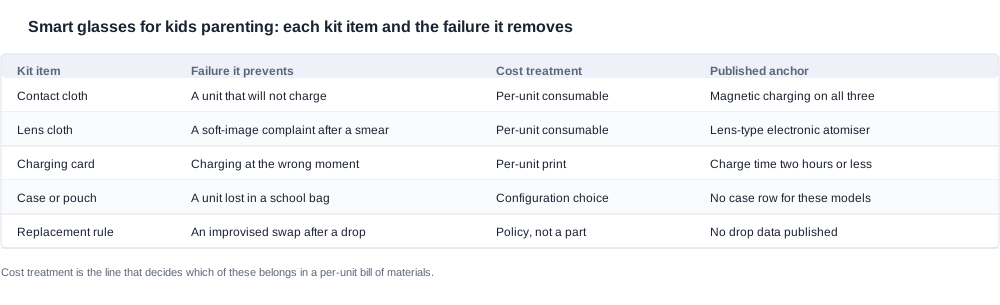
| Kit item | Failure it prevents | Cost treatment | Published anchor |
|---|---|---|---|
| Contact cloth | A unit that will not charge | Per-unit consumable | Magnetic charging on all three models |
| Lens cloth | A soft-image complaint after a smear | Per-unit consumable | Lens-type electronic atomiser |
| Charging card | Charging at the wrong moment | Per-unit print | Charge time two hours or less |
| Case or pouch | A unit lost in a school bag | Configuration choice | No case row for these three models |
| Replacement rule | An improvised swap after a drop | Policy, not a part | No drop data published |
The contact cloth. A 40 mAh cell gives very little warning before it is low, and a child's unit is handled far more often than it is put away. A dry cloth for the charging contacts removes the most common false fault in this category: a unit that will not charge and reads as a battery problem. On the A05 and the A06 the margin for a missed night is thinner than on the A07's 70 mAh cell, so this item is worth more on the smaller cell than on the larger one.
The lens cloth. Our lens technology for these models is specified as a lens-type electronic atomiser, and the published features on the A05 and the A06 include the clear and atomised lens states that go with posture and distance detection. A smeared or scratched lens is reported to the support line as a blurred image rather than as a surface issue, and a blurred image is a ticket that costs a replacement unit.
The charging card. One printed card that tells the adult where the unit lives, how long the charge takes, and what the reminder means. The published charge ceiling is two hours or less, and a ceiling rather than a fixed figure is the reason the card has to say "by bedtime" instead of "in 90 minutes". A card that states a fixed figure the catalogue does not publish creates the exact expectation it cannot meet.
The case or the pouch. Our children's models do not publish a charging-case row at all, which means the catalogue is silent on whether a case exists in any configuration rather than stating that one does not. A buyer who wants a case therefore has to establish it against the configuration string rather than against the model family. Where a case is genuinely part of the build, use it; where it is not, a named pouch is the equivalent and it is the cheaper decision, because a case adds a second cell and a second transport obligation.
The adult-only items that decide whether a unit is still in use
Three of the five items in a household kit are used by the adult, not by the child, and they are the items that most often go unmentioned in a bill of materials because nobody treats them as products.
A fixed charging point. Roughly twenty hours of rated use and magnetic charging mean the routine is nightly and it belongs to an adult. A charging point that moves is a routine that fails. In a household the difference is a shelf, a hook by a door, or a table in a hallway; in a programme it is an instruction on a printed card and a line in the insert artwork.
A charging lead kept with the unit. Our catalogue uses magnetic charging on all three of these models, which means the unit charges on its own contacts and the lead in question is the lead for the charging base or dock rather than for the glasses. A lead in a drawer is a product that appears to be broken, and the cost of holding a spare is far lower than the cost of a ticket.
A replacement rule the household can execute. This is the item that is not an object, and it is the one that a programme should write before the first unit ships. What happens when a unit is dropped, who pays for the swap, how the swap is logged, and what the household is told. Because no drop data is published for the A05, the A06 or the A07, this rule is not a formality — it is the whole of the answer.
The three items that are not physical
Two of the questions a family asks before buying this product are not about the hardware, and the gear checklist has to carry them because they gate everything else.
Where does the data go. App ownership, firmware customisation capability and data storage location are all recorded as awaiting verification for this tier. A product whose data path cannot be described cannot be explained to a school's safeguarding lead, and that is a procurement blocker rather than a support question. The parenting support resources article is the material to assemble around this, and the legal route is set out in the legal considerations article.
What this product actually is. In our documentation it is a posture and distance reminder with a lens-type electronic atomiser. It is not an eyesight product. We publish no clinical claim and we will not support a listing that says it prevents or reduces myopia, and a parent who buys on the second framing will return the product describing an outcome rather than a function. That is the single most expensive outcome in this category, because it produces a return and a public review rather than a support ticket.

The insert, and the two sentences that carry the most weight
A printed insert for this category is doing three jobs that most generic inserts do not do at all, and the third one is the reason to pay for artwork rather than for a generic sheet.
- It tells the adult what the routine is. Where the unit lives, how the charge works against a ceiling of two hours or less, and what happens when a reminder arrives. The household that has this does not need a contact-wiping instruction to be explained.
- It states the boundary of the product. What the posture and distance reminders do, and what they are not. One sentence on this topic prevents more returns than any specification paragraph, because the expectation arrives before the device does.
- It tells the household what to do when something is wrong. The first checks, in order, before a ticket is raised. A contact-wiping step, a re-seat of the charging contacts, and the point at which a replacement is the right answer rather than another attempt.
The commercial point is that the insert artwork is a per-unit print cost that buys a reduction in the return rate, and it is the cheapest reduction available in this bill of materials. It is also the item a factory is most likely to supply in generic form, because generic form requires no conversation. Asking a supplier to supply and review the insert artwork for your configuration is a reasonable request, and a supplier who has not read it back to you is a supplier who has not tested it.
What not to put in a children's packaging
There are three exclusions, and they are worth writing into the order because they are cheap to state and expensive to discover after the artwork is printed.
Solvent spray or alcohol wipes. Our documentation publishes no coating specification for any of these models, and no lens material. A solvent applied to a coating nobody has characterised is a repair rather than a wipe, and the damage it does is invisible at the moment it happens.
Any sheet carrying a vision or a myopia claim. The catalogue carries an explicit restriction on efficacy claims for this tier. An insert that repeats a claim the catalogue forbids is worse than no insert, because the insert is the document the household actually reads.
A durability or protection rating. No drop rating and no ingress rating is published for the A05, the A06 or the A07. A statement about surviving a drop on the insert is a claim the documentation cannot carry, and the household in week two is the one who tests it.

What a kit costs per unit and where the return reduction sits
The two consumables are in the box on volume grounds alone. A cloth and a contact wipe are not a second object in a pocket; they are printed on an insert or sealed in a small sachet and they add nothing to the freight weight. That is why they can be included in a consumer configuration without changing the cost structure, and it is why they are the highest-return per-unit decision available to a buyer in this category.
The arithmetic is worth running before the order rather than after the first shipment, and it needs one figure we do not publish, which is the per-unit cost of the consumables. That figure belongs in the quotation as a line item, not in a conversation. Set the kit line against the cost of one avoided return, which in this category is the unit price plus the freight plus the handling plus the reputational cost of a public review that names the brand. The kit pays for itself on a single avoided return if the consumables are priced at anything like the cost of printing them, and it is a bar most programmes do not clear because the kit was never costed at all.
The published rows above also decide which household items are worth funding. A 70 mAh cell with a two-hour-or-less charge ceiling gives an adult more room than a 40 mAh cell with the same ceiling, so the nightly action is easier to keep on the larger cell. A 40 mAh cell leaves less margin for a missed night, which is exactly when the contact cloth earns its place.
What is negotiable and what is not
The published rows are fixed and will not move in a negotiation, and neither will the interface, the cell, the certification cost of the build or the transport obligation of a second cell. The commercial structure around them moves more freely than buyers expect. Whether the case is in the box or sold as an accessory is the largest single lever, because it is the difference between one price point and two, and it changes the artwork, the freight weight and the transit file together. The consumable quantities are negotiable in the sense that the quantity per device and the restock interval are a conversation. Whether a protective film ships and whether it is factory-applied is worth asking about, because on a product where a scratch is a return it is usually the cheapest available reduction in the return rate. Colour and logo are cheap to change between runs and expensive to change after the artwork is printed. Whether the supplier supplies and reviews the insert artwork for your configuration is negotiable in principle and important in practice.
Minimum order quantity tiers are negotiable, and so is whether two models can share a purchase order, which matters more in this category than it first appears because the A05 and the A06 publish identical parameters and may well be ordered together. A first order that goes out in two parts, with the balance tied to inspection, suits a channel that is still working out its volume. The quantity kept at pilot tier is where the largest gap sits.
What we publish, what we will not claim, and what to send us
Assembling the kit, with the rows to order from
The kit is a decision with a document attached to it, and we will help a buyer assemble one. We publish what a buyer can order from: the cell capacities of 40 mAh on the A05 and the A06 and 70 mAh on the A07, the charge ceiling of two hours or less, roughly twenty hours of rated use, magnetic charging on all three, the lens-type electronic atomiser and posture and distance detection on the A05 and the A06, and Bluetooth V5.4 on the A07.
We do not publish the certification position for this category at all, and we will not fill the data-path or claims gaps with a typical figure. We will not tell a buyer that the A05 and the A06 differ, because the difference is not published, and we will not tell a buyer that the A07 is the same product with more battery, because it publishes a different feature set. Frame weight, frame size, lens material, coating and drop data are not published for these three models, and a kit decision that depends on any of them is a decision with no data behind it.
Model, price band and market
Send the model, the quantity, the target price band and the markets, and we will return the bill of materials we would propose for that configuration, the published rows that cover it, the documents that have to be settled before the order, and the three items we would keep out of the box. The kids smart glasses range lists the published configurations, the model comparison article covers the selection step that precedes the kit, the packing article covers the pouch question, and the scenario entry point is smart glasses for kids parenting.
One thing is worth saying before an enquiry arrives. The kit we would propose is a proposal, not a published bill of materials, because the configuration and the quantity decide several of its lines and neither is a catalogue row. Where a line depends on a fact we do not publish, such as the per-unit cost of a consumable, we will ask for it and mark it as open rather than quote a typical value. A kit decision made on a typical value is a kit decision with no data behind it, and the household, not the buyer, finds out first.


