Smart glasses for kids parenting: the storage position is a supervision decision
The short answer. For a product intended for children, the storage decision is a supervision decision, and it has to be made before the packaging is designed rather than after the first damaged unit arrives. A child handles a device differently from an adult: it is handled constantly, it is put down on surfaces, and it is carried in a bag that already holds everything else. That behaviour produces exactly two failure categories, and both of them are cheaper to design against than to answer afterwards. The first is the lens placed face-down on a surface, which is the most common source of lens damage in a household and which no amount of warning on a listing will prevent. The second is the device that is not where it was left, which turns a product into a support ticket. The kit therefore has to make the correct storage position the default one, and a storage position is enforceable only when it is a physical object that has to be picked up — which is why a case or a pouch beats a defined spot, and why the case question has to be settled against the catalogue rather than against a preference.
Who is specifying the kit, and what they are defending. The reader is a sourcing manager at the brand, a channel buyer or a product manager specifying a device for the family or home-education market, and in most of those deals the end user of the specification is an adult who was not consulted about the equipment. What is being defended is a two-sided position. On one side there is the commercial exposure of a unit that arrives damaged or goes missing, which lands on the seller's return rate and on a warranty claim that is usually argued rather than evidenced. On the other side there is the adult's time: a kit that requires a decision every morning is a kit that gets abandoned, and an abandoned kit produces exactly the returns it was meant to prevent. The commercial risk being managed is twofold, and the first half matters more than the second — the children's product requirements for the major markets have not been assessed for this range, and that question sits upstream of every instruction and every accessory that goes in the box.
Why the compliance question comes before the packing question. For a product intended for children, the major markets carry mandatory requirements that sit apart from the general product safety route. The requirements are set out at child product compliance and the general route is at general product safety regulation. Our published position is that the conformity status of the children's entries has not been established for those markets, and we will not fill that gap with an assumption. That position decides whether the product can be sold into the channel at all, and a storage solution designed for a product that cannot be sold is wasted effort. It is a question to put to the company in writing, and it should be answered before the kit is specified.
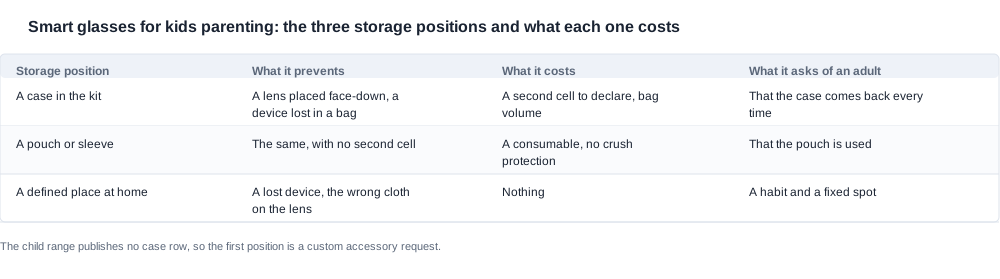

The three storage positions and what each one costs to enforce
The storage question has three answers, and the trade is between how much a child can break and how much an adult has to think about it. The table sets out what each position prevents, what it costs per unit, and what it asks of the adult. The third column is the one that decides the commercial outcome, because a position that costs nothing and relies on a habit is the position that fails in the fourth week.
| Storage position | What it prevents | What it costs | What it asks of an adult |
|---|---|---|---|
| A case in the kit | A lens placed face-down, a device lost in a bag | A second cell to declare, bag volume | That the case comes back every time |
| A pouch or sleeve | The same, with no second cell | A consumable, no crush protection | That the pouch is used |
| A defined place at home | A lost device, the wrong cloth on the lens | Nothing | A habit and a fixed spot |
A case in the kit is the right answer for a child, with one important exception. A parent cannot rely on a habit, so the rule has to be physical: the case goes back in the bag every time, and the rule is enforced by the fact that the device is inside the case. The exception is that the child range publishes no case row at all. The A05, the A06 and the A07 carry no charging-case line, which is an unpublished position rather than a published absence. The case capacities that do appear in the catalogue sit on camera models that are not child products — 1400 mAh on the L1 Pro and the CY05, and the CY03, 900 or 1400 mAh as a configuration choice on the L2 Utral, and 1200 mAh on the MT6's folding case. So a case for a child model is a custom accessory request with its own price, its own lead time and its own transport file, and a buyer who has assumed it is a catalogue line has assumed something that is not published.
A pouch or sleeve is the compromise, and it is cheaper in the right way. It costs a consumable rather than a second lithium cell, which removes the transport declaration from the conversation entirely, and it removes the bag volume that a rigid case adds. What it does not remove is the crush case, and what it does remove is any excuse for the device to be loose in a bag. A sleeve is a reasonable answer for a family that travels lightly and for a channel that wants to keep the transport file simple, and it is the answer that costs least to reorder.
A defined place at home is free and it is the one that depends on a habit. It is the right answer as a second line rather than a first one, and it becomes the first one only when the device is stationary — a desk unit in a home-education setting, a charging point in a study, a tray that is always in the same place. Its weakness is that a defined place does not travel, so any day the device leaves the house it needs the second position as well. That is a two-position kit, and it should be priced as two positions rather than as one.
The rate question sits underneath all three. A pouch, a sleeve and a wipe are consumables that are used up, and a kit specified as a one-off is a kit that is short by the third month. The number that matters is the consumption rate per household per month, and no published row informs it, because it depends on the child and on the household. It has to be measured over the first three months and then re-ordered against the measurement.
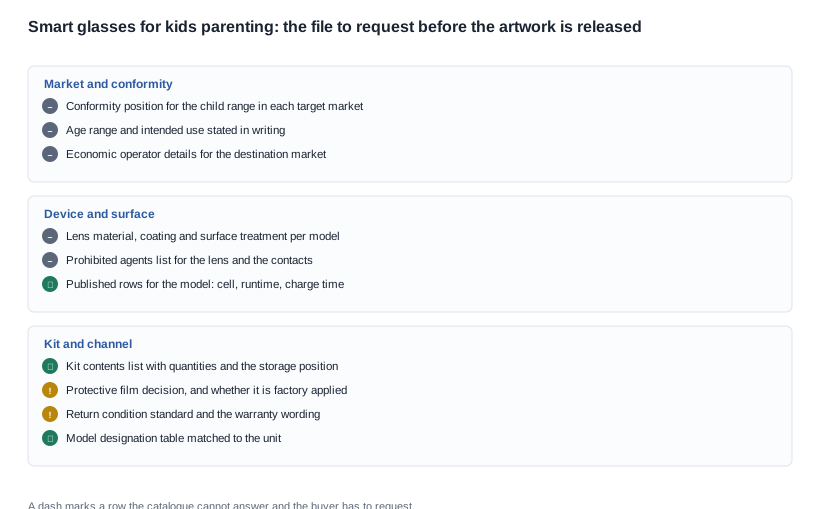
What the child range publishes, and the four rows a buyer must request
The published rows for the child range are narrow, and what is missing from them is exactly what a kit decision needs. Writing both down is what keeps a quotation honest.
What the catalogue publishes for the child range. The A05 and the A06 each publish a rated runtime of about twenty hours, magnetic charging, a 40 mAh cell and a charge time of two hours or less, and they publish no Bluetooth version at all. Both also publish the same two feature labels: a lens-type electronic atomiser, and posture and distance labelling that distinguishes a correct posture and distance from an incorrect one and a clear lens from a fogged one. The A07 publishes a 70 mAh cell, the same charge time, the same rated runtime of about twenty hours, magnetic charging and a Bluetooth version of V5.4, and it publishes no atomiser line and no posture line. The catalogue names the A05 and the A06 as children's smart protection glasses and the A07 as children's smart audio glasses; those are catalogue product names, and we publish no claim about what any of these products does for a child's vision, because we hold no evidence for one and the requirements behind such a claim have not been assessed for this range.
What is not published for the child range, and has to be requested. The lens material, the coating, the surface treatment, the frame weight and any statement about which agents may be used on a surface are unpublished for every model in the catalogue, and there is no per-model certification row anywhere in it. The catalogue's text contains no reference to CE, FCC or RoHS at all; what it does contain is a company-level export certification page, and a company-level page cannot be turned into a per-model scope. Four requests therefore have to go in writing before the artwork is released:
- The lens material, the coating and the surface treatment, per model. The completion standard is a written statement per model, because the instruction that ships in the box has to be restrictive rather than permissive when the surface is unknown, and a permissive instruction is the commonest route to a damage claim.
- The list of agents prohibited on the lens and on the charging contacts. The completion standard is a list that a parent instruction can quote directly, since an adult improvising with a household product is the failure mode, not a hypothetical.
- The conformity position for the child range in each target market. The completion standard is a written position per market, not a general statement, because the markets differ and a single file cannot cover them.
- The protective film decision and whether the film is factory applied. The completion standard is a yes or a no per configuration, because a factory-applied film is usually the cheapest reduction in lens damage available anywhere in the bill of materials, and a film applied by the buyer at home will not be applied at all.
The four rows that are published and belong in the specification. The cell capacity, the rated runtime, the charge time and the charging interface, per model, copied from the catalogue rather than summarised. A published charge time of two hours or less and a rated runtime of about twenty hours are the strongest runtime figures in the range, and they are the reason a child device in the household is rarely a charging problem — which matters, because the charging problem is the one that creates a lost device in the first place. The charging rows are collected at charging solutions, the model comparison is at how to compare models for kids parenting, and the product family is at kids smart glasses.

Where a kit for a child fails after the box is opened
The lens that was placed face-down. The child puts the device down on a table, and the lens takes the weight. The damage is invisible at the moment it happens and permanent afterwards, and it arrives as a quality complaint rather than as an accident. The control is a storage position that makes face-down placement impossible, which is the argument for a case or a sleeve over a defined place.
The device that was not in the bag. The kit had a case and the case was not picked up, so the device went to school in a pocket. The control is a rule the adult can enforce in one motion, which means the rule is attached to the device rather than to the bag, and that the return loop is a defined moment rather than an evening's intention.
The instruction that needed interpretation. A parent who was not consulted about the equipment has to work from the insert alone. An instruction that requires interpretation is an instruction that gets skipped, and it is skipped at the exact moment it would have prevented the problem. The control is a first-use test run by an adult who has not seen the product before, following only the written insert.
The consumables that were not in the box. A pouch and a wipe cost a few cents per device and they are the first lines to be cut when a budget is tightened, which is the point at which the return rate starts to rise. The control is to put them in the bill of materials as a consumable with a reorder interval, rather than as an accessory that can be added later.
The film that was assumed. The lens surface is unpublished, so the damage-reduction decision has to be explicit. The control is the factory-applied film, decided before the artwork, because a film applied at home will not be applied at all.
The unit that came back late or not at all. A missing device in a household is rarely reported on the day, and by the time it is reported the warranty conversation has moved from the device to the return condition. The control is a return condition standard agreed in advance, with a stated period, and a same-day reporting habit that the packaging can prompt.
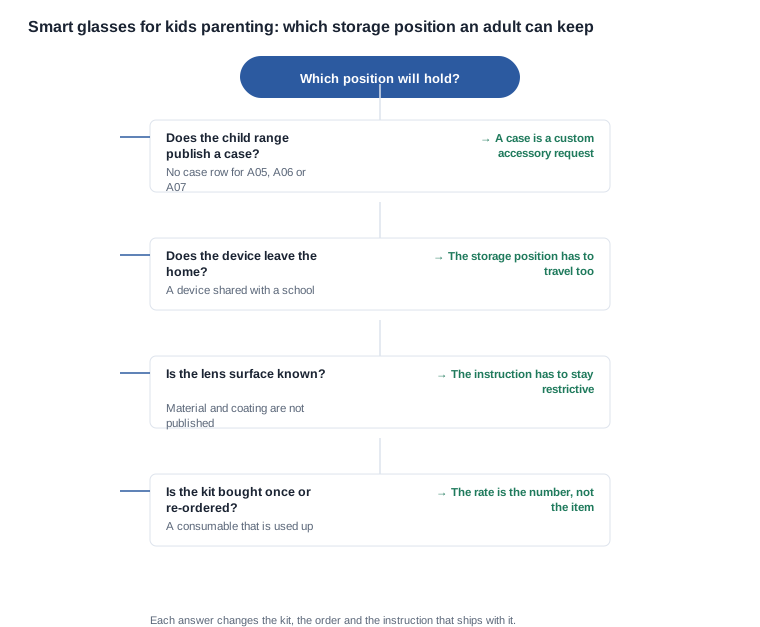
The kit that was correct and the loop that was missing. A storage position only works if something brings the device back to it. The loop is short — handover, a surface check, a count of what was used, a return to the defined place, a same-day report if something is missing — and it is the loop, not the case, that makes the position enforceable.


The commercial terms that decide whether a child kit reaches a shelf
The compliance cost is per market, per product family, and it is not compressible. That makes the market count a commercial decision rather than a marketing one: entering three markets is three document sets, three cost lines and three lead times, and the buyer should know the price of each before the market is announced. Where a market is added later, the change route should say what it costs and how long it takes, because a market added without that clause is paid for by the supplier and appears in the next quotation. The same separation applies to tooling: tooling and mould cost is normally amortised across an order while certification cost follows the product family, and a blended line hides a cost that repeats on every future order next to one that does not. Ask which line the quotation is charging.
Whether the case is a consumable or a durable item is worth negotiating explicitly, because the two are priced differently and behave differently. A durable case is an asset that is counted, insured and returned, and it is the answer for a shared or school-facing deployment. A consumable pouch is a per-unit cost that is re-ordered and never counted, and it is the answer for a household that travels lightly. The choice also decides the transport file, because a case is a second lithium cell and a sleeve is not.
The wording of the return condition standard is a negotiation, not an administrative detail. A standard that defines the state a device must be in when it comes back — lens surface, contacts, case present or absent — decides how many disputes the channel has and what each of them costs. A standard that is written before the first shipment is a commercial term. A standard written after the first dispute is a concession.
The consumable rate is the negotiation that pays fastest. A sleeve and a surface wipe cost a few cents per device and change nothing else in the operation. The quantity to negotiate is the quantity per device per month and the restock interval, not whether they are included, and the interval should be set from the rate observed over the first quarter rather than from a forecast.
The terms worth putting in the order. The published rows for each model in the set. The kit contents list with quantities, the storage position and the surface instruction. The conformity position per target market. The lens material, coating and prohibited-agents statement. The battery transport file for the exact configuration, including the case where a case is in the kit. The packaging artwork proof, with the supplier's obligation to proofread the claims on it. The return condition standard and the warranty period with a stated response. The incoming inspection criteria and the point in the flow at which they are applied. The building blocks are at pricing, contract terms and MOQ, and the certificate procedure is at certification checklist.
What we publish for the child range, and what to send us next
We publish the children's entries' cell capacities, rated runtimes and feature descriptions exactly as the catalogue states them — the A05 and the A06 at 40 mAh with about twenty hours and magnetic charging, the A07 at 70 mAh with about twenty hours, magnetic charging and a published Bluetooth version — and we publish the absence of the lens material, the coating specification, the surface treatment, the frame weight and the conformity assessment for the children's market with the same prominence. We will not publish a handling instruction for a surface whose material we have not been given, and we will not make any claim about what these products do for a child's vision.
What to send us. Send the markets, the age range, the channel, the expected volume and the storage position you are considering, and we will tell you which published rows apply, which compliance question should be settled first, which rows have to be requested in writing, and what the kit and the return loop should contain. The scenario entry point is smart glasses for parenting, the product family is at kids smart glasses, and the handling detail is at kids parenting handling.
Related reading
- How to enter the scenario — smart glasses for parenting
- The family we are placing it in — kids smart glasses
- The children's compliance route — child product compliance
- The handling side — kids parenting handling
Tell us the markets and the age range, and we will say which compliance question to settle before the kit is specified.