

Smart glasses for kids parenting real-world experience is usually written as a story about a family, and a story about a family is the least useful thing a buyer can be given, because it cannot be checked and it cannot be compared. The two traces set out below are hypothetical scenarios worked through in full, not client projects, and they are written as decision traces rather than as narratives. Each trace records the constraint, the configuration that constraint settled on, what the supplier had to supply for the trace to be reproducible, and the point at which the programme could have stopped and did not.
Smart glasses for kids parenting: two household decisions worked through
The reader behind this kind of article is a brand-side buyer, a channel buyer or an e-commerce seller who has read the specification and who now needs to know how the specification behaves when it meets an actual household. The situation is usually a shortlist to defend internally, and the fear is that the shortlist is defended with an argument that a colleague cannot reproduce. A trace is reproducible. A story is not.
The published position the traces start from
The starting point for both traces is the same three-model catalogue. The pair that carries posture and distance detection with reminder behaviour publishes a 40 mAh cell, a charge ceiling of two hours or less, roughly twenty hours of rated use, magnetic charging and a lens-type electronic atomiser. The third model publishes a larger 70 mAh cell with the same charge ceiling and the same rated use, magnetic charging, and a Bluetooth V5.4 radio row, and it publishes neither the atomiser nor the detection. That difference is what the two traces turn on.
What a trace can lean on is narrower than a specification sheet suggests, and admitting that is part of the method. Two of the three models in this line publish the same cell, the same charge ceiling, the same rated use, the same charging interface and the same feature set, and the catalogue does not say what separates them. A channel can change colour and packaging, but the app and firmware position is recorded as awaiting verification rather than offered as an option. Nothing is certified per model, and neither weight nor size is published for any of the three. A trace that leaned on a figure from outside that set would be leaning on something the documentation does not contain.
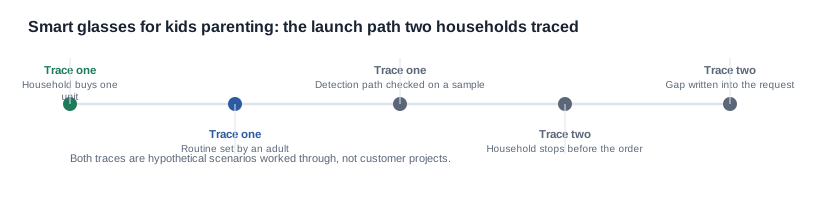
The five points on that timeline are the five points at which a household decision in this category either becomes a configuration or stops. Two of them are inside the first month, which is the argument for treating the first month as a programme rather than as a settling-in period.
What a trace records, and what it deliberately does not
A trace in this category records six things and no others: the constraint, the candidate configurations, the published rows that separate them, the rows that had to be requested, the decision that followed, and the action that made the decision reproducible for the next household. It does not record how the household felt, how long the child took to get used to it, or how the product performed in the family's view, because none of those is reproducible and all three sound like evidence.
It is worth being explicit about why that distinction is a commercial one rather than a stylistic one. A channel that writes its listing from a story will produce copy that cannot be substantiated. A channel that writes its listing from a trace will produce copy that maps to a published row, and the copy review becomes a check rather than an argument.

The first household, and the configuration it settled on
The constraint. One unit, bought for a child of seven, in a household where one adult does the charging and where the parent has stated that the intention is a behaviour tool for posture and distance rather than anything to do with eyesight. The household has a fixed evening charging point and no intention of buying a second unit.
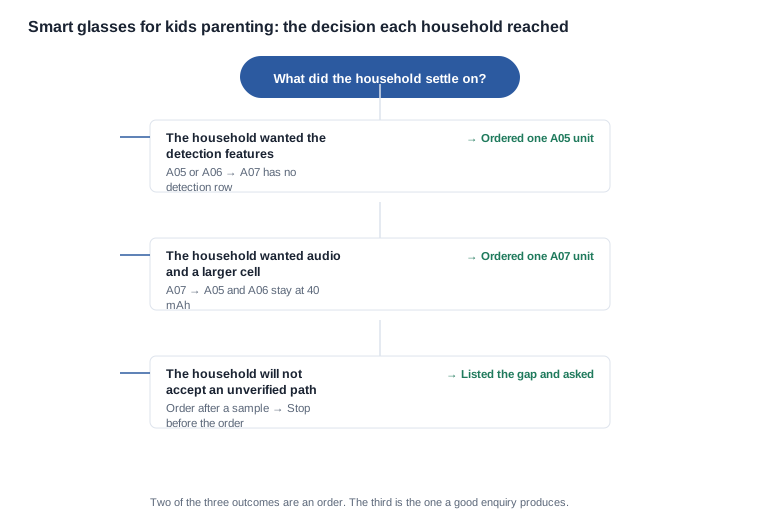
Step one, the model. The detection behaviour is the reason for the purchase, and the A05 and the A06 are the only models in this line with posture and distance detection published. The A07 publishes no detection row and no atomiser row, so it is eliminated by the constraint rather than by a preference. The shortlist is the A05 and the A06.
Step two, the designations. The A05 and the A06 publish identical rows, so the choice between them is not a technical one. The household's channel asks for the difference in writing, and the answer is that the catalogue does not publish one. The channel therefore treats them as two labels for one specification, orders both designations against a single artwork set, and lets the marketplace decide which label it takes. This is the cheapest available resolution and it takes one email.
Step three, the sizing. Frame weight and frame size are not published for any of the three models, so sizing cannot be settled from a document. The channel runs the sample with two adults and with the child, and records a range rather than a figure. Nothing about sizing is published in the listing.
Step four, the claim. The catalogue carries an explicit restriction on efficacy claims for this tier, and no myopia prevention function appears in the published material. The claim set is agreed in writing before the artwork and covers the product page, the packaging, the insert and the support script. The medical boundary page sets out how that restriction is handled.
Step five, the routine. Magnetic charging, a ceiling of two hours or less, and roughly twenty hours of rated use. The channel's insert says that the unit lives at a fixed point and that an adult charges it nightly. It does not state a charge duration beyond the ceiling, and it does not describe the reminders as working continuously.
The configuration settled on. One A05 or one A06 unit, sold singly, with a shared artwork set covering both designations, an insert that specifies the charging routine, and a listing whose only claims are the published ones.
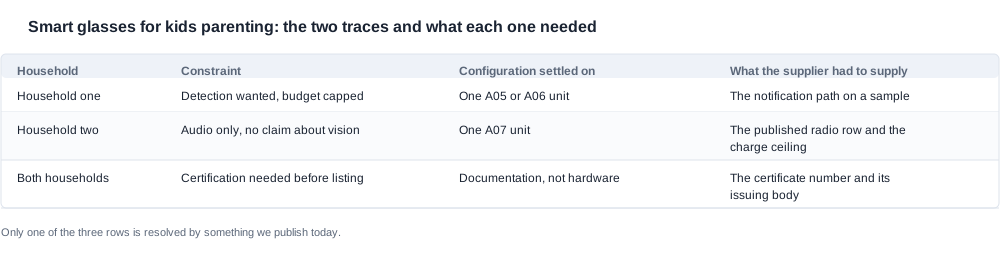
What the supplier had to supply. The published rows in writing rather than as a conversation, a sample for the sizing assessment, the notification path demonstrated on that sample, and the certification position for the model being ordered.
The second household, and why it stopped before the order
The constraint. A different household, and a different kind of enquiry. This one is a channel placing an order for a school rather than a family, and the constraint is not the product at all. It is that the school's safeguarding lead has asked for a written description of where the data goes, and the channel cannot produce one.
Step one, the model. The school wants audio for a language-learning activity rather than detection, so the A07 is the relevant model on the published rows: a 70 mAh cell, Bluetooth V5.4, magnetic charging, and no detection row to explain away. The shortlist narrows quickly, and it narrows on a published row rather than on a preference.
Step two, the data. The channel asks for a written description of what the unit holds, where it goes and who may see it. Our documentation records app and firmware customisation for this tier as awaiting verification, so the answer is that the description does not exist yet and has to be requested. That answer is truthful and it is also the answer that stops the programme.
Step three, the decision. The school cannot accept a feature whose data handling cannot be described, and it is right not to. The channel therefore does not place the order. It records the reason as an open documentation item rather than as a price objection, and it tells the supplier what it needs in order to proceed.
Step four, what would have unblocked it. A written description of the data path for the model in question, and a per-model certification position. Neither is published today. Both are requests, and both are requests a buyer can make in one line.
The configuration settled on. None, at this stage. The trace produced a specification requirement rather than an order, and that is the correct output for a programme that cannot yet be substantiated.
What the supplier had to supply. A data-handling description for the model and the market, and the certification position. Nothing else was needed to make the decision, and nothing about the hardware was ever in question.
What the two traces have in common
Set the two side by side and the pattern is visible: in both cases the hardware decided almost nothing, and the documentation decided everything.
The model was settled by a published row. In the first trace, the detection row settled it. In the second, the radio row and the absence of a detection row settled it. Neither trace needed a preference, and neither trace needed a comparison across unrelated categories.
The claims were settled before the artwork. In both traces the permitted claim set was agreed in writing first, and in neither case did a later asset drift away from it. The cost of that sequence is one email; the cost of the opposite sequence is a reprint.
The point of no return was a document, not a shipment. The first trace stopped at the sizing sample. The second stopped at the data description. Neither stopped because of a price, and neither stopped because of a product fault.
The routine was the same in both. An adult, a fixed point, nightly. The published rows make it so, and no amount of copy changes it. A channel that writes a listing implying a child manages the charging independently is writing against the published specification.
The one difference that mattered
The second trace stopped and the first did not, and the reason is worth drawing out because it is the difference between a programme that can be run and one that cannot.
A trace can stop for a reason that is outside the buyer's control, and that is acceptable: the certification file does not exist yet, the data description has not been written, the supplier's schedule is what it is. What it cannot do is stop for a reason the buyer has failed to test. In the second trace the data question was asked before the order and before any stock was committed, which cost a week. Had the same question been asked after the first shipment, it would have cost the shipment.

The trace a channel can run on its own configuration
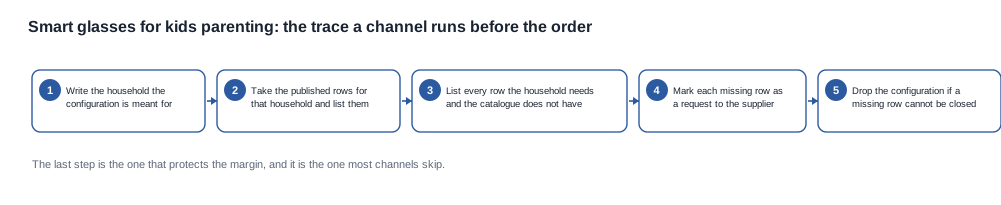
A channel does not need our traces to run its own. It needs the same five steps applied to its own configuration, and it needs to run them before the purchase order rather than after the first returns.
- Write the household the configuration is meant for. Not the demographic and not the market. The actual constraints that decide whether the unit is used, which for this category is who charges it, where it lives, and what the adult is told.
- Take the published rows for that household and list them. The cell capacity, the charge ceiling, the rated use, the interface, and the published feature set. These are the rows the listing is allowed to use and the rows the insert is allowed to repeat.
- List every row the household needs and the catalogue does not have. For this line that is the certification position, the data path, the frame weight and size, and the drop and ingress position. Writing them down is what converts an absence into a request.
- Mark each missing row as a request to the supplier. A request has an owner and a date. An absence has neither, and that is why absences survive until a shipment is already in transit.
- Drop the configuration if a missing row cannot be closed. This is the step most programmes skip and it is the one that protects the margin, because the alternative is a listing that carries a claim nobody can defend.
The fifth step is uncomfortable, which is usually a sign that it is the right one. A configuration that depends on a row nobody can produce is a configuration whose returns will be decided by the household rather than by the channel, and the household is a much worse decision-maker than a procurement team with a checklist.
The trace a channel can run on two quotations
The same five steps applied across a shortlist produce the comparison that a channel actually needs, and it is a different comparison from the one a specification sheet produces.
- Put the two quotations in the same order, row by row. Unit price, configuration string, documentation set, lead time, payment terms, minimum order quantity, warranty treatment and the terms for a unit that fails inspection.
- Compare the documentation rows first, not the price rows. A quotation whose documentation cannot be checked is not a quotation that can be compared, and treating it as one is the most common error in this category.
- Mark every row that is identical in both quotations. Those rows are settled and they are what the listing will be built on. In this range that set is the cell capacity, the charge ceiling, the rated use, the interface and the published feature set.
- Mark every row that differs and ask what the difference is. In this range the two differences that matter are the A05 versus A06 designation question and the documentation set.
- Decide the programme on the rows that differ. If the difference is a document, the programme is decided on the document. If it is a price, it is decided on the price. Deciding it on a row that is identical in both quotations is how a channel spends a month evaluating something that was never going to differ.

What the trace changes about the order
Running the trace before the order is what turns the trace into commercial terms, and the conversion is mechanical. Each step of the trace produces a line in the purchase order or in the supply agreement, and the lines that a trace does not produce are the lines a programme does not need.
The configuration string. Step one of the trace produces the configuration, and the configuration belongs in the order as a named string rather than as a model name. A model name leaves room for interpretation; a configuration string does not. This matters more in this category than elsewhere, because the A05 and the A06 publish identical rows and the two designations can therefore drift apart without anybody noticing until a shipment arrives with the wrong artwork.
The claim set as an attachment. Step four of the trace produces the claim set, and the claim set belongs in the agreement as an attachment with the artwork approval referencing it. That single reference is what prevents the listing and the packaging from drifting apart over a twelve-month programme.
The documentation set with a delivery date. Step three of the trace produces the list of rows that have to be requested, and that list belongs in the order with a date against each line and a named owner. A documentation request without a date in it is an aspiration, and the difference shows up in the month the goods are supposed to arrive.
The sample and the sizing result. Step three of the first trace produced a sizing range from a sample, and that result belongs in the programme file with the date it was measured. It is the only published evidence in this line that bears on whether a household will keep using the unit, and it expires, because a child grows.
The routine, in the insert artwork. Step five of the trace produced the charging routine, and the routine belongs in the insert artwork that the supplier produces and the buyer signs. It is a per-unit print cost, and it is the cheapest available reduction in the return rate available anywhere in this bill of materials.
What the trace leaves out, and why that matters
Two things are deliberately absent from the trace, and both of them are things a buyer might expect to find in a case study.
It does not produce a performance claim. The trace runs on published rows and on a sample, and a sample establishes that a reminder arrives and that a household can charge the unit. It does not establish a runtime, because the published runtime of roughly twenty hours is a rated figure with no test condition, and a single sample does not create a test condition. Any trace that produced a runtime figure would be producing a number with no method behind it.
It does not produce a demand forecast. The trace is one configuration against one constraint. A demand forecast is a market question and it is answered with market data, not with a worked scenario, and presenting a scenario as a forecast is the fastest way to lose a buyer's trust in the rest of the document.
The commercial consequence of the second omission is worth stating: a channel that runs its own traces on a configuration and then prices the programme on the trace rather than on the market will consistently overestimate the volume and underestimate the documentation cost. Both errors are expensive, and both are invisible until the first quarter's numbers arrive.
What we can reproduce, and what we will not invent
The working rule we apply: we will publish the rows a buyer can order from and we will not fill a gap with a typical figure from a supplier's general data. For this children's line that means the cell capacities of 40 mAh on the A05 and the A06 and 70 mAh on the A07, the charge ceiling of two hours or less, roughly twenty hours of rated use, magnetic charging on all three, the lens-type electronic atomiser and posture and distance detection on the A05 and the A06, and Bluetooth V5.4 on the A07.
We do not publish the certification position, the app and firmware behaviour, a frame weight, a frame size, a drop rating or an ingress rating for this line, and we will not estimate any of them.
We also want to be clear about what the traces above are and are not. They are hypothetical scenarios worked through on the published rows, and they contain no customer, no client project and no household that bought anything from us. We will not present a worked scenario as if it were a record of something that happened, and we will not write a case study that implies a programme we cannot describe. If a channel wants to know how a specific configuration behaves in a specific household, the answer is a sample and a trace run on their own configuration, and the model comparison article is the criteria for setting it up.
The configuration and the claim
Send the configuration you are considering, the market, the claim you intend to make and the quantity, and we will run the trace with you: which published rows apply, which rows have to be requested, which model the constraint settles on, and which of the five steps above is the one your channel has to close first. The seasonal considerations article covers the same configuration question from the demand side, and the scenario entry point is smart glasses for kids parenting.


