

Smart glasses for kids parenting seasonal considerations are usually written as a buying calendar for households, which is the wrong reader. The reader behind this article is a brand-side buyer, a channel buyer or an e-commerce seller, and the seasonal question in front of them is not when a family buys. It is what changes about the configuration, the claim set and the service window when the same product is placed in different parts of the year. The hardware does not change between seasons. Almost everything else does, and a channel that plans the year as one continuous programme is carrying the wrong assumptions into the quarter where it matters most.
Smart glasses for kids parenting: what each buying season changes
The situation behind a seasonal question is usually one of three: a channel deciding how much to hold before a school year starts, a brand deciding whether to launch into a particular window, or a supplier being asked to split a single programme across a year of demand. The fear underneath it is that the split creates two versions of the product. Two versions means two artwork sets, two packaging costs, two claim sets to keep consistent, and a returns desk that cannot tell which version a unit came from.
The published position the seasonal plan runs on
Three models exist in our children's line. The A05 and the A06 each publish a 40 mAh cell, a charge time of two hours or less, roughly twenty hours of rated use, a magnetic charging interface, a lens-type electronic atomiser, and posture and distance detection with reminder behaviour. The A07 publishes a 70 mAh cell, the same charge ceiling of two hours or less, roughly twenty hours of rated use, magnetic charging, and Bluetooth V5.4, with no atomiser row and no detection row.
The A05 and the A06 publish identical parameters and the difference between them is not confirmed. Colour and packaging customisation are available. App and firmware customisation is recorded as awaiting verification. The certification position is not provided for any of the three. Frame weight and frame size are not published for any of the three.
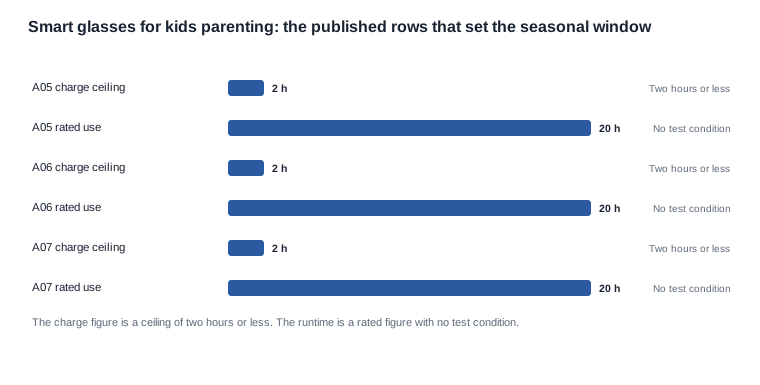
The chart above is the seasonal window in its most literal form. The charge ceiling of two hours or less and the rated use of roughly twenty hours are the same on all three models in every season, and that is exactly why they are the right starting point. A seasonal plan built on a published row does not change when the calendar changes, so the seasonal work is concentrated in the places where the documentation and the demand actually move.
What changes between seasons, and what does not
Three things change and three things do not, and a channel that confuses the two ends up with a programme it cannot operate.
What changes. The configuration being ordered, in the sense of quantity per household and per order. The claim set, because a seasonal window has its own promotional pressure and the pressure is where claims get added by accident. And the service window, because the time between a household buying and the household needing help is not the same in every season.
What does not change. The hardware, the published rows, the certification position, and the gap between the claim set and the documentation. A season does not produce a certification file, and it does not produce a frame weight. A channel expecting a seasonal change in any of these is expecting something that arrives on a documentation schedule rather than on a retail schedule.
The seasonal buying calendar
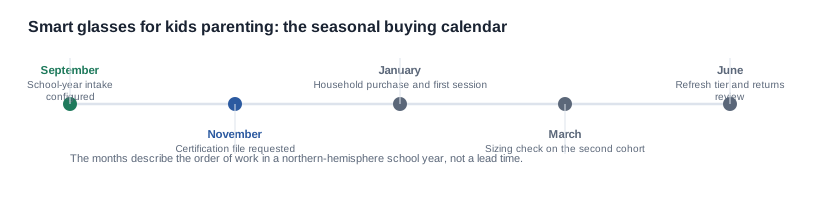
The five points on that timeline are the ones that decide a seasonal plan in this category. September is when the configuration and the claim set have to be settled, because everything downstream of them takes longer than most buyers assume. November is when the documentation request goes out, because that is the longest-lead item in the whole programme and it cannot be shortened by working harder on it. January is when households buy and when the first returns data appears. March is when the second cohort's sizing has to be checked, because a growing child is the most likely reason a unit stops being used. And June is when the refresh tier and the returns reserve get their first real numbers.

The school-year intake and the configuration it needs
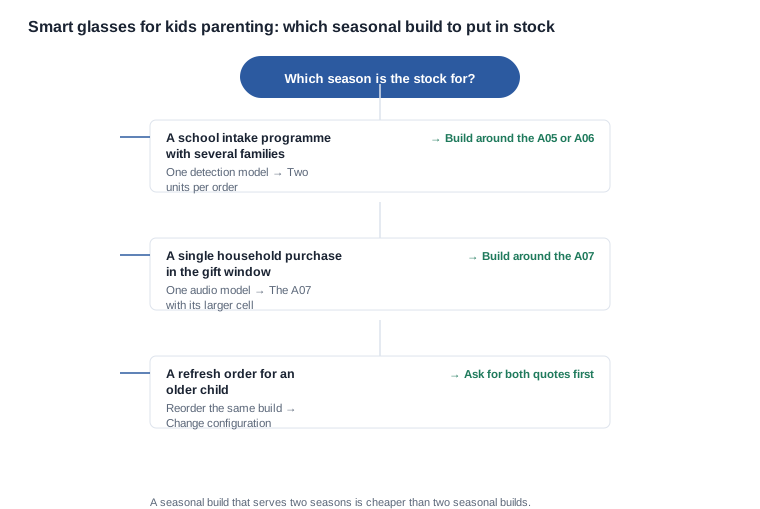
A school-year intake is the highest-volume window in this category and the one where a seasonal plan most often goes wrong, because intake demand is institutional and institutional buying has a documentation shape that a household purchase does not have.
The configuration. An intake programme typically needs two things a family purchase does not: the ability to place several models on one purchase order, and a servicing arrangement across more than one household. The A05 and the A06 publish identical rows, which makes them easy to combine on one order and, if the supplier's minimum order quantity allows it, on one documentation set as well.
The quantity question. Intake demand is larger than a family programme's and it arrives in a shorter window. Whether the supplier's minimum order quantity matches an intake's scale, and whether the intake can be split across a pilot and a run, are the two questions that decide whether the season is manageable. Asking them in September and finding out in January is a stock problem; asking them in advance is a planning problem.
The claim set. An intake is an institutional purchase, so the permitted claim set matters more, not less. A household can be managed with a careful listing; a school and a local authority cannot be. The education gear checklist is the document-side version, and the model comparison article covers the criteria that keep separate products in separate columns.
The service window. An intake concentrates the first-session questions into a few weeks, which means the support script has to be ready before the season rather than during it. The insert, the claim set and the first-session steps are all decided in the earlier part of the calendar for exactly this reason.
The winter purchase, and the claim the listing must not make
The winter window in this category carries a particular characteristic: a substantial share of its demand is a single unit bought as a present for a child whose household has not decided what it wants. That is a demand signal with no specification behind it, and it is where the seasonal claim pressure is strongest.
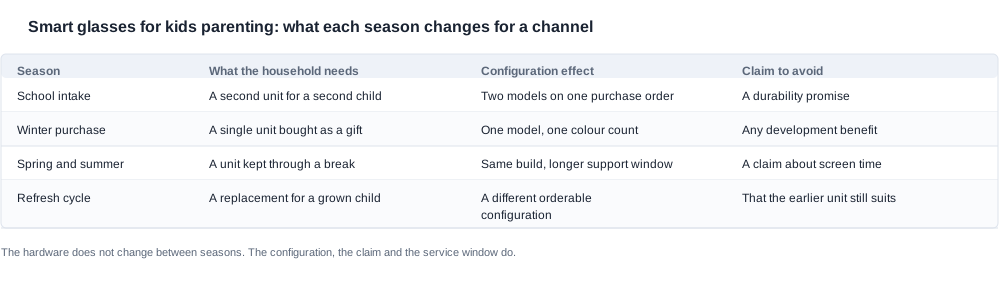
| Season | What the household needs | Configuration effect | Claim to avoid |
|---|---|---|---|
| School intake | A second unit for a second child | Two models on one purchase order | A durability promise |
| Winter purchase | A single unit bought as a present | One model, one colour count | Any development benefit |
| Spring and summer | A unit kept through a break | Same build, longer support window | A claim about screen time |
| Refresh cycle | A replacement for a grown child | A different orderable configuration | That the earlier unit still suits |
Why the winter window is the one to be most careful in. The buyer in this window has no specification, so the listing has to supply one, and a listing that supplies a specification through adjectives is a listing that supplies a claim. The categories in this category's marketing language are the ones a family most wants to believe, and the winter window is when the pressure to use them peaks.
What the listing should say instead. The published features, stated plainly: posture and distance detection with reminder behaviour and a lens-type electronic atomiser on the A05 and the A06, or a published Bluetooth V5.4 radio with a larger cell on the A07. The published cell capacity, the charge ceiling of two hours or less, roughly twenty hours of rated use, magnetic charging. Nothing about vision, nothing about hearing, nothing about development, and nothing about an outcome of any kind.
The one product decision that matters here. A present bought without a specification is a purchase that will be evaluated against whatever the recipient expected, and the only way to reduce that is to remove the expectation rather than to meet it. A listing that says what the product is, in the published terms, is doing that. A listing that says what the product might be for is not.
The configuration effect. One model and one colour count is the right answer for this window, and it is worth resisting the temptation to widen it. A seasonal window with a wider range multiplies the artwork and the packaging and makes the returns classification harder, and none of that extra range helps a household that did not know what it wanted when it opened the box.

The spring and summer months, and the service window they need
The spring and summer months in this category are not a demand peak, and treating them as one is how a channel ends up with inventory it cannot justify. They are the window in which the first cohort's units have been in service long enough for their behaviour to diverge from the behaviour of a new unit, and that has a service consequence rather than a sales one.
The commercial terms a seasonal programme needs
A seasonal programme is a supply arrangement with a shape, and the shape has to be written down because a procurement team negotiates it once and then lives with it for a year. The terms that matter most in this category are not the price terms. They are the ones that decide whether the second season can be run on the same basis as the first.
The configuration string, held across the year. The order should name a configuration rather than a model, because a seasonal programme that renews against a model name can drift into two builds without anybody noticing. This matters more in this category than elsewhere, since the A05 and the A06 publish identical rows and two designations that look distinct can quietly become one. A channel should require the same configuration string on every replenishment and check it against the first shipment.
The documentation as a condition of supply. Every replenishment against a seasonal programme should carry the same documentary position as the first order, and the supplier should be required to notify the buyer of any change to the build that affects it. A seasonal plan that renews on price alone will eventually receive a unit whose paperwork no longer matches the listing.
The lead time and the split. The split between a pilot and a run, the minimum order quantity for a seasonal replenishment, and the payment terms that suit a split delivery are all negotiable, and the room is usually in the share taken at the pilot tier rather than the run tier. That share is the factory's own risk exposure, so it is the part a buyer can move furthest. Whether a channel can hold stock against a seasonal peak or has to order against the season is a question with a cost attached, and it should be settled before the first commitment rather than during it.
The packaging and artwork cost, counted once. If the seasonal plan uses one configuration and one claim set, the artwork and the packaging are per-run costs rather than per-season costs, and the incremental cost of the second season is much smaller than the first. That is the commercial argument for keeping one configuration across the year, and it is usually more persuasive than the operational argument.
The warranty and the returns position. A seasonal programme in this category needs a warranty position that distinguishes a defect from an aged cell and from a unit that no longer suits a growing child, because those three arrive in different seasons and in different proportions. A single blanket warranty will be priced by the most common cause in the first season and then consumed by a different cause in the second.
The margin arithmetic. The total cost of a seasonal programme is the unit price plus the returns reserve plus the cost of the documentation route plus the cost of the second order, and the trade-offs between those four are settled in the quotation rather than after it. A channel that budgets the first season's margin and discovers the other three in the second is discovering them at the least convenient point in the year.
The service window is longer than it appears
A unit bought in January is still in daily use in June, and the questions it raises in June are the questions nobody asked in January. The routine may have lapsed. The child may have outgrown it. The cell may not be delivering the published figure in the way the household expects. A support script written for the purchase moment is the wrong script for this window, and the correct one is much shorter: what the published rows are, what the claim set permits, and what the replacement rule is.
The handling question in this window. Our catalogue publishes no lens material and no coating for these models, so a wipe instruction has to be restricted rather than permissive, and a household that has been using the unit for six months has had six months to form its own habits. The maintenance article covers the handling side, and the honest position for a channel is to publish a restricted instruction rather than a generous one.
The sizing question in this window. This is the month in which a growing child is most likely to outgrow the unit, and because frame weight and frame size are not published for any of these three models, a channel cannot answer it from a document. It has to be answered on a sample, and the sample result recorded with a date, because a child's size in March is not their size in September.
What a seasonal plan should hold in stock. Two things, and both of them are cheap. The refresh configuration, at a quantity that matches the observed cohort rather than the modelled one, and the consumable kit, which is a per-unit consumable and therefore scales exactly with the run. Everything else can wait for a purchase order.

The refresh cycle and the returns reserve
The last point on the seasonal calendar is the one with the most commercial weight, because it is the point at which the year stops being a sales problem and becomes a cost problem. A seasonal plan that does not budget for it treats the second year as free.
The three costs of a year. A seasonal programme in this category incurs a first-order cost, a refresh cost and a returns cost, and the second and third are the ones that are usually absent from the plan. The refresh cost is a second order at a different quantity and against a different documentation position. The returns cost is dominated by a claim mismatch rather than by a fault, which means it is a cost the channel controls through the claim set and the insert.
Why the returns reserve has to be quoted. A reserve that is assumed is a reserve that gets consumed by the first bad month and then quietly disappears, and in this category the first bad month is usually the one where the copy and the documentation disagreed. Quoting the reserve as a line makes it a decision, and a decision can be reviewed.
What the reserve is actually for. In a seasonal programme the dominant causes are a household that bought a vision product and got a behaviour tool, a household whose routine lapsed over a break, and a unit that was dropped or lost. The first is a claim set problem, the second is an insert and support problem, and the third is a replacement rule problem. All three are controllable, and none of them is a hardware cost.
The refresh tier has to be planned in the first season, not the second. A refresh quoted after the first cohort comes back is a price negotiated under time pressure, against a quantity nobody forecast. Planning it in the first season, as a tier with its own terms and its own documentation position, is what makes the second year cheap rather than expensive.
Building a seasonal plan a small team can run, and what to send us
A seasonal plan in this category does not need to be complicated. It needs to be decided in the right order, and the order is the same in every channel.
- Settle the claim set first. It decides which assets can exist, and it is the only item in the list that a later decision can invalidate. Agreeing it after the artwork has been approved is a reprint.
- Settle the configuration second. One configuration that serves the whole year wherever the published rows allow it, because two configurations double the artwork and the documentation and split the returns data.
- Request the documentation third. The per-model certification position, the data-handling description, and the material and sizing declarations. These are the longest-lead items and they do not depend on anything else in the plan.
- Set the kit and the insert fourth. Both are per-unit costs, both are decided before the run, and both are the cheapest available reduction in the return rate.
- Plan the refresh tier fifth. Not the quantity, which nobody can forecast in the first season, but the terms, the documentation position and the minimum order quantity. Those three are knowable early and they are what the second year depends on.
- Decide the seasonal split last. It is the only item on the list that depends on all the others, and it is the one most likely to be decided first by accident.
The children's line, and why a season changes no figure
The boundary we hold: we publish the rows a buyer can order from and we will not fill a gap with a typical figure from a supplier's general data. For this children's line that means the cell capacities of 40 mAh on the A05 and the A06 and 70 mAh on the A07, the charge ceiling of two hours or less, roughly twenty hours of rated use, magnetic charging on all three, the lens-type electronic atomiser and posture and distance detection on the A05 and the A06, and Bluetooth V5.4 on the A07.
We do not publish the certification position, the app and firmware behaviour, a frame weight, a frame size, a drop rating or an ingress rating for this line, and we will not estimate any of them or imply that a season produces a different answer. We will not publish a demand forecast, and we will not present a seasonal plan as a market prediction, because a forecast is a market question and this is a configuration question.
The seasons you are planning for
Send the models, the markets, the seasons you are planning for and the quantity, and we will tell you which published rows apply, which configuration serves the most seasons, which claim set covers all of them without a re-approval, and which documentation items have to be requested before the first season rather than between them. The scenario entry point is smart glasses for kids parenting.


