Four safety questions decide whether a children's smart glasses purchase is a good idea, and every one of them currently ends at a documentation gap rather than a published answer. That is the honest position for this range: three models exist, their mechanisms and battery figures are published clearly, and the certification position is not provided for any of them. A parent deserves to know that before buying, and a channel deserves to know it before listing. What follows sets out the four questions, what our published documentation settles, what closes each gap, and what a buyer should ask for when the answer stays empty.
Smart glasses for kids parenting: what a parent needs from four safety questions
The reader behind this article is a parent, an optical channel buyer or an education purchaser, and the situation is usually one of three: a household deciding whether to buy, a channel deciding whether to list, or an institution writing a procurement policy for a category it has not bought before. The fear behind the enquiry is specific and it is not a general one about children's products. It is that the device will turn out to be something other than what the household was told it was, and that the person who would have noticed will be the child.
The published position the four questions are asked against
The A05 and the A06 each publish a 40 mAh cell, a charge time of two hours or less, roughly twenty hours of rated use, a magnetic charging interface, a lens-type electronic atomiser, and posture and distance detection with reminder behaviour. The A07 publishes a 70 mAh cell, the same charge ceiling of two hours or less, roughly twenty hours of rated use, magnetic charging, and Bluetooth V5.4, with no atomiser row and no detection row.
The A05 and the A06 publish identical parameters and the difference between them is not confirmed. Colour and packaging customisation are available. App and firmware customisation is recorded as awaiting verification. The certification position is not provided for any of the three. Frame weight and frame size are not published for any of the three. Frame material composition and skin-contact material are not published for any of the three.
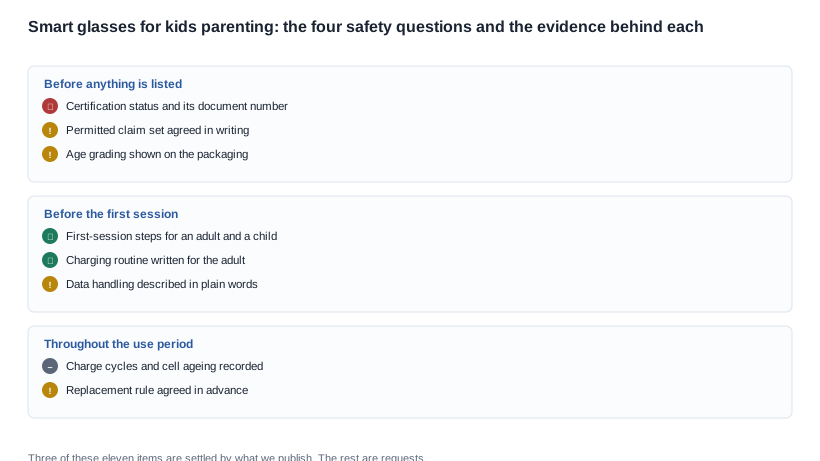
That published position is genuinely informative for two of the four questions and completely silent on the other two, and the split is worth understanding rather than accepting.
The four questions and how far each one can be closed
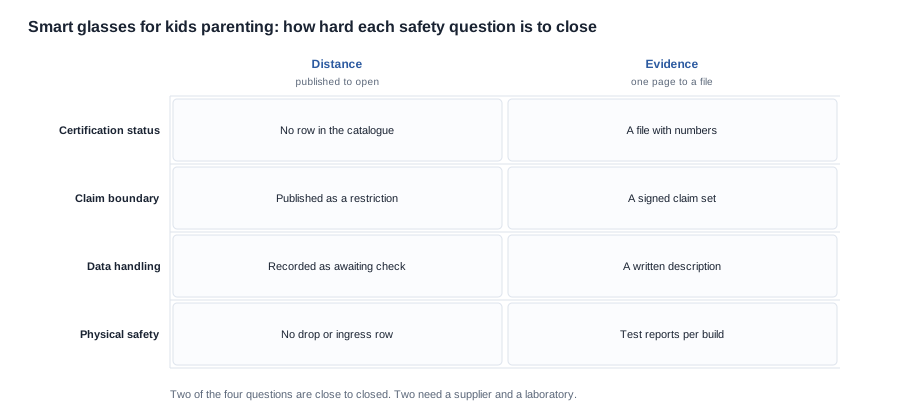
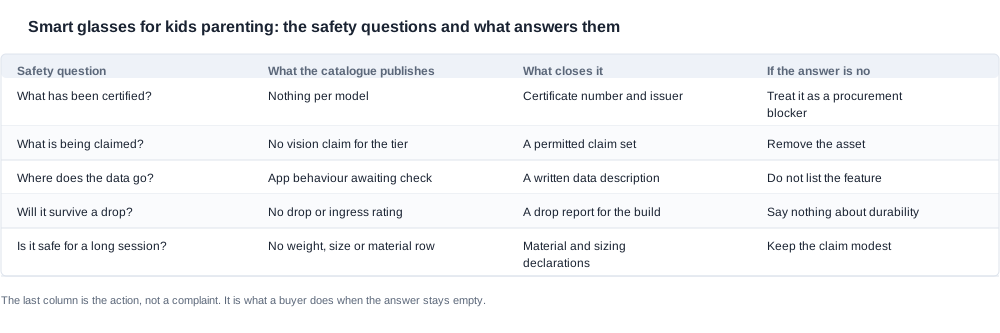
| Safety question | What the catalogue publishes | What closes it | If the answer is no |
|---|---|---|---|
| What has been certified? | Nothing per model | Certificate number and issuer | Treat it as a procurement blocker |
| What is being claimed? | No vision claim for the tier | A permitted claim set | Remove the asset |
| Where does the data go? | App behaviour awaiting check | A written data description | Do not list the feature |
| Will it survive a drop? | No drop or ingress rating | A drop report for the build | Say nothing about durability |
| Is it safe for a long session? | No weight, size or material row | Material and sizing declarations | Keep the claim modest |
The last column is the one a buyer should read twice. In every row there is a defined action that does not depend on the answer arriving, and a channel that has decided its action in advance is a channel that can list the product on Monday without waiting for a file that may take a month.

Certification status, and why it is a procurement blocker
Not provided, for the A05, the A06 and the A07 alike. This is stated plainly in our published documentation rather than left ambiguous, and it is worth being precise about what it does and does not mean.
What it means. Our catalogue contains no per-model certification row. It carries a company-level export certification page whose content is images rather than text, and the catalogue text contains no reference to CE, FCC or RoHS. A buyer therefore has nothing in our documentation to hold against the product it is about to place on a market.
What it does not mean. It does not mean the products are uncertified, and it does not mean that no certification exists. It means the position is not published here, and a buyer who needs the position has to obtain it. Treating a documentation silence as a product defect is as wrong as treating it as a certification.
Why it is a blocker rather than a paperwork item. A children's product carries additional requirements in most destination markets that sit separately from general consumer obligations. In the European Union the regime a buyer is asked about is EN 71, the toy safety standard series, alongside the general safety and traceability obligations of the General Product Safety Regulation. In the United States the regime a buyer is asked about is the Consumer Product Safety Commission regime, with ASTM F963 as the toy safety standard that a product intended for children is usually assessed against. Whether either applies to a specific build in a specific market is a question for the importer, and it is a question that needs a document rather than an assurance.
How a buyer handles it. Ask for the model, the market and the document type in one line, and treat a general assurance as a non-answer to all three. If the file does not exist yet, the order date becomes a function of that file rather than of the factory's schedule, and that is a fact to know before the order rather than after it. The retail and education solutions page sets out what those channels require on the documentation side.
How to evaluate a certification answer before you rely on it
An answer in this category arrives in a small number of recognisable forms, and the criteria for telling a usable one from an unusable one are the same every time. These six checks are what a procurement team should apply before any of them is allowed to support a listing.
- Does the answer name the model, the market and the document type together? An answer that names two of the three is not yet an answer. This is the most common form of non-answer, and it is easy to mistake for a complete one because it uses the right vocabulary.
- Is there a reference number that can be checked? A file without one cannot be verified in an issuing body's register, and a file that cannot be verified cannot be defended when a market-access question is asked. This is the single fastest way to sort a real file from a description of one.
- Does the answer identify the issuing body, and is that body recognised in the destination market? A body that does not operate in the market produces a document rather than a route, and the distinction is invisible unless somebody checks it.
- Does the file cover the build being ordered, or the family? A file made against an earlier revision of the same model is not a file for the model being shipped. Ask for the revision the assessment was made against and compare it against the configuration string on the order.
- What parts of the product does it cover? For a children's product this is where files are thinner than buyers expect. A declaration that covers the enclosure does not cover the radio module, a radio report does not cover the battery, and neither covers the materials that touch skin.
- Is there a date against it? A file without a date cannot be compared with a shipment, and an assessment that predates a supplier's own component change may not describe the product in front of you.
The red flags are consistent. The word "certified" with no body attached. The word "compliant" with no regulation named. A description of a capability rather than of a product. And an answer that is entirely general where the question was specific. None of those is a reason to stop working with a supplier; each of them is a reason to ask a second, more specific question, and the second question is where the useful answer usually is.
When the answer stays empty
If a supplier cannot produce a per-model position, the buyer's options are narrower than they first appear and worth stating before the decision is made. The product can still be bought, and what changes is what the channel is allowed to say about it and where it is allowed to be sold. A listing that carries no certification statement and no protection statement is defensible. A listing that carries an implied one is not, and an implied statement is what a marketplace listing produces by accident, through a template rather than through a sentence.
The second option is to narrow the market. A channel that sells into one market can carry a documentation gap for a while. A channel that sells into several cannot, because the gap has to be closed for at least one of them before the channel can operate at all, and the file that closes it for one market is usually the file that closes it for all of them.
The third option is to change the configuration. In this range there is no children's model with a certification row, so this option is not available, and a buyer who discovers that has learned something important about the category early rather than late.
The claim boundary as a safety control
The published mechanisms are a lens-type electronic atomiser, and combined posture and distance detection with reminder behaviour on the A05 and the A06. What the documentation does not support is any vision, myopia or eye-health efficacy claim.
Why this matters more for a children's product than for any other attribute. The claims that circulate in this category are exactly the ones a parent most wants to believe, and a parent who buys a behaviour tool believing it is a vision product will not return it. They will use it, conclude that it does nothing, and say so in public. That is a safety outcome in the only sense that matters in this category: the harm reaches the child through a family decision made on a false premise.
What the regulatory consequence actually is. In the United States the determination of whether a product falls under medical device regulation turns on its intended use and the claims made about it, so stating a myopia claim changes the regulatory category of the product and not merely its advertising. In the European Union the line runs through whether a therapeutic effect is claimed. The consequence of getting this wrong is a programme that has to be withdrawn rather than corrected.
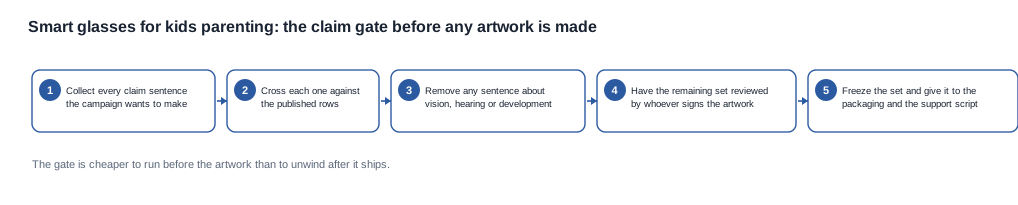
How a claim is controlled. The gate in the flow above is five steps and it is cheap. Collect every claim sentence the campaign wants to make. Cross each one against the published rows. Remove any sentence about vision, hearing or development. Have the remainder reviewed by whoever signs the artwork. Freeze the set and give it to the packaging and the support script. The gate costs an argument and it saves a reprint.
The one-sentence test. If a claim sentence cannot be answered by pointing at a published row, it does not go in the copy. That rule is simple enough to give to a copywriter and strict enough to catch most of the problems.
The data path a safeguarding lead will ask about
The catalogue entries describe posture and distance reminders and a parent-facing view. The delivery mechanism, the offline behaviour and the data handling are not documented, and app capability for the children's models is recorded as requiring verification.
Why this is the question that decides usability. A reminder feature that requires a network connection, or an app whose data handling cannot be described, is a different product from one that can be explained to a school's safeguarding lead. A household can be told what a reminder does. An institution has to be told where the data goes, who can see it, how long it is kept and whether it leaves the device. If those four answers do not exist, the product cannot be placed in an institution, and that is a market decision rather than a technical one.
What to request. A written description of what the unit holds, where it goes, who may see it and for how long. Whether the feature works without a connection. Whether the parent-facing view is the only view. And a statement of whether any of it leaves the device at all. Each of those is one line in a request, and a supplier who cannot answer them should be asked about the reason.
The safe position while the answer is outstanding. Do not list the feature as a data-connected one, and do not describe it as a local one either. Describe what the published rows say, which is that the model publishes posture and distance detection with reminder behaviour, and leave the path unstated. The kids eye protection technology article covers the published mechanisms in more detail, and the buyers most often ask article covers the standard questions those mechanisms raise.
The point where a data question becomes a programme question
There is a threshold at which a missing data description stops being a request and becomes a decision about the programme, and it is worth naming because programmes usually cross it without noticing.
The threshold is crossed when the data question comes from an institution rather than from a household. A household that cannot be given a data description will simply decide not to place the order. An institution that cannot be given one has to record a reason, and the reason it records will be that the supplier could not answer, and that record tends to end the relationship rather than delay it. Asking for the data description early, before the first institutional enquiry, is what keeps a channel inside that conversation.

Physical safety over an extended session
Two things are published for these models and both are worth attention.
Battery capacity and the charging routine. 40 mAh on the A05 and the A06, 70 mAh on the A07, with charging in two hours or less and roughly twenty hours of rated use. That is the longest rated runtime in our catalogue, and it is published without a test condition, so it is a rated figure rather than a promise. The published charging method is magnetic on all three, which means the charging action in a household belongs to an adult at a fixed point.
What is not published. Frame weight for any of these models. Frame size. Hinge and temple durability. Any small-parts assessment. Frame material composition and skin-contact material. And the lens material and coating.
On the weight question specifically. Exactly one weight figure is published in our entire catalogue, and it is 158 g for the MT6, which is an AI camera model with a foldable charging case, not a children's model, and the figure is for the glasses unit rather than for the case. It belongs to no model in this line and it cannot be used to support any statement about a children's model, in either direction. A claim about a child's long-session retention in this range has no documentary basis at all, and the honest position is to make the claim modestly or not at all.
On ingress. No ingress rating is published for the A05, the A06 or the A07. The IP54 marking in our catalogue sits on two sport camera models and does not extend to this line. A listing or an insert that says "water resistant" for any of these three is making a claim the documentation cannot carry, and the child in a downpour is the customer who tests it.
On small parts. Nothing is published, and in a product intended for a child that is a question with a specific answer available from the build rather than from a catalogue. It belongs in the documentation request alongside everything else.
The rules that follow from a gap
Where a row is not published, the rules are short and they are not negotiable.
- Do not state the row. Do not state a typical value, an average from the category, or a value borrowed from another model.
- Do not imply the row. A phrase that avoids the number while implying the answer is the same claim with less exposure.
- Do not treat the absence as a defect of the model. It is an absence in the documentation, and the remedy is a request.
- Do not let the gap travel between assets. A claim can enter through a support script that was not reviewed against the claim set, and that is how a listing ends up carrying something nobody agreed to.
The safety file to assemble, and what to send us
The safety file for this category is a document set with a decision attached to it, and the decision is the part most programmes omit. A file that lists four open items and no action is a record of a problem. A file that lists four open items with a named owner and a date and a defined action is a programme.
The file itself. The permitted claim set, signed. The certification position per model, per market. The data-handling description. The drop and ingress position. The frame weight, size and material declarations. The small-parts assessment. The charging routine as written for the adult. And the agreed incoming inspection criteria, so that the first shipment is checked against the same documents that were signed.
The decisions attached to each open item. What the listing says while the item is outstanding. Who reviews the answer when it arrives. What happens to the listing if the answer is adverse. And whether the item is a blocker for listing, for institutional sale, or only for a specific market.
The commercial terms that carry the decisions. A clause making the documentation a condition of supply. A clause covering what happens to stock already produced if a document is withdrawn or an assessment changes. Warranty treatment that separates a defect from an aged cell and from a unit that no longer suits a growing child. And a returns reserve that is quoted rather than absorbed into the margin, because in this category the dominant return cause is a gap in a claim rather than a fault in a product.
How to choose between two suppliers on this evidence. The shortlist criteria in this category are unusual, and a buyer who applies the usual ones will make the wrong choice. Unit price is not a differentiator worth the negotiation time, because the configurations are close and the differences are in the file. Lead time is not either, because the file rather than the factory sets the date. The criteria that decide it are how quickly a per-model file can be produced, whether the supplier will state the difference between the A05 and the A06, whether the claim set is agreed once for the programme or renegotiated per market, and whether the supplier will measure a sample at all. Those five answers tell a buyer more about the programme than any price on the table.
The trade-offs are worth naming too, because they are the ones a buyer is asked to weigh. A supplier with an existing per-model file will usually ask for a larger order in exchange for it, which is a reasonable trade for a channel with volume and a poor trade for one without. A supplier who will build the file for a single market is cheaper and slower, and a channel selling into several markets should weigh the total cost of the union of files against the unit price of the cheapest one. And a supplier who declines to say what the A05 and the A06 difference is has told the buyer something that is worth more than the answer would have been, even though the answer itself was the thing wanted.
The total cost of a gap, and when to accept one
A buyer should price a documentation gap rather than simply deciding to live with it, and the price has three parts. The first is the direct documentation cost, which is a quotation line and is therefore easy to compare. The second is the cost of the listing being narrowed while the gap is open, which is a lost sale rather than a cost, and it is the part that is hardest to see. The third is the cost of the gap being closed badly at the last minute, which is a reprint of the packaging and a re-listing of the product and the delay of a shipment, and it is the part that is most expensive and least predictable.
The rule of thumb is this. Accept a gap when the programme is small, the market is one, and the listing can be written without the missing row. Do not accept a gap when the channel sells into an institution, when the missing row is the certification position, or when the gap sits underneath a claim that a marketplace listing would naturally imply. Those three cases are where a gap stops being an inconvenience and becomes the reason the programme does not work.
The boundary we hold, and why a parent needs it
The boundary we hold: we will describe the published mechanisms accurately and will not attach any clinical, vision or myopia claim to them, even where a listing would sell better with one. For a children's product this protects the parent more than it protects us, because a substantiated-claim dispute is a withdrawal and a recall rather than a fine.
Certification status for all three models is not provided, and we will say so plainly rather than imply that a general compliance statement covers a children's-product requirement. Frame weight, frame size, frame material composition and data handling are not published for this range, and we will not estimate them. We will also not publish an ingress rating for these models, because the IP54 marking in our catalogue belongs to two sport camera models and extending it would be a false statement.
Which claim the age band supports
Send the models, the market, the age band and the claim you are considering, and we will tell you which of the four safety questions our published documentation settles, which two it does not, what to request for each, and what the listing can say while the answer is outstanding. We will say that rather than supply an assurance we cannot trace to a document.