
What to avoid to know about smart glasses for kids parenting smart glasses is a list where six of the eight items are expectation problems rather than product problems, and that ratio is the useful finding. In this channel the hardware is the easy part: the A05 and the A06 publish a 40 mAh cell, magnetic charging, roughly twenty hours of rated runtime, a lens-type electronic atomiser and posture and distance detection, and the A07 publishes Bluetooth 5.4 with a 70 mAh cell and the same runtime. What is difficult is the gap between what a parent assumes they are buying and what they actually are.
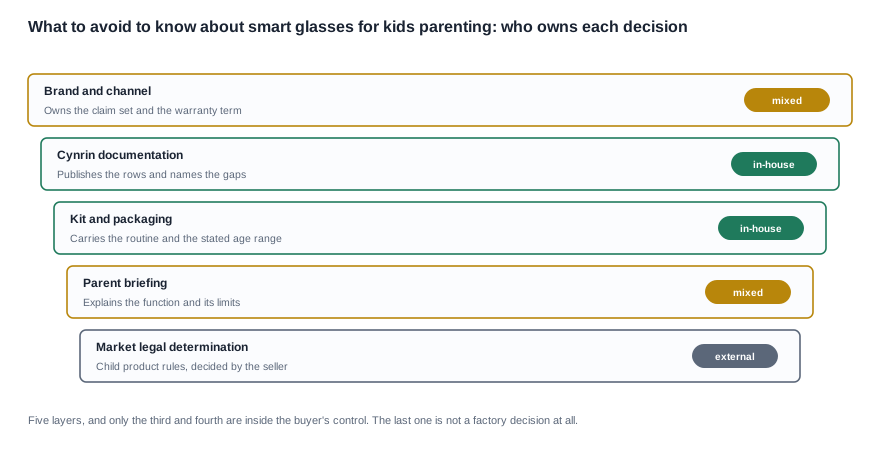
That gap is the buyer's problem, and it is worth naming precisely: the buyer in this channel is not choosing a device, they are choosing a claim set, a box, a warranty term and a briefing. Everything that goes wrong in this category can be traced back to one of those four things being written by someone who assumed the phrase in the search box was a description of the product. We publish no clinical evidence, no certification position, no sizing data and no warranty terms for this range, and we will not describe any of these products as protecting eyesight or preventing anything.
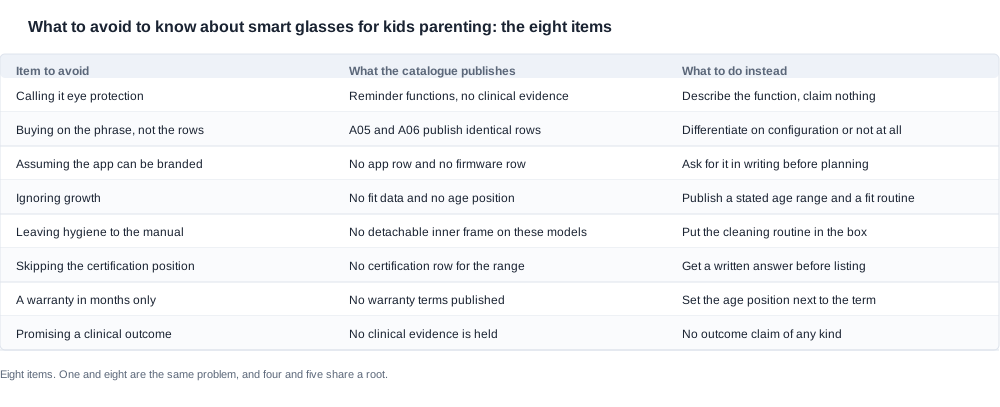
What to avoid to know about smart glasses for kids parenting: the eight items
| Item to avoid | What the catalogue publishes | What to do instead |
|---|---|---|
| Calling it eye protection | Reminder functions, no clinical evidence | Describe the function, claim nothing |
| Buying on the phrase, not the rows | A05 and A06 publish identical rows | Differentiate on configuration or not at all |
| Assuming the app can be branded | No app row and no firmware row | Ask for it in writing before planning |
| Ignoring growth | No fit data and no age position | Publish a stated age range and a fit routine |
| Leaving hygiene to the manual | No detachable inner frame on these models | Put the cleaning routine in the box |
| Skipping the certification position | No certification row for the range | Get a written answer before listing |
| A warranty in months only | No warranty terms published | Set the age position next to the term |
| Promising a clinical outcome | No clinical evidence is held | No outcome claim of any kind |
How the eight divide. Two of them — the first and the eighth — are the same problem, and they are the problem. The remaining six are process points: each one is a decision that a buyer can take, and each one has a cost that is paid later rather than at the time it is made. This is worth understanding before the list is worked through, because a buyer who treats the eight as equally urgent will spend the most attention on the least expensive one and then discover, at the point of a refund, that the two that mattered were the ones on the page.
What the two that matter have in common. Both are a matter of what the product is, rather than of what it does. A device that senses viewing distance and posture and provides a reminder is a well-specified consumer product with a clear set of published rows. The same device described as protecting a child's eyesight is a regulated claim with no supporting evidence, and the buyer who made it has created a regulatory exposure in one of the strictest product categories there is — with a child as the subject, a parent as the reader, and a refund or a complaint as the likely first symptom.
The health claim, which is the item that ends the channel
The category phrase appears in the name buyers search for, and leaning on it in a listing creates a health expectation the product does not meet. Our position is that these devices sense posture and viewing distance and they remind; they do not prevent, treat, correct or diagnose anything, and we publish no clinical evidence because we hold none.
What the catalogue actually publishes, and what it does not. The A05 and the A06 publish a 40 mAh cell, magnetic charging, a charge time of two hours or less, a rated runtime of about 20 h, a lens-type electronic atomiser function with a clear-lens state and a fogged-lens state, and posture and distance detection with a correct-posture state and a poor-posture state. That is a complete description of a device, and it is a description of functions. What is not published for any model in this range is a clinical result, a vision or hearing outcome, a certification row, a fit dataset or an age position.
Why the distinction is regulatory and not editorial. A claim that a device prevents, treats, corrects or improves a medical or visual condition is an efficacy claim, and in the jurisdictions that regulate them it converts a consumer product into a regulated device. FDA 21 CFR 800.30 is the reference point in the United States, and in the European Union the boundary runs through the medical device regulation. Neither of those is a copywriter's judgement, and neither is a factory's to make. The buyer in this channel needs a position from its own legal function before the listing is written, not after a complaint.
The position to take in writing, and to hold. One sentence, usable by a copywriter without any judgement: this device senses viewing distance and posture and provides a reminder; it makes no medical, vision or hearing claim, and no clinical evidence is held. A brand that adopts that sentence early discovers that it removes an entire category of copy review, because the boundary stops being a matter of taste and becomes a rule.
What we will and will not do. We will supply the published configuration for any model in this range, and we will supply a written statement of the claim boundary that can go into a listing, a pack and a training session. We will not supply copy containing an outcome claim, in any market, at any volume, and we will not approve a listing that uses one. We will also not describe the atomiser function in terms of what it does to a lens condition, because that is an outcome claim in a sentence that does not look like one.
Two model names with identical published rows
The A05 and the A06 publish identical parameters — the same 40 mAh cell, the same magnetic charging, the same rated runtime of about 20 h and the same function list. Nothing in the published material distinguishes the two model names. A buyer who wants to differentiate on the specification cannot, and a buyer who has not noticed will be disappointed by a product that is the same as the one they already rejected.
What that means commercially. It means a two-model range in this segment is a two-configuration range, not a two-product range, and it has to be merchandised as one product with two configurations rather than as a good and a better version. It also means the comparison a channel will actually run — between this product and a competitor's version of the same idea — cannot be settled on the published rows, because the published rows of the two products are the same. The comparison has to be settled on something else, and the honest candidates are the claim set, the box, the warranty term and the certification position.
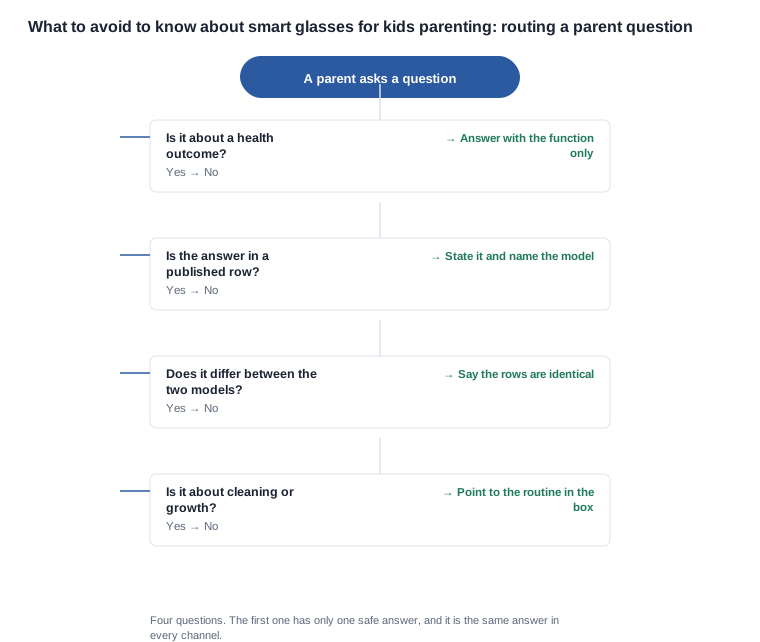
The A07 is the different one. The A07 is the children's audio model rather than the reminder model, and it publishes magnetic charging, a charge time of two hours or less, a 70 mAh cell, a rated runtime of about 20 h and Bluetooth 5.4. A range that covers both a reminder model and an audio model for the same age band is a range that has to be merchandised on the use case, because the rows themselves are what a parent cannot compare.
What to ask about the two model names. A buyer who is putting two names on two shelves needs to know why. Ask whether the A05 and the A06 are different hardware, different firmware, different packaging or different colourways, and ask for the answer in writing. If the answer is that they are the same product under two names, that is a merchandising decision rather than a problem — but it has to be a decision, and it has to be the brand's, because a customer who notices will read it as either a padding of the range or a change of model, and neither reading is a good one.
What to do about the app. The catalogue publishes no app row, no firmware row and no customisation option for any model, and a brand planning a parent-facing dashboard on the assumption that the app can be branded is planning against a capability nobody has published. That request belongs in the same written enquiry as the model-name question, and it belongs before the packaging artwork is commissioned, because an artwork package that assumes a branded app is a packaging cost that has already been spent.

Growth, hygiene and the two things a child changes
A child grows, and a frame that sat correctly in September does not sit correctly in March. This is the most common return reason in the channel and it is not a defect. The prevention is a sizing check across the age range and a stated age range rather than a warranty measured only in months. The second thing a child changes is everything that touches their face, which is why hygiene is not a manual topic in this category.
The growth problem. No fit data and no age position are published for this range, which means a channel cannot state a supported age band from our documentation and must either obtain a position in writing or state the age range as the brand's own decision. The second option is legitimate, and it is the better of the two for a consumer channel, provided it is written as a range and as a decision rather than presented as a specification. What is not legitimate is an implied age position — a "for ages 6–12" in the title of a product page whose supporting document says nothing.
What the fit routine should contain. A short instruction on how to check the geometry at home, what to do when it is wrong, and a stated point at which the family should stop using the device. That last part is the one most brands leave out, and it is the one that turns a sizing return into a planned replacement. A family that has been told when the device has been outgrown does not regard a return as a failure; a family that has not will.
The hygiene problem. A shared device is a skin contact surface, and the models in this range do not publish a detachable inner frame — the detachable inner frame is published on the V06 and the S7, and on no children's model. So the routine is the primary control rather than a supplement to one, and a lens cloth in the box does more work here than a paragraph in a manual. That is a packaging line item, not a documentation line item, and it is the cheapest available return reduction in this channel.
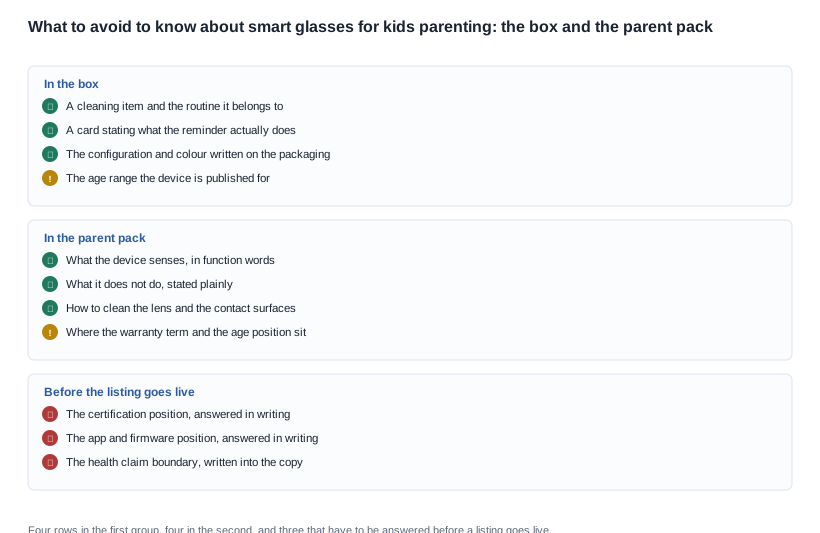
What to put in the box. Four things, and the fourth is the one most often left out. A lens cloth, with the routine it belongs to attached to a moment that already exists rather than to a manual. A card stating what the reminder actually does, in function words. The configuration and the colour written on the packaging, because the two model names carry identical rows and the packaging is where the difference has to live. And the age range the device is published for, which is the fourth item on that list and the one that belongs next to the warranty term.
What the parent pack has to carry. Four more: what the device senses, in function words; what it does not do, stated plainly; how to tend the lens and the contact surfaces; and where the warranty term and the age position sit. A parent pack that contains the first three and omits the fourth has produced a support ticket, because the question a family actually asks in month four is the one about the term.
Certification, warranty terms and the age position
Certification status is not published for the three children's models, and the additional requirements that apply to products intended for children have to be confirmed for each destination market. This one stops a launch rather than delaying a shipment, which is why it belongs at the top of a buyer's list even though it is not the first thing a parent asks.
The determination, and whose it is. Products intended for children can attract additional requirements depending on the destination market — EN 71 in Europe, the applicable consumer product requirements in the United States, and ASTM F963 as a commonly referenced standard. Whether any of these apply depends on the product, the market and the claims made. That determination is not a factory's to make and not a catalogue's to answer, and a buyer who skips it has made a compliance decision without noticing that they had made one. It belongs with the seller's own legal function, before the product is listed.
The three questions the legal function needs in order to decide. The materials and parts the device contains. The claims that will be made about it, in the brand's copy and in the parent-facing pack. And the destination markets and the channels it will be sold through. Give a legal function those three and it can make a determination; give it a catalogue and it can only ask questions back.

The warranty term, and why the age position has to sit next to it. A child grows out of a frame faster than a year, and a warranty expressed only in months produces a sizing return rather than a product claim. The age position is a separate term and it should sit beside the period in the same sentence, so that a family reading the warranty line understands both how long the product is covered and for how long it is intended to be used. No warranty terms are published for this range, so the term is the brand's own decision — and the decision has to be made before the packaging artwork goes to print, because it will be printed on it.
What to ask the supplier, in one enquiry. Four items, and all four are answerable in writing: the certification position for each model and each destination market, the app and firmware position including any customisation available, the unit weight for each model, and the runtime condition behind the published 20 h figure. The unit weight is worth asking about here specifically, because a parent-facing product page that carries a weight is a page that has to be right, and the catalogue publishes a weight for one model in the whole range rather than for any model here.
The commercial conditions. The minimum order quantity tiers, the bulk order volume and the price tier each configuration lands on, the payment terms and the deposit, the lead time the factory can commit to, and the tooling and new tooling expense for a parent-facing package with artwork on it. Two of those matter more than the unit price in this channel: the lead time, because a back-to-school window does not move, and the packaging cost, because in this category the box is doing real work — it carries the routine, the age range and the configuration, and it is the cheapest place to put all three.
How to choose between the three models in this range. The criteria that decide it are short, and they are not the criteria a category comparison usually uses:
- The function the family is buying — a reminder, a reminder with the lens atomiser, or audio. That is the only published difference between the A05, the A06 and the A07.
- The age range the family falls in, which no published row fixes and which the brand has to decide and then state.
- The certification position for the destination market, which is not published and which has to be answered in writing before the order.
- The box, because the routine in it does more to reduce returns than any line of copy on the page.
The questions to ask before you order. Five, and all five are answerable in writing: the certification position per model and per market, the app and firmware position including any customisation available, the unit weight for each model, the runtime condition behind the published 20 h figure, and the reason the A05 and the A06 carry two model names. A supplier who answers the last one plainly has told you more about the range than a specification sheet would.
The red flags. Three, and they are worth watching for in a supplier's answer rather than in a listing. A health or vision claim anywhere in the documentation. A certification answer that carries no model and no reference. And a warranty expressed only in months, with no age position beside it. Each one is a sign that the claim set has been written by someone who has not read the rows.
A total cost view of the channel. The unit price is the smallest number in this category. The larger ones are the returns a sizing gap creates, the refund a health claim creates, and the launch delay a missing certification answer creates. The trade-offs between them are not visible in a quotation, which is why the total cost is worth writing down before the order rather than discovering three months later.
What we publish, and where we will not go
We publish the hardware facts and the capability gaps, and we will not describe any of these products as protecting eyesight or preventing anything, in a listing or in a training pack. We publish the charging interface, the charge times, the cell capacities, the rated runtimes, the Bluetooth version where it is published, and the function list. We publish no clinical evidence, no certification claim, no sizing data, no age position and no warranty terms for this range, and we would rather a parent see those as open questions than have them glossed over.
What we can do. We can tell you which of the eight items the published configuration answers, and which are copy and policy problems that no product would have fixed. That split is the whole of the commercial value in this category: a buyer who has it can plan a channel, and a buyer who does not has a launch date and a refund rate.
What to send us next. Tell us the age range you intend to cover, the channels, the destination markets and the configuration you are considering, and we will return the published rows that cover it, the questions that have to be answered in writing before a purchase order, and the claim set the pack and the listing can carry without crossing the line we do not cross. The channel context is under smart glasses for parenting, the returns side is in kids parenting warranty and returns, and the training programme is in how to train parents on kids smart glasses.
One last line for the buyer. The eight items are not all expensive, but the first one is fatal, and it is fatal because it is easy. Write the claim boundary before the artwork, not after the first complaint. Everything else in this list is recoverable; that one is not.


