

Smart glasses for kids parenting: the training pack that decides the return rate
The conclusion a parenting channel can act on
The decision behind smart glasses for kids parenting is not how to run a training session. It is what the channel is willing to put in the box and say in print. A parent who has been told plainly that the device reminds and does not prevent will not come back with a complaint about eyesight; a parent who has not will come back with one, and the return will be logged as a failed purchase rather than as a misread expectation. That module of honest framing is cheaper than every other returns lever in this category combined, and it costs two sentences.
Three things decide a kids line before a purchase order is raised, and all three can be settled from documents rather than from opinions. The first is which of the three published kids models carries which feature, because the electrical rows are almost identical and the feature rows are not. The second is what the channel can put in writing about market access for each destination market, because the catalogue does not carry a per-model certification row for this range. The third is whether the brand is willing to keep the promise that the product reminds rather than prevents, and to hold the listing, the insert and the training video to that promise. Nothing else in this range is expensive to get wrong.
Who is buying, and what they are actually buying
The reader is a brand owner, a channel buyer or a product manager who has decided to put a children's smart glasses line into a retailer, a marketplace or a subscription box. The task in front of them is not an evaluation of the device. It is the production of an onboarding asset that has to survive contact with a parent who reads one page and a returns desk that reads one reason code. The fear behind the task is quiet and specific: a product that works on the sample unit, is described in the listing as protecting a child's eyesight, and comes back forty days later with a complaint that the eyesight did not change.
That fear is not a marketing problem dressed up in technical language. It is a contract problem, because the listing copy, the onboarding insert and the training video are three descriptions of the same object, and a channel that lets them disagree creates a claim the factory cannot support behind it. Most launches in this category fail at the documentation stage long before they fail at the factory stage, and the documentation is the part the buyer controls. A buyer who treats the training pack as an accessory line item is outsourcing the part of the launch that actually determines whether the second order happens.
The channel context sits under smart glasses for parenting, and the three models themselves are on the kids smart glasses page. The market-entry rules for this category are a separate matter and are covered under children's product compliance; the distinction between a company capability and a per-model document runs through every section below.
What the published rows say about the cost structure
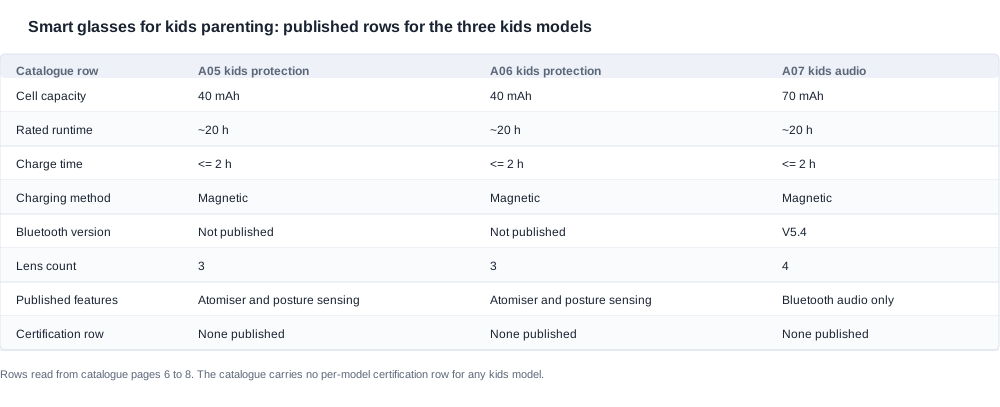
The published range gives a kids buyer very little room and very little to hide behind. Our catalogue carries three models in this family: the A05 and the A06, both published as children's smart protection glasses on a 40 mAh cell, and the A07, published as children's smart audio glasses on a 70 mAh cell. All three publish the same rated runtime of roughly twenty hours, all three publish a charge time of two hours or less, and all three charge magnetically. The commercially meaningful differences are therefore not in the electrical rows at all. They sit in what each model is published to do, and in which rows the catalogue leaves empty.
That shape has a direct commercial reading. When three models publish the same runtime and the same charging method, a quotation difference between them is a difference in tooling, in cell supplier or in margin — not a difference in what the parent receives at the other end. A buyer who compares the three on price alone is comparing a cost structure rather than a product, and the more useful comparison is feature coverage. The A05 and the A06 publish a lens-type electronic atomiser together with correct-posture and bad-posture distance detection, while the A07 publishes four lenses, Bluetooth V5.4 and no posture row at all. Three rows of difference in the catalogue therefore become three different training packs, three different listings and three different price positions.
The second supply-chain fact a buyer should carry into the quotation is about certificates rather than components. The catalogue contains a company-level export certification page, and that page is a company-level page: it is not a per-model certification row, and it cannot be read across to the A05, the A06 or the A07 as though it were one. For a children's product this matters more than it does in an adult line, because the markets a children's line is sold into are the markets that ask for the most specific paperwork, and a document held for a company is not the document a border officer or a market surveillance team wants for a model.
The A05, A06 and A07 rows a parenting channel can order from
Three models, three feature sets, one runtime
The decision on this range is a three-way selection rather than a ladder, and the table above carries the rows that decide it. The A05 and the A06 are published as a matched pair on the electrical side: 40 mAh of cell, a rated runtime of roughly twenty hours, a charge time of two hours or less, magnetic charging, three lenses, a lens-type electronic atomiser, and detection rows for correct and incorrect posture and viewing distance. The A07 is published differently on every one of those rows except the runtime: 70 mAh of cell, the same roughly twenty-hour rating, the same charge time, magnetic charging, four lenses and Bluetooth V5.4, with no atomiser row and no posture row.
Three consequences follow for a buyer, and each of them is a decision rather than an observation.
The first is that the A07 is not a step up from the A05 and the A06. It is a different product aimed at a different parent, and a channel that lists all three as a size progression will produce a parent who bought the wrong one. The second is that the runtime cannot be used to justify the cell difference, because the catalogue publishes the same roughly twenty-hour figure for all three, and a buyer who cites the 70 mAh cell as the reason for the price step is making an argument the catalogue does not support. The third is that the charging method is identical across the range, which means a charging dock, a cable and a night-time charging routine can be standardised across the whole kids line at no engineering cost. That is the cheapest simplification available in this category, and it is usually missed because buyers start from the price list rather than from the rows.
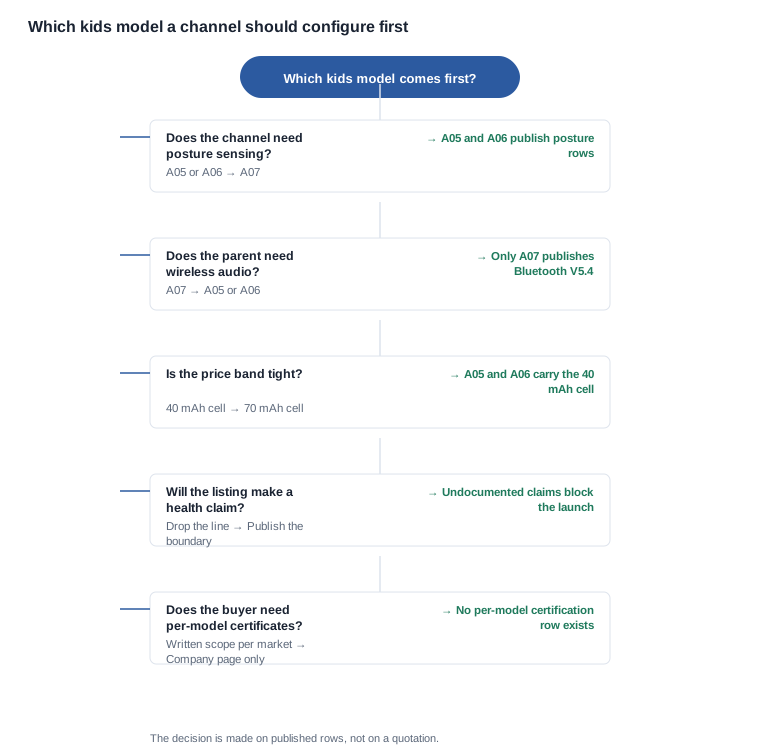
The decision path above is the short form of the selection a buyer actually runs: feature need first, then the wireless question, then the cell tier against the price band, and only then the two questions that can stop the launch outright — a health claim in the listing and a per-model certificate that nobody can produce. A buyer who answers those two last is buying first and defending later, which is the more expensive order of operations.
What the catalogue does not publish for this range
The gaps matter more here than in an adult line, because a gap in a children's line is a gap a parent will hold you to. We publish no lens material and no coating for the A05, the A06 or the A07, so no listing may call the lens scratch-resistant, anti-glare or impact-resistant. We publish no frame material and no unit weight for any of the three, so no pack may state a weight and no parent guide may state how a lighter or heavier frame behaves. We publish no ingress rating for any of the three models: the IP54 marking in our range belongs to the V06 and the S7, two sport camera models with no relation to this family, and it cannot be borrowed for a kids listing.
We publish no age range for the three models either, which is the gap that most often breaks a training pack. A module that tells a parent which age the device suits cannot be written from our rows, and any age band that appears in a listing has to be a deliberate commercial decision taken by the brand, supported by something the factory will stand behind. We publish no clinical evidence for these models and hold none, and we publish no data-handling detail for any model in the catalogue. That last gap is the one that stops the fifth training module from being written at all, and it is dealt with in the section on verification.
The practical rule that follows is simple and it is the one we ask brands to follow: every sentence in the onboarding material must be traceable to a published row, or it must be a sentence that asks a question the brand has answered in writing. A sentence that is neither is a sentence the returns desk will eventually have to interpret.
Why the capability boundary is the commercial centre of this range
The boundary between what these products do and what they do not do is not a disclaimer here; it is the product. The A05 and the A06 are published with detection and reminder rows. Nothing in the catalogue publishes them as preventing, treating, correcting or diagnosing anything about eyesight, and no listing of ours describes them that way. A brand that carries the catalogue's own product name — children's smart protection glasses — into a listing headline is making a claim that the documentation behind the name does not support, and the documentation is the only thing that survives a market surveillance enquiry.
Commercially this cuts in a direction buyers underestimate. A parenting channel that states the boundary clearly does not lose the sale to a competitor making a louder claim; it loses the customer who would have become a refund, a negative review and a chargeback. The cost of the loud claim is not the first month's revenue. It is the second order, the renewal and the marketplace account rating that depends on the defect rate a buyer cannot see until it is too late to change the listing.
Verifying the three kids models before a purchase order
The eight documents to request
Verification here is a document exercise, not a measurement exercise, because every gap in this range is a gap in what has been written down rather than in what the device does. The questions to ask the supplier are narrow, and each one should end in a document that can be filed and re-read when the channel asks for it again.
- Ask for the configuration sheet each model will print on. The rows in our catalogue are the starting point; the sheet you need is the one that will sit on the box, because a row that appears in the catalogue and not on the packaging is a row the parent never sees.
- Ask for the certification scope in writing for each destination market. The question is which test reports exist for the A05, the A06 and the A07, which laboratory issued them, and which document number each one carries.
- Ask for the test report behind every claim the listing will make. Every ingress, impact, chemical and radio claim on the listing needs a report identifier attached to it, and a claim with no identifier behind it should be cut before launch rather than argued about later.
- Ask for the lens material and coating statement, the frame material and the unit weight. These are the rows the catalogue leaves open, and they are the rows a parent returns a product over.
- Ask for the age range and the sizing the factory will support. "The size fits children aged eight to twelve" is a commitment; "the frame adjusts" is a different commitment; only one of them can be supported by a written statement.
- Ask how the device connects, what the app collects, where the data is stored and who can see it. We publish no data-handling detail for any model, so this document has to come from the factory and be reviewed by the brand before it reaches a parent.
- Ask for the model designation and the certificate register references. Every certificate number has to be checkable in the issuing body's public register, and the designation on the unit has to match the paperwork.
- Ask for the warranty and returns terms, and for the incoming inspection criteria. The warranty structure is the brand's commercial decision; the inspection criteria are what makes a defect claim enforceable rather than arguable.

The checks that take an afternoon
Two of the eight steps above can be completed in an afternoon and are the ones most often skipped. The first is the certificate register check: take every certificate number the factory has given you and look it up in the issuing body's public register, confirming that the holder, the product and the standard all match what the paperwork claims. A certificate that cannot be traced is not a slow document; it is a document that does not exist, and the cost of discovering that after a shipment is an order of magnitude larger than the cost of checking it now.
The second is the claims audit, and it is where the total cost of the launch gets its first honest number. Take the draft listing, the draft insert and the draft training script, put them side by side, and mark every sentence that describes the device. Then mark every one of those sentences as published, documented or neither. The sentences in the third group are the commercial exposure. In our experience they cluster in the same three places: a protection or eyesight statement, an ingress statement, and a runtime statement with a test condition attached to it that nobody asked for.
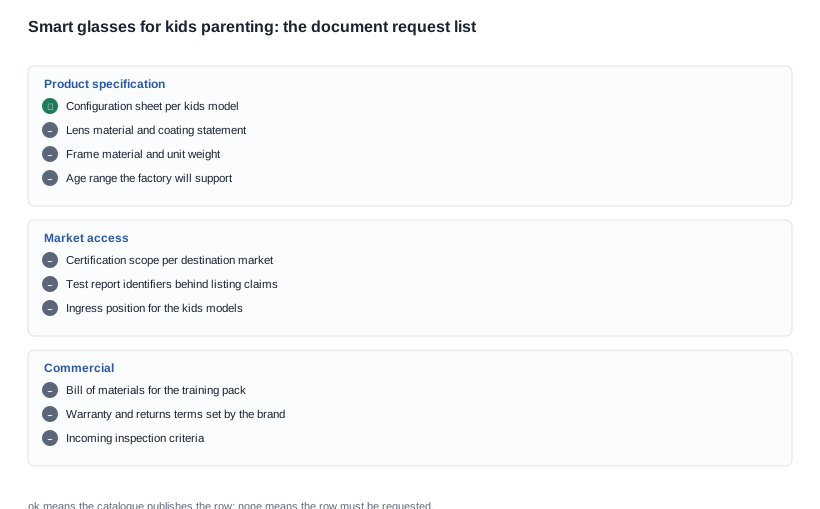
The checklist above is the same eight questions grouped by what they protect. The grouping matters more than it looks, because the three groups fail in different ways. A missing specification row produces a product complaint. A missing certification document produces a market-access problem, which is slower, more public and more expensive. A missing commercial term produces a dispute at the moment of least goodwill, which is usually when the channel has already spent the marketing money.

Where a parenting training pack fails in the channel
The failure patterns in this category are few and repeatable, and each of them has the same structure: a symptom that reaches the returns desk, a root cause that sits in a document the buyer approved, and a preventive step that costs almost nothing if it happens before launch.
The listing inherits the catalogue's product name and turns it into a claim. The catalogue publishes the A05 and the A06 as children's smart protection glasses. A listing headline that says the device protects a child's eyesight has converted a product name into a performance claim, and the conversion is invisible to the buyer who wrote it because the name came from a supplier document. The symptom arrives as a refund request citing the listing. The preventive step is the claims audit, and it is cheaper than a single unit of returns freight.
The training pack is written by whoever answered fastest. Often the supplier's marketing produces the onboarding copy because it is already in Chinese and needs a fast translation. The result is a pack that describes the device in the supplier's language, including the parts the catalogue does not support, because the copy was never checked against the rows. The preventive step is to write the pack from the published rows, in the buyer's market language, and to treat any supplier-written text as an input to be verified rather than an asset to be published.
The data module is written before the data position exists. This is the most expensive of the six, because a parent who has been told what an app collects and then discovers the brand cannot answer the question has a complaint the brand cannot resolve by issuing a refund. We publish no data-handling detail for any model in the catalogue, so this module cannot be completed from our side at all. The preventive step is to make the data position the first item in the launch schedule rather than the last.
The age band is inherited from the last product the brand sold. A channel that has sold a children's device before will reuse the age band that worked for that device, without asking whether this model is the same size. The symptom is a sizing return, which is the least avoidable return in the category because a child grows. The preventive step is to obtain the sizing in writing and to publish the adjustment range rather than a fixed age.
A waterproof statement is carried over from an adult line. Our range publishes an IP54 marking on the V06 and the S7 and on no other model, and no third-party test report is published behind that marking either. A kids insert that says the device is waterproof is unsupported twice over: the marking is on a different model, and the report behind it is not published. The preventive step is to run the ingress check against the catalogue row for the specific model, every time.
The returns policy has no fitness route. A parent whose child has outgrown the device is not a defect, but if the only route on the page is a warranty claim, the parent will file a defect claim instead and the defect rate will be wrong for every downstream decision. The warranty and returns side of this is set out in kids parenting warranty and returns, and the procurement checklist sits at kids eye protection procurement checklist.

What a kids line can still negotiate, and what it cannot
The terms that carry real room
Four commercial terms in this range have genuine room, and all four of them are worth more attention than the unit price itself. The first is whether the factory supplies the onboarding assets at all. A quick-start card, a parent-facing setup sheet and a connection diagram produced by the factory cost the buyer very little per unit and save the buyer a translation and layout cycle, but they also carry the factory's own claims, so the condition to attach is that the copy is verified against the published rows before it is printed rather than after.
The second is the bill of materials for the training pack itself. The insert, the card and the packaging artwork are per-unit costs that are visible in the quotation but rarely itemised, and itemising them is what allows a buyer to see whether the training pack is carrying the launch or whether the marketing budget is carrying it silently.
The third is the packaging artwork and the logo treatment. These are cheap to change between runs and expensive to change once printed, so the quantity to negotiate is the quantity committed to a print run, not the artwork itself.
The fourth is the payment and delivery structure. A minimum order quantity tier, a sample order cost and the split of a first run across two deliveries are all negotiable, and the split is usually worth more than it looks because it lets the brand launch into one market, measure the return rate there and adjust the training pack before the second market takes delivery.
The terms that carry none
Three things in this range are not negotiation targets, and a buyer who spends negotiating capital on them will lose the room that is actually available. The cell configuration and the charging method are published and fixed, along with the charge time and the runtime ceiling that follow from them. The mould tooling for the A05, the A06 and the A07 is a one-time cost that should be quoted as a separate line and amortised across the order rather than negotiated away inside a unit price. And the certification cost and its lead time belong to the brand's destination markets rather than to the factory's quotation; that work is done once per market and per product family, and it cannot be compressed by asking the supplier to try harder.
The warranty and the returns structure belong to the brand as well, and the right negotiation is not about the supplier's price but about what the factory will accept as evidence. When the brand decides that a sizing return is not a defect, the factory needs to be able to see that decision in the incoming inspection criteria and in the returns triage instructions. Agreeing the criteria before the first shipment is what stops the two sides arguing about the same unit in month four.
What we publish for this range, and the boundary we will not cross
The rows a parent can order from: A05, A06 and A07 capacities and runtimes
For the A05, the A06 and the A07 we publish the rows a buyer can order from: the cell capacities of 40 mAh and 70 mAh, the rated runtime of roughly twenty hours, the charge time of two hours or less, the magnetic charging method, the Bluetooth V5.4 row on the A07 and the absence of one on the A05 and the A06, the lens counts of three, three and four, and the feature rows — the lens-type electronic atomiser and the correct and incorrect posture and distance detection on the A05 and the A06. We also publish the structure of the wider range, so a buyer can see where this family sits relative to the eight audio models, the three sport models and the eleven camera models.
What we will not claim
We do not publish, and will not estimate, the lens material, the coating, the frame material, the unit weight, the field of view, the age range, the ingress rating or the runtime test condition for these three models. We publish no clinical evidence and hold none. We publish no data-handling detail for any model in the catalogue, and we publish no per-model certification row: the export certification content in our catalogue is a company-level page, and we will not present it as though it were a per-model document for the A05, the A06 or the A07.
We will not write a health claim into a training pack, a listing or an onboarding video, and we would ask any brand that intends to do so to resolve it through the right compliance route before it ships. The absence of a claim is not a marketing weakness in this category; it is the part of the offer that a parent can rely on and a channel can defend.
Channel, age band and quantity
Send the channel, the age band you intend to cover, the destination markets and the quantity, and we will return the published rows that apply to each configuration, the feature coverage that separates the A05 and the A06 from the A07, the documents to request before the purchase order, and the claims a listing can carry without overreaching. If your decision depends on a row we have not published — weight, sizing, lens material, ingress or data handling — we will tell you that the row is not published rather than estimate it, and we will tell you what to write in the request that will settle it.
Related reading
- The scenario entry point — smart glasses for parenting
- The models — kids smart glasses
- Market access — children's product compliance
- The returns side — kids parenting warranty and returns
Tell us the channel, the age band and the destination markets, and we will return which training modules the published configuration supports.


