Smart glasses for kids parenting smart glasses warranty and returns is a channel with a return profile unlike the rest of this catalogue, and the reason is structural: the buyer and the user are different people, the decision to return is made by the person who did not use the device, and the expectation the return is measured against was formed before the device arrived. Almost none of these returns is a defect, and the two that cost the most are created by the seller's own copy. That makes warranty and returns terms a procurement deliverable rather than a service policy, and it means the order in which you settle them matters as much as what they say.

Smart glasses for kids parenting: the buyer and the user are different people
The published hardware for this range is short. The A05 and the A06 print a 40 mAh cell, a charge time of two hours or less, a rated use of about twenty hours, magnetic charging, a lens-type electronic atomiser module and a posture-and-distance indication. The A07 prints a 70 mAh cell, the same charge time, the same rated use, magnetic charging and a Bluetooth V5.4 radio. We publish no warranty terms, no return policy, no frame weight and no frame size for these models, and that is the honest limit of what we can tell a buyer here.
Everything else in this article is therefore either an analysis of the published rows, or a commercial term that the buyer has to write. There is no catalogue warranty to copy, which means the buyer who has not written their own is going to discover what they agreed to at the moment a return arrives.
The three facts that shape the return profile. First, the A05 and the A06 are published with identical rows and with no row that separates them, so a returns desk that cannot read the designation off the unit cannot classify a return at all. Second, the rated use of about twenty hours sits against a 40 mAh cell on two of the three models, and a unit that has been switched off in a school bag all day is at whatever state it was left in — a flat unit at four in the afternoon is a state, not a defect, and a parent who has not been told that will return a working device. Third, the posture-and-distance indication is a prompt and not an enforcement, and a household that expected the device to make a child behave correctly will return it within a fortnight, correctly, because the product did not do what the listing implied.
Why that makes warranty terms a procurement question. Each of those three produces a predictable return, each of them is cheap to prevent, and each of them is prevented by something other than a warranty term. A warranty term says what happens after a return; none of the three is fixed by that. The terms matter for the returns that are genuinely defects, and the published rows are what tell you how many of those to expect.
The two returns that cost the most are created before the order. A household that bought the product expecting a vision outcome, and a household that bought it expecting the device to enforce a behaviour. The first is a claim the catalogue cannot support: the A05 and the A06 page shows a correct and an incorrect posture-and-distance state and a clear and an atomised lens state, and there is no published detection method, no published accuracy and no published evidence of any outcome. The second is an expectation the product never made. Both are copy problems, and no warranty term settles either of them.
Six return reasons, and which of them the hardware can absorb
The six reasons below cover the overwhelming majority of what comes back from a children's channel. The second column is what is actually happening, and the third column is the control that stops it.
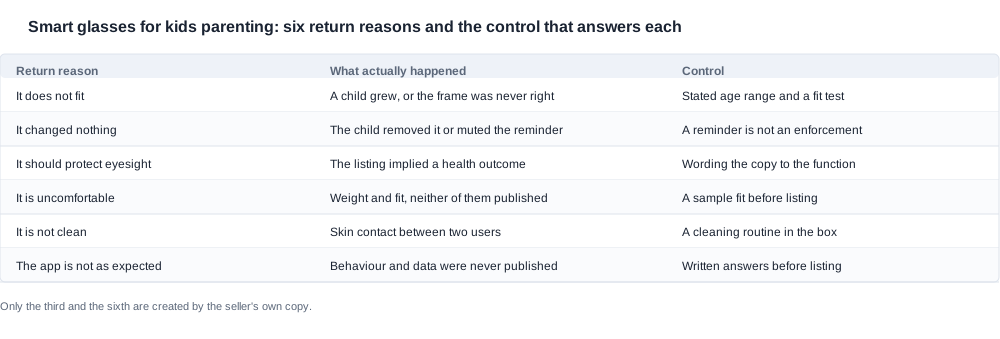
"It does not suit the child." A child grows, or the frame was never right, and the return happens in month three rather than in week one. This is not a defect and not a failure of quality; it is the product working as intended against a moving target. The published rows cannot help here at all, because no frame size and no frame weight are published for these three models, so the only control is a stated age range, a first-week test, and a warranty period expressed against the child's age rather than against the purchase date. A warranty written in months is a different promise on a device a six-year-old will use for two years than on a device an adult will use for five.
"It did not change anything." The child removed it, ignored the prompt, or turned the volume down. The parent's expectation is usually that the device will enforce the behaviour, and it cannot: it reminds. The prevention is in the parent's brief before the sale, not in the returns desk after it, and the control is a listing that describes a prompt.
"It should protect eyesight." This is the most serious of the six, because it is a health expectation the product never claimed. The A05 and the A06 indicate a posture-and-distance state and respond to it; they do not prevent, treat or correct anything, and we hold no clinical evidence. A listing that leans on the phrase "eye protection" is what creates this return, and the fix is wording the copy to the indication function. The party that has to defend a claim is the party that printed it, which is the brand or the retailer rather than the factory.
"It is uncomfortable." A weight and a sizing problem, and sharper in this category than elsewhere because the tolerance a child will accept is lower and the tolerance of the adult who paid is different again. We publish one weight figure in the whole catalogue — 158 g, for a foldable-case camera model that is not a children's model — and no sizing data for the A05, the A06 or the A07, so this is entirely a sample question and the control is a sample.
"It is not wiped down." Two siblings sharing a device, or a device shared with a school. The contamination is on the skin-contact surface. The control is a wipe routine, and the routine rather than the hardware is the primary control here, because the catalogue publishes no detachable contact surface for these models.
"The app does not do what I expected." A function and data expectation, and the biggest unknown in this range. We publish no data-handling detail for any model, no storage behaviour, no data location and no application ownership, and the application and firmware customisation for this tier is recorded as awaiting verification. A parent asking what data the device collects is asking a legitimate question, and the answer has to come from the specific build being supplied, in writing, before the product is listed.
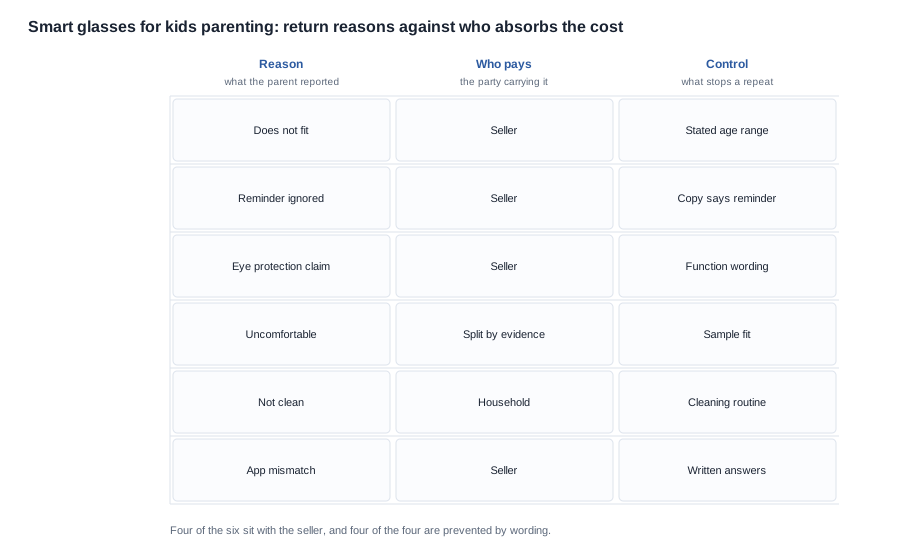
Four of the six are absorbed by the channel, and two of those four are absorbed by the copy. The matrix above is the single most useful table in this article, because it is the bridge between a returns number and a budget line. A reason the seller caused has to be fixed in the seller's assets. A reason the household caused has to be fixed in the routine. A reason that is a genuine defect follows the warranty terms. A reason nobody can explain is a documentation gap, and it belongs to the product function rather than to the returns desk.
The cost split behind a return
The cost of a return is not the unit price. It is the return freight, the desk handling time, the inspection, the re-stock or the credit, the replacement unit, and — in a channel where a return becomes a public review — the reputational cost of the review. Those six items are why a return rate is a budget line and not a service metric.
The three levers a buyer controls, in order of size. The first is the reason mix, because a return caused by a health expectation is infinitely more expensive than a return caused by a flat cell. The second is the reason code, because a return rate that is not coded cannot be attributed and therefore cannot be reduced; the cheapest reduction available in this category is a closed list of reasons applied to every contact. The third is the terms themselves, which decide how much each remaining return costs to handle.
The item nobody budgets for is the desk time. A returned unit that arrives without a reason code, without the designation and without the state at the moment of failure has to be re-investigated before it can be classified, and the re-investigation is pure cost. A channel that captures the identity set at the first contact converts most of that into a single-pass decision.
What a warranty term cannot do. It cannot reduce the return rate; it can only allocate the cost of a return that has already happened. Any buyer whose warranty strategy is a cost-allocation exercise and not a reason-mix exercise has built the second half of the problem and left the first half untouched.
The three questions to put in writing before the order. Whether a return is accepted for any reason within a stated window, or only for a defect that falls inside the published rows. Whether a reason code is recorded on every return in a form the channel can aggregate. And whether a unit can be returned in a condition that makes the fault unreproducible, because the answer to that determines whether the channel can learn anything from the return at all.

The warranty clock, and why months and age are different
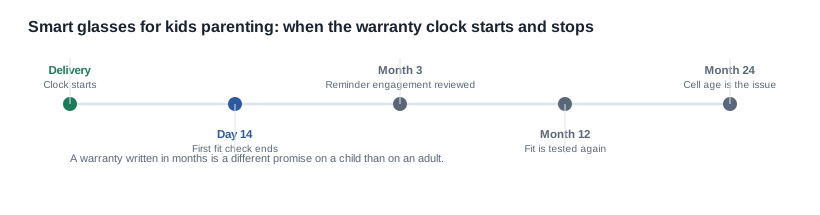
Where the clock starts is a term and not a detail. Delivery, first use and first charge are three different start points and they behave differently in a children's channel, because a unit that is bought in December and returned in January is a seasonal purchase, a return and a sizing problem at the same time. A start point tied to first use is the one that matches the reason mix above, and it is the one that a household can actually remember.
Why an age-based term is a different commercial object. A device on a child is used for years and then outgrown; a device on an adult is used for years and then replaced. A term expressed in months assumes the use case is stable, and in this category it is not. An age-based term, or an age band on the listing with a fixed purchase window, matches the way the product actually ends. It also has to be an age band the supplier will honour, and that is a term to negotiate rather than to assume.
The mid-life review points are the ones worth putting in the agreement. The first-fortnight point catches the sizing and the behaviour problems while they are still cheap. The three-month point is where a household stops using a device it ignored. The twelve-month point is where the child has grown and the second reason appears. The point at which the cell age becomes the issue is the one that separates a genuine defect from a worn-out unit, and no published figure in this catalogue speaks to cell life over years.
What is not published and therefore has to be written. The catalogue publishes no warranty period, no service level, no return window, no restocking rule and no evidence requirement for any of the three models. Every one of those is a commercial term. The buyer who expects a default is expecting something the documentation does not contain.
Why the warranty belongs in the procurement review rather than in the service review. The terms decide who pays, and the party who pays is the one whose budget the buyer controls. Settling them after launch means settling them against a realised return rate that nobody has measured yet, which is the most expensive way to set a number.

The terms to settle before the order
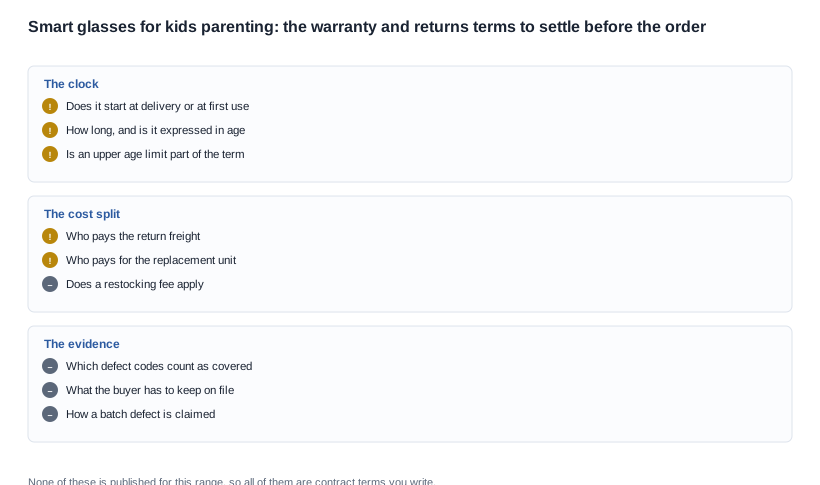
The clock group is four terms. The start point, the length, whether the term is expressed against the child's age rather than the purchase date, and whether an upper age limit applies to the listing at all. The last one is worth settling with the copy rather than with the service terms, because an age band on the listing changes the return mix more than any warranty clause.
The cost split group is three terms. Who pays the return freight, who pays for the replacement unit, and whether a restocking fee applies to a reason the seller caused. That last qualifier is the one worth arguing for, because a flat restocking fee applied to a health-expectation return is a penalty for the seller's own copy.
The evidence group is three terms. Which defect codes count as covered, what the buyer has to keep on file, and how a batch defect is claimed. The batch-defect term is the one most channels never write and the one that matters most when forty units come back in a fortnight, because a channel with no batch-claim procedure discovers that it has a quality incident rather than a return spike.
What to negotiate on this and what to accept. The reason-code list, the return window, the evidence requirements and the batch-claim procedure are all negotiable and all worth the time, because they decide what the returns desk can measure. The unit price, the volume tiers and the tooling are commercial terms that belong in the same conversation. The certification cost and lead time, the conformity determination and the child's age band are not terms at all — they are determinations, and they sit outside the warranty discussion entirely.
How to choose between two suppliers on after-sales terms alone. The criteria that survive contact with a deadline are behavioural: will the supplier accept a returned unit against a published fault without arguing the definition, will they record a reason code in a form you can aggregate, and do they have a batch-claim route with a named contact. Those three answers tell a buyer more about the likely cost of the channel than a unit price comparison does.
Which return reason the channel has to answer for
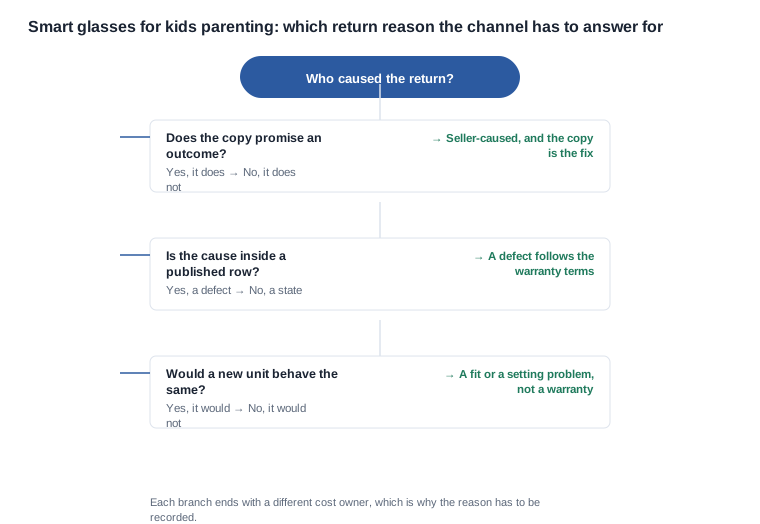
The first branch is the one that decides everything: does the copy promise an outcome? If it does, the return is the seller's, the fix is in the listing, and the unit should be credited without a fight. If it does not, the return is measured against the description the parent actually read, which is a much narrower target.
The second branch separates a defect from a state. A behaviour that contradicts a published row is a defect and follows the warranty terms. A behaviour that is merely disappointing is a state, and states are settled with a routine and a credit, not with a warranty claim.
The third branch is the one that catches the sizing problem. If a new unit would behave exactly the same way, then the problem is the household's situation rather than the unit, and the answer is a different configuration, a different age band, or a refund. A channel that keeps replacing units in this branch is buying the same return over and over.
The procurement consequence of the three branches. Each one ends with a different cost owner — the seller's copy, the warranty terms, or the returns budget — and only the middle one is a warranty matter. A buyer who has costed the returns desk and the warranty terms, and nothing else, has costed a third of the exposure.
Our position. We publish the hardware facts and we publish the capability gaps, and we will not describe any of these products as protecting eyesight or preventing anything. We will not write a health claim into a listing, and we would ask any brand that intends to do so to resolve it through the compliance route before the listing goes live. We publish no warranty terms and no return policy, because those are commercial terms that belong in an agreement with a specific channel, and we would rather say that than quote a policy you could rely on.
What we can do is tell you exactly which documents we hold for a specific model, which questions have to be answered by your own legal function rather than by the catalogue, and what a defensible description of the product amounts to. The models are on the kids smart glasses page, the technology context is under kids eye care technology, the compliance position is under children's product compliance, and the returns process behind a defective unit is at returns and RMA.
What to send us next. Send the channel, the model, the age band the product is intended for and the number of units in the first order, and we will tell you which of the six return reasons the published configuration addresses, which are settled by the copy rather than by the product, and which terms are worth putting in writing before the purchase order.
Related reading
- The claims to avoid — kids eye protection red flags
- The programme list — kids eye protection procurement checklist
- The compliance position — children's product compliance
- The product family — kids smart glasses
Tell us the channel and the age band, and we will tell you which of the six return reasons the published configuration addresses and which are copy problems.