
Livestreaming is the one use case where the failure is public and immediate, and that is why the gear in the bag has to be settled as a bill of materials rather than as a shopping list. Every item in the smart glasses for livestreaming smart glasses gear checklist below is there because it has ended a session rather than merely degraded one, and because each one is checkable before the session rather than during it. The deeper point is commercial. A kit is not a set of accessories; it is a set of decisions about what is in the box, what is shipped separately, what is added to the transport file, and what the buyer has to price before the quotation is accepted.
Smart glasses for livestreaming: the kit is a bill of materials, not a list of accessories
Who this is for. The reader is a brand product manager, a channel buyer or an e-commerce operator who has already chosen the model and now has to decide what goes in the box, what travels with the kit, and what the creator is told to do with both. The task is not a product evaluation. It is a bill-of-materials decision with a compliance tail, because a charging case is a second lithium cell and the documentation for that cell is a shipping gate rather than a preference. The fear behind it is quiet and specific: a product that works on the sample, is scratched in a week, and comes back as a review saying the image was soft.
Why two kits for the same product cost very different amounts. The published configuration rows in this range are close together on the electrical side, and the differences that matter commercially are structural rather than electrical. The camera models publish a resolution class of 8 MP or 13 MP, cell capacities from 220 mAh to 290 mAh, a charge time of two hours or less, and rated runtimes between five and eight hours. None of those rows decides what is in the box. The charging interface does, and the interface is published per model: magnetic charging on the V03 and the KY06, and the MT5 and the V06, and the S7, a Type-C port on the V03 Pro and the L2 Utral, and no published charging method at all for the MT6 and the CY05, and the CY03 and the L1 Pro. A magnetic model needs either a dock or the case carried, which turns the case from a protection accessory into part of the charging architecture. A Type-C model recharges from a cable the creator already owns. That single decision changes the bill of materials, the declared shipping weight, the transit paperwork and the price ladder together, which is why the kit question has to be answered after the interface question and never before it.
What the kit has to survive. Three exposures act on a livestream product at once: the pocket or the case, the room's own dust and handling, and the wipe-down habit that people satisfy with whatever is in their pocket. The third is the one that costs money, because the reflex wipe with a sleeve is what turns a dirty lens into a scratched one, and the damage is invisible at the moment it happens and permanent afterwards. Nothing in the published documentation tells a buyer which surfaces tolerate that, so the answer has to come from a supplied item and a supplied instruction rather than from a warning in the listing copy.
What each item in the box has to prevent, and what it costs
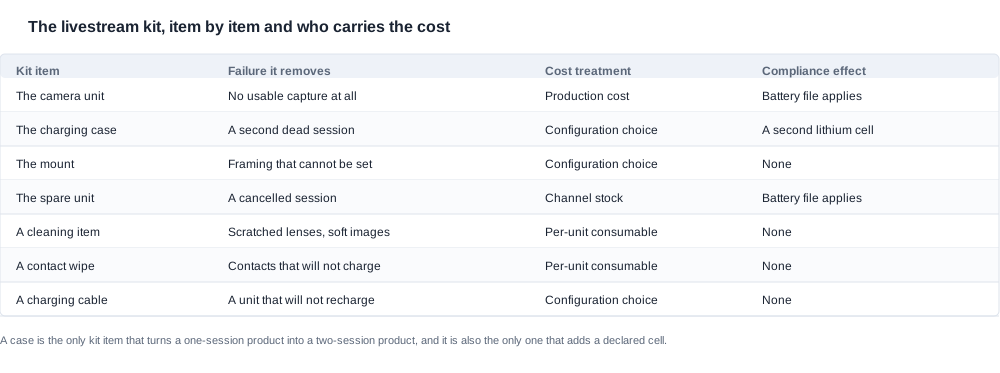
The table is the whole kit, and the third column is the one that decides the quotation. A per-unit consumable is a rounding error in the unit cost and a visible line in the margin. A configuration choice is a price-ladder decision. A spare unit is a working-capital decision that a channel owner makes long before anyone thinks about it as one, and it is usually the largest single number in the kit.
The two consumables belong in the box on volume grounds alone. A lens wipe and a contact wipe are not a second object that a creator has to carry. They are printed on an insert and live in the packaging, and they cost a few cents per unit at run quantities. That is why they can sit in a consumer configuration without changing what travels, and it is why they are the highest-return line available in this category: they are the cheapest available reduction in the return rate, and the return rate is the line that decides whether the second year of the channel is profitable.
The case is a different decision entirely, and the catalogue treats it as four different answers. The L1 Pro and the CY03, and the CY05 publish a 1400 mAh case. The L2 Utral publishes two configurations, 900 mAh and 1400 mAh, which is a configuration choice rather than a feature, and which changes the artwork, the freight weight and the transit file along with the price. The MT6 publishes a 1200 mAh foldable case. The KY06 and the MT5 ship with a case whose capacity the catalogue does not publish, and the catalogue publishes no charging-case row at all for the V03 and the S7, and the V06, while the V03 Pro has no charging-case row. A buyer who has not asked which of the five answers applies to the model being ordered has guessed, and the guess is wrong four times out of five.
The case: a second cell, a second price point, a second obligation
A case included where the interface does not need it converts a one-session product into a two-session product at the same price. That sounds like value and is actually a decision, because it adds a second lithium cell to declare, a second object to lose, and a second thing to fail. The creator who genuinely runs two sessions is the one who will buy a case separately, at a price that suits both parties better. A case omitted where the interface needs it does the opposite, and the omission shows up as a creator who cannot recharge between blocks. The published charging methods are the way to tell which situation applies.
The one weight figure in the catalogue belongs to a camera model and needs care. The MT6 is published at 158 g, and that figure is for the glasses themselves including the 265 mAh cell and the camera, not for the 1200 mAh foldable case and not for a bare frame. No frame weight is published for any model in the range. A buyer who quotes 158 g as a frame weight is quoting a number that does not exist, and a buyer who wants a frame weight has to ask for it per model.
The kit that each kind of deployment needs
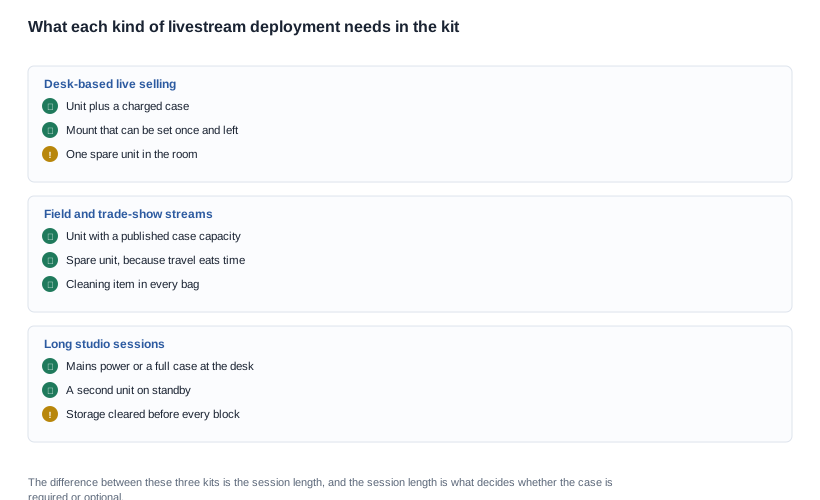
The three groups above are the practical shape of the decision. A desk-based live selling session runs from a fixed position, so the mount is set once and the case is optional. A trade-show or field session travels, so the case becomes the difference between one session and two, and a spare unit stops being a luxury. A long studio block is the case where the cell matters least, because the desk has mains power, and the case where the storage behaviour matters most, because a block is long enough to fill it.
How to price the difference between them. Start from the same device and work outward. The mount is a configuration choice and a small unit cost. The wipes are a per-unit consumable and a negligible freight effect. The case is a configuration choice, a second cell, and a second price point. The spare unit is working capital, and it is the one line that scales with the number of creators rather than with the number of units shipped. The physical kit is described in more detail at livestreaming accessories, and the packing and transport side is at how to pack smart glasses for livestreaming.
What the case decision adds to the transport file and the price
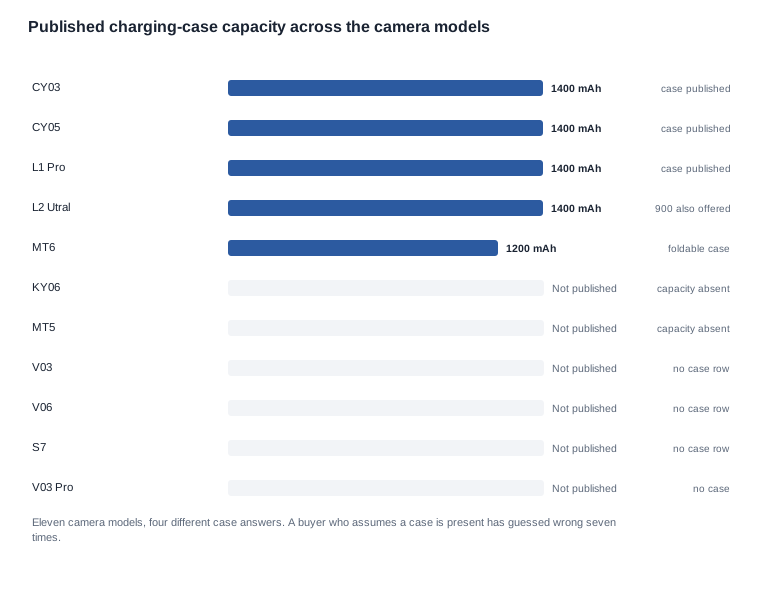
The chart above is the single most useful picture in this page, because it shows that the camera family does not have one case answer. Five models publish a capacity: 1400 mAh on the CY05 and the L1 Pro, and the CY03, 1400 mAh as one of two configurations on the L2 Utral, and 1200 mAh on the foldable case of the MT6. Two models ship with a case and no published capacity. Three models have no case row in the catalogue at all, which means the catalogue is silent rather than negative, and silence is a different thing from a published absence. One model, the V03 Pro, has no charging-case row.
The distinction between a missing row and an explicit no. A catalogue row that says the device has no case is a decision the buyer can act on. A catalogue that publishes no row for the S7 and the V06, and the V03 has simply not answered the question, and a buyer who treats silence as a no will under-order the kit, and a buyer who treats silence as a yes will over-order it. The correct move is the same in both cases: ask. It is one line in the specification message.
What the transport file covers. A case is a second lithium cell, and a configuration that includes one has a different transit file from a configuration that does not. The requirement and the paperwork are set out at battery transport. The practical rule for a buyer is that the file has to cover the configuration actually being ordered, with the case in it, and asking for it in the quotation stage rather than at the border, because the border is the worst possible moment to discover that the file does not cover the configuration in the carton. The rest of the shipping position, including the incoterms and the freight structure, is at logistics and the payment structure is at payment terms.
What the case does to the price ladder. Two prices from one platform is a materially different commercial proposition from one price, and the case is the switch between them. A channel that sells a camera model with a case in the box and a camera model with the case sold separately has a good/better/best structure built on a component that the supplier already knows how to make. A channel that puts a case in every box has one price, a higher freight weight per unit, and a second cell declared on every shipment. Both are defensible; the mistake is arriving at one of them by default.
Who supplies each part, and where the boundary sits
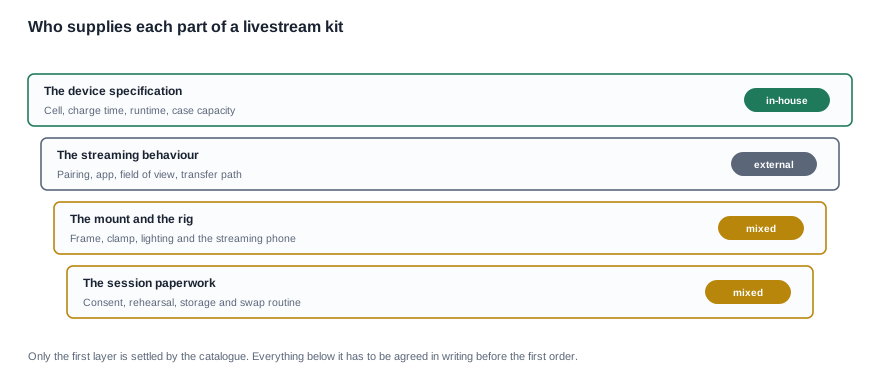
The four layers in that image describe where the kit decisions actually live. The top layer is settled by the catalogue: the cell, the charge ceiling, the rated runtime, the charging method and the case capacity. The second layer is the manufacturer's, and it covers everything about how the device behaves — the video format, the frame rate, the field of view, the device-to-phone linking sequence, the control scheme, the storage and transfer behaviour, the microphone rows and the thermal behaviour. The third and fourth layers are the buyer's and the creator's: the mount, the rig, the phone, the lighting, the consent script, the storage routine and the swap procedure.
Why the second layer is the one that needs a request. A kit decision that depends on an unpublished row is a decision with no data behind it. The buyer can still make it, but the honest thing is to write down that the value is unknown and to ask for it in the same message that asks for the sample. A buyer who substitutes a typical value is not making a decision, they are making a number up, and the number ends up in a listing.
The rows worth asking for, in one list. Send these together, in the same message as the sample request, because a request that arrives as a trickle of one-line questions gets a trickle of one-line answers and each one has to be chased separately.
- The charging method and the input for the exact configuration, including the case where one is included.
- The case capacity and the case's own charge time, for the configuration being ordered.
- The interface and the accessory set, and whether spare mounts are available rather than whole units.
- The model designation table, so that a loss in transit is traceable to a batch.
- The battery transport file for the configuration, with the case included if one is shipped.
- The per-model unit weight, if the listing intends to quote one.
- The ingress position in writing, because the IP54 marking on the V06 and the S7 is a catalogue attribute with no third-party test report published behind it, and the digit reading is at IP ratings.
- The procedure for looking up a certificate in the issuing body's public register, which is at certification checklist.
What the mount and the accessory set change in the quotation
The mount is the line that most often arrives unplanned, and it is the one that decides whether the framing works. A livestream camera that is not fixed to something will not hold its angle, and a mount chosen for the device rather than for the shot produces a feed that is technically correct and visually wrong. That failure is invisible on a sample, because the sample is set up by the person who set it up. A mount is a configuration choice rather than a consumable, so it belongs in the artwork and the quote, and it is worth settling before the packaging is printed, because a mount that changes afterwards is a change to the artwork as well as to the bill of materials.
The accessory set is where the channel's own economics show up. A kit that travels with each creator is a per-creator cost multiplied by the number of creators, and a kit that stays in the channel's warehouse is a working-capital item. Which one applies depends on the deployment rather than on the product, which is why a buyer who asks the supplier for the accessory list without telling them the deployment gets a list that is either too heavy or too thin. Tell the supplier the number of creators, the number of sessions per week and the travel pattern, and ask for the accessory set per creator and per location separately.
The spare unit question is the one to answer with a number rather than an opinion. A channel that has had one cancelled session tends to over-buy spares, and a channel that has not had one tends to under-buy. The number that settles it is the swap time: how long it takes to move a creator from a dead unit to a charged one, including the time to find the spare, the time to hand it over and the time to get the feed stable. Measure it once on a pilot, and the spare quantity follows from it. The supporting rows for the charge side are at battery life.
The rows that are worth asking for, and the ones that are not
A question about a published row is a slow way to get an answer. The cell capacity, the charge ceiling, the rated runtime, the charging method and the case capacity are on the catalogue page, and a supplier who quotes them from a sheet is quoting a catalogue. Asking for them adds a round trip and tells you nothing. The questions worth a round trip are the ones the catalogue does not answer, and every one of those eight items above is a question the catalogue has deliberately left open rather than one that has been overlooked.
A question about a claim is a different kind of question. Buyers often ask whether the product is certified for a market, and the answer for this catalogue is a statement of what the catalogue contains: a company-level export certification page with images rather than text on it, and no per-model certification row anywhere. That is not a refusal, it is a description, and it tells the buyer which document to ask the supplier for. The scope of a per-model certification is exactly the kind of material that belongs in the quotation rather than in a conversation.
What we publish, and where we stop. Our position is that we publish the rows a buyer can order from, and we will not fill the gaps with typical values. For the camera family that means the resolution class, the cell capacities from 220 mAh to 290 mAh, a charge time of two hours or less on every model, the rated runtimes between five and eight hours, the charging method per model, the case capacities where a case row exists, and the single published weight of 158 g for the MT6 glasses. We will not publish a lens material, a coating, a hinge specification, a field of view, a video format, a frame rate, a storage capacity, a transfer path, a runtime test condition or a frame weight for any model where the manufacturer has not given us one. The full model list with its rows is at ai camera glasses, the charging decisions are at charging solutions, and the sample terms are at samples.
What to send us next. Send the interface you have decided on, the models you are comparing, the target price band, the volume and the markets, and we will return the bill of materials each configuration should carry, the published rows that cover it, the documentation that has to be settled before the purchase order, and the claims the listing can make without overreaching. The scenario entry point is smart glasses for livestreaming, and the commercial structure of a first order is at pricing.
Send us the interface, the models and the price band, and we will return the bill of materials each livestream configuration should carry.


