
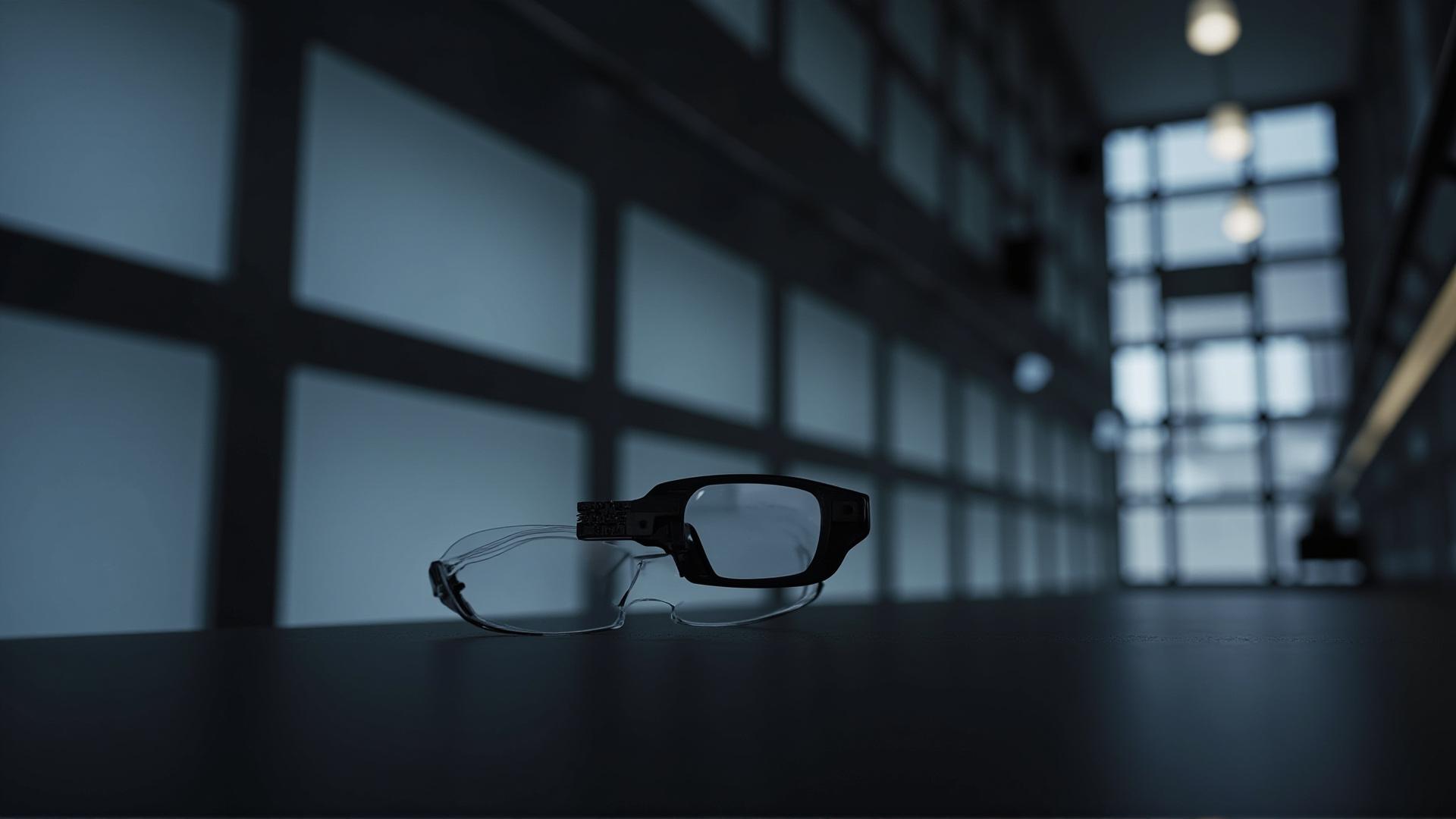
A livestream camera puts a recording device on a person's face, in public, pointed at whoever is in front of it, which makes the safety questions here mostly about other people rather than about the product. The questions below are the ones that have ended broadcasts or created complaints, and the pattern across them is consistent: four of the six are controlled by a document or a procedure, and only two are controlled by hardware. That is the uncomfortable finding, because the two that are controlled by hardware are the ones everyone thinks about, and the four that are controlled by a procedure are the ones that get skipped.
Smart glasses for livestreaming: the safety duty around the camera
Who this is for. The reader is a brand owner, a channel operator or a procurement manager who is putting a camera into rooms where people work, where the output is public, and where the brand's name is attached to whatever appears in the frame. The task in front of them is not a product evaluation. It is the allocation of a duty: which risks the manufacturer carries, which the venue carries, which the platform carries, and which the brand carries because nobody else can. The fear behind that task is a specific and asymmetric one — a broadcast that ends badly is an operational incident, while a person who appears in a feed without having agreed to it is a matter of the brand's reputation, and only one of those two appears in a support ticket.
Why these questions are mostly about other people. The device is the least of the four duties, because the device rows a buyer can read: the camera models publish a resolution class of 8 MP or 13 MP, cell capacities from 220 mAh to 290 mAh, a charge time of two hours or less, and rated runtimes between five and eight hours. The video format, the frame rate, the field of view, the storage path and the transfer method are not published for any model, and those gaps matter commercially. None of them is a safety question, and treating them as safety questions is how a deployment ends up with a long unresolved specification list and a short safety sheet.
What actually goes wrong in a livestream deployment. Three things end a broadcast: the unit fails in a way nobody prepared for, the mount shifts and the picture goes somewhere it should not, and the power runs out mid-session. Two things end the channel's credibility rather than the session: a person is recorded without having agreed to it, and a claim is made that the documentation cannot support. The first group is an operations problem and the second is a governance problem, and the controls for them are different in kind.
What can go wrong in a livestream, and the control that stops it
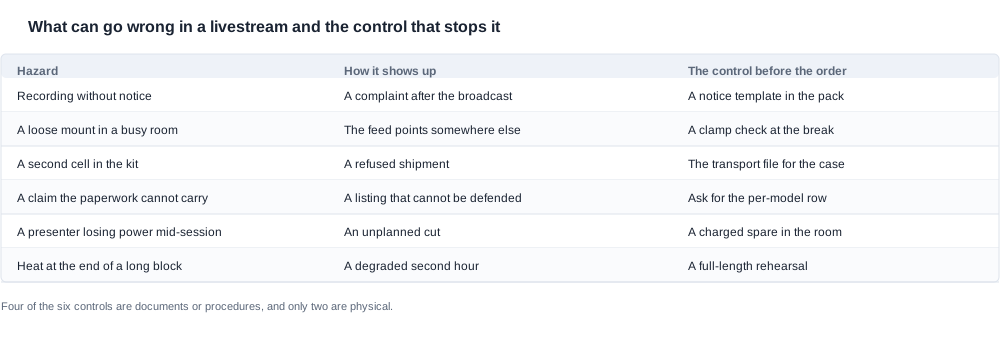
The middle column of that table is how the hazard actually shows up, rather than how it is described in a risk register, and the third column is the control that has to exist before the first session rather than after the first incident. Four of the six controls are documents or procedures, which is the point of the table: a document is cheap, it scales, and it can be checked by someone who was not there.
The three that end a broadcast
A loose mount in a busy room. The device is on a head, on a clip, or on a rig, and a busy room is a room where people move past it, bump it, and reach across it. The picture does not necessarily stop; it points somewhere else, which is worse, because nobody notices until the footage is edited. The control is a clamp check attached to a defined moment — a handover, a break, or the start of each block — and a written instruction on what to do if the angle has shifted.
A presenter losing power mid-session. The published runtime is a band, and the charge time is a ceiling of two hours or less, so a unit that has been fully drained needs up to that window before it is usable again. The control is a charged spare in the room and a rehearsed swap, with the swap time measured rather than assumed, because the swap time is what determines how many spares the channel holds.
Heat at the end of a long block. Thermal behaviour is not published for any model, and a continuous feed is a different load from a series of short captures, so the end state of a long session is unknown until one has been run. The control is a full-length rehearsal and a scheduled break inside the published runtime band, with the break planned rather than taken when the presenter seems uncomfortable.
The two that end a channel's credibility
Recording without notice. The remedy is procedural, and it is not complicated: a recording notice, a rehearsed answer to a request to stop, and a place for both in the setup sheet. The legal framing of the same subject is at smart glasses for livestreaming legal considerations, and the two pages are complementary rather than interchangeable — one is the question of who is responsible, the other is the question of what physically goes wrong.
A claim the paperwork cannot carry. This is a marketing risk dressed as a safety risk, and it is the one that reaches furthest, because a listing copy outlives the campaign that produced it. The catalogue carries a company-level export certification page whose content is images rather than text, the text of the catalogue contains no reference to CE, FCC or RoHS, and there is no per-model certification row for any model. The only ingress position published anywhere in the range is the IP54 marking on the V06 and the S7, and that is a catalogue attribute with no third-party test report published behind it. A listing that says waterproof, or that implies a certification the file does not contain, is a claim the brand cannot defend, and the reading of the two digits is at IP ratings.
Who carries the duty, layer by layer
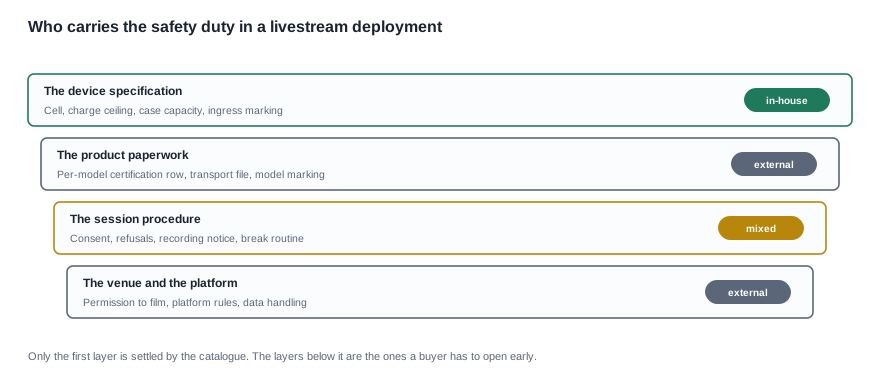
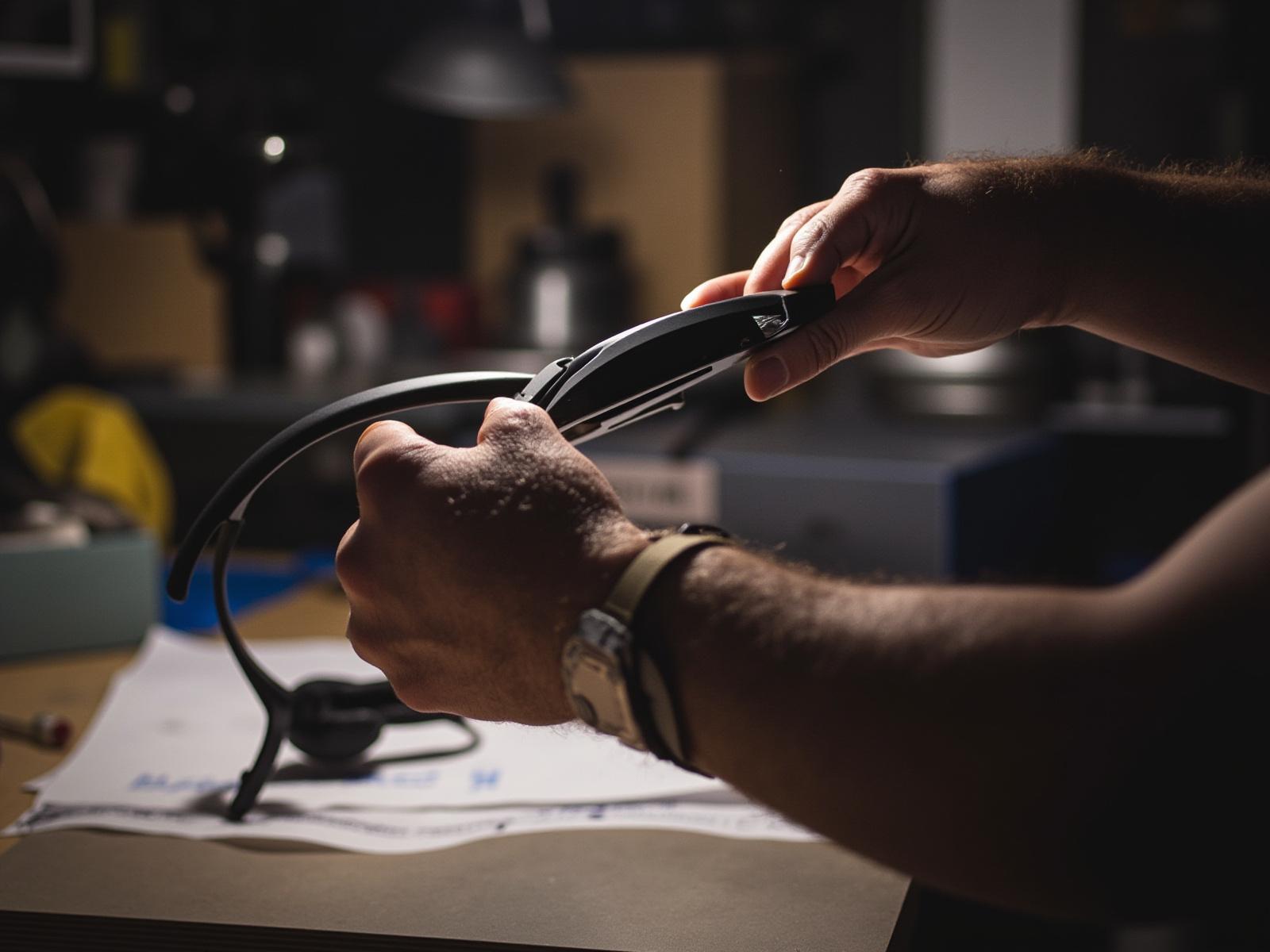
The four layers above are the whole of the duty structure, and each one has a different owner and a different timetable. The top layer is settled by the catalogue and needs no negotiation. The second is the manufacturer's and needs a request. The third is the brand's and needs a rehearsal. The fourth sits outside the supply chain entirely, and it is the layer where a buyer has least control and therefore the one that should be opened earliest.
The layer a buyer can change and the layer it cannot
The first layer is the one the buyer can rely on. The cell capacity, the charge ceiling, the rated runtime, the charging method, the case capacity and the resolution class are all published per model, and they are the rows a buyer uses to size the deployment. The single published weight in the range is 158 g for the MT6 glasses including the 265 mAh cell and the camera, with no frame weight published for any model, which is relevant when a device sits on a head for a long session.
The second layer is where the safety questions are actually opened. The video format, the frame rate, the field of view, the device-to-phone linking sequence, the control scheme, the storage and transfer behaviour, the microphone rows, the network requirement and the thermal behaviour are all unpublished. A buyer who wants a safety case for a device has to request these rows, and the request is the safety case. The procedure for handling the documents that accompany them is at certification checklist, and the battery transport file for the configuration is at battery transport.
The third and fourth layers are the brand's, and neither can be delegated. The session procedure — consent, refusals, the recording notice, the break, the swap, the storage routine — is written by the brand and rehearsed by the people who will use it. The venue and the platform rules are set by other organisations and can change without notice. A buyer who treats the fourth layer as a fixed constraint is usually right, and a buyer who treats the third layer as somebody else's problem is usually the one who ends up handling the incident.
The safety questions to answer before the first session
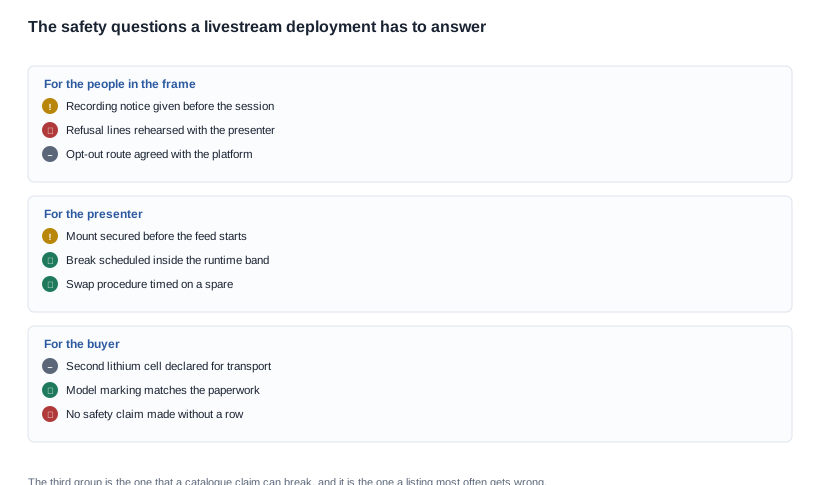
The three groups in that image are arranged by who can answer them. The first group is the presenter's, and the answer is a rehearsed routine. The second is the buyer's, and the answer is a document and a measurement. The third is the manufacturer's, and the answer is a written row.
A list a presenter can work from
The routine is short, and the discipline is in keeping it short enough that it survives a busy day. Five items, and each one attaches to a moment the presenter already has:
- Before the session starts, confirm the device is charged, the spare is charged, and the storage is empty. These three together remove most of the failure modes that end a broadcast.
- At the start of each block, check the mount and the framing, and say out loud what the device is pointed at if the room has moved.
- At the scheduled break, check the angle again and confirm the unit is still recording if the session expects it to be.
- If the session runs long, swap to the spare rather than waiting for the unit to stop, because the published runtime is a band and the end of a band is not a scheduled event.
- If someone asks to stop, the answer is immediate and there is no discussion. That answer has to be rehearsed, because it is the one moment where a presenter who has not practised it will hesitate on air.
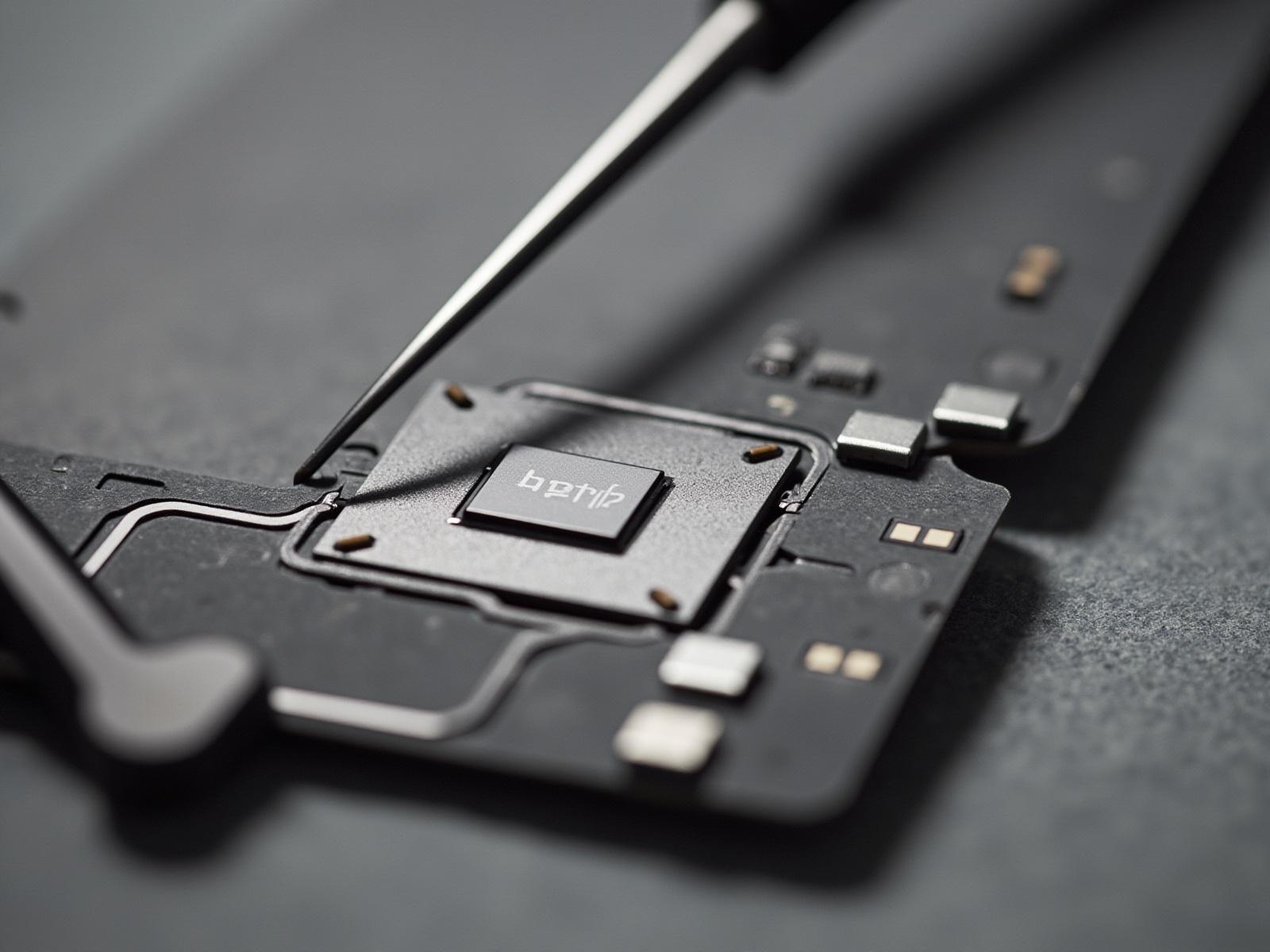
The buyer's answers, which are documents rather than routines. The model designation table, so that a unit in a shipping query or a quality claim can be traced to a batch. The battery transport file for the exact configuration, including the case where a case is in the box. The agreed incoming inspection criteria, so that a fault found at the warehouse is not the same as a fault found on air. The warranty period with a stated response time, so that a replacement during a live week is a known process rather than a negotiation. The commercial framework is at contract terms and the quality control structure is at quality consistency.
The manufacturer's answers, which are rows. The runtime test condition. The thermal behaviour over a full-length session. The storage capacity and the fill behaviour. The transfer path, because a file that has to be moved off the device after a session is a workflow with a duration in it. The charge indication behaviour, so a presenter can tell from the device alone whether it is recording. The rows to request are the same eleven that the neighbouring pages collect, and the comparison across models is at how to compare models for livestreaming.
The safety criteria a buyer should apply before the first order
The six criteria below are the ones a procurement manager can actually settle, and they are ordered by the cost of getting them wrong. A criterion that can eliminate a model belongs above a criterion that can only refine one, because a pilot day is the most expensive hour in a deployment programme and it is not worth spending on a model that was never eligible.
- The runtime covers the session twice over, measured against the lower bound of the published band, so that a single degraded cycle does not end a session. This is a published row and it eliminates models on a document.
- The published case capacity covers the recovery window for the configuration being ordered, where a case row exists at all. This is a published row and it eliminates configurations.
- The mount and the mounting position are settled, and the spare mounts rather than spare units are available. This is a commercial question and it belongs in the quotation.
- The storage and transfer behaviour is closed by a sample, so that the clearing routine can be written before the first session rather than invented during it. This needs a pilot day.
- The audio path is closed in the real room, because the microphone rows are unpublished for every model and the room is the variable. This needs a pilot day.
- The per-model market document is held, so that the listing's claim is one the file supports. This is a document request and it determines what the copy may say, not whether the device works.
Why the first two criteria are worth more than the other four combined. They are free — they are on a page — and they are the two that decide whether a deployment survives an ordinary Tuesday. A model with seven hours of runtime and a 1400 mAh case handles a long session and a second session; a model with five hours and no case row does not, and the difference is invisible in a demonstration and obvious in week two. The remaining four criteria are about quality rather than survival, and a buyer who has budget for a pilot can settle all of them in one day.
The pitfall worth naming. The most common safety mistake in this category is not a missing control; it is a control written for a different deployment. A clamp check for a studio session does not survive a room where people walk past the device, and a consent script written for a closed set of staff does not survive a public shop floor. A control has to be written against the room, the people and the length of the actual session, and a control copied from another deployment is a control that has been tested against nothing.
When an incident happens on air

The six steps above are ordered by what must not happen first. The first step is the one people argue about — stopping the feed is a decision someone has to make in a second, and the argument is always about whether stopping makes it worse. It does, and the argument about it is also the thing that makes it worse, because the decision gets deferred. The third step is the one teams skip, and it is the one that decides whether an incident stays an incident or becomes a dispute: the recording is held, it is not deleted, and it is not reshared.
The two questions to answer within the day. What was on air, and who was in frame. Those two questions determine whether the matter is an operational correction or a notification, and the answer to the second is usually the one that decides the severity. An incident where nobody was identifiable and no one objected is a correction. An incident where a person was identifiable and had not agreed to it is a notification, and the notification is owed to them, not to the platform.
The decision that cannot wait, and the one that can. The first decision — stop the feed — has to be made in seconds by whoever is closest to the controls, and it is the one that is easiest to defer because a room full of people can talk themselves out of it. The second decision — what is said to the person who was in frame — can wait until the recording has been reviewed, and it should, because a half-hour of evidence is usually worth more than an immediate apology that turns out to be aimed at the wrong person. A team that has written both decisions down in advance handles the first quickly and the second properly, and a team that has not will make the first one slowly and the second one publicly.
The logging discipline, and the commercial consequence. Step six is the one that protects the year-two order. A log entry that names a row, or names a procedure when there is no row, becomes a specification item, and a specification item becomes an acceptance criterion. A log entry that only names a unit becomes a returns statistic, and a returns statistic that mixes specification gaps with manufacturing defects cannot tell the buyer which conversation to have. The returns data is the number that decides the replacement volume, so the quality of the split is worth more than the volume of data.
What we publish, and where we stop. Our position is that we publish the rows a buyer can order from, and we will not fill the gaps with typical values. For the camera family that means the resolution class, the cell capacities from 220 mAh to 290 mAh, a charge time of two hours or less on every model, the rated runtimes between five and eight hours, the charging method per model, the case capacities where a case row exists, and the single published weight of 158 g for the MT6 glasses. We will not publish a video format, a frame rate, a field of view, a storage capacity, a transfer path, a linking sequence, a control scheme, a microphone row, a network requirement or a thermal behaviour for any model where the manufacturer has not provided one, and we will not make a safety or ingress claim that a document does not support. The model list is at ai camera glasses and the accessory set is at livestreaming accessories.
What to send us next. Send us the session format, the rooms, the number of presenters and the models you are comparing, and we will return the safety questions that have to be answered before the first session, which of them are settled by the published rows, which are procedures you have to write, and which are documents you have to request from the manufacturer.
Send us the session format, the rooms and the models, and we will return the safety questions to settle before the first session and who carries each one.


