
Smart glasses for office: not a winner, but a shortlist of three
There is no single best smart glasses for office model, and a buyer who is told otherwise is being sold a shortlist. The catalogue publishes twenty-eight rows organised in three named tiers plus a handful of individually named configurations, and a twenty-eight-row range with three tiers and several unpublished rows cannot be reduced to one recommendation without knowing something the catalogue does not publish. What it can be reduced to is a shortlist of three, and the reduction takes four answers.
The first answer is what the office actually needs the unit to produce: a record, a call, or neither. That answer sets the tier and nothing else can override it. The second is whether the unit leaves the desk, because a unit that is carried between rooms needs a documented spare power source and a unit that never leaves the desk does not. The third is when the record is read back, because a record reviewed months later is the only situation in which the resolution class is doing work. The fourth is whether the charging interface is published for the model, which is a narrow question with a wide commercial consequence: five of the eleven camera models publish magnetic charging, two publish Type-C, and four publish no charging interface row at all, so four candidates cannot have their charging point specified until the interface is confirmed.
The order of those four questions matters more than the questions themselves. The tier is decided first because it eliminates more than half the range; the case rule second because it eliminates a further third; the review-distance question third because it decides between two classes rather than excluding anything; and the interface question last, because it is the only one that is answered by asking rather than by reading.

Why there is no single best model for an office
Two reasons, and both of them are properties of the published specification rather than of the products.
The first is that the imaging rows are a class and not a specification. The camera tier publishes 8 MP on eight models and 13 MP on three, and publishes no field of view, no video format, no frame rate, no stabilisation figure and no low-light performance for any of them. A buyer choosing on resolution alone is choosing a label, and a label cannot beat a label: 13 MP is not better than 8 MP, it is a different number on a different module in a different product line, and the L1 Pro and the L2 Utral are 13 MP models that share a 290 mAh cell and an about-seven-hour runtime with the 8 MP CY03 and the CY05.
The second reason is that the weight, the cycle life, the runtime condition and the certification position are unpublished for every model, with the single exception of one whole-unit weight figure. A category with one published weight and no published cycle life cannot support a recommendation that a buyer is expected to defend over a year, which is why the defensible output of a selection exercise is a shortlist with its gaps named, not a winner.
The camera tier, model by model, and what each one commits to
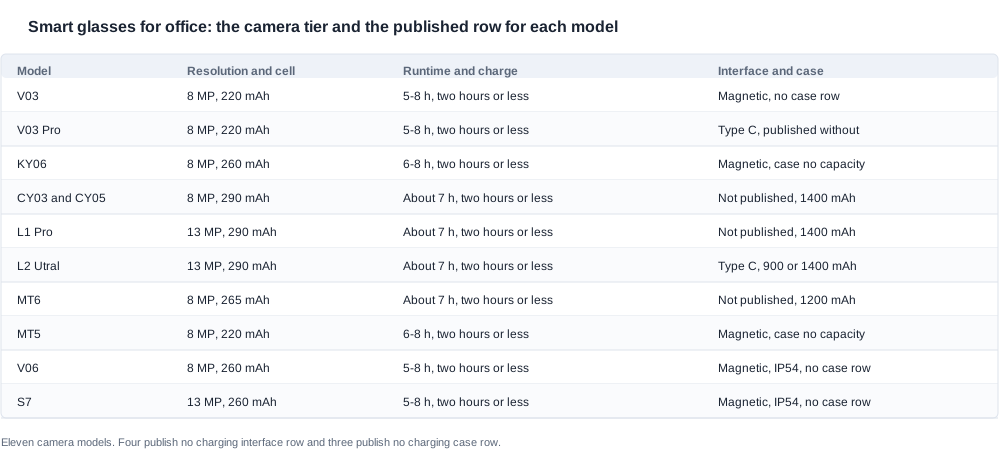
The table below is the camera tier as the catalogue states it, arranged so that the models that can be ordered on published information are separable from the models that need a question answered first. The camera tier is the only tier that applies when the office needs a record, and it is eleven models.
The four models published with no charging case row
Four of the eleven publish no charging case row at all: the V03 Pro, the V06 and the V03, and the S7. That single position is real and is worth carrying into the shortlist. A model with no published row is a model whose case status is unknown, which is a question, and it is a question for four of the eleven rather than for one. A blank row is silence, and silence has to be closed with a supplier answer before the shortlist can be finalised.
The practical consequence for a selection is that the V06 and the V03 Pro, and the V03 and the S7 can only be shortlisted for a use where the unit stays at a fixed point, or for a travelling use only if the organisation accepts a unit whose spare power source has not been documented yet. That is a procurement question rather than a specification question, and it belongs in the request for quotation. The V06 and the S7 also carry the IP54 marking, which is the only ingress position published in the range and is relevant only if the deployment includes environments where splashing water and a dust protection level are meaningful.
The four models whose charging interface is not published
Four camera models publish no charging interface row: the CY03 and the MT6, and the CY05 and the L1 Pro. All four do publish a charging case capacity — 1400 mAh on the CY05 and the L1 Pro, and the CY03, 900/1400 mAh on the L2 Utral, and a 1200 mAh foldable case on the MT6 — which is a separate fact and does not fill the interface gap. The MT6 is also the only model in the entire range with a published weight, 158 g for the glasses body including its 265 mAh cell and its camera and excluding the foldable case, and the case weight is not published.
This group is where the most attractive models sit and where the procurement work is heaviest. Three of the four carry a 290 mAh cell and an about-seven-hour runtime, the L1 Pro is a 13 MP model in that group, and the MT6 is the one with a published weight and a foldable case. A buyer who selects one of them has selected a configuration whose charging point, dock type and consumable cable decision all wait on a one-line confirmation. That is a reasonable trade, and it is a trade that has to be made knowingly rather than by omission.
The audio tier, and when it is the right answer for an office
The audio tier is eight models, and it is the right answer for an office whose requirement is calls, conferencing or private audio rather than a record. The models are the LC-105-2 and the YK12, the K02 and the G07, the K01 and the LC-105-1, and the D12 and the D11, and the published rows divide them by cell configuration and by runtime.
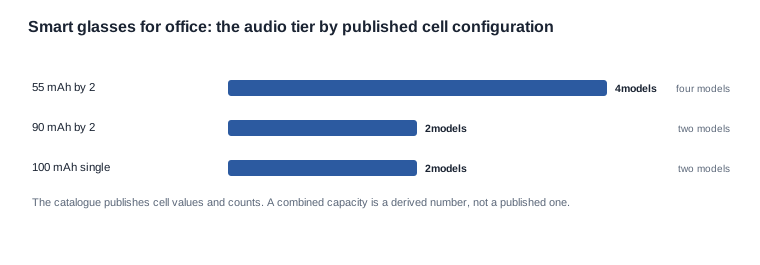
The published rows to use in a selection are the charge time, the rated runtime, the Bluetooth version, the cell configuration, the charging mode, and the structural features. Bluetooth 5.3 is published on the K01 and the K02, and 5.4 on the LC-105-1 and the YK12, the D12 and the LC-105-2, and the G07 and the D11. Magnetic charging is published across the audio tier, and Type-C on the D11 and the D12. The LC-105-1 and the LC-105-2 publish 55 mAh × 2 and a runtime of about eight hours; the K01 and the K02 publish 90 mAh × 2 and about eight hours; the D11 and the D12 publish a single 100 mAh cell and about seven hours; and the G07 and the YK12 publish 55 mAh × 2 and about six hours, the G07 with ultra-slim detachable temples and the YK12 with surround sound and a slim temple.
The runtime band is the one that decides the audio selection for a full working day, and the G07 and the YK12 are the pair to think about carefully. A model publishing about six hours does not reach the end of an eight-hour day, which means a second charging point at the desks where those two are issued, or a different issue pattern. The LC-105 pair and the K01 and the K02 publish about eight hours, and the D11 and the D12 publish about seven, which is a working day with a margin. The audio tier product page is bluetooth audio glasses, and the bone-conduction configuration is a separate line on bone conduction audio.
One gap belongs in the selection on its own: no model in the audio tier publishes a touch row, so it cannot be assumed for the K02 or for the K01, even though the two share a Bluetooth version, a cell configuration, a charge time and a runtime. A buyer building an audio configuration around a temple control has selected a question for the supplier rather than a model, and that question has to be answered in writing before the order is placed.
The rows that are not in any of the three tiers
Six catalogue rows sit outside the camera, audio and sport tiers, and a buyer who has read a list of twenty-eight products and stopped at twenty-two has not seen them. They are the AR row at 100 mAh and about eight hours with magnetic charging, the A05 and the A06 children's protection rows at 40 mAh and about twenty hours, the A07 children's audio row at 70 mAh and about twenty hours, the photochromic row at 100 mAh and about seven hours, and the bone-conduction row at 200 mAh and about seven hours with Type-C charging and a published 35 dB amplification gain.
None of them belongs in an ordinary office shortlist, and the reasons are worth stating in order, because two of them are mistakes a buyer can make without noticing.
The three children's rows are the easiest mistake. The A05, the A06 and the A07 are children's products, which places them under a different and stricter product regime and makes them unsuitable for issue to adult staff. A buyer who has found a twenty-hour runtime in the catalogue and has read it as an attractive office figure has read a children's row. The rows themselves are not defective; they are simply for a different market.
The bone-conduction row is the second easy mistake, because a published 35 dB amplification gain reads like a specification a procurement team can order. The row is a bone-conduction audio configuration, and a configuration that amplifies sound sits close to a boundary that has to be settled separately, by asking the question rather than by assuming it. It is not part of an office shortlist for a general workforce, and any buyer considering it for a specific accessibility use should treat its regulatory position as a question to put in writing before the selection is closed rather than as a line in a comparison table.
The AR row and the photochromic row are the remaining two, and they are ordinary in the sense that no special reasoning excludes them: an AR row at 100 mAh and about eight hours, and a photochromic row at 100 mAh and about seven hours. What excludes them is that neither is a camera configuration, neither publishes a charging interface the camera tier publishes, and neither publishes a charging case, so a buyer whose requirement is a record has no published row to order them against. A buyer whose requirement is a pair of light-changing lenses with audio is a legitimate requirement, and the honest answer for it is that the selection starts again with the published rows rather than with a comparison against the camera tier.
The sport tier, and the two models in it that carry a camera
The sport tier is three models: the YKC02, the D17 and the ZH12. All three publish Bluetooth 5.4, a charge time of two hours or less, and a rated runtime, and two of them are the only models in the entire range that publish a shorter charge time — about one hour on the D17 and the ZH12, against two hours or less on everything else.
The YKC02 is a sport model with no camera. It publishes a 70 mAh × 2 cell configuration, magnetic charging, about eight hours of runtime, surround sound and a long battery life, and it belongs in the sport tier rather than the audio tier. It is an audio configuration in a sport package, and a buyer who lists it as an audio model is misclassifying it, which matters because the audio tier carries an eight-model count that a specific published cell configuration and runtime band attach to.
The D17 and the ZH12 are the two sport models with a camera, and both publish a remote control capture, which is the feature that makes them relevant to an office at all. The D17 publishes 115 mAh, about seven hours of runtime and Type-C charging; the ZH12 publishes 100 mAh, about eight hours and Type-C charging, and both publish surround sound, with the ZH12 published as three-dimensional surround audio. A discreet remote trigger is genuinely useful in a meeting, and a charge time of about one hour is a genuine advantage over the two-hours-or-less ceiling that the rest of the range publishes. The cost is that neither model publishes an ingress rating, a field of view, a frame weight or a charging case, and the D17 and the ZH12 sit outside the camera tier's eleven.
The disqualifiers, and the four ways a model leaves the shortlist before price
Four rules remove models from consideration before anyone discusses a unit price, and applying them in order is what turns a catalogue into a shortlist.
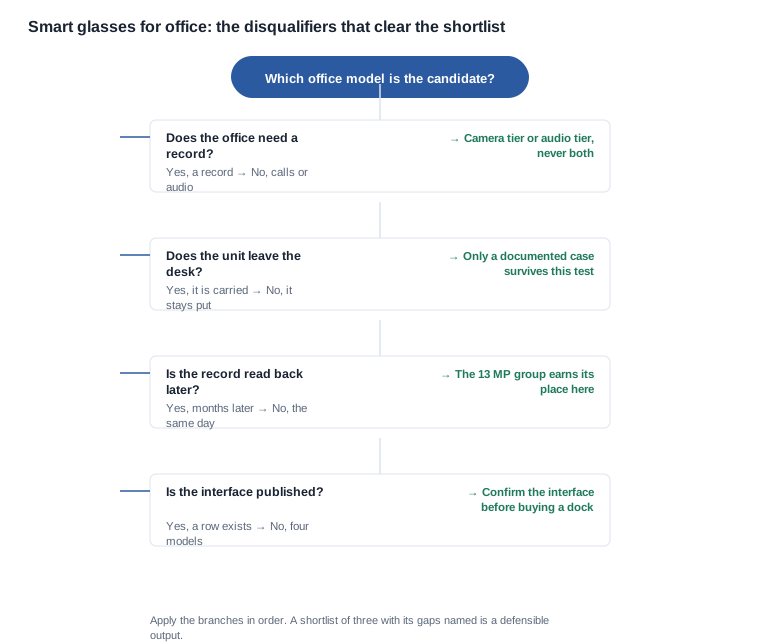
The first disqualifier is the tier itself. A camera model cannot serve an audio requirement and an audio model cannot produce a record, and the two sets share only a charge time. A buyer who has specified "smart glasses" without specifying a tier has not started the selection.
The second is the case rule. If the unit leaves the desk, the model has to have a documented case, which removes the V06 and the V03, and the S7 from the running and leaves the V03 Pro only for an organisation that has decided a unit can travel without one. The second disqualifier is the one that most often gets skipped and it is the one that most changes the answer.
The third is the interface gap. Four camera models publish no charging interface row, which does not disqualify them but does put them behind a confirmation. The fourth is the record purpose, and it is the one that decides between the two resolution classes rather than excluding anything: a record read back months later justifies the 13 MP group, and a record read back the same day does not.
The commercial disqualifiers, and why they come after the technical ones
Three more exclusions apply, and they apply to the shortlist rather than to the catalogue, so they depend on the buyer's own programme rather than on the product.
The first is the minimum order quantity. If the shortlist contains a model whose minimum order quantity is above the size of the issue, that model is not a candidate for this order, whatever its published rows say. This is a question for the supplier and it is answered per model, because the range covers a children's row at forty milliamp hours and a camera row at two hundred and ninety, and the volume that makes one viable is not the volume that makes another viable.
The second is the private-label and packaging position. A buyer who intends to put a brand on the product, or who needs a particular packaging arrangement for a channel, has to know what that costs and how long it takes, because tooling is a one-time charge that a procurement lead time has to carry and a factory has to schedule. The published catalogue carries no minimum order quantity, no unit price, no lead time and no tooling charge, so every one of these is confirmed per enquiry, and a selection exercise that skips them produces a shortlist the buyer cannot order.
The third is the sample position. Most of the rows a buyer would like to shortlist have at least one unpublished field of view, and the only way to settle that is to handle a sample unit and measure it. A buyer who is not going to take a sample should know that before the shortlist is closed, because a shortlist that depends on a measurement the buyer has decided not to make is not a shortlist.
The order is deliberate. Technical disqualifiers are applied first because they are free and because they eliminate most of the range. The commercial disqualifiers come second because they are per-programme, and they are the ones that decide whether a shortlist of three becomes a purchase order or a request for more information. The full commercial structure of a first order is at pricing, and the sample and acceptance checks are at the office test sequence.
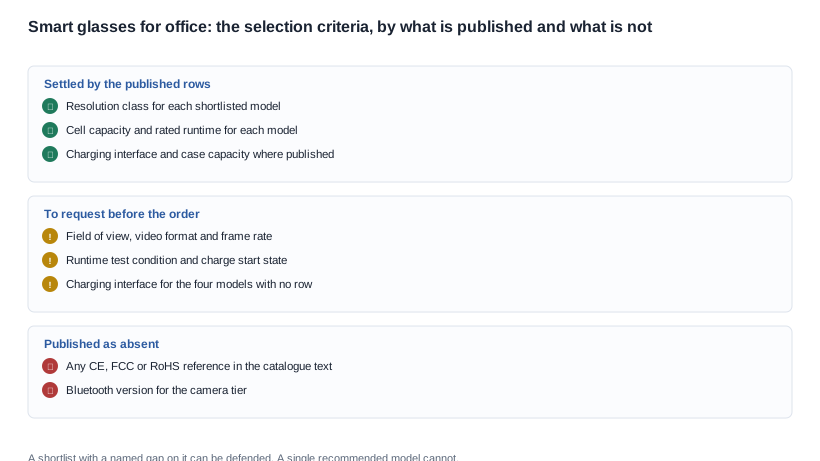
A shortlist of three models, each with its published row recorded and its gaps named, is a defensible selection output. A single recommended model is not, and a buyer who receives one should ask which of the four questions above was answered on their behalf and on what basis.
What we publish, and what to send us next
We publish the rows a buyer can order from, and we will not fill the gaps with typical figures. For the camera tier that means the resolution class, the cell capacity, the charging interface where it is published, the rated runtime, the charge time, the charging case capacity where it is published, the structural features that are published, the colour counts, and the IP54 marking on the V06 and the S7 stated as a catalogue attribute. For the audio tier that means the Bluetooth version, the cell configuration, the charge time, the rated runtime, the charging mode, the absence of any published touch row, the surround sound published on the YK12 and the ultra-slim detachable temples published on the G07. For the sport tier that means the Bluetooth version, the cell configuration, the charge time, the rated runtime, the charging mode, the remote control capture and the surround sound published on the D17 and the ZH12.
What we do not publish and will not estimate: the frame material, the lens material, the coating, the hinge specification, the unit weight beyond the single 158 g whole-unit figure for the MT6, the field of view, the video specification, the storage and overwrite behaviour, the operating temperature range, the cycle life rating, the runtime test condition and the standby draw. We will not state that the range is certified to CE, FCC or RoHS, because the catalogue text contains no reference to those standards and there is no per-model certification row, and we will not extend the IP54 marking beyond the two models that carry it.
Send us the record purpose per role, whether the unit leaves the desk, when the record is read back, the destination market and the number of units, and we will return a shortlist of three with the published rows for each, the question that has to be answered before the charging point is ordered, and the documents that have to be settled before the order. The ongoing handling of a chosen configuration is at how to maintain smart glasses for office, the published power rows are at battery life, the camera configurations are listed under AI camera glasses, and the scenario entry point is smart glasses for office.
Related reading
- The scenario's starting point — smart glasses for office
- The product lines — AI camera glasses and bluetooth audio glasses
- The catalogue rows — battery life
- The gate checklist that catches the gaps — the deployment gate checklist
Send us the record purpose, whether the unit leaves the desk and when the record is read back, and we will return a shortlist of three with the published rows for each.


