
This is a worked deployment of twelve smart glasses for outdoor units to a trail maintenance crew, written entirely from published catalogue rows. It is a hypothetical case rather than a client project: there is no customer name, no quoted price, no delivery result and no performance figure that did not come from the catalogue. What transfers is the decision sequence, because the sequence is the part that works across projects and the numbers are the part that changes with every order.
The scenario is deliberately unglamorous. A crew of twelve works outdoors in variable weather, records condition assessments for a handover process, keeps the units on site overnight, and uses them for several hours at a stretch. Nothing about it requires a leading-edge configuration, which is exactly why it is useful to work through: it forces the deployment questions to the front, where they can be answered on paper.
Smart glasses for outdoor deployment: a twelve-unit crew across ten working days
Three catalogue facts shape this deployment before anyone argues about a model.
The first is that the protection marking in this range sits on two models and nowhere else. The V06 and the S7 both carry a catalogue IP54 marking, both are camera models in the sport form factor, and both publish a detachable inner frame. No other entry in the twenty-eight carries any ingress marking at all. There is no third-party test report number published behind the marking on those two, and no test standard cited in the catalogue, so the marking is a catalogue attribute that a buyer may describe and may not present as a tested level.
The second is that unit weight is published for exactly one entry. The MT6 glasses body is published at 158 g, covering the frame, the 265 mAh cell and the camera, and excluding the foldable charging case that sits beside it at 1200 mAh. No other model has a weight row, and no model has a bare frame weight. Every other model in the range has to be weighed on a sample before a wearer-comfort claim can even be discussed.
The third is that the charging infrastructure, not the product, is the deployment. Rated use across the camera tier runs from about seven hours on the 290 mAh models to a five-to-eight-hour band on the 260 mAh models, and none of those figures carries a test condition. Standby current is not published for any entry in the range, so overnight retention cannot be modelled from documentation at all.
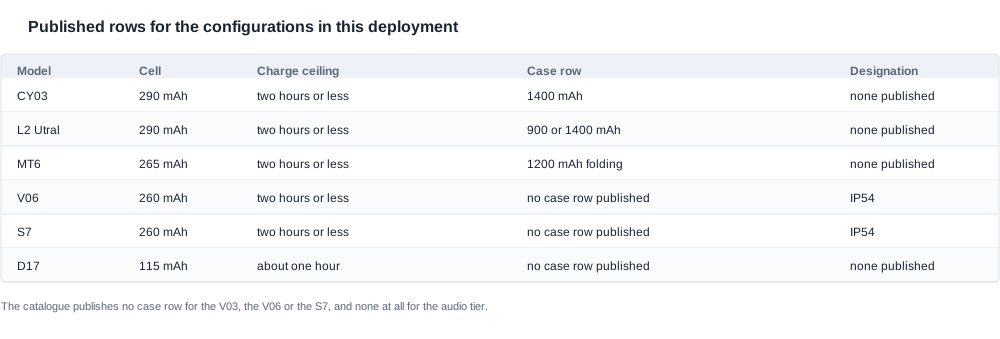
| Model | Cell | Charge ceiling | Case row | Designation |
|---|---|---|---|---|
| CY03 | 290 mAh | Two hours or less | 1400 mAh | None published |
| L2 Utral | 290 mAh | Two hours or less | 900 or 1400 mAh | None published |
| MT6 | 265 mAh | Two hours or less | 1200 mAh folding | None published |
| V06 | 260 mAh | Two hours or less | No case row published | IP54 |
| S7 | 260 mAh | Two hours or less | No case row published | IP54 |
| D17 | 115 mAh | About one hour | No case row published | None published |
The rows above are the whole of what the catalogue contributes to this deployment. Everything else in the plan — the weather protocol, the charging rota, the asset register, the acceptance criteria — has to be created by the buyer, and creating it is most of the work.
Why twelve units changes the answer. Small quantities are forgiving. A buyer placing an order for three units can absorb a design that does not quite fit the task, because the cost of replacing them is one conversation. Twelve units with a handover process attached is a different object: the crew is trained on the configuration, the review process depends on the footage existing, and a mid-season change costs a retraining cycle and a second set of acceptance criteria. The practical consequence is that the configuration freeze in this deployment is not an administrative step, it is the decision that keeps the season coherent.

Separating the recording duty from the protection duty

The requirement has two halves and they pull in opposite directions. The assessment record is the point of the deployment, so the units have to capture, which points at the camera tier. The crew also works in rain and mud, so the units have to survive something, which in this catalogue means the V06 or the S7 and nothing else. The two models that publish a marking are both camera models, and the camera models that publish a large charging case carry no marking at all.
That is not a contradiction to be argued away; it is the deployment's central constraint, and the way to handle it is to stop asking one unit to do both jobs. Six units of the V06 carry the protection duty and the recording duty in weather that is splash and dust rather than sustained rain. The remaining six units are a cased camera configuration with a larger cell and a published charging case, used in conditions where the marking is not claimed. Two configurations, one purchase order, one asset register with both designations in it.
The split has to be written down, or it will be lost. Field crews do not respect a configuration distinction that appears only in a procurement file. The weather protocol, which is the artefact that carries the distinction into the field, has to say which units may be used in which conditions, and it has to be derived from the designation rather than from the weather forecast. The wording that survives scrutiny is short: the marked units are for splash and dust exposure, the unmarked units are for dry conditions and for work that must not stop when the rain starts.
The charging side of the split is where the deployment actually lives. With twelve units and no published standby current, overnight behaviour is an assumption until it is measured. The rota therefore has a named owner, and the owner is not the procurement manager. It is whoever is on site, because the failure mode is a flat unit in a bag at six in the morning, and that failure is only visible to someone who is there.
One consequence deserves naming because it is easy to miss. The V06 and the S7 publish no charging case row, so the marked half of this deployment is powered by the magnetic interface alone. The catalogue publishes no case capacity for either, which means the protected units need a different overnight arrangement from the cased half — a bench, a cable inventory, or a rotation that keeps some units in service while others charge. That is not a defect in the range. It is a difference between two configurations that has to be designed into the rota rather than discovered on a wet Tuesday.
What the split costs, stated honestly. Two configurations instead of one means two accessory lists, two sets of acceptance criteria, two lines in the asset register, two entries in the training session, and twice the number of spare units held against a field failure. For a twelve-unit programme that is a real overhead, and it is the reason the split should be taken only when the environment genuinely demands it. A deployment that works in splash and dust conditions throughout its season should buy one configuration and spend the saving on the spare units instead. The split in this scenario earns its cost because the crew works in rain and mud for part of the year; in a deployment where it does not, it is pure overhead.
And the split has a failure mode of its own. Two configurations in the field means two things to distinguish at seven in the morning, and the most likely error is a cased unit used in the rain and a marked unit used where a cased unit was needed. The protocol handles it in the only way that reliably works, which is physical rather than verbal: the marked units are the ones that carry the visible designation and the detachable inner frame, and the accessory set is different enough that the two are not interchangeable in the field. A protocol that relies on the crew remembering which model is which will fail at least once.

The five artefacts the crew had to create
The deployment produced five documents that did not exist before it, and they are the reason the deployment is worth writing down.
- A weather protocol, stating where each configuration may be used and where it may not, derived from the published designation rather than from the requirement. Its value is that it converts a catalogue attribute into an operating rule that a crew lead can enforce.
- A charging rota with a named owner, because with twelve units and no published standby figure, overnight behaviour is an assumption rather than a specification. The rota also records which units rotate and which sit in the case.
- An asset register opened on delivery day, carrying the model designation, the batch or serial reference, the configuration and the firmware for each of the twelve units. After three months this is the only document that can answer which build a compatibility complaint is about.
- A written camera specification, produced because the sensor model, the field of view, the video specification, stabilisation and low-light behaviour are not published. If the assessment records have to be usable as evidence in a handover, the camera's behaviour has to be defined by somebody, and the buyer is the only party who can define it.
- A case replacement plan, because a charging case is the most failure-prone consumable in a field programme and the availability of a spare case is not published for any model.
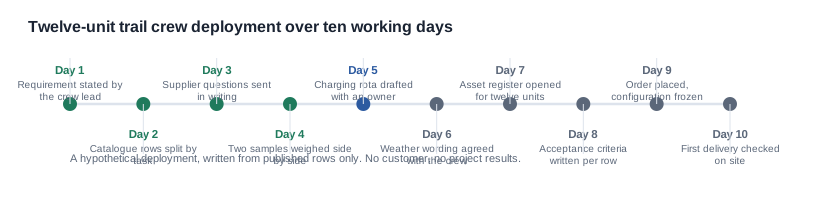
The tenth day is the one worth marking. The sequence below is the working order for this deployment, and the last entry is not the shipment arriving — it is the shipment arriving and being checked against the criteria written on day eight. A delivery that is not checked against criteria on arrival is a delivery that establishes whatever standard the first shipment happened to have.
Why the ten days are worth naming at all. The duration is not a forecast and it is not a promise about our own lead time, which is confirmed per enquiry. It is the shortest sequence in which every artefact above can be produced in the right order, and it is useful as a shape rather than as a schedule. A buyer who has fewer days than this has either already asked the questions or has decided to ship without the answers.
| Day | Activity | Output |
|---|---|---|
| 1 | Requirement stated by the crew lead | A written task, not a feature wish list |
| 2 | Catalogue rows split by task | Two configurations named |
| 3 | Supplier questions sent in writing | A request list with deadlines |
| 4 | Two samples weighed side by side | A unit weight per configuration |
| 5 | Charging rota drafted with an owner | A named person and a rotation |
| 6 | Weather wording agreed with the crew | A rule the crew can apply |
| 7 | Asset register opened for twelve units | A register with twelve rows |
| 8 | Acceptance criteria written per published row | Measurable criteria, one per row |
| 9 | Order placed, configuration frozen | A dated configuration document |
| 10 | First delivery checked on site | A check against the day-eight criteria |
Day three is the day that decides whether the rest works. The requests sent on day three are the sensor model, the field of view, the video specification, the stabilisation behaviour, the low-light behaviour, the storage and overwrite behaviour, the standby current, the operating temperature range, the per-model unit weight, the spare-part route and the ingress report. Every one of them takes longer to answer than the deployment takes to set up, which is precisely why a request sent on day three can arrive before day nine and a request sent on day nine cannot arrive at all.
Where the responsibility actually sits in a deployment
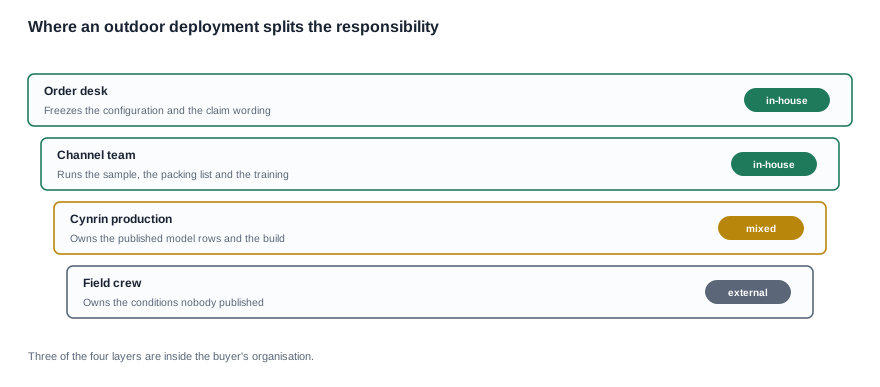
A deployment like this has four layers, and the most common failure is not a technical one — it is a layer that assumes another layer owns a problem it does not own.
The order desk owns the configuration freeze and the claim wording. This is the layer where the decision "we will describe the marking as a marking" has to be made, because the wording is published to customers from this layer and nowhere else. A channel team owns the sample, the packing list and the training. The factory owns the published model rows and the build. The field crew owns the conditions nobody published, which is the largest single category of risk in the whole deployment.
Three of the four layers sit inside the buyer's organisation, and that is a useful fact rather than a comfortable one. It means most of what determines the deployment's outcome is not under the factory's control at all: the rota, the register, the training and the acceptance criteria are all buyer-side. What the factory controls is the rows, the build and the documents. When a deployment goes wrong, the cause is usually found in the first group even though the complaint is always phrased about the second.
The layer boundary that causes the most trouble is the claim. The factory publishes a marking. The order desk turns it into a sentence on a product page. The channel team puts that sentence into a listing. The field crew is then asked to honour a promise the factory never made. Every layer passes its work on correctly, and the customer still ends up with a unit in a river. This is why the weather protocol in artefact one is written by the order desk and read by the crew, rather than being assumed by both.
**A second boundary worth naming is the evidence.Our catalogue holds a company-level export certification page whose content is imagery rather than wording, and no reference to CE, FCC or RoHS is written into the catalogue text, and there is no per-model certification row anywhere in the range. So a deployment that needs a substantiated radio or safety document does not have a factory document to forward — it has a request to send and a lead time to plan for. The layer that owns that request has to be named before the order is placed, or it defaults to nobody.
A third boundary sits between the two cased configurations. The CY03, the CY05, the L1 Pro and the MT6 publish no charging method row at all, so their interface is not published, while the L2 Utral publishes a Type-C port. A deployment that mixes the L2 Utral with any of the other four inherits a cable-management problem that the catalogue makes invisible, because four of the five cases in the tier look identical in the specification file. The accessory list has to name the interface per model even where the catalogue leaves it blank, and the blank has to be closed with a written answer before the purchase order rather than after the first shipment.
What we will substantiate and what we will not
The boundary we hold: we will state the published protection designation with its precise meaning, attribute it to the two models that carry it, and stop there. We will not present the marking on the V06 and the S7 as a tested level, because no test report behind it is published, and we will not describe a marked unit as waterproof, rainproof or all-weather. We will not extend the marking to any other model in the range, and we will not infer a certification position for a model from a company-level capability, because there is no per-model certification row to infer from.
For the rest of this range, frame weight is not published for any model other than the single MT6 body figure at 158 g, and low-temperature performance, impact resistance, cycle life for the hinge and the contacts, the runtime test condition, the standby current, the sensor model, the field of view, the video specification and the storage behaviour are all unpublished. Unit prices, production lead times and minimum order quantities are confirmed per enquiry rather than published as fixed numbers, and we will not put a figure on a placeholder.
What we will do for a deployment shaped like this one is take the task, the crew size, the environment, the season and the handover requirement, and tell you which published configurations cover it, which published rows have to be requested in writing before the order, and where the documentation stops and the deployment's own artefacts begin. The selection logic sits at choosing a model for outdoor use, the published entries are on the sport smart glasses range page, and the evidence route for a deployment that has to enter a regulated market is set out in certification documentation requirements.
There are three things in this deployment we will not do, and they are worth setting out as a list rather than a paragraph. We will not quote a unit weight for any model other than the MT6 body figure of 158 g, even where a competitor's listing for the same form factor carries a weight, because a quoted figure that has not been measured on our build is a claim about somebody else's product. We will not date a configuration freeze on our own behalf, because the date has to be the buyer's and it has to match the production slot. And we will not substitute a demonstration for an inspection criterion, because a demonstration is a document the factory produces and an inspection criterion is a document the factory can be held to — and only the second of those has any value at the goods-in dock.
If you are running a similar programme, send us the crew size, the task, the environment and the season. We will return the configuration split the published rows support, the document list to send in week zero, and the acceptance criteria that can be written before the first shipment arrives.
Related reading
- How the selection works — choosing a model for outdoor use
- The published entries — sport smart glasses range
- The evidence route — certification documentation requirements
- The ingress wording — IP ratings advanced considerations


