

A channel's outdoor gear checklist has more entries than a specification sheet, because the product is only half of what makes a sale work and the other half decides the returns. The useful version of the list is not a packing list. It is a partition: which items go in the carton, which sentences go on the product page, and which habits go into the training session for the first cohort and onto the card for everybody after them.
That partition is where almost every avoidable return in this category comes from. A claim in the second group that the first group cannot protect produces a return no packing advice defends — a waterproof statement where the documentation carries a splash designation, or a night-recording statement where no low-light figure is published. The answer in every one of those cases is to remove the claim rather than to prepare an explanation for it, and that is a commercial decision rather than a copy decision, because a narrower claim sells fewer units in the worst month and more units across the year.
The second thing this list has to do is serve three different audiences at once. The carton serves the customer on day one. The product page serves a shopper who has not bought anything. The training session serves the channel's own staff, who are the people who will answer the question when the claim turns out to be narrower than the customer assumed.
Smart glasses for outdoor gear: the split between protecting the product and protecting the claim
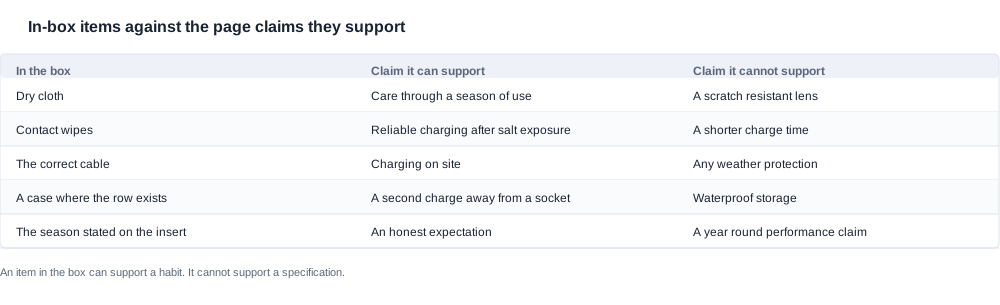
| In the box | Claim it can support | Claim it cannot support |
|---|---|---|
| Dry cloth | Routine care through a season of use | A scratch-resistant lens |
| Contact wipes | Reliable charging after salt exposure | A shorter charge time |
| The correct cable | Charging on site | Any weather protection |
| A case where the row exists | A second charge away from a socket | Waterproof storage |
| The season stated on the insert | An honest expectation | A year-round performance claim |
The first group is the physical kit, and it is short. The catalogue publishes a charging case for five camera configurations — the CY05 and the CY03, and the L1 Pro — each at 1400 mAh, the L2 Utral at 900 or 1400 mAh, and the MT6 as a 1200 mAh folding case — and the KY06 and the MT5 carry a case with no published capacity. The catalogue publishes no charging case row at all for the V03 Pro and the V06, and the V03 or the S7. That distinction matters commercially, because it decides whether the accessory list has a case line in it at all for a given configuration. A buyer who has listed a case for one of those four has listed an accessory the catalogue does not document.
The cable line is per model and cannot be standardised. Seventeen entries charge magnetically and seven use a Type-C port; four camera configurations — the L1 Pro and the CY03, and the MT6 and the CY05 — publish no charging method row at all. A channel that ships one cable with every outdoor SKU will ship the wrong cable to a meaningful fraction of its own range, and the symptom will arrive as a support ticket rather than as a returns statistic.
The dry bag line is the one that gets omitted and should not be. No configuration in this range publishes an ingress marking beyond the IP54 on the V06 and the S7, and that marking's second digit describes protection against splashing water rather than immersion. A dry bag protects the unit in the way the published rows cannot promise, and it protects the channel's claim at the same time because it keeps the unit away from the exposure the claim does not cover.
The second group is the page, and the discipline there is leaving rows blank. Sensor model, field of view, video resolution and frame rate, stabilisation, low-light behaviour, the storage and overwrite behaviour, the standby current, the operating temperature range, the per-model unit weight beyond the single MT6 body figure at 158 g, and the lens material and coating are all not published. A channel that fills those rows will collect the complaint, because a filled row is a promise whether or not anybody signed it. An empty row is not a weakness on the page; it is the reason the rest of the page can be believed.
The third group is the season, and it is the cheapest commercial decision on the list. An outdoor purchase made in July is evaluated in October, when the conditions are colder and wetter than the demonstration. A product page that names the season it was designed for produces a customer whose expectations are already correct in October, and the same product page without the season produces a customer who discovers the limits at the worst moment and writes about it.

The in-box items and the page claims each one can carry

The six steps below are the order in which a channel launch actually happens, and each one ends with something a second person can check. The order matters because the last step is the only one that can correct the first four.
- Freeze the configuration and the colour before the cartons are packed. Model, colour, case capacity, interface and packaging all stop moving at a dated point, and the production slot and the freight quotation both depend on it. The completion standard is a dated document held by both sides.
- Put the in-box items in the carton and the page claims on the insert. The two lists are written together even though they end up in different places, because an item in the box and a sentence on the page have to be consistent with each other. The completion standard is a carton sample checked against both lists.
- Check the sample against the published rows before the first shipment. The unit that ships is not the unit that was sampled at the factory, and the difference between an engineering sample and the production batch is invisible until the second delivery. The completion standard is a check record per model, with the batch reference written next to it.
- Train the first cohort on the three habits, then repeat it on a card. A session for the people who sell and a card for everybody after them, because the first cohort will leave. The completion standard is an attendance record and a printed card in the carton.
- Read the first reviews against the claims that were published. Not against the claims that were intended. This is the step that catches a page that has quietly drifted, and it is the cheapest quality control a channel has.
- Correct the claim that the reviews contradict. Change the page, not the explanation. A customer who is told that the marking means more than it means will eventually be told otherwise by a review, and the review costs more than the page edit.
Step two is where the accessory set becomes a cost decision. A case in the carton is a published capacity, a packaging decision and a freight-band decision at once, because the carton dimensions change the volumetric weight the forwarder calculates. A channel that adds a case to a day-trip SKU to win a feature comparison is paying for it three times: once in the unit cost, once in the freight band, and once in the returns it will generate from customers who assumed the case made the product weatherproof.
Step three is the step that turns the catalogue into an inspection. Each published row becomes a line in an incoming check — the cell capacity, the charge ceiling, the runtime band, the interface, the case capacity where one is published, the colour. Where the catalogue publishes nothing, there is nothing to check, and the temptation is to substitute a plausible value. The discipline is to leave the line out and to note that it was left out, so that the incoming record describes the product rather than an idea of it.
Step five is the one that is usually skipped and it is the highest-value step in the sequence. Reviews arrive within weeks of the first shipment, and they arrive in the same order every time: complaints about the claims that were too broad, then complaints about the claims that were too narrow. Reading them against the published claim set rather than against the product produces a correction list that is usually two sentences long and usually removes the source of the recurring complaint.

Three training habits and the channel cost of each one
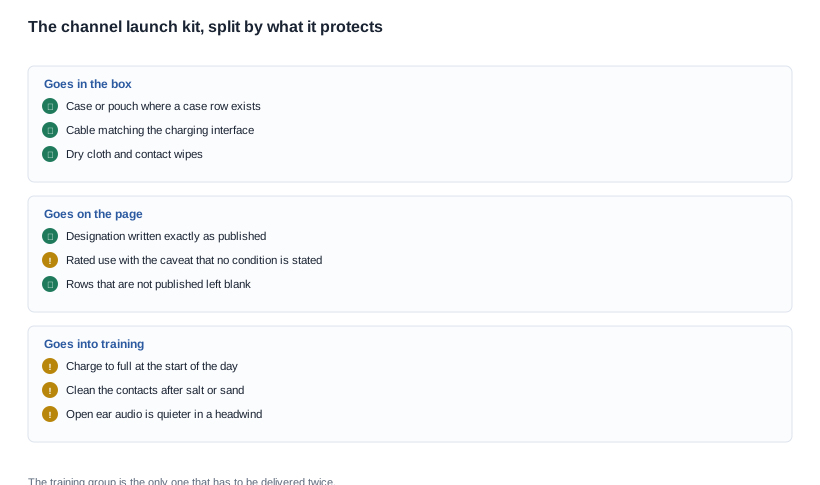
Ten minutes on three habits removes most of the avoidable returns in this category, and the three are the same three every time because they are the three failure modes the published rows predict.
Charge to full at the start of the day rather than topping up. The published charge times are ceilings, twenty-six entries at two hours or less and the D17 and the ZH12 at about one hour, and a ceiling leaves no margin for a partially charged unit. A channel that trains its staff to check the charge state before the first job rather than after it converts a class of complaints that always arrive as "it ran out" into something that never reaches a ticket.
Clean the charging contacts after salt or sand exposure. Salt, sand and sweat produce an intermittent charge on a magnetic interface, and the symptom is diagnosed as a battery fault. This is the habit with the highest ratio of saved cost to minutes spent, because the diagnostic step that distinguishes the two takes about two minutes and the diagnostic step that distinguishes them is not in any published row.
Expect less audio into a headwind than at walking pace. This one is physics rather than a defect, and runners and riders work it out within a week if somebody tells them it is not a fault. In a channel it matters because it is the habit most likely to generate a one-star review that has nothing to do with the product and costs a support ticket and a rating to resolve.
The cost structure of training is worth understanding. A training session costs a facilitator and an hour of staff time and covers the first cohort only. A printed card in the carton costs the packaging budget and covers every subsequent customer, including the ones who never speak to anybody in the channel. That is why the card is not a substitute for the session — it is a second delivery of the same three points to an audience that includes people who were never in the room. A channel that runs the session and skips the card is training the people it already has.
And there is a fourth habit that belongs in the same list, aimed at the channel's own staff rather than at the customer. Nobody in a channel should describe the IP54 marking on the V06 and the S7 as waterproof, and nobody should describe a model that publishes no marking as water resistant at all. The staff who answer the question after the first complaint set the customer's expectation, and a staff member who says "it is splash resistant" has saved a return that a marketing page claiming "waterproof" created.
The same three habits should also exist as three macros in the support system, because the first contact is where the return is either prevented or confirmed. A macro that opens with the charge state, asks whether the charging contacts were wiped before the charge, and states the marking's meaning in one sentence does more for a return rate than any amount of copy on the product page, and it does it at the point where the customer's own account of what happened is still in front of the agent. A channel that has the three habits in training but not in the macro system has trained the staff who already knew and left the rest to improvise, and the improvisation is where the unsupported promise gets made.
Where an outdoor claim actually lives across four layers
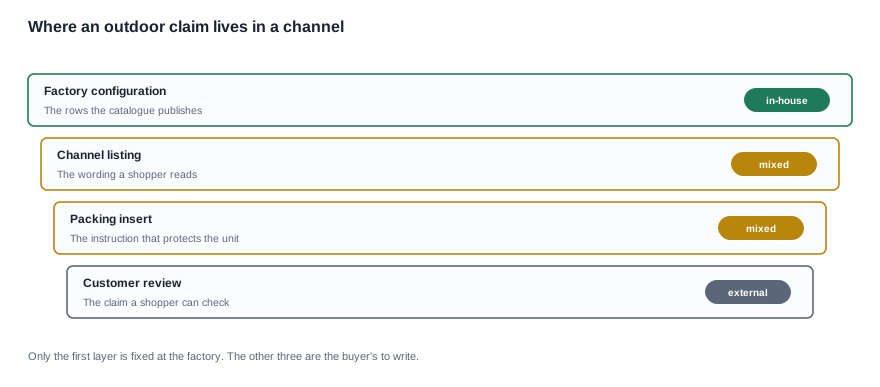
Four layers carry an outdoor claim, and only the first is fixed when the goods leave the factory. That is the single most useful thing to understand about this category, because it means three quarters of the claim risk is under the channel's own control.
The factory configuration holds the rows the catalogue publishes: the cell capacity, the charge ceiling, the runtime band, the interface, the case capacity, the pixel class, the structural features and, on two models, the IP54 marking. Nothing after this point can change what is true about the unit. The channel listing holds the wording a shopper reads, and that wording is written by the channel. The packing insert holds the instruction that protects the unit in the field, and it is also written by the channel. The customer review holds the claim a shopper can actually check, and it is written by everybody.
The layer that fails most often is the second one, and it fails by drift. A listing written correctly at launch picks up adjectives over six months of optimisation work, each one small and reasonable in isolation, until the page says something the catalogue does not support. The defence is a copy review with a date on it rather than a policy, and the review compares the live page against the published rows rather than against the previous version of the page.
The layer that fails quietly is the third. An insert is written once and never revised, so it drifts away from the product in the opposite direction: it keeps referring to a case configuration or a cable type that a later batch no longer uses. That produces the worst kind of support ticket, the one where the customer followed the instruction and it still failed, because the instruction was the problem.
The fourth layer is where the channel learns what the other three got wrong. A review is the only one of the four that is written by somebody who has no interest in the product succeeding, and the recurring complaint pattern is therefore the most reliable evidence a channel has about its own claim set. Treating the review feed as a quality control input rather than as a marketing problem is what converts it into a specification change.
And there is a fifth layer that is not in the diagram because it sits outside the channel. The distributor, the importer and the market's own compliance reviewer each see the claim separately and each can reject it on their own terms. A claim that survives the channel's own review can still fail at the border, which is a reminder that the narrowest defensible wording is the one that survives all four reviews rather than the one that passed the first one.
The range of claims we can support in a channel launch
The boundary we hold: we will tell a channel which configurations exist, which published figures apply to which of them, and where the honest limit sits for the destination climate. For the outdoor range that means the cell capacities, the charge ceilings, the rated use bands, the charging interfaces, the structural features that are published, the case capacities where they are published, the pixel classes on the camera models, and the IP54 marking on the V06 and the S7 described as a catalogue marking and attributed to those two models only.
What we will not support, and will not supply a substitute for: any ingress claim on a model that publishes no marking, any statement that a marked model is waterproof rather than splash protected, any low-light or night-recording statement, any lens scratch-resistance or coating statement, any unit weight for a model other than the MT6 body figure at 158 g, and any operating temperature statement. Our catalogue carries a company-level export certification page whose content is images rather than text, the catalogue text contains no reference to CE, FCC or RoHS, and it contains no per-model certification row anywhere — there is no row that says which model is certified for which markets, and there is no row that says pending confirmation either. So a certification claim for a specific model is a document to request in writing from whoever holds it, not an attribute to read off our catalogue.
What we will do at a launch is supply the specification package the channel actually needs. The published rows per configuration, the case capacity and interface per model so the packing list is right, the marking attribution for the two models that carry one, the list of parameters that are not published so the page can leave them blank on purpose, and the wording for the three training habits. Minimum order quantities, unit price bands, production lead times and packaging costs are confirmed per enquiry because they depend on the configuration freeze, the quantity and the destination market.
The channel framework sits under smart glasses for outdoor, the published sport entries are on the sport smart glasses range page, and the seasonal risk profile that decides which habit goes in the box is at seasonal considerations. The evaluation protocol that the carton sample is checked against is at what to bring when evaluating.
If you send us the channel, the destination market, the configurations you intend to stock and the season the line launches into, we will return the published rows behind each configuration, the accessory set the documentation supports, the claim set the product page can carry, and the items we would leave out of the carton.
Related reading
- The seasonal risk profile — seasonal considerations
- The evaluation protocol — what to bring when evaluating
- The published configurations — sport smart glasses range
- The accessories side — outdoor accessories


