

Smart glasses for outdoor: worth running only where the weather is
An outdoor product evaluated in a room produces a result that is true and irrelevant, because the four things that decide an outdoor purchase — retention under movement, endurance across a trip pattern, survival of dust and water, and the claim the listing may make about all three — are properties of the environment rather than of the device. So the first question for a buyer planning an outdoor evaluation is not what to test but where, and the answer is somewhere with dust, somewhere with a slope, somewhere with a long gap between sockets, and somewhere it will rain. Everything else on the kit list exists to make that run reproducible.
Who is buying and what they are deciding. The reader is a buyer at the brand, a channel buyer or a product manager who has to qualify an outdoor product before committing a channel to it. The decision is not whether the product is acceptable in a showroom; it is which claims the listing may carry, which configurations are worth stocking, and which of the published figures the buyer can defend when a customer returns a unit after a wet weekend. The fear behind it is that the failure shows up publicly: a review that says the image was soft, a review that says it stopped working in the rain, and a return rate that cannot be explained because nobody measured anything before the order.
Why the published documentation is not enough to plan the evaluation. Our published position for the sport family is a resolution class, a cell capacity, a rated runtime, a colour count, a charge time, a charging interface, and the IP54 marking on the camera models with no third-party test report published behind it. The audio tier publishes Bluetooth 5.3 on the K01 and the K02 and 5.4 across the rest, cell configurations from 55 mAh × 2 to 90 mAh × 2, charge times of two hours or less, rated runtimes of six to eight hours, and structural features including the ultra-slim detachable temples on the G07 and the slim detachable temples on the YK12. The sport models publish the same kind of row, with roughly one hour on the D17 and the ZH12. Not published for any model: the sensor, the field of view, the video specification, the low-light behaviour, the storage behaviour, the per-model frame weight, the operating temperature range, the cycle life rating and the runtime test condition. The published rows tell the buyer what the product is. They do not tell the buyer whether the product survives the trip it is sold for.
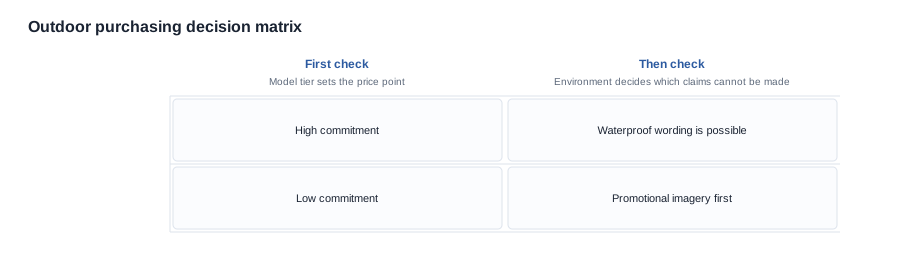
The two axes that organise the whole evaluation. The first is the purchasing axis: which model tier is being qualified, because that fixes the price point and therefore the audience. The second is the environment axis: how the product is actually going to be used, because that decides which promises cannot be made. A low-claim product sold into a high-commitment environment is where the returns come from, and it is a scoping decision rather than a product defect. The matrix above is the working version of that judgement.
The kit, item by item, and what each one is for
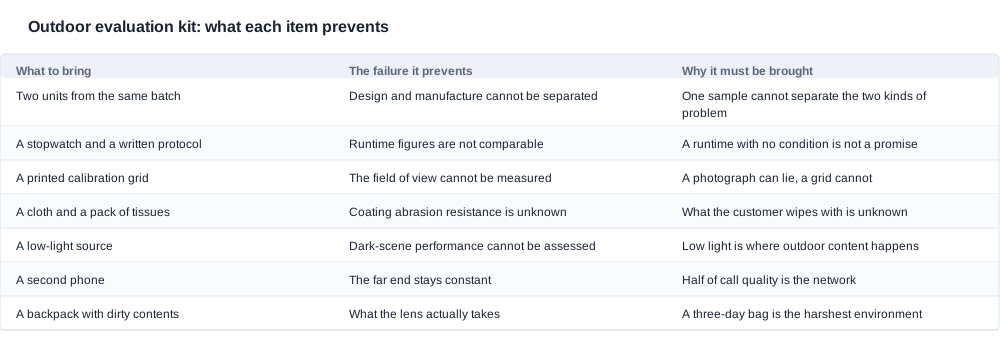
| What to bring | What it is for | The question it answers | Why it cannot be substituted |
|---|---|---|---|
| Two units from the same batch | Separating design from manufacture | Is this a product characteristic or a unit fault | One unit cannot answer it, and the two remedies differ |
| A stopwatch and a written protocol | Making the endurance comparable | What the runtime figure actually means | A stopwatch without a protocol measures the tester |
| A printed calibration grid | Measuring the field of view | How much the listing photographs can claim | A photograph can be cropped; a grid cannot |
| A cloth and a pack of tissues | Reproducing the improvised wipe | What the coating has to survive in practice | The lens material and the coating are not published |
| A low-light source with a way to measure it | Reproducing the dark scene | Whether the product works where the content happens | A dim room is not a dark scene, and the difference is the claim |
| A second phone, of a different make | Holding the far end constant | Is the call quality the device's or the network's | The far end changes the result more than the device does |
| A route with a climb and a descent | Reproducing the movement | Does the device stay where it was put | Retention is the first thing that fails and it is invisible on a desk |
| A backpack with something dirty in it | Reproducing the three-day carry | What a lens is actually pressed against | A clean table is not a bag |
The two units are the most important item and the most often skipped. One sample cannot separate a design characteristic from a manufacturing inconsistency, and the two need completely different remedies — a product change and a supplier conversation. A buyer who finds a problem on one unit and cannot tell which kind it is has to resolve that before they can act on it at all, and resolving it after production has started is the expensive version of the lesson.
The written protocol is what makes any of it comparable. The volume, the phone state, the light level, the distance, the speed, the movement, the storage state and the ambient temperature, fixed before the first run. A runtime measured at a fixed volume with the device paired and a runtime measured across a day of intermittent use with the camera running are different numbers, and the published runtimes carry no condition at all. The published rows and what they omit are at battery life, and the adjacent test route is at testing smart glasses for cycling.
The backpack and the dirty contents are the outdoor-specific item, and they are the most predictive one. A lens is damaged as often by what it rests against as by what is used on it, and a three-day bag is the most abrasive environment in the category. The bag test produces the storage rule the listing then has to promise — a pocket, a sleeve or the case — and the case capacities are published on four camera models, with a second lithium cell to declare in each. The transport requirement is at battery transport, and the seasonal note that changes the plan is at outdoor seasonal considerations. The product family is at sport smart glasses and the scenario entry point is outdoor.
The tissues and the cloth predict the scratch claim better than a pristine sample can. A customer wipes a lens with whatever is to hand, and the lens material and the coating are not published, so no coating can be called safe against abrasion. A week of representative handling is a better predictor of the scratch claim than a single clean photograph, and the cost of the kit is a few cents.
Running the evaluation so that the result is usable

A protocol that returns numbers but no criterion has demonstrated the product rather than specified it, and a demonstration is a document the supplier produces, not one that can be written into incoming inspection. Five steps, each with a completion standard:
- Ask. Request the output parameter sheet with methods, the runtime with its condition, the storage and overwrite behaviour, the ingress position in writing, and the model designation table. The completion standard is a written answer per item, not a verbal one.
- Measure. Run the baseline still set, the measured field of view, the video with the frame rate held while moving, the low-light repeat, and the storage wall. The completion standard is a file set with the conditions recorded next to it.
- Record. Capture the conditions for every result: volume, phone state, light level, distance, speed, movement, storage state and ambient temperature. The completion standard is that a colleague could re-run the test from the sheet alone.
- Check. Look up every certificate number in the issuing body's public register, confirm the model on the certificate matches the model being ordered, confirm the configuration covered includes the case, and confirm the battery transport file covers the configuration. The completion standard is a register entry per model.
- Judge. Write the pass lines into the incoming inspection criteria. The completion standard is a criterion per measured characteristic, with the number and its condition attached.
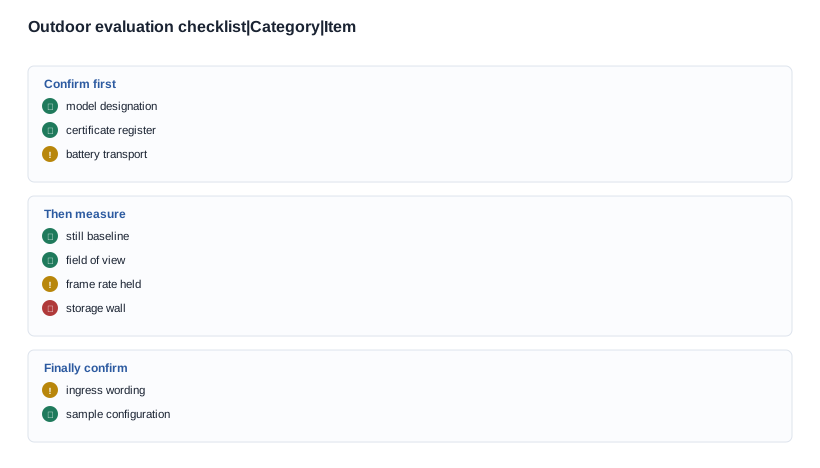
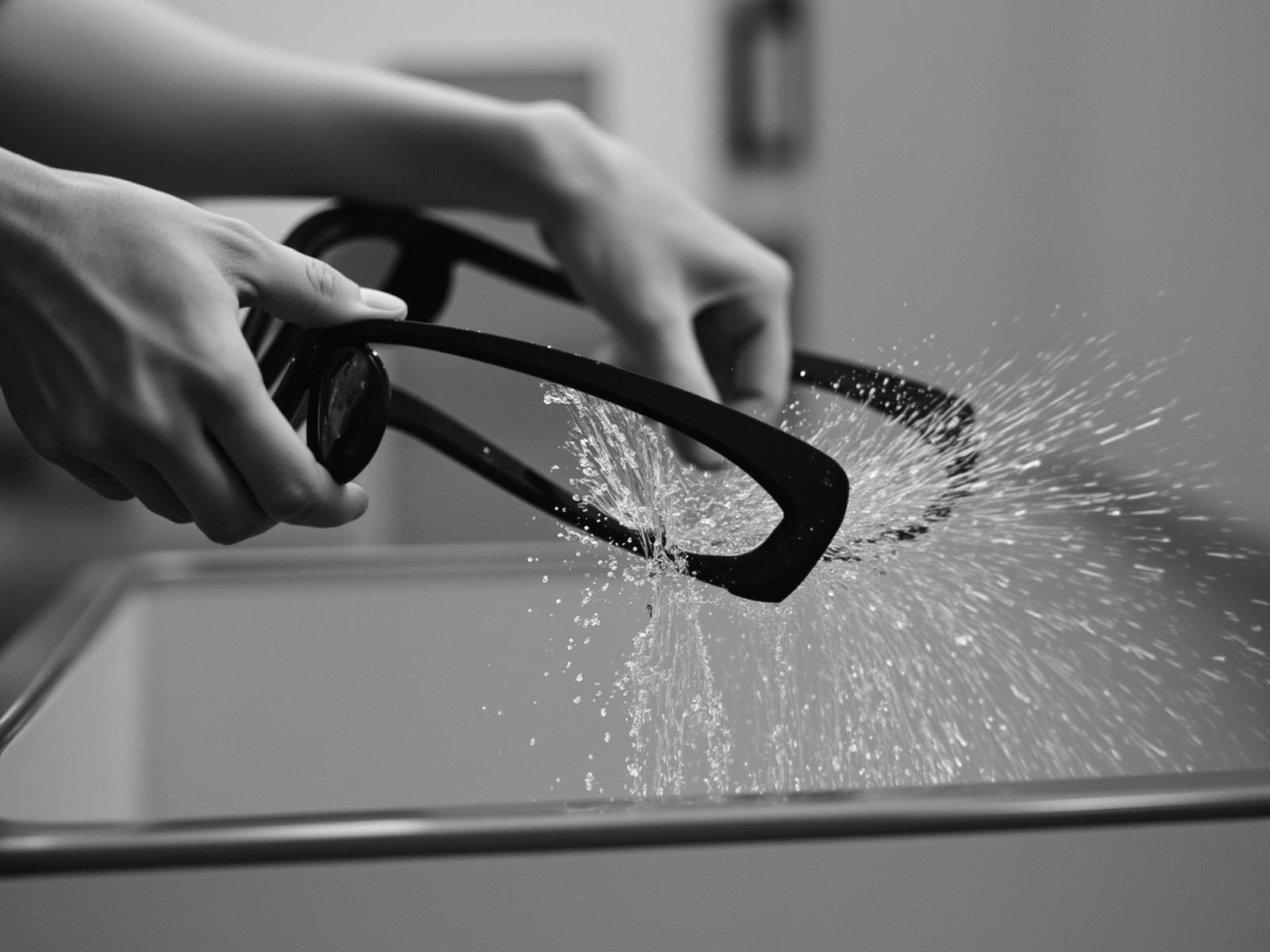
What the water test can and cannot produce. The IP54 marking on the sport camera models covers splashing water and a dust protection level, not immersion and not a sustained downpour, and no test report behind it is published. An evaluation in the rain can therefore produce a statement of the form "tested in conditions of X for Y hours, after which the pass lines were still met" — a defensible observation with its conditions attached. It cannot produce "IP54 tested" or "rainproof", because those assert something the documentation does not support. The digit reading is at IP ratings, and the advanced considerations are at IP rating advanced considerations.
Documents to request before a deposit. The signed evaluation sheet with its conditions, the output parameter sheet with methods, the runtime figures with their conditions, the storage and overwrite behaviour, the ingress position in writing, the per-model weight, the operating temperature range, the model designation table, the certificate register, the battery transport file, and the agreed incoming inspection criteria. The clause language sits at contract terms, and the commercial structure of a first order sits at pricing.
Where an outdoor evaluation produces a false result
A room, a desk and a short session. It measures a product that will not be used that way, and the buyer's shortlist survives the evaluation and then fails outdoors.
One unit. The most expensive mistake available, because it turns a solvable question into an argument.
A protocol that changes between candidates. If the light, the speed or the distance moves between runs, the comparison measures the setup rather than the products, and the buyer ends up choosing the better setup.
Testing the picture and stopping. A still is the easiest thing to shoot and the least predictive thing to sell in this category, because the customer is filming while moving.
A water test read as a waterproof claim. The test shows what the marking means; it does not convert the marking into a different marking, and the difference is visible in a one-star review.
A result that never becomes a criterion. A measurement nobody writes into the incoming inspection is a demonstration, and a demonstration is a document the buyer cannot enforce.
An endurance figure with nothing behind it. It is the costliest line in an outdoor procurement file, because the workload behind the number is the customer's to choose, and what they choose in an outdoor range is a season of use rather than a session on a desk.
A single evaluation on a single day. An outdoor product is exposed to a season, not a morning, and the endurance question in particular is answered better by a trip pattern than by a controlled run.
The questions an outdoor buyer should never skip. Four. Is the ingress position published in writing, because the marking is a catalogue attribute and the report behind it is not published. Is the runtime condition stated, because no runtime in this range carries one and a customer will supply their own workload in a review. Is the storage and overwrite behaviour published, because an outdoor session is long and a silently overwritten take is a take that does not exist. And is the sample confirmed to be the production configuration, because a promotional batch is not the product and the difference is invisible until the second delivery.
What the kit produces once the evaluation is finished. A claim set that survives a customer standing in the rain, a criterion per measured characteristic that can be written into a purchase order, and a storage rule the packaging can print. None of those is a number the buyer reports upward; all three are the reason the evaluation was worth a day of a buyer's time. The evaluation is also the only point at which the channel can be told what the product should not be sold as, which in this category is worth as much as what it can.
Which parts of the evaluation stay open commercially
Fixed, and not a negotiation target. The camera and audio architecture, the cell and the interface, and the ingress architecture. The lens material, the coating and the frame material. Certification cost and lead time. Tooling, spread over the first order and appearing as a separate quotation line.
Negotiable, and in the order the money is. Whether the supplier will run the protocol against production units rather than engineering samples, and whether they will supply the recordings so the result can be re-judged — that single clause is worth more than any unit price reduction in this category, because it converts a supplier's demonstration into a buyer's criterion. Whether a case is included and at which capacity, which is the cheapest way to build a consumer price ladder from one platform. The incoming inspection criteria, which are a negotiation between two parties rather than a unilateral document. Whether the supplier funds a baseline measurement on the production batch, which is the document that answers every complaint in the second year. Whether a film comes with the device, and whether it is applied before boxing. Minimum order quantity tiers, and whether two models can share a purchase order. Logo, lens tint and packaging. Splitting a first run into two deliveries against a staged payment. The units a season order leaves at pilot tier.
What the evaluation is worth once it is done. The result is not a score; it is three artefacts that a buyer can use afterwards. A claim set that the documentation carries, which stops the listing from promising more than the marking supports. An inspection criterion per measured characteristic, which turns the evaluation into something enforceable on a delivery rather than a memory. And a returns ratio from the first shipment, which is the only measurement in this category that tells a buyer whether the configuration they chose is the configuration the customer needed. A buyer who skips the evaluation gets all three of those anyway, in the form of a return rate and a review feed, and pays for them in customer acquisition rather than in sample time.
A worked example. Take a consumer outdoor brand evaluating two configurations for a spring launch, one audio-led and one camera-led. The first move is the claim set, because it decides the whole plan: the listing will describe the IP54 marking as a catalogue attribute covering splashing water and a dust protection level, it will not say waterproof, and the evaluation will be written to produce observations with conditions rather than a waterproof claim. The second move is the protocol, which is fixed before the first run across the volume, the phone state, the light level, the distance, the speed, the movement, the storage state and the temperature. The third move is the two-unit rule, which is what makes the outcome actionable. The fourth is the storage rule that the bag test produces, which is a pocket or the case, and the case decision is made on the price ladder rather than on the test result. The outcome is a claim set the documentation carries, an inspection criterion per measured characteristic, and a first shipment that produces the returns ratio needed to decide the second year's configuration.
Smart glasses for outdoor: what the catalogue covers, and where we stop
It is worth being precise: we publish the rows a buyer can order from and we will not fill the gaps with industry averages. For the outdoor range that means the cell capacities, the resolution class, the charge times, the charging interface, the rated runtimes, the structural features that are published, the colour counts, the case capacities where they are published, and the IP54 marking on the sport camera models stated as a catalogue attribute.
What we do not publish and will not estimate: the sensor, the field of view, the video resolution and frame rate, the stabilisation, the low-light behaviour, the storage and overwrite behaviour, the capture latency, the thermal behaviour, the per-model unit weight beyond the single 158 g whole-unit figure for the MT6, the operating temperature range, the cycle life rating, the runtime test condition and the standby draw. We put no IP54 test claim on any product in our range, because the catalogue publishes no report of any kind behind that marking, and we do not offer a demonstration as if it settled the question.
What we will do: take the trip profiles, the season, the channel, the price band and the markets, and tell you which published rows apply, which claims the listing can carry, which tests have to be run on a production unit, and which criteria belong in the purchase order. The product families are at sport smart glasses and AI camera glasses, the consistency process is at quality consistency, and the scenario entry point is outdoor.
What to send us next. Send the trip profiles, the season, the channel, the price band and the markets, and we will return the evaluation plan, the published rows that cover it, the claim set the documentation supports, and the criteria to write into the purchase order. The field behaviour in the adjacent case is at outdoor real-world experience, and the model comparison is at comparing models for field work.
Related reading
- The point where the scenario starts — outdoor
- Which family this is — sport smart glasses
- The adjacent test route — testing smart glasses for cycling
- The seasonal note — outdoor seasonal considerations
Tell us the trip profiles and the season, and we will return the evaluation plan and the claim set the documentation supports.


