

The smart glasses for outdoor glossary is short on numbers and long on definitions, because the outdoor segment is where a buyer most often uses a term the supplier means differently and nobody notices until the goods are on a shelf. The terms below are the ones that actually get used in a conversation about outdoor smart glasses, with the position our published material supports. Where a definition would require a specification we do not hold, the entry says so rather than filling in something that sounds complete.
The reason this matters commercially is that half of the underlying specifications in this range are unpublished, so vocabulary is doing a lot of the work that documentation should be doing. A buyer and a supplier who agree what "rated use" means have removed one whole category of dispute before it starts. A buyer and a supplier who each assume the other means "a guaranteed session" will spend a season discovering the difference in returns.
Smart glasses for outdoor vocabulary: what each term commits a buyer to
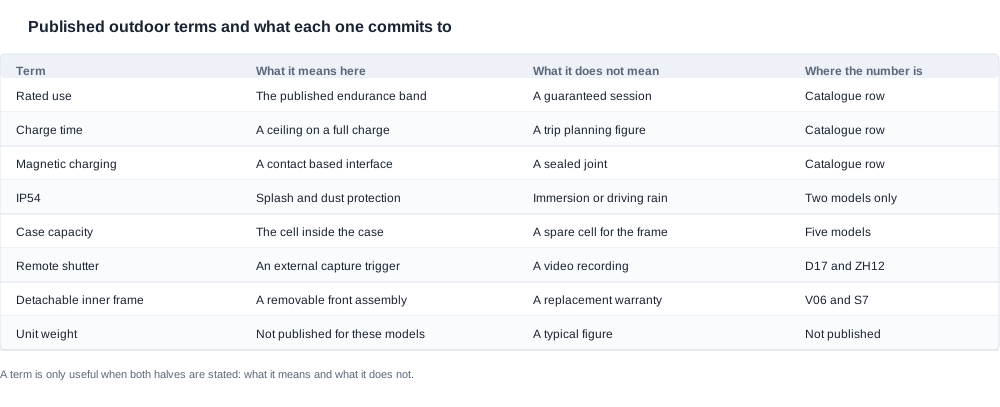
| Term | What it means here | What it does not mean | Where the number is |
|---|---|---|---|
| Rated use | The published endurance band | A guaranteed session | Catalogue row |
| Charge time | A ceiling on a full charge | A trip planning figure | Catalogue row |
| Magnetic charging | A contact-based interface | A sealed joint | Catalogue row |
| IP54 | Splash and dust protection | Immersion or driving rain | Two models only |
| Case capacity | The cell inside the case | A spare cell for the frame | Five models |
| Remote shutter | An external capture trigger | A video recording | D17 and ZH12 |
| Detachable inner frame | A removable front assembly | A replacement warranty | V06 and S7 |
| Unit weight | Not published for these models | A typical figure | Not published |
"Rated use" is a band and the band is the claim. The catalogue publishes five to eight hours on the 220 mAh and 260 mAh camera models, about seven hours on the 290 mAh models, roughly six to eight hours across the audio tier, and about twenty hours on the children's entries. None of those figures carries a test condition — not the volume, not the workload, not the ambient temperature — so the honest use of the term is a ceiling under favourable conditions, and the honest plan built on it has margin underneath it. A buyer who treats the band as a fixed session length is the single most common source of a mid-day failure report in this category.
"Charge time" is a ceiling, and the distinction from a schedule is worth putting in writing. Twenty-six of the twenty-eight entries publish two hours or less; the D17 and the ZH12 publish about one hour. Two hours or less permits exactly two hours, and a rota built on an "under two hours" assumption will fail once in a season. The published figure also carries no starting state and no end criterion, which means it cannot be used as a case turnaround time in a goods-in or returns operation.
"Magnetic charging" describes an interface, not a seal. Seventeen entries publish magnetic charging and seven publish a Type-C port. Four camera configurations — the CY03 and the MT6, and the CY05 and the L1 Pro — publish no charging method row at all, only a cell capacity, a charge ceiling, a runtime, a pixel class and a case capacity. "Magnetic charging is the default across the range" is therefore a statement about the majority, not about the model in the quotation, and the model in the quotation is the one that matters.
"IP54" is the term with the most commercial weight and the least documentation behind it. Two models in the entire range carry a catalogue marking: the V06 and the S7, both camera models in the sport form factor. The second digit, a four, describes protection against splashing water; it does not describe immersion, a water jet or driving rain. No third-party test report number is published behind the marking on either model and no test standard is cited in the catalogue, so the marking can be described and cannot be presented as a tested level. Every other model in the range publishes no ingress marking at all.
"Case capacity" is the cell inside the case, and there are only five of them. The L1 Pro and the CY03, and the CY05 publish 1400 mAh, the L2 Utral publishes 900 or 1400 mAh, and the MT6 publishes a 1200 mAh folding case. The KY06 and the MT5 have a case with no published capacity. The catalogue publishes no case row at all for the V03 and the S7, and the V06 and the V03 Pro, so an outdoor buyer planning around a case has to ask the factory which of those four can be supplied with one. Those last two states are different and a buyer who merges them will mis-state what is in the carton.
"Remote shutter" and "detachable inner frame" are the two serviceability terms in the range. The remote shutter is published on the D17 and the ZH12, and it is the feature that distinguishes a camera worn on the head from one held in the hand. The detachable inner frame is published on the V06 and the S7, and it converts a damaged front assembly from a scrapped unit into a replaced part. Neither term implies anything about spare-part availability, which is not published for any model.
"Unit weight" is the term with no number behind it at all in this range. It appears once: the MT6 glasses body at 158 g, covering the frame, the 265 mAh cell and the camera and excluding the foldable charging case. No other model has a weight row and no model has a bare frame weight.

How much of the range the catalogue actually specifies
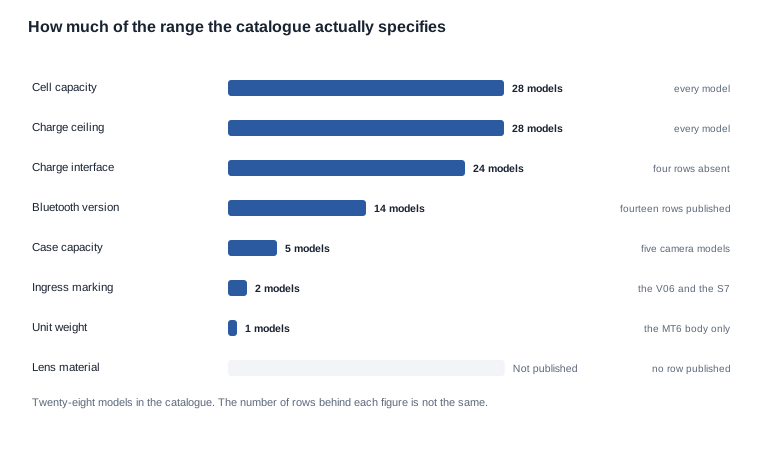
The bars above are the most useful summary of this category that we can offer, and they are uncomfortable to look at. Of twenty-eight catalogue entries, the cell capacity and the charge ceiling are published for every one. The charging interface is published for twenty-four, with four camera rows absent. The Bluetooth version is published for fourteen, with the eleven camera rows, the two children's protection entries and the bone-conduction entry all absent. The case capacity is published for five. The ingress marking is published for two. The unit weight is published for one. The lens material is published for none.
That distribution is not a criticism of the catalogue; it is the reason the vocabulary has to be precise. Where a row exists, the buyer can measure against it and can hold a supplier to it. Where a row is absent, the only honest position is that the parameter is unpublished, and the negotiation moves from the specification to the document request. A buyer who knows in advance which side of that line a parameter sits on does not spend the first week of a programme discovering it.
The Bluetooth row is worth a second look because it is frequently assumed in the other direction. The catalogue publishes Bluetooth 5.3 on the K01 and the K02 and Bluetooth 5.4 across the rest of the entries that carry a Bluetooth row, including the AR entry, the ZH12 and the YKC02, and the A07 and the D17, and the electrochromic entry. It publishes no Bluetooth version for any camera model, which is a deliberate absence rather than an omission: a camera model that is described as a Bluetooth product is making a claim the documentation does not support.
The two rows at the far right of the chart are the ones that decide how a page can be written. One published weight figure and no lens row means the page cannot carry a comfort specification and cannot carry a coating or scratch-resistance specification, whatever the specification sheet from another supplier says. A competitor listing those rows is describing a different product, and a buyer who copies a competitor's parameter table into a specification has imported a number that will be tested by somebody else.

Which terms the factory settles and which ones the buyer settles
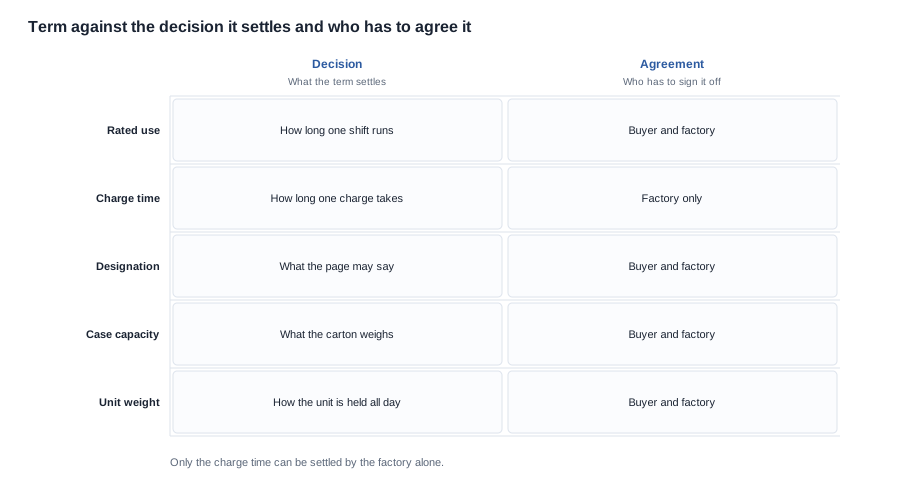
Six terms do most of the work in an outdoor negotiation, and the interesting property of them is that only one can be settled by the factory on its own. Everything else is a bilateral term, which means it has to appear in the specification or the purchase order rather than in a conversation.
Charge time is the only term with a single owner. The factory states it, and the buyer plans around it. There is nothing to negotiate about a published ceiling, and a buyer who spends negotiating capital trying to improve it is spending it on the one parameter in this category that is nearly uniform across the range.
Rated use is a bilateral term because the published band carries no test condition, and the workload the buyer intends to put on the unit is not published anywhere. The way to make it bilateral rather than ambiguous is to write the workload into the specification — the volume, the workload, the ambient temperature, the start state — and then to agree a measurement protocol that produces a comparable number for the buyer and the factory.
The designation is bilateral because the buyer decides what the marking is used to say. The factory publishes that the marking exists on two models; the channel decides whether the product page says splash and dust protection, or says something wider. That decision has no technical input and enormous liability input, and it belongs in the channel's own claim register rather than in a purchase order.
Case capacity is bilateral because it changes the carton. The published capacity is a factory fact, but the carton dimensions, the volumetric weight, the freight band and the retail price all follow from it, and the buyer owns two of those. A case is the cheapest published figure in the range to convert into a commercial decision.
Unit weight is bilateral for the same reason as the designation, only in reverse. Nothing is published, so the buyer has to weigh a unit from the production batch and then agree that the measured figure is the specification. Without that agreement, a unit weight in the specification is an estimate, and an estimate is the thing that turns into a dispute.
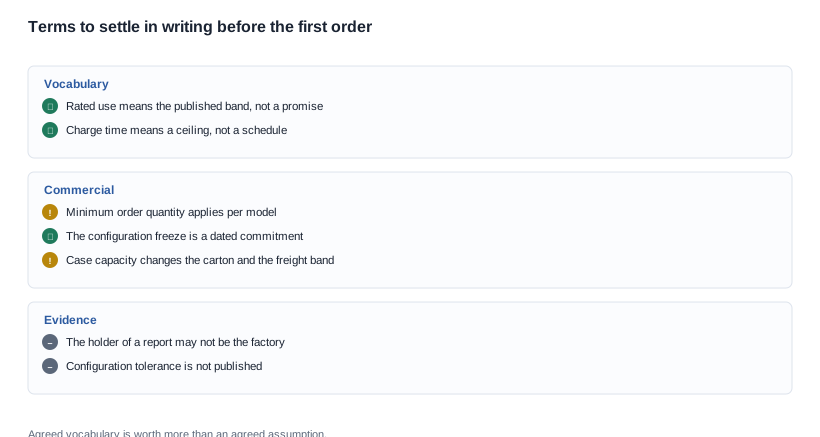
The checklist above is the practical form of that distinction. Two vocabulary items can be written into the specification as agreed definitions rather than as parameters: rated use means the published band rather than a promise, and charge time means a ceiling rather than a schedule. Both are free to agree and both prevent a recurring argument. Two commercial items have to be written down because they change what the order is: the minimum order quantity applies per model rather than per order, and the configuration freeze is a dated commitment rather than a date in a conversation. Two evidence items belong on the file because they are questions rather than numbers: the holder of a report may not be the factory, and configuration tolerance is not published for any model in the range, which is why an accepted sample signed by both sides is the usual substitute.
Two more vocabulary items deserve a line in the specification because they decide what happens when something goes wrong. An accepted sample settles what the product is supposed to be when a shipment is disputed, and it is worth more than any tolerance percentage in a purchase order because both parties are looking at the same object rather than at a formula. A definition of the batch or lot reference decides whether a quality control action can be raised at all, and a channel that has never agreed what a batch reference means will find, at the first supplier corrective action, that it cannot name the thing it is complaining about.
And one vocabulary item is worth defining precisely because it is used in two different ways inside the same organisation. "Lead time" in a purchasing department usually means the interval between a purchase order and a shipment, while the same phrase in a planning department usually means the interval between a decision and the product being usable in the field. When the gap between those two includes a certification or documentation step, the two intervals are not the same number, and the season plan built on the first one will miss the second. In this range that gap is real: the charging interface is absent from four camera rows, the ingress report behind the marking on the V06 and the S7 is not published, and the lens specification is not published for any model, so each of those is a document that has to be obtained before a configuration can be finalised.

Three terms that decide an outdoor order before a price is discussed
Two of the technical terms above decide the order outright, and one commercial term decides it just as often.
The designation term decides whether the product can be sold into the segment at all. A channel that intends to make a water claim needs either a model that publishes a marking and a sentence that stays inside it, or a third-party report for the model it has chosen. Only the V06 and the S7 publish a marking in this range, so a channel whose strategy depends on a water claim is looking at two configurations plus a documentation request, not at a wide choice. That is a scoping decision rather than a product defect, and it is much cheaper to make before the brief than after the listing.
The rated use term decides the working day and therefore the accessory set. A five-to-eight-hour band read conservatively as five sets a long working day at the bottom of the band, which in turn decides whether a case goes in the carton and whether the case is a per-unit item or a shared one.
The commercial term is the per-model minimum order quantity, and it is the one buyers misread most often. A minimum order quantity that applies per model designation is not the same as a minimum order quantity that applies to the order. A programme with four models can therefore be four production runs, four lead times and four freight bookings rather than one of each. The distinction is covered at length in the MOQ guide, and it is worth reading before a brief is priced, because a programme planned as one run and delivered as four will not hit the season it was planned for.
Three further commercial terms deserve a place in the same conversation. Volumetric weight is the shipping weight a forwarder calculates from carton dimensions rather than from the scale, which is why a case changes the freight band and why the case is a commercial term as much as a hardware one. The configuration freeze is the dated point at which the model, colour, case capacity, interface and packaging stop moving, and everything downstream depends on it. And the evidence holder is the party that actually holds a test report or a certificate, which may not be the factory — a term worth establishing before assuming a document will follow the goods into another market.
The limits of every term we publish, stated alongside the term
The short answer: in a category with this many unpublished specifications, a shared vocabulary is worth more than a shared assumption, and a term which is published with its limit stated is worth more than a term which is published as a bare number. We publish the terms we can support with a figure, and where a definition would need a specification we do not hold, we say the specification is not published rather than inventing a definition that sounds complete.
That means we will say that the IP54 marking sits on the V06 and the S7 and describes splash and dust protection, that twenty-six of our entries publish a charge ceiling of two hours or less while the D17 and the ZH12 publish about one hour, that the case capacity is published for five camera models and the unit weight for one, and that the lens material and the coating are not published for any model. We will also say what the catalogue does not contain: it carries a company-level export certification page whose content is images rather than text, the catalogue text contains no reference to CE, FCC or RoHS, and it contains no per-model certification row anywhere — there is no row that says which model is certified for which markets, and there is no row that says pending confirmation either. A per-model certification position is therefore a document to request in writing from whoever holds it, not an attribute to be read off our catalogue.
We will not adopt a term in a conversation and then apply it loosely in a specification. If a buyer asks us to confirm that a model is waterproof, we will say that the marking we publish is a splash and dust designation on two models and ask which sentence the page is intended to carry. If a buyer asks for a unit weight, we will say that the catalogue publishes one body figure and that the others are not published, and that the way to get one is to weigh a unit from the production batch. If a buyer asks for a lens specification, we will say it is not published and that it is on the request list.
The selection vocabulary in action is at the outdoor selection guide, the terminology that has to be settled on a sample is covered at the outdoor testing guide, and the published entries are on the sport smart glasses range page.
If you send us the terms your own team uses, and we have given any of them a different meaning, we would rather correct it now than in a purchase order. Tell us the terms, the configurations you are quoting and the destination market, and we will return the published rows behind each term and the list of terms that have to be written into the specification rather than left in the conversation.
Related reading
- The commercial term in depth — MOQ glossary
- The selection vocabulary applied — the outdoor selection guide
- The sample-side terminology — the outdoor testing guide
- The published configurations — sport smart glasses range


