

Smart glasses for outdoor product recommendations fail as a list, and the reason is that "outdoor" is not one requirement. A trail run, a landscape shoot, a working day on a site, a long walk with audio and a wading trip are five different problems, and the configuration that answers one of them is usually the wrong answer to another. The recommendation below is a decision tree rather than a ranking, and it starts from what the customer will actually be doing rather than from a feature list — because a ranking tells a buyer which model is popular, and a decision tree tells them which model is defensible.
Two things make this range unusually tractable for that approach. The catalogue is explicit about where its boundaries sit: the range holds twenty-eight entries divided into eleven camera models, eight audio models and three sport models, plus three further entries without a model designation. And the published gaps are equally explicit, so a buyer can see not only which configuration fits an activity but which claims that configuration is unable to carry.
The range for this scenario is therefore the sport platform — the V06 and the D17, the YKC02 and the ZH12, and the S7 — the camera platform, and the audio platform. And the honest answer for some outdoor activities is that none of them is the right product.
Smart glasses for outdoor recommendations: start from the activity, not the feature list
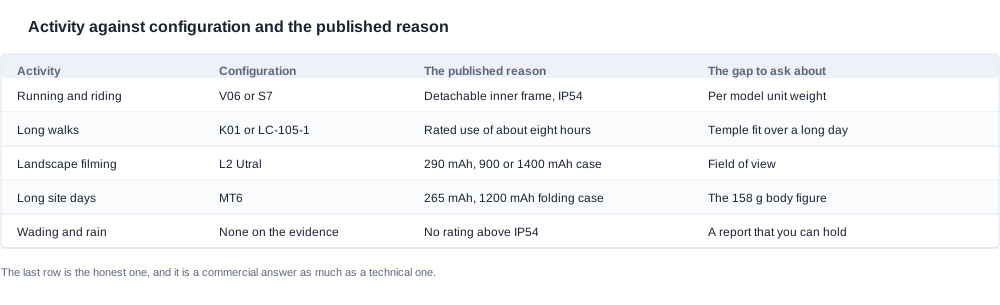
| Activity | Configuration | The published reason | The gap to ask about |
|---|---|---|---|
| Running and riding | V06 or S7 | Detachable inner frame, IP54 marking | Per-model unit weight |
| Long walks | K01 or LC-105-1 | Rated use of about eight hours | Temple fit over a long day |
| Landscape filming | L2 Utral | 290 mAh, 900 or 1400 mAh case | Field of view |
| Long site days | MT6 | 265 mAh, 1200 mAh folding case | The 158 g body figure |
| Wading and rain | None on the evidence | No rating above IP54 | A report that you can hold |
The order of the questions decides the model tier before price is discussed. The first question is whether the unit records, because a camera model and an audio model are different products with different accessory sets, different case positions and different claim sets. The second is whether the unit is for a sport day, a walk or a working day, because that decides the endurance band the buyer plans against and whether the case goes in the carton. The third is what the weather is, because only two models in the entire range publish a protection marking and a buyer who plans around that fact early avoids designing a range around a claim that cannot be made.
A feature-led approach gets this wrong in a specific and expensive way. A buyer who starts from the wish list — a camera, long battery, water resistant, light — arrives at a shortlist of models that each satisfy three of the four requirements and miss the fourth in a way that matters. The water requirement is the trap, because it is the one where the published evidence is thinnest: the marking exists on two models, it describes splash and dust rather than immersion, and no third-party test report number is published behind it. A shortlist built on the wish list looks credible on a comparison sheet and cannot be published.
The second thing worth saying about this range is that some of the entries are not in the same conversation. The A05, the A06 and the A07 are children's protection and audio entries, the catalogue carries an AR entry and an electrochromic entry without a model designation, and there is a bone-conduction entry. None of them is an outdoor sport recommendation, and several of them carry constraints that a channel should not create by accident — the children's entries carry a separate track of product requirements that no certification evidence is published for, and the bone-conduction entry publishes a 35 dB amplification gain that we will not present as a hearing-aid-level claim and that no outdoor recommendation should be built around.
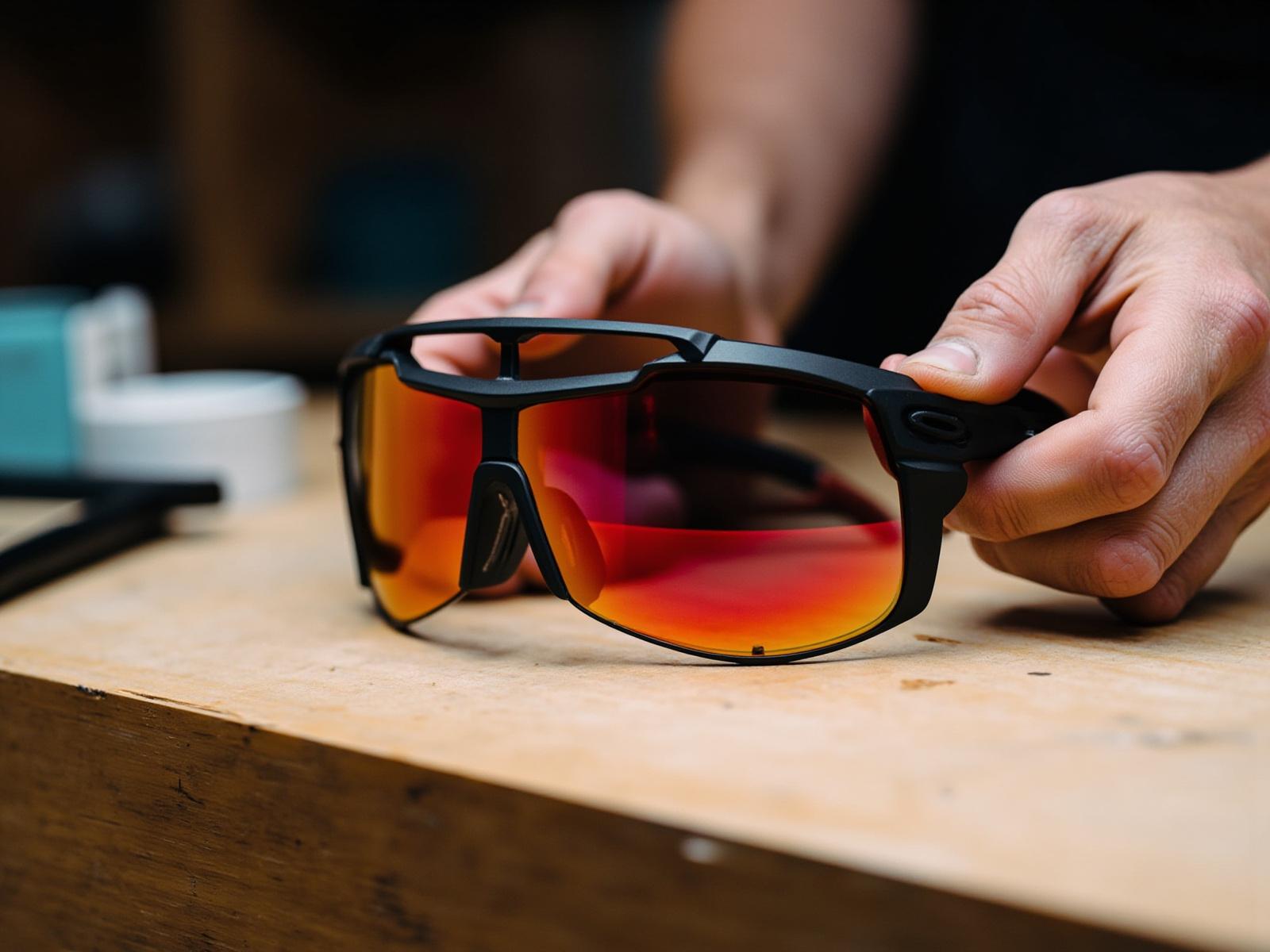
The branches that lead to a camera configuration
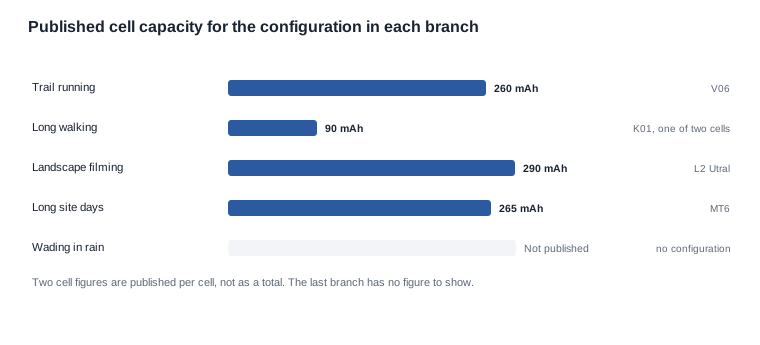
The sport branch is the V06 and the S7, and it is the only branch where a published marking exists. The V06 publishes an 8-megapixel camera, a 260 mAh cell, a five-to-eight-hour rated use, magnetic charging, a catalogue IP54 marking, an ergonomic frame design, a detachable inner frame and four colour options. The S7 is the 13-megapixel version of the same platform, publishing a 13-megapixel camera, the same 260 mAh cell, the same rated band, magnetic charging, a catalogue IP54 marking and a detachable inner frame.
The detachable inner frame is the feature that decides this branch, because a front assembly that touches the skin with sweat every session eventually gets retired, and a removable part turns that into a servicing task rather than a write-off. The colour count matters on the V06 for a retail channel where the finish is the sale. The marking covers splashing water and a dust protection level; it is not a rain rating, an immersion rating or a heavy-downpour rating.
The sport branch also has two entries that are not cameras. The D17 publishes a 115 mAh cell, roughly a one-hour Type-C charge, about seven hours of rated use, remote shutter control and surround sound, and the ZH12 publishes a 100 mAh cell, the same roughly one-hour Type-C charge, about eight hours of rated use, remote shutter control and stereo surround sound. The remote shutter is what keeps a rider's hands on the bars, and it is the only published capture trigger in the range. The YKC02 publishes Bluetooth 5.4, two 70 mAh cells, magnetic charging, surround sound and about eight hours of rated use, and it is a sport model rather than one of the eight audio models.
The long-walk branch is the audio tier, and the reason is endurance and weight rather than weather. The eight audio models publish rated use from about six to eight hours: the LC-105-1 and the LC-105-2, and the K01 and the K02 at about eight, the D11 and the D12 at about seven, and the G07 and the YK12 at about six. The G07 publishes an ultra-slim detachable temple and the YK12 publishes a slim temple, which for a full day is worth more than a marginal durability difference. No capacitive touch feature is published for the K01 or the K02, so a recommendation that names either of them for a touch control is wrong on the evidence.
The working-day branch is a camera model with the case, and the case is the reason. The published case capacities are 1400 mAh on the CY05 and the CY03, and the L1 Pro, 900 or 1400 mAh on the L2 Utral, and a 1200 mAh folding case on the MT6. The KY06 and the MT5 carry a case with no published capacity, the catalogue publishes no case row at all for the V03, the V06 or the S7, and the V03 Pro has no charging-case row. A working day is a long session, and the case is what turns one charge into several.
The MT6 deserves a specific mention in this branch for one reason. It publishes a 265 mAh cell, a 1200 mAh folding case and a glasses body weight of 158 g — the frame, the cell and the camera, excluding the foldable case, whose weight is not published. It is the only weight figure in the entire catalogue, and it is the reason the branch is worth a sample weighing rather than an assumption.
The branch where no model in the range qualifies
Wading, climbing and sustained rain are the branch where the answer is none of them. The IP54 marking that exists in this range describes protection against splashing water and a dust protection level. It does not describe immersion, a water jet, or being rained on heavily, and no model in the range publishes a rating above it. A customer who wades or works in the rain needs a product with a rating that covers that exposure, and there is no such product in this catalogue.
This branch has a commercial answer, and it is not a product recommendation. The honest commercial move is to sell the marked configurations with the marking written accurately and to state the boundary to the customer, because a brand that says "IP54, splash and dust protection" and a customer who knows what that means is a good outcome. A brand that says "waterproof" and a customer who is in a river is not, and the cost of that outcome lands on the channel's return rate and on the review feed that follows it.
The alternative to a claim is a document, and it has a lead time. If the destination environment genuinely requires a rating that covers immersion or sustained rain, then what is required is a test report that the buyer can hold, requested from whoever holds the evidence, with enough time to land before the season. That is a programme constraint rather than a product constraint, and it is much better identified at the brief stage than at the listing stage.
The same branch produces an honest answer for two other activities that get bundled into "outdoor". A climbing or mountaineering use needs an operating temperature range, a drop figure and a retention specification, none of which is published for any model. A night or low-light use needs the low-light behaviour, the sensor model and the video specification, none of which is published either. The bar chart above shows why its last row reads "not published": there is no configuration to put a number next to.
What each recommendation still leaves open
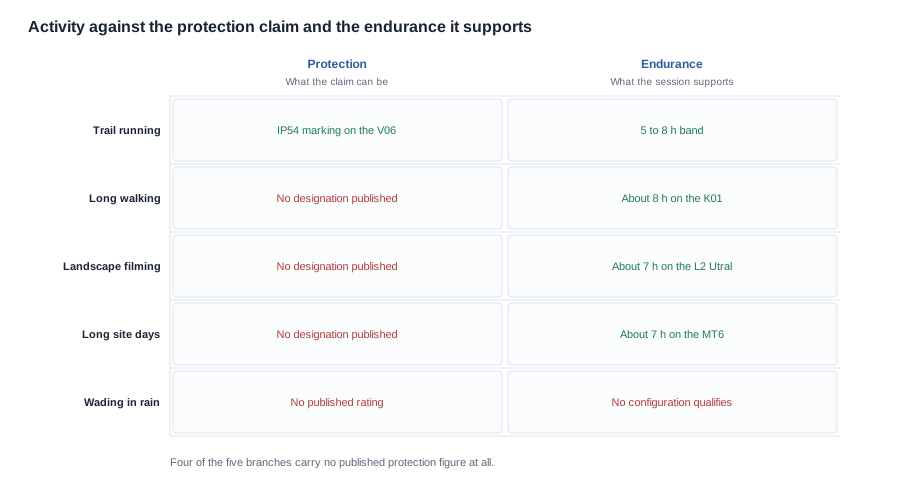
Four of the five branches carry no published protection figure at all, and that is the single most important thing a buyer takes from this table. The V06 and the S7 publish a marking; the LC-105-1 and the K01, and the MT6 and the L2 Utral publish no marking of any kind. So the recommendation for a long walk or a long working day is a recommendation without a water claim, and the page that sells it has to be written accordingly.
Two branches also leave the endurance figure without a condition. The five-to-eight-hour band on the V06 and the S7, the about eight hours on the K01 and the LC-105-1, the about seven hours on the L2 Utral and the MT6 — none of them carries a test condition, and no operating temperature range is published for any model. The matrix therefore reports a session length, not a guaranteed session, and the difference matters most in exactly the branches where the recommendation is most attractive: the long walks and the long site days.
Three gaps recur across the branches and are worth naming as a single request list rather than as separate questions. Unit weight is published for one entry only, so the recommendation for the V06 and the S7 has to be confirmed on a sample from the production batch. The field of view is not published for any model, so the landscape branch has to be verified before the composition is promised. And the field of view figure gets quoted as diagonal, horizontal or vertical by different suppliers without being labelled, so the question has to ask for the axis as well as the number.
And one gap is a commercial one rather than a technical one. The charging interface is published for twenty-four of the twenty-eight entries, with four camera rows absent — the MT6 and the CY05, and the L1 Pro and the CY03. Three of those four are configurations that this recommendation actively suggests, because they carry the published 1400 mAh and 1200 mAh cases. So the branch a buyer chooses for the case is also the branch where the interface has to be asked for in writing rather than assumed from the rest of the range.
There is one more gap that is easy to overlook because it is about the cell rather than the product. The catalogue publishes cell capacities as published values per cell, not as totals: the K01 and the K02 at 90 mAh × 2, the LC-105-1 and the YK12, and the LC-105-2 and the G07 — each at 55 mAh × 2, and the YKC02 at 70 mAh × 2. A comparison table that silently adds those into a single number converts a published value into a derived one and makes the supplier look like the source of a figure nobody published. The comparison is legitimate; it just has to be labelled as a derivation.
Four of these gaps are documentation requests rather than measurements, and that changes the commercial shape of the recommendation. A unit weight has to be measured on a sample from the production batch, so it carries a sample order, a freight cost and a delay. The field of view, the operating temperature range, the low-light behaviour and the sensor model have to be requested in writing from the supplier, so they carry a lead time and a dependency on somebody else's engineering calendar. A buyer who quotes a recommendation to a customer before those four answers have arrived has quoted a position that may not survive contact with the factory, and the customer-facing part of the recommendation — the product page, the specification sheet, the pre-sale deck — has to carry the same caveat the internal document does.
The commercial consequence is that the recommendation is not a configuration on its own; it is a configuration plus a request list with dates against it. For a channel buying against a season, the request list is the thing that determines whether the configuration is available in time, and it is normally attached to the first order rather than to the recommendation. Attaching it to the recommendation instead is what turns a technical due diligence step into a procurement one, and it costs nothing to do early: the same request sent in week zero and in week twelve is the same request with a very different answer date.
And the price tier has to be built per branch, not per range. The recommendation table above spans configurations with very different published case positions, which is to say very different carton contents, which is to say very different freight bands and very different landed costs for the same quantity. A range-level price negotiation across all five branches is a negotiation about an average that no customer actually buys. The tier that makes commercial sense is the one where the case position, the interface and the accessory set are the same, and that is usually a narrower grouping than the recommendation table implies.
The naming discipline that keeps the recommendation honest
Here, we publish the sport models' configuration exactly as the catalogue states it, including the detachable inner frame on the V06 and the S7, the roughly one-hour charge on the D17 and the ZH12, the remote shutter, the surround sound and the four colour options on the V06. We will not describe a splash-protected product as waterproof, we will not extend the marking on two models to any other model in the range, and we will not publish a durability claim we cannot support.
What we will not publish, and will not estimate for any of the recommendations above: the sensor model, the field of view, the video resolution and frame rate, the stabilisation, the low-light behaviour, the storage and overwrite behaviour, the standby current, the operating temperature range, the cycle-life rating, the per-model unit weight beyond the single MT6 body figure at 158 g, and the lens material and coating. Our catalogue carries a company-level export certification page whose content is images rather than text, the catalogue text contains no reference to CE, FCC or RoHS, and it contains no per-model certification row anywhere — so a per-model certification position is a document to request in writing rather than an attribute to be read off the catalogue.
What we will do is narrow the range against a specific activity and tell you the whole of the trade. Send us the activity, the season, the length of the day, the destination market and the quantity, and we will return the configuration the published rows support, the gap that configuration leaves open, the document request that closes it, and the wording the product page can carry. The channel context is under smart glasses for outdoor, the published entries are on the sport smart glasses range page, and the model comparison for a field-work programme is at comparing models for field work.
We will also decline to recommend where the documentation does not support a recommendation. That is not caution for its own sake. A recommendation a channel cannot publish is a recommendation that produces a claim dispute at the first customer who tests it, and a claim dispute costs more in returns, in freight and in the review feed than the configuration it was built on was ever worth.
Two questions answer most of what a buyer sends us, and they are worth putting in the first email. The first is what the customer is doing with the unit and for how long in a single outing, because that collapses the recommendation table to one or two branches. The second is what the destination climate is and which markets the channel sells into, because that decides whether the marking can be used at all and whether a certification request has to run alongside the purchase order. With those two answered we can return a configuration, its published rows, the claim set the documentation supports and the document request that closes the gap — which is usually a shorter list than the buyer expects, because most of the published rows already cover the recommendation.
Related reading
- The distribution context — smart glasses for outdoor
- The published configurations — sport smart glasses range
- The comparison approach — comparing models for field work
- The choosing logic — choosing the right model for outdoor


