
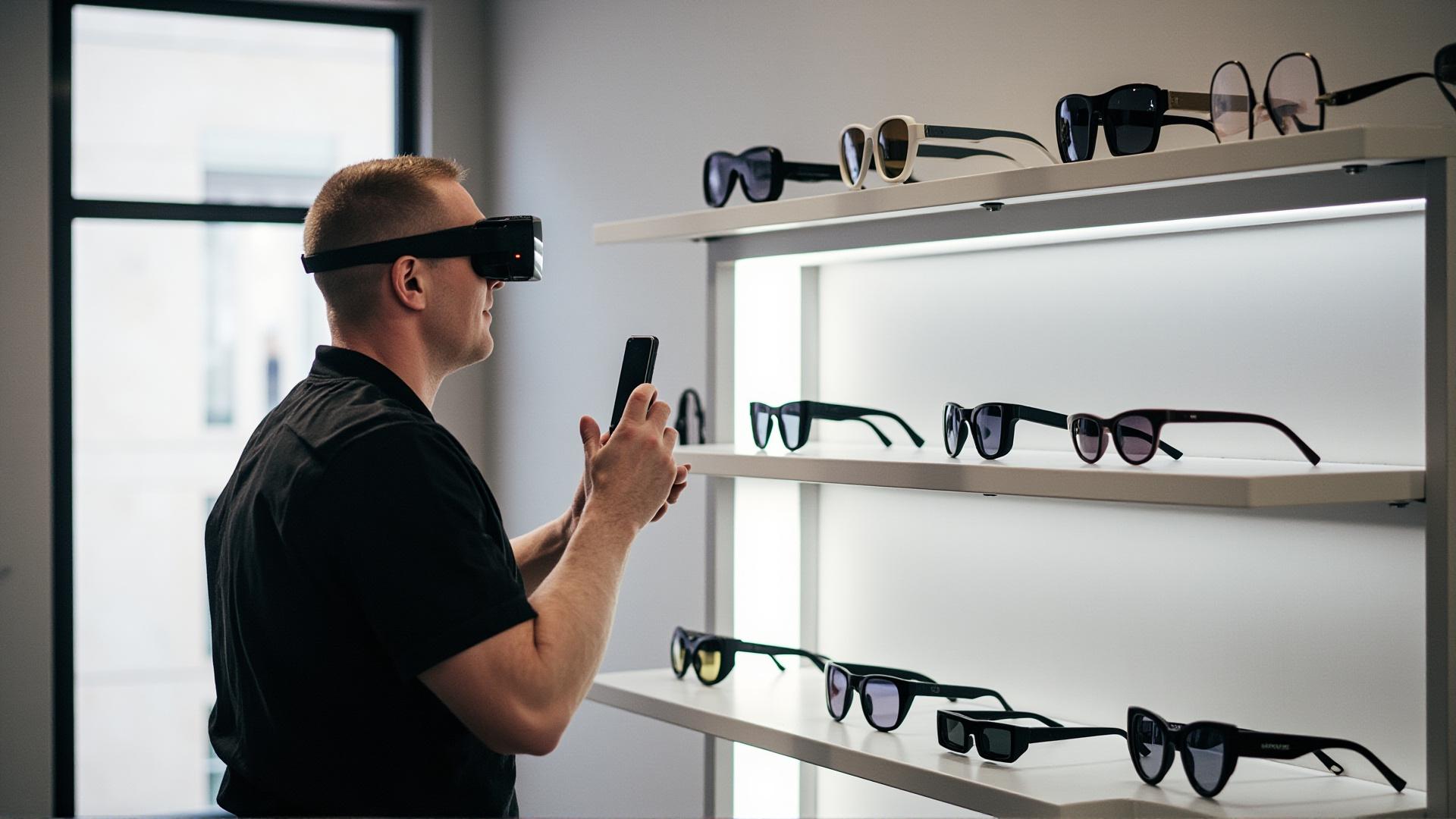
The honest summary is that this product is strong at documenting what happens on a day out and weak at surviving the weather that the day out usually involves. Everything below follows from that, including the two claims a channel should be careful about and the seasonal shape of the commercial decision. A category entry that is positioned honestly as a spring-to-autumn line will sell fewer units in December and return far fewer across the year; the same category positioned as all-weather will do the opposite.
The reason this matters at procurement level is that the outdoor category's economics are seasonal in a way that most consumer electronics are not. Stock bought in August for a December season carries a warehousing cost and a markdown risk, and the units that fail in the wet months come back in the same quarter that the discount calendar is trying to clear the channel. The pros and cons below are stated against published rows wherever a row exists, and against an absence of a row wherever one does not, because in this category the absences are the expensive part.
Smart glasses for outdoor pros and cons: the case measured against published rows
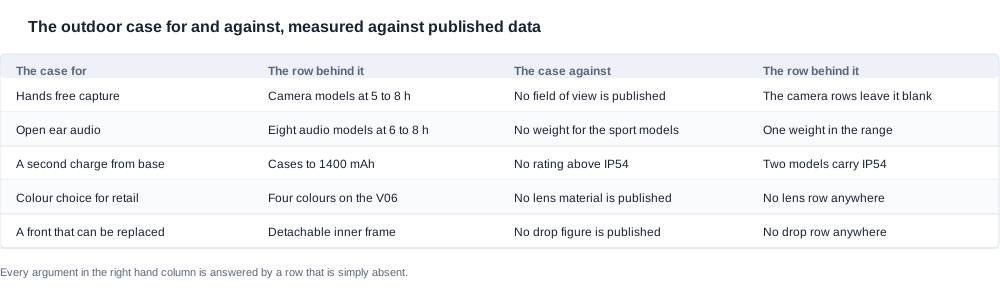
| The case for | The row behind it | The case against | The row behind it |
|---|---|---|---|
| Hands-free capture | Camera models at 5 to 8 h | No field of view is published | The camera rows leave it blank |
| Open-ear audio | Eight audio models at 6 to 8 h | No weight for the sport models | One weight in the range |
| A second charge from base | Cases to 1400 mAh | No rating above IP54 | Two models carry IP54 |
| Colour choice for retail | Four colours on the V06 | No lens material is published | No lens row anywhere |
| A front that can be replaced | Detachable inner frame | No drop figure is published | No drop row anywhere |
The strongest argument for the category needs no specification at all. A walk, a climb, a ride or a site visit is recorded without a hand occupied and without a visible gesture, and that argument does not depend on anything we have or have not published. It is also the argument that survives the most scrutiny, because it is a statement about the form factor rather than about a performance figure. That is worth knowing when a channel is being asked to justify a price: the case for the category is a case about the product's shape, and the case against it is a case about what the documentation cannot yet support.
The second argument is the audio tier, and it is the one with the broadest published coverage. Eight audio models publish rated use from about six to eight hours, and the G07 and the YK12 publish an ultra-slim detachable temple and a slim temple respectively. Open-ear audio that leaves the ears uncovered is a safety property rather than an audio feature for a cyclist or a walker in a place where hearing the surroundings matters, and a channel can say that without citing a single figure.
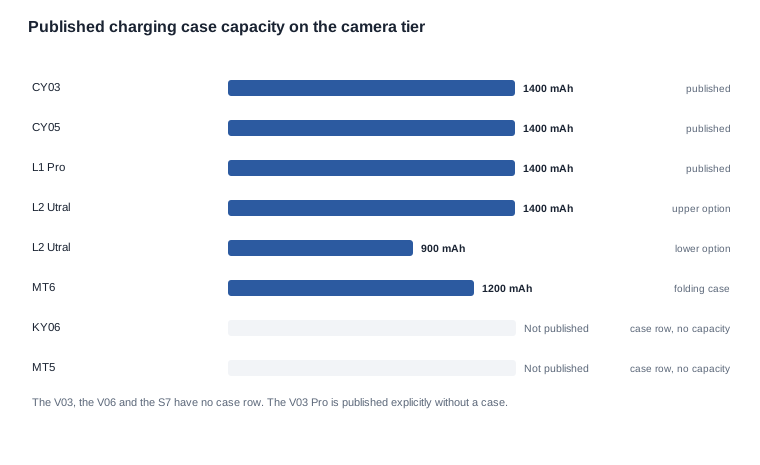
The third argument is the accessory ladder, and it is the one that quietly determines the range economics. The camera tier publishes case capacities of 1400 mAh on the L1 Pro, the CY05 and the CY03, 900 or 1400 mAh on the L2 Utral and a 1200 mAh folding case on the MT6. That is what lets one platform serve a day trip, a two-day trip and a longer trip at three different price tiers without changing the product. A channel that understands this is building a price ladder; a channel that does not is building a single SKU with three different accessory lists.
Now the case against, which is three absences in a row. The field of view is not published for any model, so the camera rows leave the most commercially important parameter blank and the product page cannot say what the frame captures. The per-model unit weight is not published for anything except the single MT6 glasses body at 158 g, which covers the frame, the 265 mAh cell and the camera and excludes the foldable charging case, so no model in the sport tier can carry a comfort or lightness claim. And the lens material and coating are not published at all, so there is no scratch-resistance statement and no coating statement anywhere in the range.
The fourth absence is the structural one. No model in this range publishes a drop figure, so "shockproof", "unbreakable" and "military-grade" are all unavailable, and the hinge and the temple joint have no published cycle life either. A category that is sold on durability has to have durability data, and in this range it does not — which is the single strongest argument against carrying it as a durability proposition.
And the fifth absence is the one that decides the season. No operating temperature range is published for any model, and the published runtime figures carry no temperature condition, so a winter evaluation is not the same measurement as a laboratory one. That is not a small gap: it is the gap that makes the category a spring-to-autumn proposition rather than a year-round one.
The seasonal decision behind stocking an outdoor line
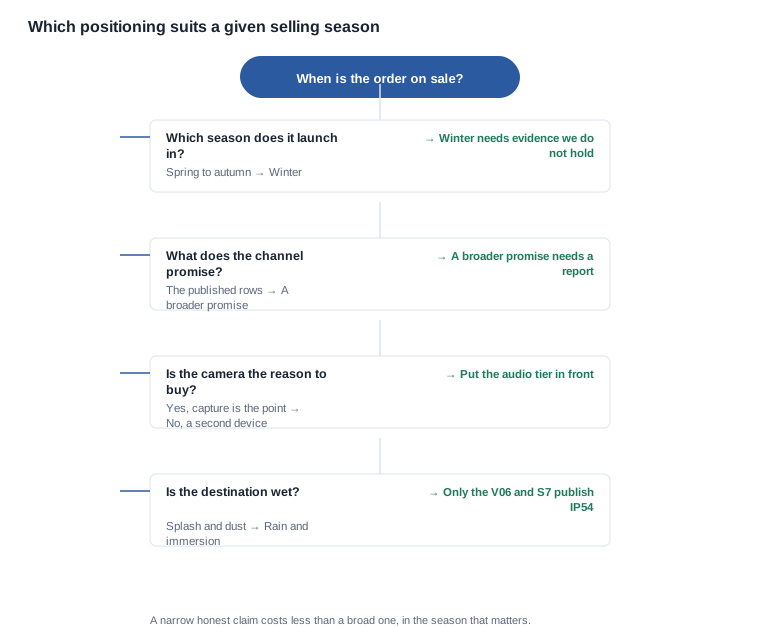
The first question in the decision is when the order goes on sale, because that fixes everything else. A spring-to-autumn launch can carry the published rows as they stand. A winter launch needs evidence this range does not hold: an operating temperature range, a runtime figure measured below room temperature, and an ingress rating above the IP54 that two models carry. That is not a marketing brief that needs more adjectives; it is a set of measurements and documents that have to be produced.
The second question is what the channel is willing to promise. If the promise is the published rows — the cells, the charge ceilings, the rated use bands, the case capacities, the marking on the two models that carry one — then the range is publishable as it stands. If the promise is broader, then a broader promise needs a report, and the report request has a lead time that should be in the season plan rather than in the launch week.
The third question is whether the camera is the reason to buy. If it is, the camera tier carries the range and the audio tier is a second product for a second segment. If it is not — if the customer is buying open-ear audio and the camera is a bonus — then the audio tier should lead the listing and the camera tier becomes the upsell. Putting the wrong tier first is expensive, because it sets the expectation that the accessory set and the return reasons will follow.
The fourth question is where the destination is wet, and only two models in the whole range publish a marking. The V06 and the S7 carry a catalogue IP54 marking, describing a dust protection level and protection against splashing water; no third-party report number is published behind it and no test standard is cited. Every other configuration in the range publishes no ingress marking at all, so the wet-destination answer for the rest of the range is that the product page simply cannot make a water claim.
What a narrow honest claim costs, and what a broad one costs. The narrow version sells fewer units in the worst month and returns fewer across the year, because the customer who knows the product is for autumn walks does not expect it to survive a January one. The broad version sells more units in the worst month and returns more across the year, and the returns are concentrated in exactly the quarter the channel is trying to clear stock. The second cost is invisible in the revenue figure and visible in the return rate, and a return rate is what a distributor and a marketplace both look at when they decide whether to reorder.
There is a third cost to the broad version that lands on the people who did not make the decision. A broad claim is made once at launch and then defended by every support agent who inherits the ticket, and the agent who has to explain that "waterproof" meant splash protection is not the person who wrote the sentence. The cheapest way to avoid that is a claim register — one line per configuration, one line per claim, and the published row or the document behind each one — reviewed on a date rather than when a complaint arrives.
The two claims that turn a working range into a liability
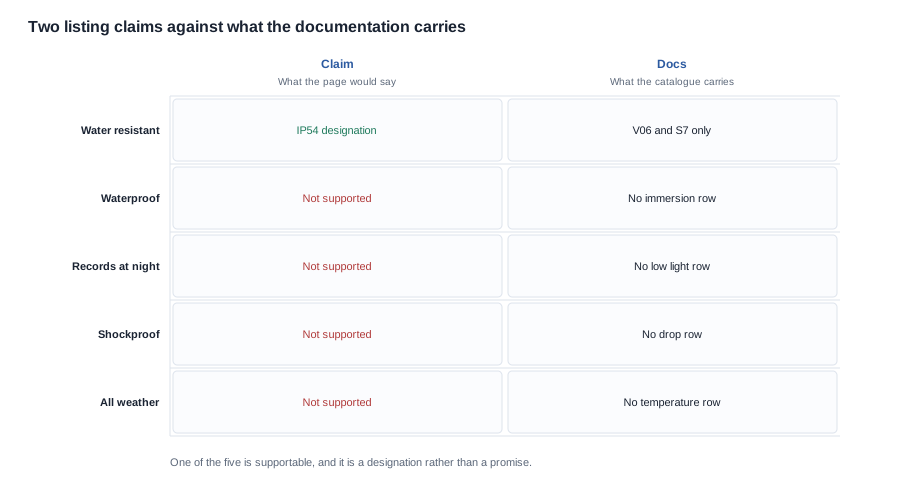
"Waterproof" where the documentation carries IP54 is the most common listing error in this category and it is the one that produces the most avoidable returns. The documentation says what the second digit covers, and the second digit covers splashing water. It does not cover immersion, a water jet or driving rain. A listing that says waterproof is not making a slight exaggeration; it is making a different claim, and the difference becomes visible the first time a customer is standing in the rain. The wording that holds up names the marking and states its meaning in the same sentence.
"Records at night" where the low-light performance is unpublished is the subtler of the two, and the subtler one is the more expensive. A demonstration at dusk can look convincing, because the reviewer is standing still, in the right place, with the unit close to the subject. The disappointment arrives months later, when the customer is walking at night and the footage is unusable. Nothing in the catalogue supports the claim — no sensor model, no low-light behaviour, no video specification — so the claim has no evidence behind it at all, and the review it generates is a review that damages the listing's overall rating rather than just that one claim.
Three further claims are unavailable for the same structural reason, and a channel that writes them will get the same result. "Shockproof" has no drop figure behind it anywhere in the range. "All-weather" has no temperature row behind it. And a scratch-resistance or lens-durability statement has no lens material or coating row behind it. All three are the kind of claim that appears because a competitor's listing carries it and a copywriter assumed it was available.
There is one claim in this range that is supportable, and it is narrower than any of the five above. "Water resistant" as a designation description, attributed to the V06 and the S7 and to no other model, is a description of a published marking. The matrix above puts it beside four claims that are not supported, and the contrast is the point: a designation can be described, an adjective cannot be substantiated.

What an all-season positioning would actually require
Here, the outdoor proposition is a spring-to-autumn product, and a channel which says so on the page sells fewer units in December and returns far fewer across the year. We will tell you which configurations exist, which published figures apply to which of them, and where the honest limit sits for the destination climate.
Making that positioning work commercially needs four things, and only one of them is a copy decision. The first is the published claim set, written to the marking's real meaning, with the two marked models separated from the rest of the range on the page rather than blurred together. The second is the seasonal calendar: the buying, the listing, the stock and the markdown cycle all set to a spring-to-autumn rhythm, with the winter months treated as a service period rather than a selling period. The third is the accessory ladder, because the case is what turns one product into three price tiers and lets the channel hold value into the shoulder season. The fourth is the returns expectation, written into the purchase order and the support process so that a wet-season return is treated as a product finding rather than as a customer error.
Moving to an all-season positioning would need evidence that this range does not currently hold, and the list is short and specific. An operating temperature range, published for every model a channel intends to stock. A runtime figure measured at the lower end of that range rather than at room temperature. An ingress rating above the IP54 designation, with a report behind it that can be checked against the issuing body. A drop figure. A lens material and coating specification. And a per-model unit weight, which is the parameter most channels assume they already have and which this catalogue publishes exactly once. Six items, of which two are measurements the channel can take on a sample and four are documents only the supplier can produce.
That list is a programme, not a wish. Four of the six are documents with lead times, and a document request that goes out after the deposit is a document that arrives after the season has started. The practical sequencing is that the document request is part of the first enquiry and the two measurements are part of the first sample, which means the all-season decision is really a decision about how early to start rather than about whether the category is good enough.
And the commercial comparison between the two positions is narrower than it looks. The narrow position costs the channel the December months and some of the shoulder-season market. The broad position costs it the return rate in the months it cannot control, the support cost of a claim its own staff cannot defend, and the review rating that follows — and the review rating is the part that damages the whole listing rather than one campaign, because a marketplace aggregates it across every unit sold and every season.
The bar chart below is the reminder that the case against is mostly about what the catalogue does not contain. The camera tier publishes five case capacities and leaves the V06 and the V03, and the S7 and the V03 Pro with no case row at all, so the accessory ladder is real but partial. The KY06 and the MT5 sit in a third state — a case with no published capacity — which is a third thing to check before a packing list is written, and the only one of the three that needs a written answer from the supplier.
The questions a channel should ask before it commits to a season
A buyer planning an outdoor line for the first time is asked for a brief and a price, and the two documents that make the difference are a shortlist with a stated criterion behind each entry and a question list that goes to the supplier in the same week. Neither is expensive and both change the outcome of the season.
The red flags are worth listing explicitly, because they are the same in every outdoor brief we see. A brief that asks for a waterproof product rather than a rating. A brief that asks for a night-recording capability without a low-light requirement. A brief that treats a published runtime figure as a guaranteed session. A brief that assumes the catalogue carries a per-model certification row. A brief that expects a unit weight to be available for every model. And a brief that treats the sport models as a set that shares a marking — which they do not, because only the V06 and the S7 publish one and both of them are camera models.
The questions to ask the supplier are short, and the answers should arrive in writing. Which configurations publish a charging interface, given that four camera rows do not. Whether a spare inner frame can be supplied separately for the V06 and the S7, and on what lead time. Whether the published case capacities are as published, and whether a case can be supplied against a minimum order quantity of its own. Whether a report exists behind the IP54 marking on those two models and who holds it. What the per-model unit weight is when measured on the production batch. Whether the lens material and coating specification can be provided. What a sample order costs and how long it takes, because every answer that requires a sample has to be budgeted and scheduled rather than assumed to be free.
And the trade-offs a buyer should price rather than avoid. A heavier accessory set buys a second charge at the price of a bigger carton, a different freight band and a higher landed cost. A narrower claim set loses the winter market and gains a lower return rate. A configuration with a published case capacity costs more in the packaging and returns less in the field. Each of these belongs in the total cost of the line rather than in a column of preferences, and a brief that has already priced them is a brief that survives a cost review without being rebuilt.
The one criterion worth writing into the purchase order before anything else is an acceptance criterion per published row. The cell capacity, the charge ceiling, the runtime band, the charging interface, the case capacity where one is published, the colour and the configuration reference. Those are the rows a quality control team can actually check at goods-in, and writing them into the contract turns the channel's inspection from a courtesy into a contractual term. Everything else on this list is a negotiation; that one is an enforcement mechanism.
Two commercial terms belong in the same conversation because a seasonal category changes their weight. The first is the production lead time, which in this category is part of the season plan rather than a procurement detail, because a configuration ordered after the winter decision is made arrives after the season it was meant to serve. The second is the returns policy, which for a category with this few published durability figures has to be written against the channel's own inspection results rather than against an assumed defect rate — and it is far cheaper to write it in week zero than to renegotiate it in the second year.
Three sourcing pitfalls are worth naming, because each of them is invisible until the order is placed. The first is that the minimum order quantity is per model rather than per order, so a four-configuration line can be four production runs with four lead times and four freight bookings. The second is that the published case capacities change the carton, which changes the volumetric weight the forwarder calculates, which changes the freight band — so the accessory decision is also a landed-cost decision and a price-tier decision. The third is that a bulk order or a wholesale commitment made against the wrong configuration is not adjustable afterwards, because the tooling and the packaging are committed at the same time as the quantity.
And the practical answer to how to choose is to choose the branch first. The five branches in this category carry different published protection positions, different case positions and different gaps, and a line that mixes them has to carry five claim sets rather than one. Choosing the branch before the model is what keeps the claim set, the accessory set and the inspection criteria to one per configuration, which is what makes the range manageable at goods-in and at the returns counter.
The commercial shape of this category as we see it
We will tell you which configurations exist, which published figures apply to which, and where the honest limit sits for the destination climate. Where a claim cannot be supported we say so before the launch rather than after the reviews. For the outdoor range that means the cell capacities, the charge ceilings, the rated use bands, the charging interfaces, the structural features that are published, the case capacities where they are published, the pixel classes on the camera models, and the IP54 marking on the V06 and the S7 described as a designation and attributed to those two models only.
What we will not publish, and will not estimate: the sensor model, the field of view, the video resolution and frame rate, the stabilisation, the low-light behaviour, the storage and overwrite behaviour, the standby current, the operating temperature range, the drop performance, the cycle-life rating, the lens material and coating, and the per-model unit weight beyond the single MT6 body figure at 158 g. Our catalogue carries a company-level export certification page whose content is images rather than text, the catalogue text contains no reference to CE, FCC or RoHS, and it contains no per-model certification row anywhere, so a per-model certification position has to be requested in writing from whoever holds the evidence.
And there is one commercial fact that belongs in this article rather than in a compliance one. Minimum order quantities, unit price bands, production lead times and packaging costs are confirmed per enquiry rather than published, because they depend on the configuration freeze, the quantity and the destination market. For a seasonal category that matters more than it usually would, because the lead time is part of the season plan: a configuration that has to be ordered after the winter decision is made will arrive after the season it was meant to serve.
For the application framework, see smart glasses for outdoor. The seasonal risk profile that decides the calendar is at seasonal considerations, the ingress wording is at IP ratings advanced considerations, and the published configurations are on the sport smart glasses range page.
If you send us the destination climate, the launch season, the channel and the quantity, we will return the published rows behind each configuration, the claim set the documentation supports, the accessory set the carton can carry, and the parameters that would have to be closed before an all-season positioning became possible.
Related reading
- The seasonal risk profile — seasonal considerations
- The ingress wording — IP ratings advanced considerations
- The published configurations — sport smart glasses range
- The application framework — smart glasses for outdoor


