

Smart glasses for running are good at the thing runners actually want from a wearable, and poor at three other things runners also care about, and knowing which is which is most of the decision. The thing it is good at is first-person capture with the hands free. The three it is poor at are stability, weight over distance, and audio in wind. Below, every question is answered in one of three ways — with a published catalogue row, with an honest statement that the row is not published, or with the question to put back to the supplier — because a short answer that needs an assumption behind it is worse than a long answer that admits one.
Our range for this scenario. The sport platform — the S7 and the V06, the ZH12 and the YKC02, and the D17 — plus the eight audio models for a buyer who is selling sound rather than footage. What follows is drawn from what the catalogue publishes and, just as importantly, from what it does not.
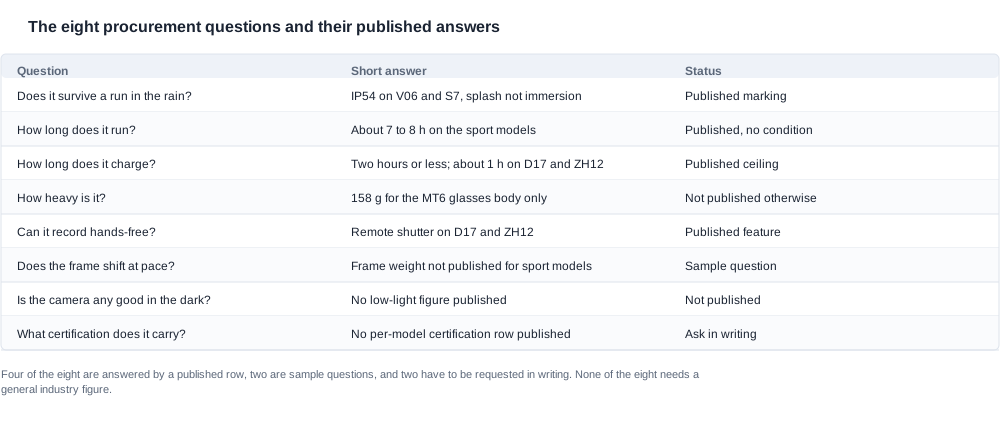
How to read the table. Four of the eight questions are answered by a published row. Two are sample questions, which means no document will settle them and a unit has to. Two have to be requested in writing, because the catalogue does not contain them and any listing that implies an answer is guessing. That split is the practical shape of buying in this category: a short list of facts, a short list of tests, and a short list of letters to write.
Smart glasses for running: the eight procurement questions and what each one is worth
The four questions the catalogue answers outright. Whether the unit survives a run in the rain: the IP54 marking covers splashing water and a dust protection level, and it appears on the V06 and the S7 and on no other model. How long it runs: the sport models publish about seven to about eight hours and the sport camera models publish a five-to-eight-hour band, with no test condition attached to either. How long it takes to charge: two hours or less for most of the range and about one hour on the D17 and the ZH12, in every case a ceiling rather than a typical figure. And whether it can record hands-free: the remote shutter on the D17 and the ZH12 removes the need to reach for the device mid-stride, which in this scenario is worth more than the feature would be in almost any other.
The two questions only a sample can settle. Whether the frame shifts at pace, because frame weight is not published for any sport model and the answer depends on a head shape rather than on a specification. And whether the camera frames a moving subject usefully, because the field of view is not published and a narrow field of view on a subject in motion crops badly. Both are settled by a unit worn on a long session by somebody representative of the channel, and neither is settled by a document.
The two questions that have to be asked in writing. What certification the quoted configuration carries, because the catalogue carries a company-level export certification page whose content is images rather than text and publishes no per-model certification row anywhere. And what the unit weight is for each quoted model, because the catalogue publishes exactly one weight figure in the whole range — 158 grams for the MT6 glasses body, including its battery and camera and excluding its foldable charging case, whose capacity is published at 1200 mAh — and that model is not one of the running candidates.
The question a buyer asks that has no good answer. How good is the camera in low light. No low-light capability is published, no field of view is published and no video format is published, so the answer is not "we will check it" but "it is not published, and a listing should not imply it." A brand whose members run at dusk has to decide whether to publish a resolution claim and accept the gap, or to state that the product is published for daylight routes.
The branch that decides the range before anything else
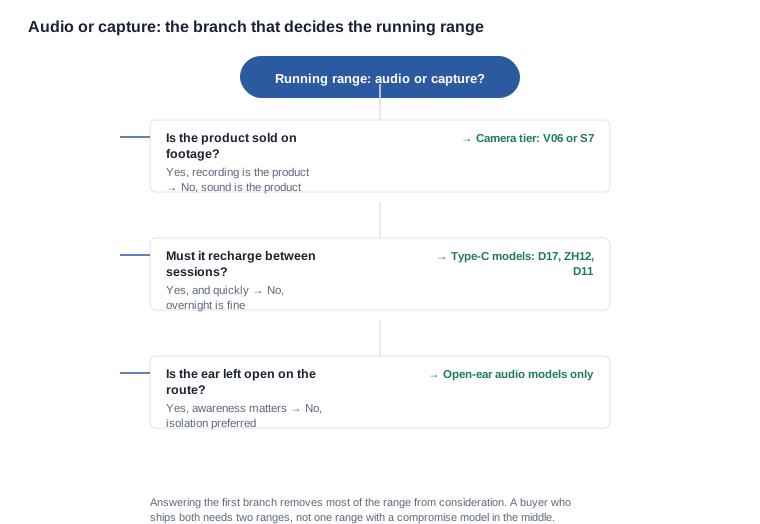
The three questions above, and why they come first. Whether the product is sold on footage, whether it has to recharge between sessions, and whether the ear has to stay open on the route. Each answer removes models from consideration immediately, and a buyer who answers them before opening a supplier catalogue will spend a third of the time on the comparison that actually matters. A buyer who answers them after will spend that third of the time on models that were never eligible.
Why capture and audio are two products, not one product with a switch. The capture buyer wants a camera and tolerates the audio; the audio buyer wants sound and would rather have earbuds. The camera models draw the heaviest published load on the cell and the audio models publish runtimes from about six to about eight hours. The sport range serves the first; the eight audio models — the LC-105-1 and the K01, the G07 and the D12, the K02 and the D11, and the YK12 and the LC-105-2 — serve the second. A brand that ships both is running two SKUs with two accessory lists, two return profiles and two price tiers, and it should plan for both rather than for a compromise unit.
And the third branch is a genuine design constraint, not a preference. Open-ear audio leaves the ear unobstructed, which is why traffic, a pace partner and a vehicle all stay audible — a safety property in this scenario rather than a comfort one. It also means the audio models cannot offer the isolation that a buyer selling to a commuter might want, and a buyer who assumes otherwise will discover it in the reviews rather than in the specification.
The three questions the catalogue cannot answer, and what to do instead
The five criteria a running shortlist should be scored against. These are the criteria that survive the absence of published rows, and each one is a criterion rather than a number.
- Does the published charge-time ceiling fit the session pattern, expressed as two hours or less or about one hour?
- Does the published runtime band cover the longest session, knowing that no test condition is attached?
- Does the charging interface match the accessory and the transit plan the channel already has?
- Does the model publish a structural feature that turns a replacement into a part, such as the detachable inner frame?
- Can the remaining gaps be written into a purchase order as conditions rather than left as assumptions?
How to use the criteria, and when to stop. Score the candidates against the five, keep the ones that clear all five, and take a sample of each survivor. The point of the criteria is to shorten the sample requirement rather than to replace it: a candidate that fails on the interface or on the charge time is eliminated by a document, and only the three sample questions need a unit in a pocket. The trade-off to watch is that criteria one and two sit close together, and a buyer who treats a five-to-eight-hour band as interchangeable with an about-seven-hour figure will keep the wrong candidate for the wrong reason.
The red flags that should end a comparison rather than start a negotiation. A quoted charge time expressed as an average when the published figure is a ceiling. A quoted weight for a model whose weight is not published. A waterproof claim where only IP54 is marked. A runtime quoted without a condition. A supplier who cannot say which per-model certification documents exist for the quoted configuration. Each of those is a sign that the documentation behind the offer is thinner than the offer itself, and in a repeat-order category that is a more expensive problem than a price difference.
How to choose between two candidates that clear all five. This is where the trade-offs have to be made rather than avoided. The comparison is not unit price against unit price; it is the documented configuration against the documented configuration, with the gaps priced. A candidate with a published unit weight and a test condition costs more to verify and less to dispute than one without them, and a buyer that has measured the dispute cost once will value the documentation accordingly. What to ask is the same set of seven rows in both cases, so that the comparison is made on what each supplier actually published.
The one that changes the accessory plan. Whether the case travels with the unit. A magnetic interface means the case is part of the charging architecture rather than an accessory beside it, and the models that charge over Type-C can be recharged from a cable the runner already carries. In the running candidate set, five models publish magnetic charging and two publish Type-C, and that single fact decides whether the kit, the freight weight and the transit file are one plan or two. The published case capacities are 1400 mAh on the L1 Pro and the CY05, and the CY03, 900 mAh or 1400 mAh as a configuration choice on the L2 Utral, and 1200 mAh on the MT6's foldable case.
The one that decides the unit count. Whether a published runtime can be relied on for a rotation plan. It cannot, and the reason is specific rather than general: no published rated-runtime figure in the range carries a test condition, so the figure cannot be converted into "sessions per charge" without knowing what was running while it was measured. A club that plans rotations on the published band alone will find out the real figure from its own members, at its own cost, and the field protocol is how a buyer gets that number instead.
The one that decides the listing copy. Whether the product is suitable for the condition it will be used in. Nothing published answers it, because the operating temperature range, the runtime test condition, the field of view, the frame weight and the cycle-life rating are all unpublished. What a listing can do is describe the published rows precisely and mark the rest as not published. A listing that does that is defensible; a listing that fills the gaps with typical values is the single largest source of returns in this category.
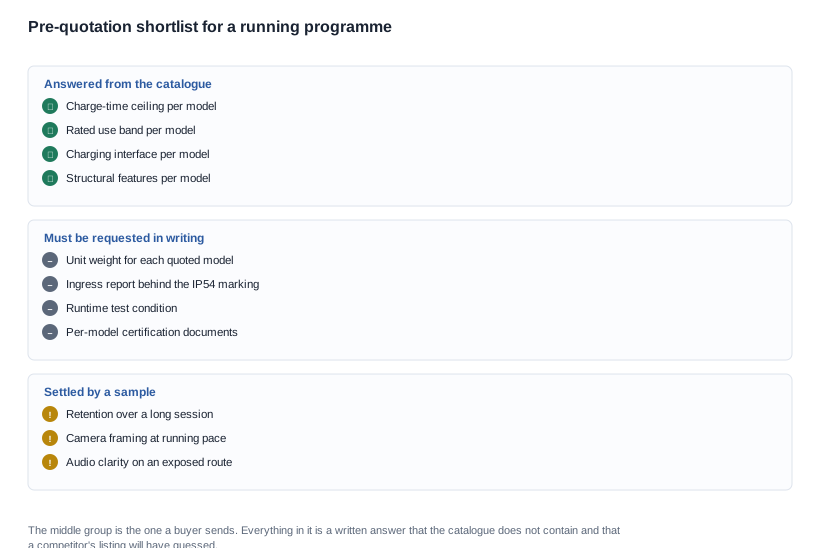
The three groups in the shortlist, and the order they should be worked in. The first group is answered from the catalogue and takes minutes. The second group must be requested in writing, and it is the group that takes longest because it depends on somebody else's internal process — so it should be requested first, on the day the quotation is requested, rather than once the sample has arrived. The third group is settled by a sample, which is why a sample order and a written request for the missing rows should go out together rather than in sequence.
The working order, as four steps.
- Answer the three branch questions — capture or audio, recharge between sessions, ear open or not — and write the answers down.
- Take the resulting candidate list and pull the published rows for each model into a single table.
- Send one written request for the missing rows, with the model designations listed one per line.
- Order a sample and run the three sample questions on it while the written request is outstanding.
Why step three is sent before step four, and not after. The written request depends on the supplier's internal process and therefore has the longest lead time of anything in the plan. The sample can be dispatched quickly but cannot be evaluated until it arrives, which takes at least as long. Sending them in the wrong order means the evaluation of the sample happens before the answers to the four written questions land, and the buyer then has to evaluate the same unit twice. Sending them together costs one extra unit in the plan and saves a second evaluation cycle, which in a category where the sample questions are the only way to settle three of the eight, is the difference between a decision and a delay.

Briefing a supplier so the answers arrive with the quotation
A request for quotation is the only moment when a supplier is willing to answer anything. By the time the sample arrives, the buyer has already chosen a supplier and the questions that would have changed the choice are the ones worth asking. The brief therefore has to do two things at once: state the configuration and the commercial terms, and list the rows whose absence would disqualify the model. The second part is the part that gets left out, and it is the part that determines whether the buyer discovers a gap at quotation time or at first delivery.
The seven items a running request for quotation should contain. The model designations being quoted, one per line, with the quantity band and the price tier requested. The destination market and the channel, because the same unit carries different documentation in different markets. The request for the unit weight in grams per model. The request for the runtime test condition per model. The request for the ingress report behind the IP54 marking, where it exists. The request for the per-model certification documents for the quoted configuration. And the request for the charging interface and case configuration per model, with the case capacity, because the accessory plan and the transit file both follow from it.
Why the seven are framed as requests rather than as questions. A question can be answered with a description; a request has to be answered with a document, and the difference is the difference between a supplier saying that the runtime is measured under typical conditions and a supplier sending the test protocol. Only the second can be put into a purchase order. A request that names the format — a figure in grams, a test protocol, a laboratory report with a reference, a certificate per model — produces a document far more often than a question that asks what the position is.
And what to do with a supplier who answers four of the seven. That is not a rejection, it is a comparison. A supplier who answers the weight, the runtime condition and the ingress reference, and declines the certification documents for the quoted configuration, has told the buyer that the documentation is thin but the engineering contact is real, and the buyer can then price the documentation risk rather than discover it. The important thing is that the four answered rows become part of the written specification and the three unanswered rows become conditions of the order, so that the gap is visible to whoever signs it.
The one item that is worth asking for twice. The runtime test condition. It is the row most often answered with a phrase rather than a document, and it is the row that decides whether a published band can be used to plan a rotation. A buyer who asks for it once and receives a phrase should ask again, because a band without a condition cannot be converted into sessions per charge, and that single conversion is what a club, a rental or an employer channel needs most from the published figures.
What the format changes for a buyer shipping sound rather than footage
Three things the audio-only programme does not have to solve. No camera load on the cell, which means the runtime question is about the cell rather than about the sensor. No framing question, because there is no footage to frame. And no recording boundary to write into a club brief, which is the document that takes the longest to agree in a group channel.
Three things it does have to solve. The wind question, because no microphone specification is published for any model and wind is the hardest condition for any microphone on an exposed route. The contact question, because most of the audio models in the running candidate set charge magnetically and a contact that will not take a charge after a run reads as a fault. And the retention question, because the G07 publishes ultra-slim detachable temples and the YK12 publishes slim detachable temples, which is a sizing system rather than a cosmetic option and a return-rate lever in a channel with a wide size range.
The published rows a sound programme can quote. The K01 and the K02 publish 90 mAh per side, Bluetooth 5.3, magnetic charging and about eight hours of rated use, and neither of them publishes capacitive touch — no model in the catalogue carries a published touch row. The D11 and the D12 publish a single 100 mAh cell, Type-C, Bluetooth 5.4 and about seven hours. The LC-105-1 and the LC-105-2 publish 55 mAh per side, magnetic charging and about eight hours, while the G07 and the YK12 publish 55 mAh per side and about six hours. The D17 and the ZH12 sit in the sport family rather than the audio family, and both publish the remote shutter and about an hour of charging over Type-C.
The trade-off to state rather than to hide. Every one of those models leaves the ear open, and every one of them publishes a rated runtime without a test condition. A buyer shipping sound into a running channel is selling a product whose two defining properties are both conditional on the conditions, which is why the listing has to carry the conditions rather than the adjectives. The sport smart glasses range holds the published rows and the running channel context holds the scenario.
The questions to put back to the supplier, and where our position ends
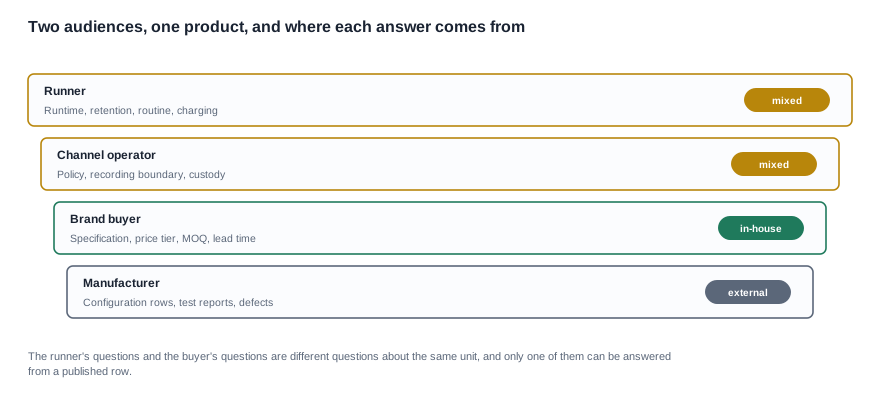
The four audiences, and why the answers come from different places. The runner's questions are about runtime, retention, routine and charging, and most of them are answered by the published rows. The channel operator's questions are about policy, the recording boundary and custody, and none of them are answered by a specification. The brand buyer's questions are about the specification, the price tier, the MOQ and the lead time, and the first of those is the one this article has been about. The manufacturer's questions are the configuration rows, the test reports and the defect notices. Only one of the four layers can be answered from a catalogue, which is why a buyer who is waiting for a complete answer from a supplier is waiting for something that does not exist.
What we will answer, and how. Send the capture-or-audio answer, the session length, the interface the runner already carries, the channel, the price band and the destination market, and we will return which published rows apply to each model in the running candidate set, which rows have to be closed in writing before a purchase order, and which questions are sample questions rather than document questions. We will narrow the range against the run, and we will say which of the eight questions above is a published row, which is a written request and which is a sample.
What we will not do, and why the refusals are the point. We will not describe the IP54 marking on the V06 and the S7 as waterproof, because no test report behind it is published. We will not quote a unit weight for a model whose weight is not published, and we will not use the MT6's 158 grams as a proxy for a different product class. We will not publish an operating temperature range, a cycle-life rating, a field of view or a per-model certification row, because we do not hold them. We will not estimate how a run will go for a given runner, because the catalogue contains no fit data, no microphone specification and no thermal figure for any model. Each of those refusals is a row in the table above marked as a gap, and a buyer planning against the gaps can plan; a buyer planning against assumptions will find out which assumption was wrong from the returns desk.
What to send us. Tell us the distance and the weather, and we will tell you which of the published rows answers the question and which two need a sample or a written request. The pack for a running route covers the kit side, the field protocol covers the measurement side, and the scenario entry point is smart glasses for running.
Related reading
- The field protocol — running real world experience
- The pack — how to pack for running
- The selling channel — smart glasses for running
Tell us the distance and the weather, and we will tell you which published rows answer the question and which need a sample.


