Smart glasses for running turn every customer into an unpaid test engineer, and the commercial question is not whether that testing happens — it always does — but whether the brand is collecting the result in a form that can be acted on. A run produces a small number of repeatable observations, each of which narrows to a specific cause. The observation is worth almost nothing on its own; the cause classification is what converts a review into a supplier instruction, and the classification only works if it was defined before the first unit shipped.
The three published facts that shape the whole programme. The catalogue publishes the sport models' configuration and the audio models' rated runtimes, and it publishes no frame weight, no fit data, no microphone specification and no thermal figure for any model. That combination decides the method: because the specification sheet cannot settle the questions a run raises, the run has to be recorded properly, because the documentation will not settle them later.
Why this is worth more than a laboratory report, and where the claim stops. A laboratory report describes a component under a stated condition, and it describes every unit identically. A run describes the finished product in the workload it will actually meet, on the unit the customer actually owns, repeated on every shipment without anyone budgeting for it. That is a genuine advantage for a buyer who wants to know what the channel will report. What it does not give you is a controlled result: no route, no distance and no temperature is held constant unless the buyer makes it constant, which is exactly why the protocol below exists.
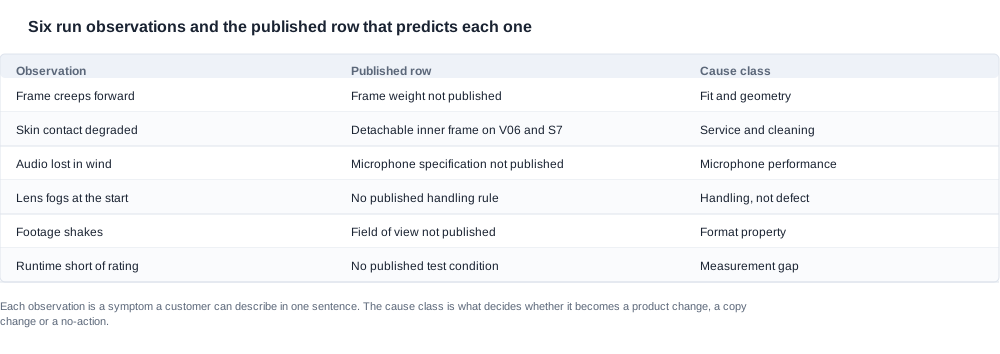
The six observations a run produces, and the cause each one narrows to
The table above maps six observations to the published catalogue row that predicts them and to the cause class the observation belongs to. The mapping is the whole method. Once a cause class is attached, the response is determined: a product change, a copy change, a handling instruction, or no action at all. Without a cause class the same observation becomes a support ticket, and a support ticket is a cost with no route to a fix.
The fit observation, and the difference between a sizing problem and a temple problem. A frame that creeps forward during a run and returns to position when the runner stops is a geometry problem; a frame that creeps and stays crept is a temple-stiffness problem. The two have different remedies and, more importantly, different costs: the first is a sizing and accessory conversation, the second is a quality conversation with the supplier. We publish no sizing data and no per-model unit weight for the sport models, so the published position cannot settle this. What settles it is the observation recorded with a distance attached — how far into the run it started to move.
The skin-contact observation, and the one published structural answer in the range. The V06 and the S7 publish a detachable inner frame, which means the part of the unit that meets sweat can be separated from the electronics. Where that architecture exists, contamination becomes a wipe-down task; where it does not, the same contamination has to be handled by routine alone. That is the difference between a serviceability advantage and a maintenance instruction, and it is worth pricing into the spare-parts line rather than discovering it in month eight.
The wind observation, which is a microphone question rather than a volume question. When the wind is louder than the source, the instinct is to turn the volume up, and the result is worse. The correct diagnosis is that the microphone is the limiting component, not the speaker, and that diagnosis is not available from any document because no microphone specification is published for any model. A buyer who expects audio to carry over an exposed road route has to establish the behaviour by measurement, and the measurement has to be made on the route rather than in a quiet room.
The fogging observation, which is handling rather than a defect. A lens that fogs at the start of a run and stays fogged is a warm face against a cold frame. The remedy is to let the frame reach temperature before it is worn, which is a rule that belongs in the instructions and in the insert, not in the returns ledger. Recording it as a defect is the expensive mistake here, because it puts a fault into the data that the hardware did not produce.
The bounce observation, which is a property of the format. Every step shakes a head-mounted camera, and the shake is in the shot. This is not a defect and it is not fixable in hardware without a mount, and we do not supply mounts. A buyer who learns this before the listing is written saves the customer the discovery; a buyer who learns it afterwards has a review to answer. The format itself and what it changes sets out the same limitation from the product side.
The runtime observation, which is the most commercially useful number a run produces. A unit that is flat well before its published figure produces the gap between the measured value and the rated one, and that gap is what a rotation plan, a spare-unit count and a warranty provision are all built from. The published sport-model figures run from about seven to about eight hours and the sport camera models publish a five-to-eight-hour band, and none of them carries a test condition. The battery life page explains why that absence matters commercially rather than technically.
Designing the return-reason taxonomy before the first shipment
The most expensive mistake in this application is not a bad product; it is a good product measured badly. A returns log that records the customer's sentence and then assigns a category at the desk produces a category that reflects the desk's assumptions rather than the field's evidence, and every warranty provision built on it will be sized for the wrong problem. The taxonomy therefore has to be written before the first unit ships, and it has to be short enough that the returns desk will actually use it.
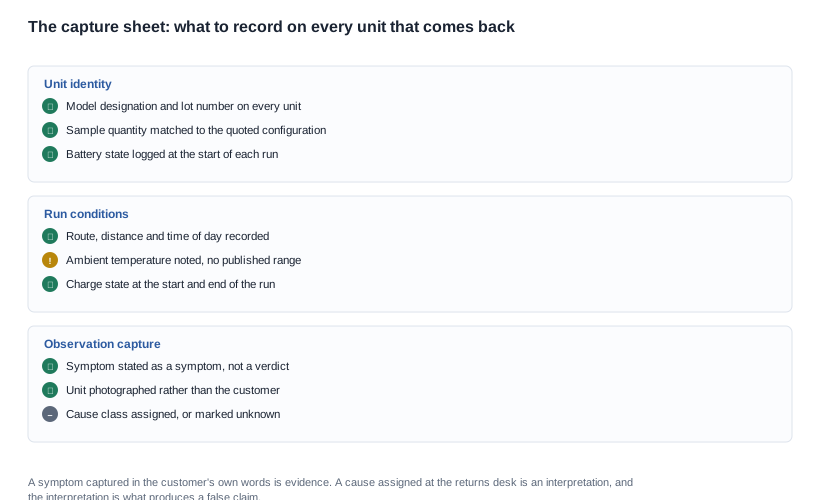
The three groups in the capture sheet, and why each field earns its place. The unit-identity group exists because a symptom without a lot number cannot be tied back to a production run, which means the rate cannot be compared between two shipments and a defect trend stays invisible. The run-conditions group exists because the same symptom at twenty degrees and at five degrees is two different symptoms, and no operating temperature range is published for any model, so ambient temperature has to be recorded by the tester rather than looked up. The observation-capture group exists because the sentence a customer writes contains the cause, while the category assigned afterwards contains an interpretation.
The distinction that does the most work. A symptom is written in the customer's words and describes what happened: the frames slipped forward after five kilometres, the audio cut out in rain, the unit would not charge after a run. A cause is a conclusion about the mechanism: retention rather than fit, environmental attenuation rather than an electronic fault, a dried contact rather than a failed cell. The first is evidence and the second is a hypothesis. A returns process that records both, separately, is the only way to tell later whether the hypothesis held.
The four units that need a cause class rather than a label. Fit creep becomes either a geometry issue or a temple issue. Audio loss becomes either microphone performance or wind exposure. A unit that will not charge becomes either a contamination issue or a genuine electrical fault. And a runtime shortfall becomes either a cold-cell effect, a camera-load effect or an under-stated rating. Each of those four splits changes what happens next, and each of them is answerable from the observation plus the conditions, provided both were recorded.
And the class that most systems forget. A large share of what comes back is a working unit that the customer no longer wants: a channel decision, a colour preference, an unused device bought for an event. Those returns must be counted separately from fault returns, because a warranty provision sized on a blended number is both too generous on faults and too small on the total. The taxonomy needs a fifth class for it, and the class needs to be applied by a person reading the customer's sentence rather than by a rule.
The wording discipline that keeps the taxonomy usable. Each class needs a one-sentence definition written from the customer's point of view, and the definition has to be answerable with a yes or a no. A class described in engineering terms — an ingress event, a retention failure, a cell degradation — is not answerable by the returns desk and will be answered inconsistently, which is the same as not having a taxonomy. A class described as a question — did it slip, did it cut out, did it charge, did it run flat, was it wanted — is answerable, and the mapping to a technical cause happens afterwards, with the supplier or the product team rather than with the customer.
Why the classification belongs upstream of the returns desk. The alternative arrangement, which is the common one, lets the desk assign a cause from a short menu and then reports the menu. That report is convenient, it is wrong in a specific way, and the error is always in the same direction: it assigns causes to hardware because hardware causes are the ones the desk recognises. The classifications that get missed are the ones with no part number attached — the handling rule that was never written, the route condition that was never specified, the expectation that the listing itself created. Those are exactly the categories that a running channel can fix without touching the hardware, which is why the taxonomy has to be designed by the buyer rather than inherited from the supplier's defect list.
Running the field protocol without a laboratory
A field programme does not need a laboratory, but it does need discipline, and the discipline is cheap: same route, same distance, same time of day, same number of units, and a written record for every run. The protocol below is the minimum that produces a rate you can quote in a second-order negotiation rather than an impression you can quote in a sales meeting.

Step one and step two decide whether the programme is worth running at all. Samples have to come from the quoted configuration and carry a lot number, and every unit has to be run on the same route at the same time of day for the same distance. Without those three controls, the data describes a mix of conditions rather than a product, and the buyer cannot tell a product effect from a route effect. The cost of this step is a fixed protocol that the field team does once per unit; the cost of skipping it is a programme that produces numbers nobody can act on.
Step three is where the taxonomy earns its place. The six observations are logged against the six cause classes, and anything that does not fit is marked unknown rather than forced into the nearest class. Marking unknowns is what makes the programme honest, and it is also what tells the buyer which published rows are missing rather than which observations are rare. A high unknown rate on one observation is a request for a published row; a high unknown rate across all six is a request for a better capture sheet.
Step four is the seasonal control. The same protocol is run again in a different temperature band, because cell behaviour, condensation and sweat rate all move with the season and none of the operating figures are published. Two bands are enough to separate a seasonal effect from a product effect; a single band cannot, and a buyer who concludes from a summer programme that the winter units will behave the same has concluded something the data does not support.
Step five is the conversion step, and it is the one most programmes skip. Findings that stay in a spreadsheet are a research cost. Findings that become a written supplier instruction and a contract clause become a procurement asset, because the next shipment can be judged against a document rather than against an opinion.
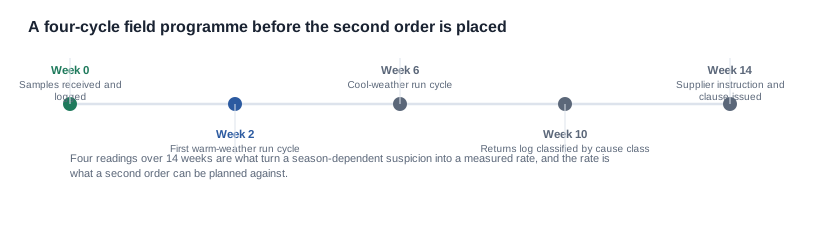
The cadence above, and what each cycle buys. The four readings over 14 weeks are what turn a suspicion into a rate, and the rate is the only number worth putting in front of a supplier in a second-order discussion. The final cycle is the one that produces the deliverable: a supplier instruction that names the cause class, states the action, and is attached to the specification for the next order. A programme that ends with a report rather than with an instruction has produced a cost and no asset.

Smart glasses for running: what a field programme settles and what it cannot
It is worth being explicit about the limits, because a field programme that is over-claimed ends up being trusted for things it has never tested. The programme can establish a rate: how often a symptom appears per hundred units per hundred sessions, under a stated protocol, on a stated configuration. It can establish a direction: which cause class dominates, and whether that changes between a warm and a cool cycle. It can establish a specification requirement: the weight, the retention feature, the runtime condition or the charging interface, turned into a written line that a supplier must answer.
What it cannot establish, and must not be used for. It cannot establish a per-model frame weight, because the programme measures what happened on the sampled units rather than what the specification is for every unit, and one sample is not a population. It cannot establish an ingress rating, because an ingress marking is a laboratory classification and a run cannot create one; the IP54 marking on the V06 and the S7 is published as a catalogue attribute with no test report behind it. It cannot establish a cycle life, because a programme of four cycles cannot extrapolate to the hundreds of charge cycles a warranty term implies. And it cannot establish a compliance position, because the catalogue carries a company-level export certification page whose content is images rather than text and publishes no per-model certification row.
The distinction that keeps a programme honest. A measured rate is a finding about the configuration that was measured. It is not a statement about the product family, and it does not survive a change of hardware revision, a change of route, a change of season or a change of supplier without being re-measured. Programmes that quote a first-cycle rate in a second-year negotiation are quoting a memory rather than a measurement, and the difference shows up in the defect allowance. The safest commercial discipline is to state the protocol alongside the rate every time the rate is used, so that the reader can see exactly what the number covers.
And what the programme is worth relative to its cost. The cost is a fixed protocol, a capture sheet and the discipline to record unknowns instead of rounding them off. The return is a rate, a specification amendment list and a defensible position when a supplier is asked to justify a defect allowance. For a first order in an unfamiliar application, that is a reasonable trade, and for a repeat order it becomes the difference between a programme that improves and one that merely repeats.

The four artefacts a completed programme hands over
The returns log with two separate columns. The customer's own sentence in one column and the assigned cause class in another, never merged. This log is the raw material for every rate in the programme and the artefact that a supplier is most likely to ask to see, so it should be exportable in a form that does not require retyping.
The rate table, with the protocol in the header. Symptom counts and cause-class counts per hundred units, per hundred sessions, with the route, the temperature band and the date range stated above the numbers rather than in a footnote. A rate without its protocol is not a rate; it is an anecdote with a denominator.
The specification amendment list. The published rows that a supplier must now answer in writing before the next order, each with the observation that prompted it and the consequence if the answer is negative. This is the artefact that converts a research activity into a procurement instrument, and it is also the artefact that gets quoted in the second-order negotiation as the reason a term has changed.
The decision on the configuration itself. Whether the first configuration was right, stated as a decision with a rate attached and a recommendation on what changes in the next order. A configuration decision made on a rate is defensible in a way that a configuration decision made on enthusiasm is not, and it is the only one of the four artefacts that is a decision rather than a record.
What this means for the supplier conversation. A buyer who arrives with a rate table and a specification amendment list is negotiating from measured evidence. A buyer who arrives with a list of six observations from two units is negotiating from anecdote, and the supplier can tell the difference immediately. That difference is the commercial return on the field programme: it is not the data itself but the position it creates at the moment a unit price, a lead time or a defect allowance is being agreed.
The boundary of what we will put our name to
Stated plainly: we publish the sport models' configuration exactly as the catalogue states it, that we will not describe a splash-protected product as waterproof, and we publish no frame weight, no fit data and no microphone specification for any model, so we will not estimate how a run will go for a given runner. We will also not present a field programme's results as a claim about the whole population when they came from a small sample, because that is the same error as estimating a weight, in a different column.
What we will do with a programme's results. Take the six observations from a sample, tell the buyer which of them a product change could address, which are properties of the format that will not change, and which are measurements the catalogue simply does not publish. We will tell them which of the three causes behind each observation can be separated from the others with the capture sheet in the checklist above, and which cannot be separated without a temperature band. That is a shorter answer than a specification sheet, and it is the one that can be acted on.
The channel context is under smart glasses for running, the product range is on the sport smart glasses page, and the format's practical limits are covered at how to pack for running.
Related reading
- The format's limits — smart glasses for running
- The pack — how to pack for running
- The channel backdrop — smart glasses for running
Send us the six results and we will tell you which a product change could address and which are properties of the format.