

A running channel's return rate is decided by three things, and only one of them is a defect. This article sets out the three, the proportion each one should be expected to reach, what can be written into a listing to reduce the two a buyer controls, and — the part that is usually missing — how to write a warranty term that can actually be evidenced when the catalogue publishes no cycle-life figure at all. The conclusion worth carrying into a procurement meeting is that a running channel's warranty cost is mostly decided by the listing and the insert, both of which are free, and only secondarily by the warranty clause itself.
The published position a returns plan has to work with. Our published camera figures are 220 mAh to 290 mAh cells with rated use between five and eight hours, and the test condition behind a rated figure is not stated in our documentation. Sensor model, field of view, video resolution, storage behaviour and low-light capability are all not published. Unit weight is published for one model only, at 158 grams for the MT6 glasses body, including its battery and camera and excluding its foldable charging case. The IP54 marking appears on the V06 and the S7 and on no other model, and no report behind it is published. Every one of those is a sentence a listing can get wrong, which is why the first return class below is bigger than any defect rate in most channels.
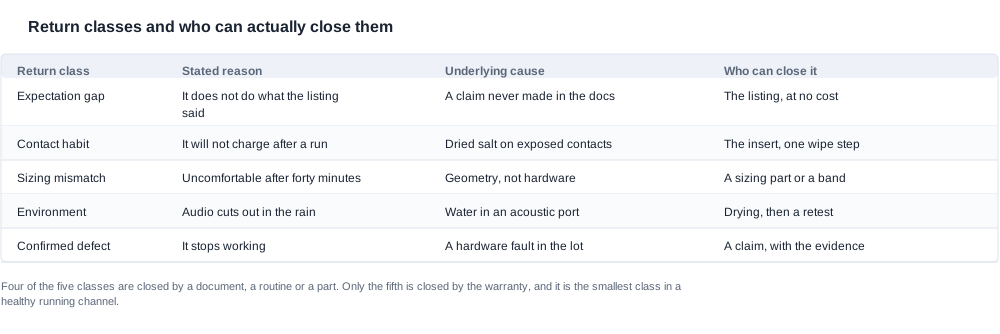
How to read the table above. The last column is the commercially decisive one. Four of the five classes are closed by a document, a routine or a part, and only the fifth is closed by a warranty claim. A channel that treats its returns as a warranty problem is therefore treating the smallest class as the whole problem, and a channel that measures the class mix instead of the total can see immediately which lever is worth pulling.
Smart glasses for running: what a running channel's returns are actually made of
The expectation gap, and why it accumulates faster than a defect rate. The customer bought on a listing that implied something the documentation does not support — night recording, waterproofing, a weight figure, audio at running pace into a headwind — and the product did not do it. The return reason describes a capability rather than a build, and it accumulates faster than any defect rate because every unit sold adds to the population that has read the listing. This class is also the only one that a buyer can reduce at zero unit cost, by removing the unsupported implication from the copy.
The charging and contacts habit. The unit will not charge after a run. Dried salt on exposed magnetic contacts produces an intermittent charge that reads as a fault and is cleared in thirty seconds with a dry cloth. It is the single largest preventable category in this application, and the prevention is a printed step in the box insert rather than a support article. The models that publish a Type-C interface have the same class of problem from a different cause — lint and debris in the port — and the insert wording has to be right for both interfaces, which means it has to be per-configuration rather than generic.
The sizing and fit class. Pressure under a cap, temple pressure, a head shape that suits a display unit and not a worn one. We publish temple options on some sport-category models — slim and removable — precisely because this interaction is common, and a channel that ships only the default configuration collects sizing returns it had a chance to prevent. This is the one class where a second configuration rather than a better document is the answer, and it is the class most often left alone because it needs a second SKU rather than an edit.

The three questions that rank the return classes
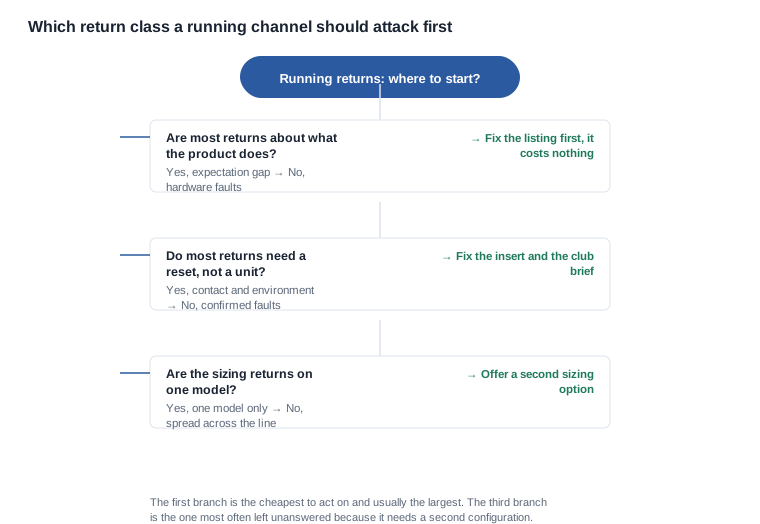
The three questions, and why the order decides where the effort goes. Whether most of the returns are about what the product does, which points at the listing and costs nothing to fix. Whether most need a reset rather than a replacement unit, which points at the insert and the club brief. And whether the sizing returns cluster on one model, which points at a second sizing option. The order matters: the first is free, the second is cheap, and the third needs a second configuration, so a channel that works the questions in order spends its effort in the right order.
The three answers, and what each one commits the channel to.
- If most returns are about capability, the listing is changed before the next shipment and the change is recorded as a version.
- If most returns need a reset, the insert and the club brief are rewritten with the action written as a numbered step.
- If the sizing returns cluster on one model, a second sizing component is added to the bill of materials for that model only.
What the fourth class should look like. The confirmed defect class should be the smallest, and a channel where it is not the smallest has a different problem: either the listing is overselling, or the insert is not being read, or the configuration is wrong for the population. Those three causes are all upstream of the warranty, and none of them is fixed by a longer cover period. That is the single most important insight in this article — a longer warranty on a channel whose returns are mostly avoidable buys a bigger provision for a problem that was never the problem.
Writing a warranty term you can evidence
The constraint that shapes every warranty clause in this category. Our documentation does not include a cycle-life figure at a stated retained capacity, so a two-year battery expectation cannot be evidenced from our side. It has to be modelled as unknown and budgeted accordingly, rather than written as a term that assumes a figure nobody has measured. A clause written in the confident language of a battery warranty is a clause that will be tested, and the test will be an argument rather than a measurement.
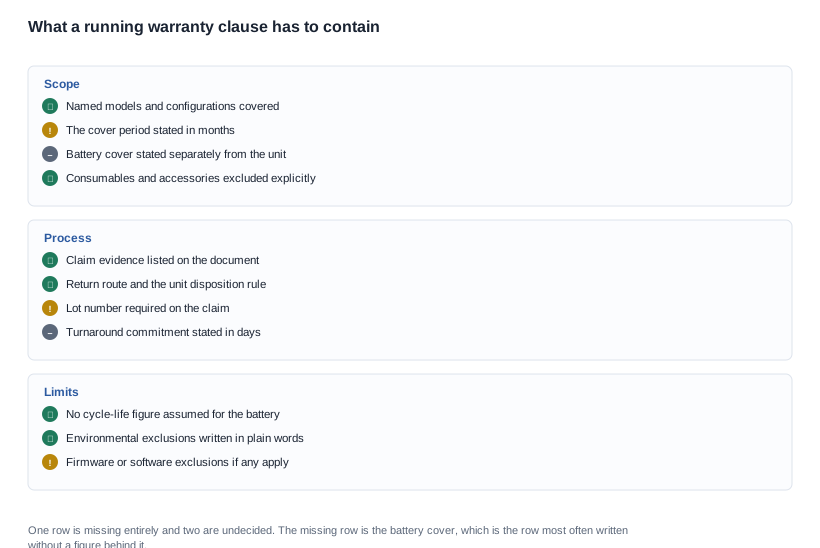
What a defensible clause looks like instead. Six elements, and each of them exists because something is missing from the documentation rather than because it is standard. The cover period stated in months rather than years, so that it can be revisited against measured data rather than defended as a promise. Battery cover stated separately from the unit cover, so that the unknown can be scoped separately. Environmental exclusions written in plain words — rain, immersion, heat, sustained downpour — rather than as a reference to a rating the report behind which is not published. The claim evidence listed on the document, so that a claim can be judged without a negotiation. The lot number required, so that a defect cluster can be found. And a turnaround commitment stated in days, because a warranty term with no service level attached is a warranty term with no operational meaning.
The three rows on the checklist that need a decision before launch. The cover period, the battery cover and the turnaround commitment are the three a channel leaves open because each of them requires a commercial decision rather than a copy decision. The cover period depends on the risk appetite the business has already decided; the battery cover depends on the cycle-life figure nobody has; and the turnaround depends on the reverse-logistics route. What the checklist makes visible is that these three are decisions, and that leaving them open until the first claim is more expensive than making them badly on day one.
Why the warranty cannot fix the two controllable classes. A warranty pays money after a unit comes back. It cannot prevent a unit from coming back, and by the time the money is spent the cause has already cost the channel a unit, a return movement, a handling operation and a customer. The expectation gap and the contacts habit are both closed by something that costs cents per unit and nothing per claim, and a warranty term is the wrong instrument for both because it acts at the wrong point in the chain.

Listing wording that removes a whole return class
The five sentences that cost nothing and remove most of the expectation gap. State the season the product is published for. State the designation exactly as written — IP54 is not waterproof, and only the sport category carries one. Publish the battery figure with the caveat that the test condition is unstated. Mark the rows that are not published as not published, rather than omitting them and letting the reader assume. And say that audio is less clear at running pace into a headwind. That last sentence removes an entire class of complaint and costs almost no conversion, because it converts a disappointment into a stated condition.
Why stating a limit raises conversion rather than lowering it. A listing that states a limit is a listing that cannot be accused of misleading a customer, and the channel that can be trusted on the first claim is trusted on the second purchase. In a category where the buyer is often a club, a team or an employer rather than an individual, the reputational cost of one disputed claim is multiplied by the size of the group. The running training article covers the group-instruction side, and the first-run expectations article covers what the first session actually establishes.
The insert sentence that removes the contacts class. One line, written as a numbered action rather than as advice: dry the charging contacts before charging. It has to be written for the interface in the box, because the instruction differs between a magnetic model and a Type-C model, and a generic instruction that mentions both will be read as neither. The cost is a line of artwork and a few seconds of the customer's attention. The saving is a class of returns that otherwise arrives as a fault.
And the sentence that belongs in the club brief rather than the listing. What the device does not do. A club brief that states the limits removes the expectation gap before it reaches the channel, because the member has been told rather than surprised. This is the cheapest control in the whole returns structure, and it is the one most often left out because the brief is written for the members rather than for the returns desk.
The returns log that has to exist before the second order

The five steps, and what the fifth one is for. The stated reason is logged verbatim before any category is assigned, because the sentence the customer writes contains the cause and the category assigned afterwards contains an interpretation. The reason is then classified against the table above. The cheap close is attempted before a replacement is approved, which is the step that separates a reset from a return. The disposition and the cause class are recorded for every unit. And the class mix is published to the supplier before the next order is placed.
Why step five is the step that changes the commercial position. Three months of that data will tell a buyer whether the warranty provision is sized for the right problem. Most running channels find that it is sized for defects when the actual cost is sitting in the expectation gap and the contacts habit — neither of which a warranty term can fix. Publishing the mix to the supplier turns that finding into a commercial conversation: either the supplier supplies the configuration rows that close the listing gap, or the buyer closes it in its own copy, and either way the buyer knows which lever it is pulling. It is also the cheapest diagnostic available: four columns in a spreadsheet, maintained weekly, and no instrumentation of any kind.
The comparison the second order should be based on. Not the unit price and not the cover period, but the landed cost per hundred units in service, which is the unit price plus the handling cost of the class mix plus the provision. Two suppliers with different unit prices and different cover periods can produce the same number, and a supplier with a higher unit price and a better-documented configuration can produce the lower one. That comparison is only possible with a returns log, which is why the log is a procurement instrument rather than an administrative one.
What a buyer should ask a supplier before accepting a returns position. Five questions, and they are the same questions as the class mix, asked from the other side. Which published configuration rows exist for the quoted configuration, since the expectation gap is usually a documentation gap. Whether the charge-time ceiling is published with its starting state, since the contacts habit is easier to fix when the condition is stated. Whether the runtime figure is published with its test condition, since a runtime claim without a condition is a claim a customer will test. Whether an ingress report exists behind the IP54 marking on the V06 and the S7, since a marking without a report is a listing risk. And whether a defect-notice path against the lot number is accepted, since a returns log without lot numbers cannot find a bad batch.
Why these five questions belong in the request for quotation rather than in the returns review. By the time a returns review is happening, the units have been sold, the listing has been published and the returns provision has been set. The five questions are all answerable before any of that, and every one of them is a question the catalogue does not answer by itself. A buyer who asks them at the quotation stage is buying documentation; a buyer who asks them after the first hundred returns is paying for the same documentation in reverse logistics.
Pricing the returns position into the commercial terms
The returns provision is a line in the order, not a footnote. Every running channel has a number in its budget that covers the cost of units that come back, and in most channels that number is set as a percentage of revenue rather than as a consequence of the class mix. The alternative is better: the provision is the class mix multiplied by the per-case cost, and the class mix is measurable from the first hundred returns. A buyer who writes the provision that way can revisit it at the second order with evidence rather than with a feeling.
The four clauses that make a returns position enforceable. The conformity clause, which requires the delivered configuration to match the quoted specification and therefore makes an oversold listing a supplier question as well as a copy question. The documentation clause, which requires the published configuration rows and the compliance documents to arrive with the goods. The acceptance clause, which allows an arrival inspection against the written specification so that a mismatched shipment is caught at the port rather than in the channel. And the remedy clause, which states what happens if a delivered unit does not conform, because a silent remedy clause defaults to a dispute rather than to a credit.
The commercial lever a buyer rarely pulls. Where a channel's class mix shows that the expectation gap is large, the correct supplier conversation is not about a discount. It is about the configuration rows that are missing from the documentation, because those rows are exactly what the listing was missing. A supplier that supplies the field of view, the ingress position, the runtime test condition and the unit weight in writing has removed the ambiguity that produced the returns, and that is worth more to the channel than a price reduction, because the price reduction is paid on every unit while the documentation is paid once.
And the lever that is usually wrong. Extending the cover period. It costs money on every unit that would have been covered anyway, it enlarges the provision without touching the cause, and it raises the price of the product for the one class of buyer who does not need it. In a running channel where most returns are avoidable, the cost of the cover period is real, immediate and recurring, and the benefit is concentrated on the smallest class. That trade-off is worth making deliberately rather than by default, and the checklist above is what makes it deliberate.
What we will and will not commit to in writing. We will tell you which published figures apply to which configuration and which rows are gaps. We will not supply a cycle-life figure, a return rate or a warranty performance claim, because none of them is not published in our documentation and none is ours to promise on your channel's behalf. We will not present the IP54 marking on the V06 and the S7 as a waterproof claim, and we will not quote a unit weight for any model other than the MT6 glasses body at 158 grams. Our view is that a running channel's warranty cost is mostly decided by the listing, and the listing is free to fix.
What to send us. Send the models under consideration, the channel, the target market, the expected volume and whether the units are shared or individual, and we will return which published rows apply to each configuration, which rows a listing must avoid implying, which warranty scope elements can be evidenced from our documentation, and which ones you will have to set as a business decision instead. The published model data is on the sport smart glasses range, and the application framework sits at smart glasses for running.
Related reading
- What to expect on day one — the first run
- Training users in one session — the three habits
- Sport smart glasses range — published configurations
Send us the channel and the target market, and we will tell you which published rows apply and which warranty scope elements can be evidenced.


