A security purchase is decided by four rows, three of which we can publish and one of which we cannot. This checklist is ordered so the unanswerable row is identified before the order rather than after it. It is written as a request-for-quotation discipline rather than a product comparison: the items below are the questions a buyer sends, in the order they should be sent, so that the answers come back written, comparable and attached to a model designation. The most common failure in this category is not choosing the wrong device. It is receiving four quotations that answer four different sets of questions and comparing them anyway.
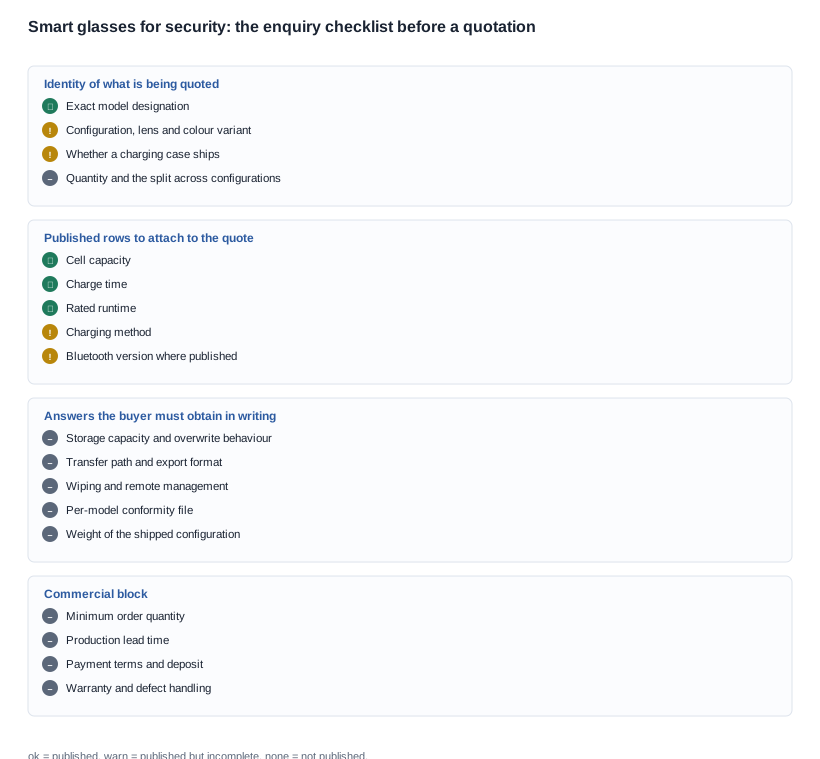
Smart glasses for security: the enquiry checklist before a quotation
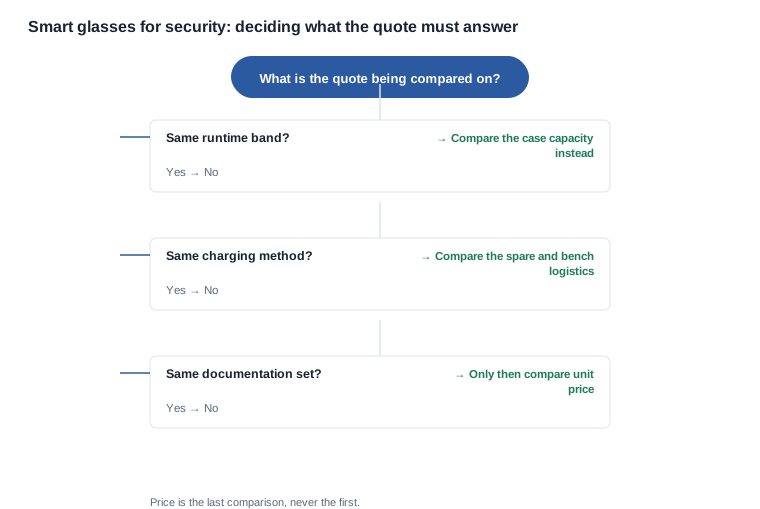
Send the request as one message, in five groups, before asking for a price. The order matters. A request that arrives as a price enquiry gets a price reply, and a price reply cannot be compared to another price reply when the two quotations answer different questions — which is the situation most buyers find themselves in when they try to compare three security suppliers on unit price alone.
Group one: fix the identity of what is being quoted
Nothing else in this list can be evaluated until these four are settled, because every published figure in the catalogue belongs to a specific model and configuration.
- The exact model designation. Not a family name and not a photograph. The camera tier holds eleven distinct models — the CY05 and the KY06, the L2 Utral and the V03 Pro, the MT5 and the MT6, the V03 and the CY03, the L1 Pro and the V06, and the S7 — and they differ on exactly the rows that decide a deployment. A quotation naming "the AI camera glasses" is not comparable to one naming the L1 Pro, and neither is comparable to a quotation naming the CY05. The whole catalogue holds 28 models, of which 8 are audio models, 3 are sport models and 11 are camera models, so a family name is genuinely ambiguous.
- The configuration, including lens variant, colourway and any bundle. The V03 Pro is a photochromic-lens configuration of the V03 platform, which is why the two are easy to confuse in a reply even though their published rows differ — and they differ on a row that matters, because the catalogue publishes no charging-case row for either of them, and neither model is published as having no case.
- Whether a charging case ships, and at what published capacity. This is the row most often left out of a quotation, and it changes the operating model rather than the specification. Five camera models publish a capacity — the CY05 and the CY03, and the L1 Pro publish 1400 mAh, the L2 Utral publishes 900 or 1400 mAh, and the MT6 publishes 1200 mAh in a foldable case. Two publish that a case exists without publishing its capacity, which are the KY06 and the MT5. Four have no case row at all, which are the V03 Pro and the S7, and the V06 and the V03, and no model in the range is published as having no case. A quotation that says "with case" without a capacity is answering two of those three states, and it is not clear which two.
- The quantity and how it splits across configurations. A fleet quote that mixes models is the most useful quote to request and the hardest to compare, so the split should be stated explicitly rather than left to the supplier's discretion.
Group two: attach the published rows so the answers line up
A request that asks for these rows by name produces a reply that can be compared line by line with another supplier's reply. A request that asks "what are the specs" produces prose, and prose from two suppliers cannot be compared without re-reading both.
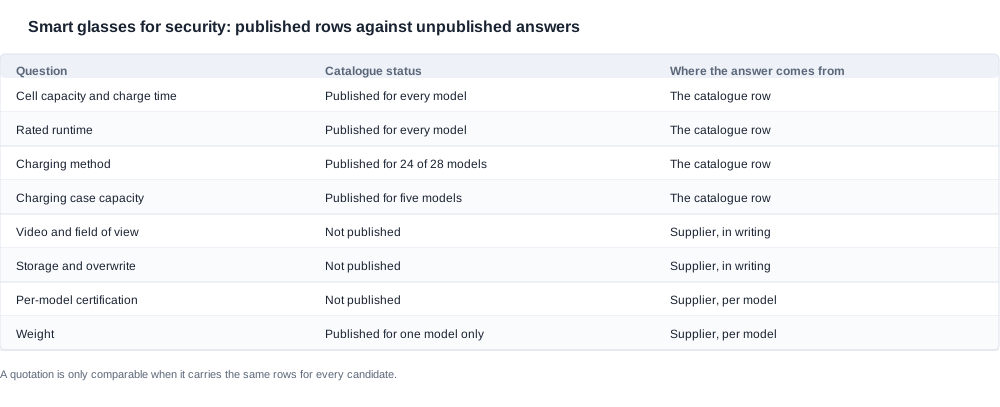
- Cell capacity. Published for every model in the catalogue, from 40 mAh on the children's A05 and A06 through 100 mAh, 115 mAh, 200 mAh and 220 mAh up to 290 mAh on the camera tier. In the camera tier specifically, the published values are 220 mAh on the V03 Pro and the MT5, and the V03, 260 mAh on the V06 and the S7, and the KY06, 265 mAh on the MT6, and 290 mAh on the CY05 and the L1 Pro, and the CY03 and the L2 Utral.
- Charge time. Published for every model. Twenty-six of the 28 catalogue models publish two hours or less; only the D17 and the ZH12 publish approximately one hour. Write the requirement as "two hours or less", because that is what the catalogue states — "under two hours" is a different and narrower claim.
- Rated runtime. Published for every model. In the camera tier: 5 to 8 hours on the V03 Pro and the V03, and the S7 and the V06; 6 to 8 hours on the KY06 and the MT5; about 7 hours on the L1 Pro and the MT6, the CY05 and the CY03, and the L2 Utral. No runtime in the catalogue is published with its test condition, which matters more than the number itself.
- Charging method. Published for 24 of the 28 models: magnetic across 17 and Type-C across 7. The four camera models that publish no charging method row at all are the CY03 and the MT6, and the L1 Pro and the CY05, and all four publish a case capacity. The L2 Utral is Type-C and is not magnetic, which is worth stating because it is the only camera model with both a published Type-C interface and a published case choice.
- Bluetooth version. Published for the audio and sport tiers — V5.3 on the K01 and the K02, V5.4 on the D11, the D12, the LC-105 pair, the G07, the YK12, the YKC02, the D17 and the ZH12. Not published for the camera tier, so a camera quotation should not claim one.
- Published ingress marking. The IP54 marking appears on the V06 and the S7 only, with no third-party test report number behind it. It is not a family-wide claim, and the reading of what IP54 does and does not cover is at IP ratings and what they do not cover.
The five answers to obtain in writing
These are the rows the catalogue does not publish for any model. They are not reasons to decline a supplier — they are the questions to put in writing, and the quality of the answers is itself a qualification criterion.
- Storage capacity and overwrite behaviour. How much can be held, what happens when it is full, whether the oldest material is overwritten, and whether the boundary is signalled. For a device carried across a shift, an unpublished overwrite behaviour is the difference between a complete record and a gap in one.
- The transfer path. How the file leaves the device, whether the transfer can be interrupted and resumed, and how long a transfer of a full shift's material takes on a real network. This answer carries an operating cost, and it is the answer that decides whether the fleet needs a dedicated retrieval step or an opportunistic one.
- The export format and time-stamping. Whether a file can be exported in a form an investigation or an insurer will accept, and whether a timestamp and a device identifier are embedded. The catalogue publishes no time-stamping method for any model, and this is the row that determines whether a recording is evidence or merely a file.
- Wiping and reassignment. Whether a unit can be cleared between operators or between clients, and how that clearing is evidenced. For a channel that hires equipment out, this is a contractual requirement rather than a feature, and it is also the row that decides what happens to the previous user's material.
- Data location and remote management. Whether the device or its platform stores anything remotely, and whether it can be located, locked or updated centrally. A fleet of security devices that cannot be located after loss is a procurement problem in its own right, and the loss-and-recovery clause in the agreement is only as strong as the answer here.
There is a practical reason to ask these five as a block rather than one at a time. Each one describes a point in the lifecycle of a file, and the lifecycle has to close for the deployment to work. The device holds the file; the file leaves the device by the transfer path; the file arrives in an export format that somebody else can open; the file carries a time and an identity that make it attributable; and the file can be removed when the retention period ends. A supplier who answers four of the five has described a chain with a break in it, and the break will be discovered at the worst possible moment — during an incident review, or during a subject access request, or during a dispute with a client.
Two of the five are also the ones most likely to receive a confidently wrong answer, because both have an intuitive default that sounds like an answer. Storage invites "it stores plenty", which is not a capacity and not an overwrite behaviour. Remote management invites "you can manage it centrally", which says nothing about whether that management can lock, locate, update or clear the unit remotely. Both defaults are worth challenging in writing, and the way to challenge them is to ask for the behaviour rather than for the capability.
A good answer to all five looks like a numbered list tied to a model designation, with "not available for this configuration" written where that is the truth. A supplier who answers three precisely and marks two honestly has told the buyer more than one who answers all five vaguely, and the difference between those two replies is worth more than the difference in unit price.
The commercial block to settle before a deposit
These terms are separate from the specification because they are the supplier's terms rather than the product's, and because each of them changes a number the buyer has to model rather than a figure the buyer has to read.
- Minimum order quantity, stated per configuration. A supplier quoting an MOQ for the family rather than for the configuration being bought has not answered the question, because in this category the MOQ is usually a mix constraint rather than a unit count, and a family MOQ hides whether the quoted configuration is even orderable at the volume in question.
- Production lead time for the quoted quantity, and whether it changes at the next volume band. A pilot lead time quoted at urgency is not a renewal lead time, and a buyer who does not ask will find out at the renewal rather than at the order.
- Payment terms and the deposit trigger. Milestone deposits tied to sample acceptance, first-article passage and shipment place the risk with the party that can actually control it. The route is at procurement payment terms.
- Warranty period and the defect route, including what happens to a unit that fails in the field, what evidence the buyer must supply to open a claim, and how long the claim takes. A warranty period without a defect route is a number rather than a remedy.
- Tooling and certification quoted separately. What certification costs and how long it takes are dictated by the programme and by whoever certifies it, and a buyer who cannot see the split cannot model the break-even volume of a channel with a long compliance lead.
- The price basis for repeat orders, requested at the pilot stage even as a stated intention. It is almost always available before the first order and almost never available after it, because by the renewal the supplier has already priced the pilot and knows the buyer will take the same terms.

The questions that decide whether a row is disqualifying
Three questions in this category are worth asking early because their answers can end the project, and it is cheaper to learn that before the sample than after it.
What is the maximum continuous recording time? If the answer is an adjective rather than a figure, the configuration cannot be specified for shift documentation, and the conversation should move to a supplier who will answer it in writing. The published runtime band of 5 to 8 hours on the camera tier is a rated figure without a test condition, and it cannot be converted into a continuous recording time by arithmetic.
Is there a defined procedure for a lost or unreturned unit? In a security deployment that is an evidence question, not an inventory one. What happens to the material on a unit that does not come back, whether the unit can be disabled remotely, and who is notified and when.
What does the compliance file cover, for this model and this configuration? The catalogue contains no per-model certification row and no CE, FCC or RoHS reference in its text, so the entire documentary basis comes from the supplier and has to be requested per model. The route is at the certification checklist, and the battery transport file for the cells and any case is a separate request, because a case is a second lithium cell travelling on every shipment.

Running the enquiry with a supplier
Two practical instructions make the replies usable rather than merely received. Ask for the answers as a list rather than a letter, because a list can be compared row by row across suppliers and a letter cannot. Require the model designation against every answer, so that a gap is visible rather than inferred. State the shift and the environment up front, because both the published rows that matter and the questions that matter change with them: a ten-hour post makes the case row decisive, and an outdoor post makes the ingress position decisive.
A fourth instruction is worth adding when the buyer is comparing more than one supplier: ask every supplier the same five questions in the same order, in one message. The value is not in the answers being good, it is in the answers being comparable. A supplier who cannot answer one of the five will say so in the same place in the reply where the others did, and a buyer can then see at a glance which configuration is genuinely covered and which is being sold on the strength of the published rows alone. That comparison is the only defensible basis for choosing between two quotations that both contain everything needed to price the order.
The same three instructions tell a buyer when a supplier is worth taking further. A supplier who reorganises the request into their own structure, answers three of the five unpublished questions and marks the other two as unavailable, and quotes the case capacity for exactly the configuration being discussed, has demonstrated the working practice that the buyer's own programme will need. A supplier who answers all five in adjectives, quotes a family-level MOQ, and attaches a case to a model whose catalogue row publishes none, has demonstrated that the answers will not be comparable later either.
Where the deciding row comes back as a gap, and the gap is genuinely the deployment's deciding factor, the conclusion is not that a different model from this catalogue will solve it. It is one of two things: either the evidence can be obtained elsewhere — a test on a sample, a third-party document, or a written supplier statement — or the deployment is scoped to the conditions that can actually be evidenced. Both are legitimate answers. Neither is solved by a listing that implies otherwise, and a buyer who has asked the question in writing has already done the part of the work that matters.
The rows we will commit to in writing
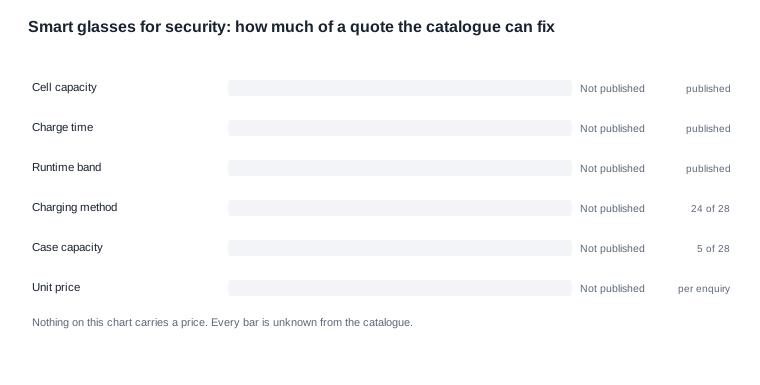
Cell capacity, charge time, rated use, Bluetooth version where published, charging method where published, and charging-case capacity and position are published per model, and they are the six rows we will commit to in writing. Everything else on a camera product — sensor, field of view, video resolution, frame rate, storage behaviour, overwrite behaviour, the transfer path, the export format, the time-stamping method, the recording indicator, ingress beyond the IP54 marking on the V06 and the S7, and weight beyond the single published figure of 158 g for the MT6 glasses body excluding its foldable case — is not published in our documentation, and it stays marked.
That distinction is not a formality. It is the difference between a specification a deployer can defend to their own management and one that dissolves the first time somebody asks where the number came from.
Stated plainly: we will give you the published configuration and mark the rows we do not hold. We will not supply a low-light capability, a storage figure, a continuous-recording behaviour, or a statement that the product is suitable for surveillance — the last is a use-case claim belonging to the deployer and their legal adviser. We will not present a company-level capability as a per-model certification, because the catalogue does not contain a per-model certification row and a company-level capability is not one.
What we will do is take the deployment profile — shift length, environment, retention requirement, transfer path, channel and destination market — and return the published rows that cover the configurations that qualify, the five answers to obtain in writing, and the acceptance criteria to write into the order. The model-selection route is at how to choose the right model, the counter-argument is at pros and cons, and a deployment account is at real-world deployment experience. The published configurations are listed at the AI camera glasses range, and the scenario entry point is smart glasses for security.
Related reading
- The counter-argument to this checklist — pros and cons
- A deployment account — real-world deployment experience
- The published configurations — AI camera glasses range
- The compliance route — certification checklist
Tell us the shift, the environment and whether recording is required, and we will tell you which of these rows our documentation answers and which have to come from the supplier in writing before a deposit.