Smart glasses for security: two hypothetical deployments, and the order that separated them
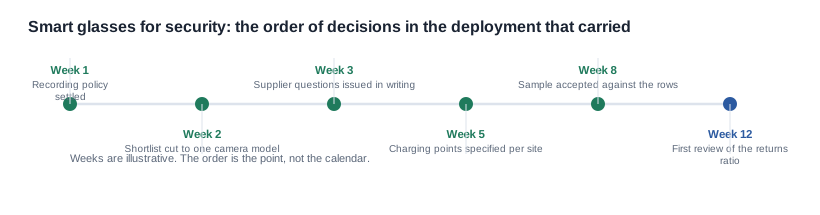
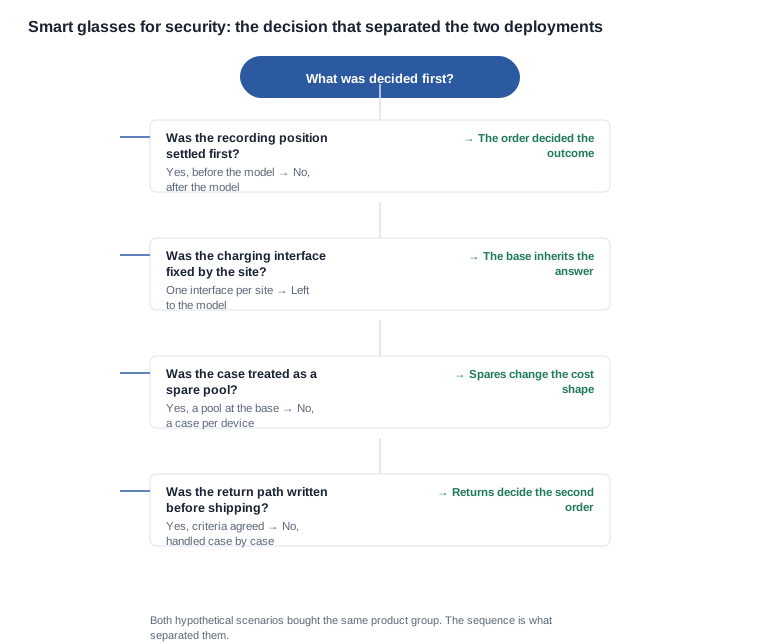
Two deployments of the same camera group, drawn as a hypothetical case rather than a client project, separated by one variable: the order in which the recording question and the charging question were answered. In the first, the recording position was settled in the first week, before a single model was shortlisted, and the deployment carried. In the second, the device was selected first because the unit price was available and the unit price was the only number that was, and the deployment stalled four months later on a question that had never been opened. Neither scenario is a report of a real customer. Both are worked examples, and they are here to make one point that is easier to see in a scenario than in a checklist: in this category, the sequence of decisions is worth more than the content of any individual decision.
The scenario set-up, stated once so the two cases can be compared. A property services operator running security coverage on three sites — an office campus, a retail park and a logistics yard — with twelve officers across three vehicles and shifts of ten to twelve hours. The record from the campus was to be reviewed weekly in an incident meeting, so the requirement was an image rather than audio alone. The buyer was a brand owner who intended to place repeat orders but had never deployed this category. The budget was a fixed envelope for the first year, which meant the comparison had to include the operating costs and not only the unit price.
What the two cases have in common, so that only one variable is left. Both bought from the same camera group. Both used the same shortlist logic, which was to match the job to the published rows and then close the gaps with written supplier questions. Both had a supplier able to answer the questions in writing. Both had a site willing to run a handover routine. The product was not the variable, and neither was the price. The variable was the order.

The deployment that carried, and the three decisions that carried it
The first scenario is a brand owner who, before contacting any supplier, wrote down what the record was for: an incident review, held weekly, reviewed by the site management and retained for a defined period. That single act removed most of the difficulty before any hardware was discussed, because it told the buyer which questions to ask and, more usefully, told the buyer which questions not to ask.
Decision one: the recording position came before the model
With the purpose of the record settled, the shortlist became a short exercise against published rows rather than an open search. The camera group was the only group that could serve the job, and within it the eleven camera models were separated by their published rows: an 8 MP sensor on eight of them and 13 MP on three — the L2 Utral and the L1 Pro, and the S7. The runtime requirement of the ten-to-twelve-hour shift eliminated several models on the published figures alone, and the outdoor exposure of the logistics yard narrowed the field further to the two models carrying an IP54 marking, the V06 and the S7. Both publish a removable inner frame and a 260 mAh cell with a rated run time of five to eight hours, and both charge magnetically.
Decision two: every remaining gap became a written question, not a footnote
The shortlist left the group with a short list of models, and each remaining gap on each model became a numbered question sent to the supplier with a request for a written answer: storage capacity and overwrite behaviour, the runtime test condition, the field of view, the low-light behaviour, the capture route and latency, the standby draw, the frame and lens material and coating, the per-model certification scope for the destination market. The distinction that matters is the written answer. A verbal assurance is not evidence, and the whole point of writing the questions down was that they would still be there in month four when the first dispute about a recording arrived.
Decision three: the base was designed before the first shipment
Because the shortlist had settled on magnetic charging, the base design was settled too: a charging point at each vehicle, a charging point at the store, and a spare pool at the base rather than a case per device. The catalogue publishes no charging-case row for the V06, which means the spare-power strategy for this scenario had to be a pool rather than a case, and a buyer who assumed otherwise would have designed the wrong logistics. The consumables were specified as two line items — a cleaning item and a contact-cleaning item — at a stated rate per device per week, because a rate is what a store stocks against and a single item per device is not a supply plan.
What the buyer actually sent, and what came back
The question list in week three of the carried scenario ran to nineteen numbered items across the shortlisted models, and it is worth seeing its shape rather than its length. Seven items asked for a published figure that exists for some models and not others: the runtime test condition behind the rated run time, the standby draw, the unit weight, the certification scope, the ingress test report behind the marking, the coating specification and the case status for models where the catalogue publishes no case row. Eight items asked for behaviour rather than a figure: what the device does at the storage limit, whether it warns, how a file reaches the review system, whether a still capture is immediate, what happens to a file when a transfer fails, whether the device can be configured to a site storage policy, whether a device can be remotely locked, and what the device does when it is issued without a case. Four items asked about the commercial structure: the consumable quantity per device per week, the restock interval, the incoming inspection criteria, and the return path.
What came back is the part that matters. Some answers matched the published rows. Some narrowed them. Some answered a question the catalogue had left open, which is the outcome a buyer should be paying for. A small number of answers changed the shortlist, and the one that changed it most was an answer about behaviour rather than a number — the behaviour of the device at the storage limit is not in the catalogue, and in this scenario it turned out to be a configuration item rather than a fixed property. A buyer who had assumed the answer would be found in a specification would never have asked the question.
The practical lesson is narrow and transferable. A written question list does three things at once: it makes the gaps explicit, it creates a record that survives the next quarter, and it gives the supplier a chance to supply the answer that no catalogue can. The price of the list is an afternoon of drafting. The cost of not sending it is the month-four review in the second scenario.
What the carried deployment actually measured
The first review at week twelve produced three numbers that the buyer had never had before: the returns ratio from the incoming inspection, the number of devices that completed a shift without a mid-shift recharge, and the rate at which consumables were drawn. Those three numbers are what a second order should be built on, because they are the only figures in the deployment that describe the site rather than the catalogue. The charge plan that supported it is at how to charge smart glasses for security, and the published power rows are at battery life.

The deployment that stalled, and the point at which it stalled
The second scenario has the same site, the same officer numbers and a larger first order, because the buyer had been quoted on all eleven camera models and the larger order produced a better unit price. That is the whole of the difference in the procurement step, and it is a completely ordinary decision.
Where it stalled: month four, at the first incident review
The first review meeting produced a recording that could not be played. The device had been in service for a shift, the file was present, and the file contained nothing usable. Three plausible causes existed and none of them could be eliminated from the records available, because the records available were a device, a shift log and an absence of information. The buyer could not establish whether the storage had overwritten, whether the transfer had failed, or whether the lens had degraded to the point where the image was unreadable. In each case the supplier would have been asked the same question — and in each case the answer would have been the answer given in writing in week three of the carried scenario, which is exactly why that scenario had written it down.
The stalled deployment had a second, quieter problem behind the first. The recording policy had been settled after the devices were in service, because the policy had been treated as a legal question rather than a procurement input. The legal review produced a retention period, and the retention period required storage that no model in the range was documented to support. The order had therefore placed eleven models on a site whose policy its own hardware could not be shown to satisfy.
The three questions that would have caught it, in order
- What does the device do when the storage limit is reached, and does it warn before it happens? Published for no model. It is the difference between a recoverable gap and an invisible one.
- What is the route by which a file reaches the review system, and what is published about it? Not published for any model in the range.
- What does the destination market require for this device, per model? The catalogue carries a company-level export certification page that holds images rather than text, and the catalogue wording names no CE, FCC or RoHS. There is no per-model certification row anywhere, so the scope had to be requested — and it had not been.
None of these three is a technical question a buyer should be expected to guess at. All three are standard items on the question list, and the carried scenario had already asked them.
What the stall actually cost
The direct cost was a replacement order, a second training cycle and a review cycle that produced nothing actionable. The indirect cost was larger and harder to see: the operations team had already formed an expectation that the device would not produce usable records, and that expectation does not reverse when the hardware changes. A deployment that fails once at a review meeting has to win the team's confidence back, and the cheapest way to do that is not to fail at all. This is the failure pattern set out at troubleshooting before deployment, and it is why the pre-deployment checks exist.
The reorder decision, which is the only number that really belongs to the buyer
The week-twelve review in the carried scenario produced three figures, and the reason those three were chosen is instructive. The returns ratio from the incoming inspection measures the gap between the published rows and what actually arrives in the box. The share of devices that completed a full shift without a mid-shift recharge measures the gap between the published run time and the site reality, which depends on the environment, the temperature and how much the camera is actually used rather than carried. The consumable draw rate measures the operating practice of the site rather than the device. Every one of those three is a figure the buyer owns and can improve. None of them is a catalogue figure, and none of them can be obtained from a supplier.
That is the practical reason a first order should be scoped to produce measurement rather than to fill a fleet. A first order that is large enough to be commercially sensible and small enough to leave a reorder decision open is what turns a purchase into a learning cycle, and the learning is cheap compared with the alternative, because the cost of finding out at the second order is a second order at the wrong specification. This is the commercial sequence behind the buying checklist and the warranty side of the same decision is at warranty and returns planning.

What the two scenarios share, and what a buyer can borrow from them
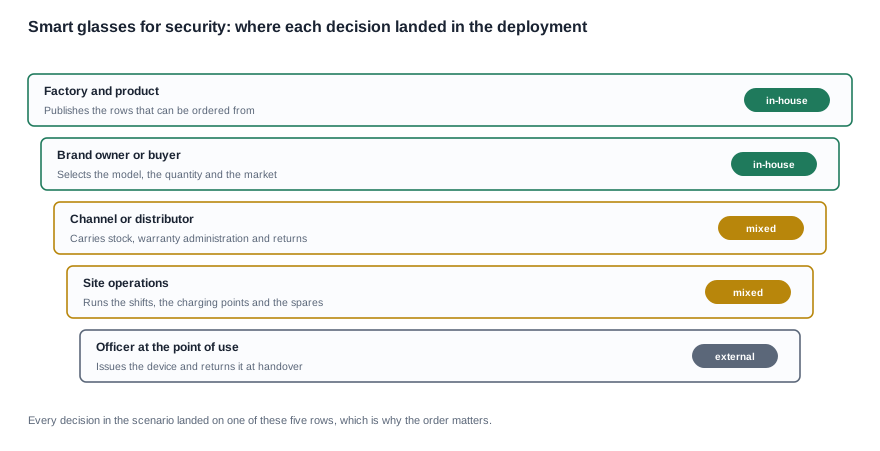
The two scenarios were drawn to make a method visible, and the method has five parts. Each part is a decision a buyer can take before the order, and each part is answerable from the published rows plus the written supplier answers.
The method, step by step
- Write the purpose of the record first. One sentence, naming who reviews it, how often, and for how long it is kept. This single sentence decides the group, and it is free.
- Eliminate whole groups using published rows only. The camera group for an image deliverable, the audio group for a voice deliverable, the sport group for a voice deliverable with a remote photo control. The counts are eleven, eight and three.
- Narrow the survivors on the rows that are published. Resolution class, cell capacity, charge time, runtime, interface, and the IP54 marking where the site needs one.
- Convert every gap into a numbered written question, with a supplier answer required in writing, before any unit price is discussed.
- Design the base before the first shipment, with the charging interface fixed by the site, the spare strategy chosen from what the catalogue publishes, and the consumable rate stated per device per week.
What a buyer can borrow directly
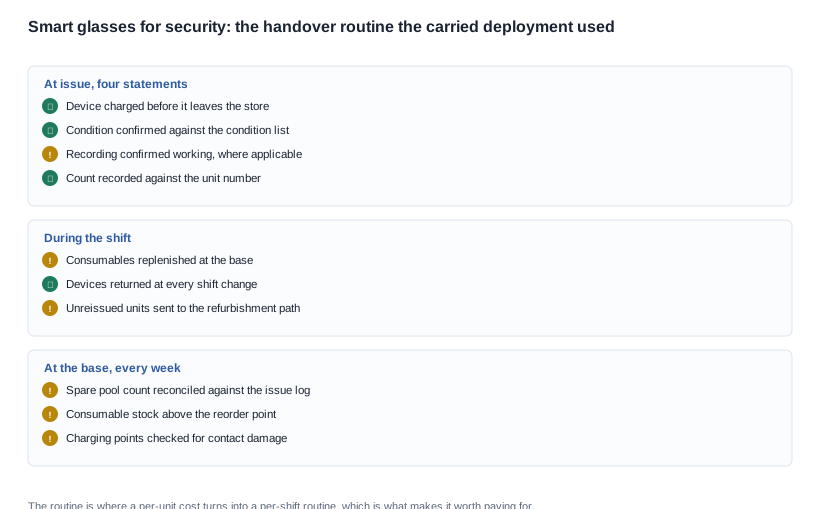
Borrow the recording sentence. It is the highest-leverage sentence in the category and it takes ten minutes. It converts a hardware search into a specification, and it is the answer to the question that decides which group is even in scope. Borrow the written question list. The gaps are the same in every deployment of this group: storage and overwrite behaviour, runtime test condition, field of view, low-light behaviour, capture route and latency, standby draw, frame and lens material, coating, unit weight, and certification scope. A buyer who has asked them once has asked them for good. Borrow the base design step. A charging point is an installed asset and a cable is a consumable, and the difference is not visible in the unit price. Borrow the handover routine. The routine is where a per-unit consumable becomes a per-shift routine, and it is also where the loss rate becomes a number instead of a budget variance.
What the two scenarios do not prove
They do not prove that one group is better than another, because both cases used the same group. They do not prove that the carried scenario would have carried in a different market with different recording rules, because the recording sentence is the part that would have changed. And they do not establish any figure for failure rates, return rates or output quality, because those figures belong to a specific site and the catalogue publishes none of them. The trade-offs between the groups are set out at security pros and cons, and the model-to-job logic is at security product recommendations.
The limit we place on deployment accounts
We do not publish deployment accounts, because we do not operate the sites and any figure we produced would be an invention. What we can do is publish the rows a deployment is built on, answer the questions that decide whether it works, and tell a buyer which parts of the sequence are sequence rather than product.
That means the resolution class on every camera model, the cell capacities and cell counts, the charge times, the rated run times, the charging interface, the charging-case capacity where the catalogue publishes one, the IP54 marking on the V06 and the S7 stated as a catalogue attribute, the Bluetooth version on the audio models, the sport models identified as sport models, and the published structural features. We do not publish the field of view, the video resolution and frame rate, the stabilisation, the low-light behaviour, the storage capacity and overwrite behaviour, the capture latency, the standby draw, the runtime test condition, the thermal behaviour, the operating temperature range, the cycle life rating, the frame and lens material, the coating, the hinge specification, the unit weight of any model other than the MT6 glasses body at 158 g, or any per-model certification scope. We will not state that a device in this range is tested to IP54, because no test report is published behind that marking, and we will not extend the marking beyond the two models that carry it.
What we will do is take a described deployment — the sites, the shifts, the record purpose, the vehicle count, the target market and the annual volume — and return the group that can serve it, the models inside that group, the published rows that support them, the written questions that close the remaining gaps, and the base design those rows imply. The scenario entry point is smart glasses for security.
Related reading
- How the scenario opens — smart glasses for security
- The model-to-job matching — security product recommendations
- The trade-off structure — security pros and cons
- The pre-deployment checks — troubleshooting before deployment
Describe the sites, the shifts and the purpose of the record, and we will return the group, the models, the published rows and the base design they imply.