

Smart glasses for travel seasonal considerations are not a technical topic, which is exactly why they get missed, and the reason they cost money is a calendar rather than a component. The device does not change between January and July; the specification sheet is identical in both. What changes is the environment the device is in, and the environments are where the returns come from. The conclusion is that a travel launch has to align three separate clocks — the lead time, the seasonal exposure and the returns lag — and a brand that aligns only the first one launches into a season it did not budget for.
Smart glasses for travel: the season does not change the product, it changes the returns clock
The reader is a brand owner, a channel buyer or a category manager planning a travel launch, and the decision in front of them is when to put the product on sale, in which markets, and how the returns are going to be explained to a finance team that expected a launch quarter rather than a launch plus a returns quarter.
Why the season is a commercial problem and not a product problem. The catalogue's rows describe a product that does not vary with the weather: a charge time of two hours or less on 26 of the 28 entries and roughly one hour on the D17 and the ZH12, cell configurations from 40 mAh up to 290 mAh, rated runtimes across the whole camera tier, and a charging interface on 24 entries. None of those rows changes with the season. What changes is the probability that a given unit is exposed to heat, cold, water, grit or a parked vehicle, and the probability is what turns a specification into a returns rate.
The lag is the part that surprises people. A unit sold in June reaches the channel in June, is used through the hot season, and comes back in September. A unit sold in October is used through the cold and the wet season and comes back in January. The returns do not arrive in the quarter that generated them, which means a channel that measures returns against the launch quarter will conclude that the product is fine in June and broken in October, when the product is identical and only the exposure differs.
What a season-aware plan actually changes. Three things and no more: the launch month, the market list, and the copy. Which configuration travels to which market is a fourth, and it is the one with the largest commercial effect, because the two entries that carry an ingress marking are camera entries and the three sport entries do not carry it.

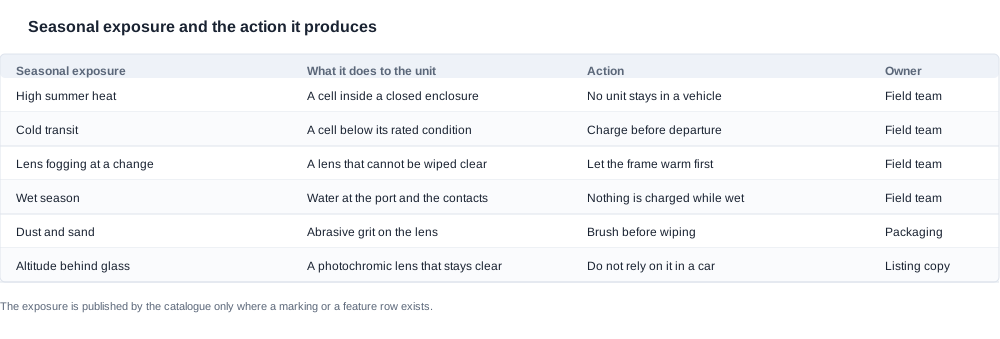
The seasonal exposures and the action each one produces
High summer heat
A device left in a parked vehicle is in a genuinely hot enclosure, and a charging case makes it marginally worse because it is a closed enclosure around a second cell. The catalogue publishes no operating temperature range and no thermal data for any entry, so the handling answer cannot be derived from a published limit — it has to be conservative. The published configuration helps in one narrow way: seventeen of the 28 entries charge magnetically and carry no exposed port, which removes one opening from the equation.
The action: the device does not stay in the vehicle, and it is not charged until it has cooled. The owner: the field team, through the travel briefing. The measurement: heat-related returns counted by month and by market, which is the substitute for the temperature range the catalogue does not publish.
Cold transit and the lens
Cold has two separate effects and they pull in opposite directions. The cell behaves differently when it is cold, and every runtime in the catalogue is published without a temperature condition — the figure to plan against in winter is the one measured on a cold sample, and no such sample is described. Separately, a lens fogs when a cold frame comes against a warm face, and a fogged lens cannot be wiped clear because wiping a fogged lens at low temperature tends to spread it rather than clear it.
The action: let the frame come up to temperature in a pocket before it goes on, and charge before departure rather than on arrival. The owner: the field team. The measurement: cold-market returns separated from generic flat-unit reports, which is only possible once the return-reason coding exists.
The wet season
Water at the port and at the acoustic openings is the wet-season exposure, and the rule that follows is about charging rather than about cleaning: a wet device does not go on a charger, and the contacts have to be dry before the case is used. On the two entries that carry the IP54 marking — the V06 and the S7 — the marking covers splashing water and a dust protection level. It does not cover immersion and it does not cover a sustained downpour, and there is no third-party test report published behind it. For a buyer this is the whole usable content of the marking: a description of what the marking means, not a waterproof promise.
The action: nothing is charged while wet, and the case is opened only after the unit has dried. The owner: the field team. The measurement: charging failures in wet-market months, compared against dry-market months for the same configuration.
Dust, sand and altitude
The lens is plastic and abrasive grit wiped across plastic acts as a sanding compound, so the order of operations matters: brush the loose grit off first and only then wipe. High altitude adds two things that pull in opposite directions. The ultraviolet is stronger, which is the condition a photochromic lens responds to — but a photochromic lens responds to ultraviolet light rather than to visible brightness, and a windscreen blocks most of the ultraviolet, so a photochromic lens is largely inactive in a vehicle. And it is cold, which is the cell and the lens case above.
The action: brush before wiping, and do not rely on a photochromic lens inside a car. The owner: the field team for the grit, the listing copy for the lens claim. The measurement: surface-related returns, which are hard to attribute until the coding set exists.
The three clocks a travel launch has to align
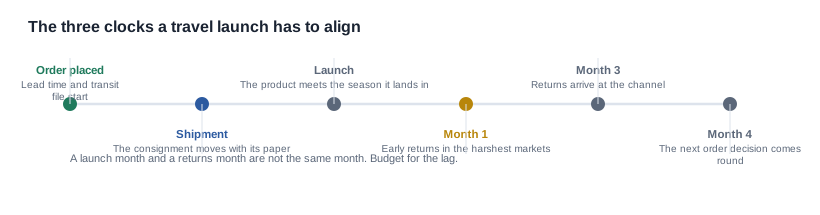
The three clocks are the deployment clock, the exposure clock and the returns clock, and the failure mode is assuming they run together.
The deployment clock is lead time plus transit. It is the one most buyers already manage, and it is the reason the transit file for the shipped configuration has to be prepared before the consignment is booked rather than collected when the border asks. The catalogue publishes a charge time on every entry and a case capacity on five camera entries, and a case is a second lithium cell, which is the item the transit file is actually about.
The exposure clock is the seasonal calendar of the destination markets, and it is the one that decides the market list rather than the launch date. A product launched for summer itineraries and one launched for winter city breaks have the same specification and different failure exposures. A buyer who has a warm-market list and a cold-market list has two different products to brief, and the configuration that suits one of them may be the wrong one for the other.
The returns clock is the lag between the sale and the return, and it is the one most often left unbudgeted. A channel that counts returns in the launch quarter will always under-count, and the resulting view will be that the product performs well in summer and badly in winter. The returns clock has to be set explicitly in the plan, and it has to be used when the second order is decided rather than when the returns arrive.
How the three clocks are read together. The launch month is chosen so that the product spends its first six weeks in the exposure it can tolerate. The market list is chosen so that the exposure matches the configuration. The returns budget is set on the returns clock, which is the exposure clock plus the channel's own return window, which for an imported order can be two to three weeks on its own.

What the catalogue can and cannot say about a season
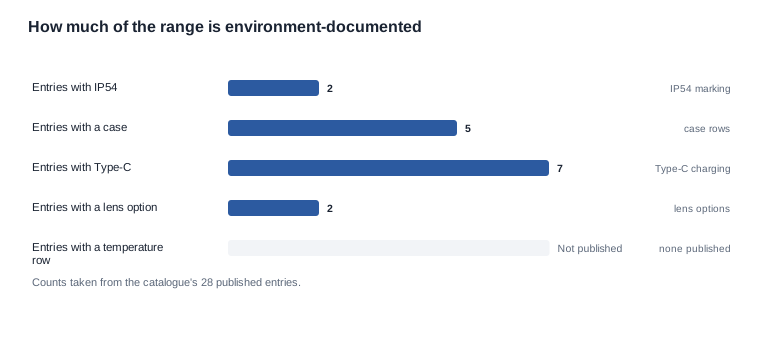
The range is unevenly documented for environmental exposure, and the unevenness is itself a procurement finding. Two of the 28 entries carry an ingress marking. Five carry a case capacity. Seven use Type-C. Two carry a lens option — the photochromic option on the V03 Pro, and the separate electrochromic entry with its own published rows. Not one carries an operating temperature range.
What that means for a seasonal decision. The buyer's options on seasonal protection are narrow and should be named honestly. The first is the marking, on two entries, as a marking. The second is the architecture: seventeen entries charge magnetically and carry no exposed port, four entries have no charging method row published at all, and the MT6's published foldable 1200 mAh case and the L2 Utral's choice of a 900 or a 1400 mAh case are the two configurations in the range where the packaging itself adapts to the kit. The third is the copy, which is where most of the seasonal work actually happens.
The two entries worth looking at for a seasonal brief. The D17 and the ZH12 are the only entries in the range published at roughly one hour of charging, and a short charging window is a winter and a transit-window argument rather than a summer one. The V06 and the S7 are the only entries with an ingress marking, and both are camera entries with a sport profile, publishing 260 mAh and 5 to 8 hours over magnetic charging. Those four entries between them are the seasonal shortlist, and it is worth noticing that they sit in different tiers — one of the arguments for keeping the seasonal decision separate from the tier decision.

Choosing the launch month and the price band
The seasonal question for a category manager is a price-band question as much as a timing question, because a product launched into the season it handles badly arrives with its returns attached to the same quarter as its best-selling variant.
The launch-month rule that actually holds. Launch into the exposure the configuration tolerates, and plan the returns against the clock that exposure produces. A product with a case, sold into a summer market, has its returns curve peaking three months after the launch. A product sold into a winter market without a temperature figure has its returns curve peaking three months after a colder quarter. The launch month does not change the returns; it changes which quarter they land in.
The price-band rule. A seasonal launch is a claim about the environment, and the environment claim is what the customer buys. A product with an ingress marking can be positioned against rain and dust for the two entries that carry it. A product without one cannot make that claim, and the difference between the two is a packaging and positioning decision rather than a price decision — although the pricing has to reflect the different returns exposure.
What the season does to the commercial terms. A seasonal order is not an ordinary order with a different date on it, and the terms have to reflect that. A bulk order that spans two seasons should be split into two deliveries so that the second delivery arrives in the season it is meant for, because a unit that lands in a warm market a month after the launch has already missed its exposure window. The payment terms can follow the split, and a staged deposit against the first delivery protects both sides better than a single payment against a single shipment. The freight and customs window needs to be quoted per market rather than per shipment, because the winter routes and the summer routes have different transit times and different documentation requirements. And the warranty position has to be written for the season rather than for the product, because a channel that sells into a wet season and then applies a dry-season exclusion is going to generate complaints that the agreement did not anticipate.
Building the seasonal plan as a procurement document
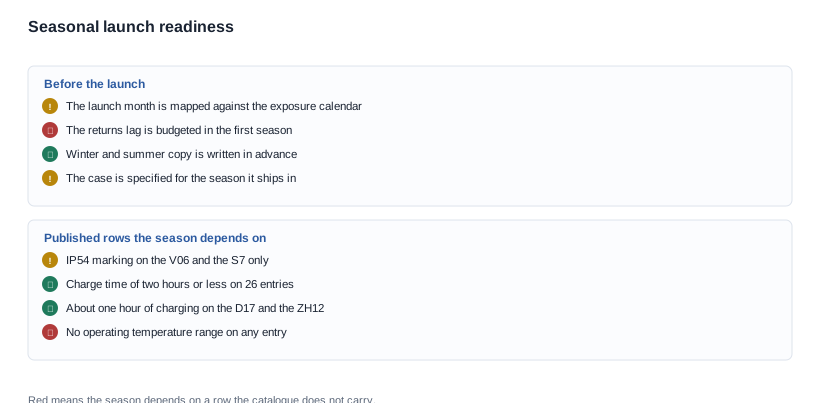
A seasonal plan that lives in a slide deck cannot be ordered against, and the seasonal part of a travel programme is exactly the part that determines the order: the configuration, the quantity, the market, the month and the packaging. Six steps turn the plan into something a supplier and a freight forwarder can both act on.
- Fix the season, then the market, then the month. The order matters because the market list constrains the month rather than the other way round. The completion standard is a market list with an exposure attached to each market and a launch month that follows from it.
- Attach a configuration to each market. The configuration follows the exposure: a market with a wet season needs either an entry with an ingress marking or a case and a handling rule, and the catalogue only offers the marking on two entries. The completion standard is one configuration per market, quoted.
- Size the quantity against the exposure, not against the forecast. A launch into a high-exposure season needs a higher spare-unit provision than a launch into a mild one, and the provision belongs in the first order rather than in a contingency the channel has to source alone. The completion standard is a spare percentage stated on the order.
- Price the packaging for the season. A case is a packaging item and a packaging cost, and the seasonal brief decides which case configuration travels. The completion standard is a packaging specification per market, quoted separately from the unit.
- Set the returns clock against the freight window. For an imported order the freight and customs window can run two to three weeks, which sits on top of the seasonal exposure lag. The completion standard is a returns budget dated on the exposure clock rather than on the sale date.
- Put the seasonal commitments in the agreement. Which claims the listing may carry in this season, which markets it is restricted to, and what evidence the supplier must hold for the configuration. The completion standard is a clause per claim, not a general warranty paragraph.
Why this belongs with the supplier rather than in the marketing calendar. Two of the six steps — the transit file for the shipped configuration and the per-market certification document — have to be settled before the shipment is booked, and the season determines both. A buyer who fixes the launch month after the order is placed has fixed the order's constraint by accident, because the lead time, the transit documentation and the exposure all have to be compatible and only one of them is negotiable after the fact.
The questions to ask the supplier before the launch month is fixed. What is the operating temperature range for this configuration, and at what capacity does the runtime figure hold. Whether a per-model certification document exists for the destination markets in this season. Whether the transit file covers the shipped configuration including the case, since the file is prepared against a lead time that is longer than the season's lead time. And whether a baseline measurement on the production batch is available for the configuration being launched, because it is the document that answers a returns question after the season has started.
How to choose between two seasonal configurations on the criteria that matter. The trade-offs are narrow enough to be decided on three questions, and asking them in this order avoids the common mistake of comparing the two entries on a specification they both lack. First, does the configuration carry the exposure the market produces — an ingress marking, a case, or only a handling rule. Second, does the configuration's published file cover the claims the listing will carry, because a seasonal listing makes environmental claims and those are the claims the catalogue is thinnest on. Third, what does the total cost look like once the packaging, the freight window, the spare provision and the returns lag are counted, because the unit price is the smallest term in a seasonal comparison and the seasonal one is usually decided by the second and third questions together.
What we publish on seasonal exposure, and where we stop
Here, we publish the configurations, the case capacities, the charge times and the charging methods, and we publish no operating temperature range, no thermal data and no temperature-corrected runtime figure for any entry, because our source document contains none. We will not describe a splash-protected product as waterproof, and we will not present a photochromic lens as responding inside a vehicle.
What we publish is the charge time on every one of the 28 entries, the cell configurations, the rated runtimes across the camera tier, the charging interface on the 24 entries where the catalogue carries one, the case capacities on the five camera entries where they are published, the resolution class on the camera entries, the radio version on the audio and sport entries, the IP54 marking on the V06 and the S7 stated as a catalogue attribute, and the published feature lines including the remote shutter on the D17 and the ZH12 and the photochromic lens option on the V03 Pro. What we do not publish and will not estimate is the operating temperature range, the thermal behaviour, the cycle life, the standby draw, the runtime test condition, the per-entry frame weight beyond the single whole-unit figure for the MT6, and any per-model certification row.
What we will do. Take the months, the destinations, the trip lengths and the configurations under consideration, and return the seasonal exposure map for those months, the published rows that bear on each exposure, the configurations that answer them and the ones that do not, and the launch and returns timing we would plan against.
What to send us next. Send the launch window, the destination markets and the configurations, and we will return the exposure map, the launch and returns timing, and the copy constraints the published rows impose. The training programme is at how to train for travel, the sport range is at sport smart glasses, and the scenario entry point is smart glasses for travel.


