

Smart glasses for travel: the file a shipment cannot pass without
The conclusion a travel channel can act on
A travel product crosses at least two borders before it reaches the customer, and the document that decides whether it crosses cleanly is not the training card and not the listing. It is the battery transport file for the exact configuration being shipped, including the charging case if one is in the box. Our catalogue publishes no battery transport documentation for any model, and the catalogue text contains no UN38.3 marking at all, so that file has to be requested before a purchase order rather than found at the border. A travel channel that treats it as a formality discovers it at the worst possible moment, with the freight already loaded.
The second conclusion concerns the configuration, because the case is a second cell. Seven camera models publish a charging case: five of them publish a capacity — 1400 mAh on the CY03 and the CY05, and the L1 Pro, 900 or 1400 mAh as a configuration choice on the L2 Utral, and 1200 mAh in the MT6's foldable case — and two more, the KY06 and the MT5, name a case without publishing its capacity. Four camera models publish no case row at all: the V06 and the V03, and the S7 and the V03 Pro. So a travel configuration that ships with a case roughly doubles the declaration surface, and whether it should is a commercial decision made before the quotation rather than a logistics detail discovered after it.
The third conclusion is about a number the catalogue publishes and a travel buyer cannot use. Every model in the range publishes a charge time — two hours or less on all of them except the D17 and the ZH12, which publish roughly one hour — and that completeness is unusual and genuinely useful. But a published charge time carries no starting state and no end point, so it cannot be turned into a transit-window plan, and it cannot be used as a case turnaround time for a channel that stocks spare units. It tells a buyer roughly how long the device takes; it does not tell a buyer how long to wait.
Who is buying, and what crosses the border
The reader is a brand-side buyer, a channel buyer or an e-commerce seller assembling a travel line: a distributor stocking a travel accessory brand, a rental operator issuing devices at an airport desk, or a brand owner opening a travel category. The situation is usually a quotation to compare, a launch into a new market, or a fleet to issue on hire, and in each case the same question sits underneath: which configuration can legally and physically cross the borders on the route, and what has to be settled before the first shipment rather than at it.
The fear underneath it is not a bad price. It is a container held at a transit point while somebody tries to establish what is inside it, with a customer waiting at the other end and a launch date that has already been announced. That failure is entirely avoidable in the quotation stage, because the information needed to avoid it is a document request, and the document request is free.
Two things have to arrive before the configuration can be fixed. The first is the route: the transit markets and the destination, because the packing and declaration requirements attach to the journey and not to the product. The second is the hire model, because a rental operation issues the device at a desk and has to hand it to someone who has two minutes, while a retail channel hands it over in a box and has days to explain it. Those are different products with the same hardware.
Why the published charge time cannot plan a transit window
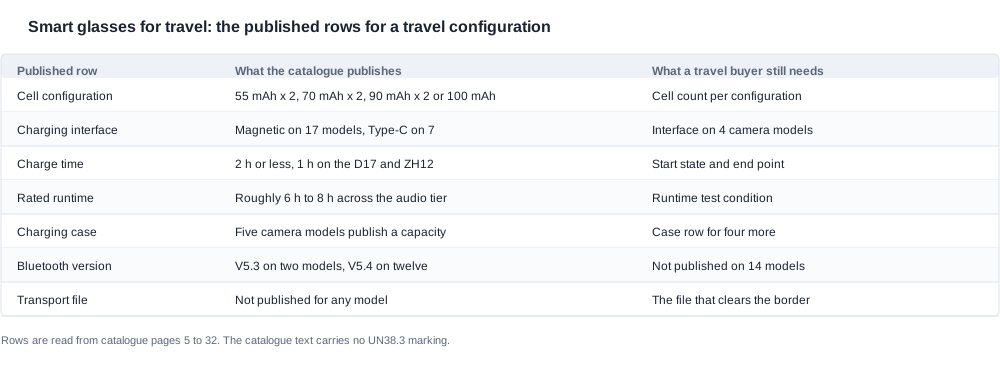
The table above is the working version of the travel criteria list, and it separates what the catalogue publishes from what a travel buyer still has to obtain. The cell configuration is published per model in the form the catalogue uses, which is a cell capacity multiplied by a cell count — 55 mAh × 2 on the LC-105 pair, the G07 and the YK12, 70 mAh × 2 on the YKC02, 90 mAh × 2 on the K01 and the K02, and single cells of 100 mAh on the D11 and the D12, 115 mAh on the D17, 40 mAh on the A05 and the A06 and 70 mAh on the A07. A declaration needs the cell count, and the published figure gives it as a product rather than as a total, so it has to be read out rather than summed on the paperwork.
The Bluetooth row is worth reading for the same reason. V5.3 is published on the K01 and the K02 and V5.4 on twelve models across the range, but fourteen models publish no Bluetooth version at all — every camera model, the A05, the A06 and the bone conduction row. A travel channel that lists a Bluetooth version for a camera model is publishing a number it cannot source, and the radio conformity evidence for those models is a document to request rather than a page to point at.
The interface row decides the card, because the arrival charge is the first thing that happens and the first thing that can fail. Type C is published on the D17 and the ZH12, the V03 Pro and the L2 Utral, and the D12 and the D11, and a Type-C device recharges from a cable that also charges a phone and a laptop. Magnetic charging is published on seventeen models, and a magnetic device needs its own cable or its case, which in a hotel room at eleven at night is one more object to find. The card therefore has to name the cable and the adapter for the transit markets as well as the destination, and a channel that ignores the transit market discovers the problem at an airport.

The rows a travel configuration can be built from
The cell configuration and the second cell
The case question is the one that decides a travel configuration, and it is a decision about declaration surface rather than about battery life. A case in the box is a second lithium cell travelling with the device, so the file, the packing statement and the carrier's paperwork all have to describe it. The published capacities give a real spread to work with — 1400 mAh on the CY03 and the CY05, and the L1 Pro, 900 or 1400 mAh as a configuration choice on the L2 Utral, 1200 mAh in the MT6's foldable case — and the L2 Utral's choice is worth noting, because two configurations of the same model produce two different declarations and two different freight weights.
Where the catalogue is silent, the buyer has a decision rather than a fact. Four camera models publish no charging-case row, so whether a case exists for them is not established by the catalogue and has to be asked. Two more name a case without publishing its capacity, which is the worst of both positions for a declaration: the buyer knows there is a second cell and does not know its size. The safe rule for a travel channel is that the case is either a named configuration on the purchase order with its capacity published, or it is not in the box at all.
The requirement itself is set out at battery transport, and the question to the supplier is narrow: does the file cover the configuration I am ordering, with the case in it, and does it cover the transit markets on my route.
The rows that are not published for any model
Five rows are absent from every page of the catalogue, and all five of them matter to a travel deployment. There is no battery transport documentation for any model. There is no runtime test condition, so the published runtime bands — roughly six to eight hours across the audio tier, five to eight on parts of the camera group, roughly seven to eight on the sport tier — cannot be quoted as a travel day. There is no standby figure, so the gap between a session ending and the device being found flat in a hotel room cannot be predicted from the catalogue. There is no operating temperature range, so a device carried on a deck or in a vehicle in a hot or cold market has no published working limit. And there is no cycle life rating, so the number of charge cycles a hire fleet will get before the cell degrades is not a published figure.
The certification position is the same. The catalogue carries a single company-level export certification page, and it carries no per-model certification row, and the catalogue text contains no CE, FCC, RoHS, REACH or UN38.3 marking whatsoever. For a travel channel that is the decisive gap, because the radio conformity evidence a traveller's device needs in each destination market is a per-model document, and the directive it is filed under is the Radio Equipment Directive (EU) 2014/53/EU with the EN 301 489 series as the harmonised EMC standard. A buyer who needs that file has to ask for it by model and by market, and the supplier cannot answer from a catalogue page.
Verifying the travel configuration before the first order
The document request that clears the border
Verification in this category is almost entirely documentary, and it fits into a single request if it is written narrowly enough.
- Ask for the battery transport file for the exact configuration, including the charging case if one is in the box, and ask for the test summary reference it carries rather than the file alone.
- Ask for the packing statement that matches the configuration, so the cell count in the box and the cell count on the paperwork are the same number.
- Ask for the charging method for the models where it is not published, and for the case configuration where the catalogue publishes no case row, so the declaration is complete before it is written.
- Ask for the radio conformity evidence per model for each destination market, including the declaration of conformity and the test reports behind it.
- Ask for the certification scope per model for each destination market, because a travel channel faces several markets with one product.
- Ask for the runtime figures with their test conditions and the standby figure, so the hire duration can be set from a measurement rather than from a rating.
- Ask for the operating temperature range and the cycle life rating, both of which a hire fleet needs and neither of which is published.
- Ask for the model designation table, the certificate register references and the agreed incoming inspection criteria, so a returned unit can be traced and a damaged unit can be triaged.
The order matters because the transport file gates the shipment and everything else gates the card. Work backwards from the file to the configuration and from the configuration to the commercial terms, because a term negotiated against a configuration that later changes is a misunderstanding with an invoice attached.
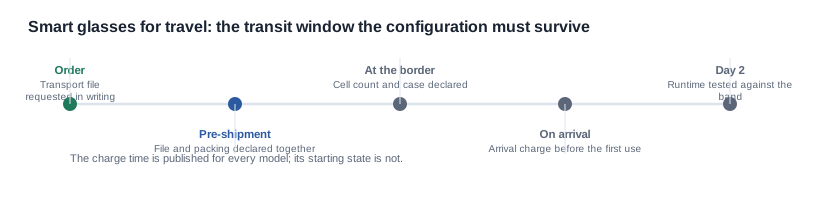
The sequence above is the order the documents have to arrive in, and the third step is where a lot of travel channels discover the problem: the cell count and the case have to be declared together, which means the case decision cannot be deferred to the packing stage.
The card, and the two trainings behind it
A travel product has one moment where the customer is receptive, and it is not the sale. It is the unpacking — in a hotel room, at the end of a long day, in a country whose sockets they have just joined. Everything the training teaches has to survive that moment, and anything that needs a screen, a manual and a quiet half hour will not. So the output is a card read once, in bad light, by a tired person, with four things on it.
| On the card | Why it is there | What it rests on |
|---|---|---|
| Which cable, and what to do when the socket is not the right shape | The arrival charge is the first thing that happens and the first thing that can fail | The published interface rows, and the market's socket standard |
| How to connect it, and what to do when it will not | The second thing that happens, and the most common support contact | The Bluetooth version rows and the product's own procedure |
| Where it goes when it is not being carried | The third thing, and the one that prevents a scratched lens | A pocket, a sleeve or the case, since lens material and coating are not published |
| What may be recorded, and where | The fourth thing, and the one a traveller cannot work out alone | A per-market position, written for the traveller rather than for a regulator |
The connection line has to include the failure case. The Bluetooth version rows are published per model, but there is no qualified list of phone models and operating system versions, so the card cannot promise compatibility. It can only give the procedure and say what to do when the procedure does not work, and a card that only says "pair your phone" generates a support contact on day one. The related question is at does it need a phone.

Staff and users need different training from the same pack. The staff session — for a retailer, a rental operator or a travel desk that issues the device — is short and covers the issue, the condition and the count. The user session is the card, plus the four habits. The two share the storage line and the charging line and differ on everything else, and a programme that blends them produces a user who has been told about an issue procedure they do not own and a member of staff who was never told what condition the device should be in.
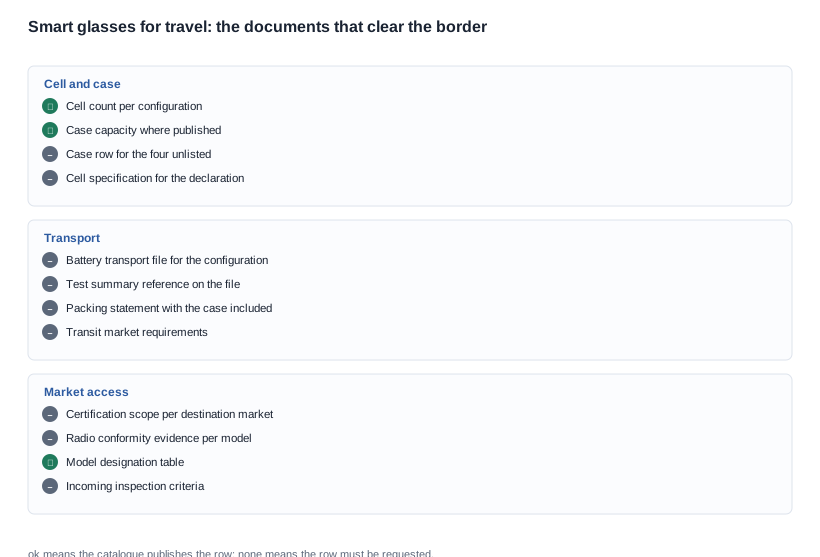
The checklist above groups the request by what each group protects. The cell and case group fails as a held shipment, the transport group fails as a refused entry, and the market-access group fails as a product that cannot be sold into the market it was designed for.

Where a travel deployment goes wrong
The failures below reach a buyer as a surprise, and each is written as a symptom, a root cause and a control.
A transport request made after the order. The requirement is asked about at the border rather than in the quotation, which is the worst possible moment to discover it, and the consequence falls on the buyer rather than on the factory. Control: the file is a condition of the purchase order.
A case added at the packing stage. A configuration that shipped without a second cell is repacked with one, and the declaration no longer matches the paperwork. Control: the case is a named configuration with a published capacity, or it is not in the box.
Training that happens at the sale. The customer is receptive at the unpacking, not in a shop. Control: the card is issued at the point of handover and at the issue desk.
A card that assumes a screen. A link to a setup video is a link that does not get followed in a hotel room. Control: the card carries the procedure in text and the adapter in the box.
A runtime quoted as a travel day. The published figures carry no condition, and a customer who tests on the second day finds the difference. Control: the card states the published band and the absence of a condition.
No count of what went out. In a rental or a retail loan scheme, without a number the loss rate is invisible until it is expensive. Control: count out and count back against the model designation.
What a travel programme costs commercially
What a travel programme can still move
Four terms in a travel programme carry real room, and all four sit outside the unit price. The first is whether the case is included and at which capacity, which is the main commercial lever in a travel configuration: it changes the price point, the freight weight and the transport file together, so it has to be decided in one conversation rather than three. The second is whether the supplier prints the card and reviews it before it ships, so that the criteria the card teaches are the same criteria the incoming inspection uses, in the language of the destination market.
The third is whether an adapter ships for the transit market, which is a per-unit consumable with a real failure rate attached and a very small unit cost. The fourth is the consumable set — a cleaning item and a contact item — because a bag is the least clean object a lens spends time against and a traveller's shirt is the most available cloth in it, while a dirty contact turns a device into a support contact rather than a fault.
Order bands, the quantity kept at pilot tier, and an opening order sent as two shipments against staged payment are all negotiable, and the part held at pilot tier is usually the most valuable, because that is the supplier's own risk exposure. The incoming inspection criteria and the issue condition list are a negotiation between two parties and are worth settling in writing, because in a hire channel the condition a device is returned in is the condition the next customer receives.
What a travel programme cannot move
Three costs are not negotiation targets. The cell configuration, the charging interface and the case architecture are fixed for a given model. The battery transport documentation and its lead time follow the testing process and the issuing body, and they are incurred per configuration rather than per unit. And tooling is a one-time cost that should be quoted as a separate line and amortised across the order, because a quotation that folds tooling into the unit price hides both its size and the point at which it stops being payable.
The travel-specific addition to the commercial conversation is the destination and transit market list, because a configuration that is cleared for one market may need a different radio conformity evidence set for another, and a channel that prices one market and ships to three has under-budgeted the compliance work. A buyer who wants the exact terms will find: the terms as written is at contract terms, and the commercial outline of an opening order at pricing.
What we publish for travel, and what we will not claim
Concretely, we publish the rows a buyer can order from and we will not fill the gaps with typical values. For this range that means the Bluetooth versions per model, the cell configurations as cell capacity and cell count, the charge times of two hours or less and roughly one hour on the D17 and the ZH12, the rated runtimes, the charging interface per model where it is published, the structural features that are published, the colour counts and the case capacities where they are published.
What we do not publish, and will not estimate: the battery transport documentation, the runtime test condition, the standby figure, the cycle life rating, the operating temperature range, the per-model unit weight beyond the single 158 g whole-unit figure for the MT6, the frame material, the lens material, the coating, the hinge specification, the field of view, the video specification and the Bluetooth version of any camera model. We publish no per-model certification row, and we will not present the company-level export certification page as though it were a per-model document.
What we will do is take the markets, the transit points, the trip lengths, the channel and the price band, and tell you what the card has to carry in that order, which claims it must not make, and which documents have to be settled before the first order. Send us the route and the configuration you are considering, and we will return the published rows that cover it, the transport and market-access documents to request, and the interface decision that decides whether a case is in the box.
Related reading
- How to enter the scenario — smart glasses for travel
- The range covered — Bluetooth audio glasses
- The seasonal note — travel seasonal considerations
- The transport requirement — battery transport
Tell us the markets, the transit points and the configuration, and we will say what the card has to carry and what has to be cleared before the first order.


