
Frame materials are the first thing a buyer asks about and the last thing worth arguing about, because in this category the material is decided by the electronics rather than chosen for the appearance. A temple has to carry a cell, a protection circuit, a control board, possibly a camera module and a speaker, and the material has to survive that assembly as well as survive the head.
Which means the material choice in a smart glasses frame is a set of constraints, and the useful question for a buyer meeting this for the first time is what those constraints are rather than which material is best. The criteria below are the ones that decide the outcome, and they are the same criteria a veteran buyer uses.
Our published data for the range is thin on materials specifically, and it is worth seeing how thin before you start. The catalogue lists twenty-eight product entries, and eleven of them carry a camera — eight at 8 MP and three at 13 MP. The unit weight is published for exactly one model in the range, and that figure needs its exact terms: the MT6 glasses unit at 158 g including its 265mAh cell and its camera, excluding the foldable charging case, whose capacity is 1200mAh and whose weight is not published. The weight of a bare frame is not published for any model. The frame dimensions, the temple length and the temple curve are not published for any model. The certifications named across the catalogue are a company-level export certification statement with no per-model rows behind it, so nothing there can be read as a certificate for an individual product. The published colour options are three for the V03 Pro and four for the V06.
So smart glasses frame materials smart glasses for beginners is an orientation to the choices, written for a buyer meeting this for the first time, and it is oriented around the constraints rather than around the names.
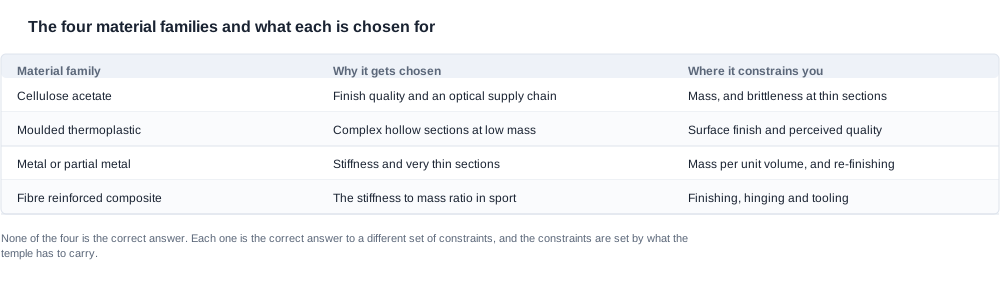
Smart glasses frame materials: four families and what each is chosen for
Cellulose acetate. The traditional optical frame material, and the one buyers associate with a smart glasses product because it resembles eyewear. Its virtue in this category is that the existing supply chain understands it: tooling, finishing, hinge assembly and lens edging all work. Its constraints are mass and brittleness at thin sections. An acetate temple carrying electronics has to be thicker than an optical temple, and thin acetate is where it fails.
Injection-moulded thermoplastics, usually on a nylon or TR90 base. This is the material most of the electronics in this category actually use, because it takes the complex hollow shapes and the integrated bosses that a battery and a board need, and because it is light. Its constraint is finish and perceived quality: a moulded plastic frame has to be finished well to avoid reading as a toy, and the surface quality is where the difference between a good product and a cheap one is visible.
Metal, usually on the temples or as a partial frame. Its virtue is stiffness and the ability to carry thin sections. Its constraints are cost, mass per unit of volume, and the fact that a metal temple cannot be re-finished easily.
Fibre-reinforced composites. Occasionally used in sport and cycling products where the stiffness-to-mass ratio is the priority. Their constraints are that they are harder to finish, harder to hinge, and — in a product that has to pass as eyewear — harder to make resemble eyewear at all.
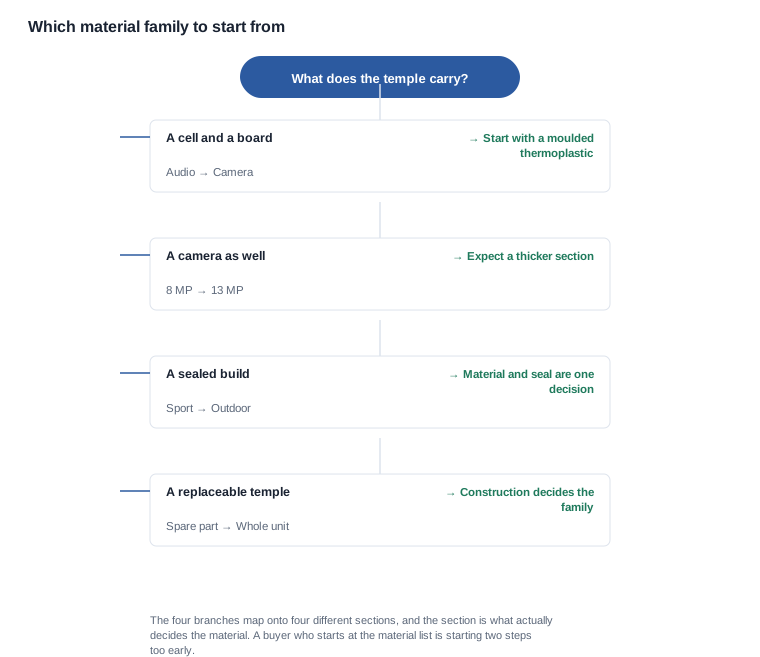
The four families are not competing products. They are four answers to four different constraint sets, and the constraints are set by what the temple has to carry. A buyer who starts with the family list is starting two steps too early, and the reason this matters commercially is that the choice of family determines the tool, and the tool is the largest single number in a first order. If you are learning how to choose a frame material for the first time, the shortlist you need is not a list of materials at all: it is a list of the payload configurations that are viable, and the tool count that each of them implies.
Why the family is decided by the payload and not by the appearance
The single most useful thing a first-time buyer can internalise about frame materials is that the payload decides the family, and that the appearance is decided afterwards by the finish.
Here is the chain in full, and each link is a physical constraint rather than a preference.
The payload sets the volume. A cell alone needs a bay. A cell plus a control board needs more. A cell, a board, a speaker and a camera module need more again, and the camera module is the one that changes the shape of the bay rather than only its size, because a camera has to point in a direction.
The volume sets the section. The temple has to be deep enough to hold the bay, and the section is what the material has to be stiff enough for. This is the step at which most first-time buyers' intuitions fail, because they think of the material as deciding the thickness, when in fact the payload decides the thickness and the material then has to live with it.
The section sets the family. A payload that fits in a thin section can be carried by a moulded thermoplastic, which is light and takes complex shapes. A payload that demands a deep, stiff section pushes towards a different construction entirely — a metal temple, a wrapped core, or a thicker moulded section with a heavier mass. The family is the consequence.
The family sets the tool. And the tool is the largest single number in a first order, it is a one-off, and it is the item with the longest lead time. That is why the sequence matters: a decision taken at the family level without a payload behind it is a decision that will be revisited at the tool stage, and a decision revisited at the tool stage costs a second tool.
The finish comes last in this chain, and that is not a marketing position. Matte, gloss and soft-touch are process steps applied to a material that has already been chosen, and they can be changed without a new tool in most cases. Which means the finish is the cheapest variable in the whole chain and the appearance is the most flexible — the exact opposite of how the conversation usually starts.
The four questions that settle the material
One: what has to go in the temple? A camera module, a speaker and a microphone demand more volume and more stiffness than a cell alone. The requirement drives the section thickness, and the section thickness drives the material. This is the question to answer first, because everything else depends on it.
Two: what is the target mass? This is the one nobody can answer from a catalogue in our range. The unit weight is published for one model in the entire catalogue, at 158 g for the MT6 glasses unit including its cell and camera and excluding the foldable case, and not published for the rest. If mass is your decision variable, ask for it in grams per model, in writing, per build, and treat the answer as a data request rather than a courtesy.
Three: what is the finishing requirement? Matte, gloss or soft-touch. A gloss surface shows fingerprints and shows tool marks; a matte surface hides tool marks and shows less of the design detail. The finish also determines what the quality inspection actually examines, and a gloss inspection is a stricter inspection than a matte one.
Four: what is the ingress requirement? A sealed enclosure in a specific material behaves differently from a moulded one with a seam, and the material and the sealing approach are one decision rather than two. In our range the published ingress marking is IP54, and it appears on the V06 and on the S7 and on no other model — as a catalogue marking, with no third-party test report number published behind it.
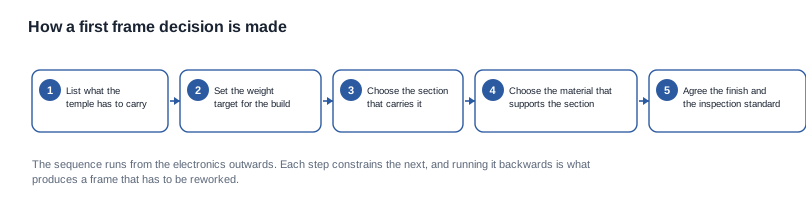
The sequence in that diagram is the whole of the method, and it runs from the electronics outwards. Each step constrains the next one, and running it backwards is what produces a frame that has to be reworked. A buyer who starts with "we want it to resemble acetate" has started at step five and will find the other four steps at the point where they are expensive.
A worked example of the four questions
Four questions are easier to apply than to describe, so here is one programme run through them end to end. It is a hypothetical scenario rather than a client project, and it is here to show the sequence rather than to report an outcome.
The programme. A brand is putting an open-ear audio product into a workplace channel. The requirement is a four-hour daily use with a single charge, the product has to survive being put on and taken off repeatedly, and the channel has already fixed the unit price band.
Question one: what goes in the temple? A cell and a control board, and a speaker port in each temple. No camera module, so the bay does not have to change shape. The published cell configurations relevant here are the dual arrangements at 55mAh×2 and 90mAh×2 and the single cells at 100mAh and 200mAh, and the brand's four-hour requirement with a single daily charge points it toward the dual arrangements rather than the smallest single cell.
Question two: what is the target mass? The brand has no published figure to work from, because our range publishes a mass for one model only. So the brand sets the target from its own supply chain rather than from a catalogue, and asks for the figure per model in writing. This is the point where a first-time buyer discovers that the number they need is a data request, not a courtesy.
Question three: the finish. The channel is a workplace channel with retail lighting, so the brand asks for a gloss assessment against a reference board rather than a general approval. That is the cheapest decision in the whole programme and it is made now, at the quotation stage, rather than at the first article.
Question four: the ingress requirement. A workplace product is not sold into rain and is not sealed, so no ingress marking is required, and the brand can skip that whole line of enquiry. Saying so explicitly at the start is what stops the programme buying a specification it does not need.
What the sequence produced. A payload that fits one of the published dual-cell configurations, a mass target the supplier can quote against, a finish approved against a physical board, and no ingress scope. Each of those four answers came from a question that took one email, and each of them removes a variable that would otherwise have been settled by a supplier's preference at a later and more expensive stage. The trade-offs in the sequence are real — a tighter mass target narrows the payload options and a sealed build widens the compliance scope — and the point of running the four questions in order is that you get to see those trade-offs before the tool, rather than after it.
What a first-time buyer gets wrong about frames
Assuming the frame can be like an optical frame. An optical frame carries a lens and nothing else. A smart glasses frame carries electronics, and the frame has to be designed around them. This sounds obvious and it is still the most common mistake, because the finished product resembles an optical frame and the quotation reads like an optical quotation.
Assuming a colour option means a new material. The published colour options in our range — three for the V03 Pro and four for the V06 — are finish and pigment decisions within an existing material, not new materials. A new material is a new moulding process and a new qualification. The distinction is worth a great deal, because the first is a commercial decision and the second is an engineering one.
Assuming the frame is not a part that fails. In this category the temple, the hinge and the charging interface are the service items, and the frame's structural role is different from an optical frame's. A hinge on an optical frame carries almost nothing; a hinge on a smart glasses frame carries a cell.
Assuming mass is discoverable later. It is the variable that drives retention and returns, and it is the one that is not published in our range for nearly every model. It also cannot be derived from a photograph or from a material name, so the request has to go out early.
Assuming the certification page answers the product question. Our catalogue carries a company-level export certification statement, and there is no per-model row anywhere beneath it. A buyer searching for "the certificate for this model" will not find one, and a buyer who assumes one exists will discover it after the artwork is printed. The practical habit is to request certificate numbers per model, with the issuing body and the validity dates, and to treat a family-level document as covering nothing in particular.
The two mistakes that survive into production
Most of the mistakes above are caught during evaluation. Two are not, because they do not show up until the line is running, and it is worth naming them while a first-time buyer is still reading.
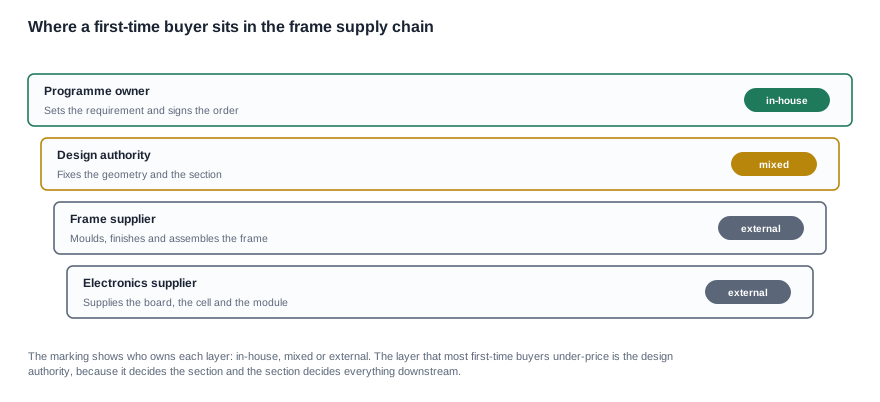
The first is discovering that the frame and the electronics were designed separately. The section was fixed by one team and the bay was fixed by another, and the two do not agree. It surfaces as a unit that will not assemble, or as a section that is deeper than it needs to be, or as a bay that has to be filled with foam to stop it moving. This is a structural agreement problem rather than a material problem, and the way to prevent it is to ask the supplier to confirm that the section and the bay were developed together, with the cell configuration in hand.
The second is discovering that the finish approval was an approval of a sample rather than of a standard. A first article is approved against one unit, and if the supplier has no reference board, then the next unit is judged against a different unit and the rejection rate is a surprise. The way to prevent it is to ask for the inspection standard in physical terms before the first article and to keep the board. It is a small request and it changes the definition of what "approved" means.
Both of these are cheap to prevent at the quotation stage and expensive to prevent afterwards, and both of them are the reason this category rewards a buyer who writes the questions down before the order rather than after it. The red flags are easy to spot once you know them: a supplier who quotes a frame mass for a build you did not ask about, and a supplier who has no inspection standard for the finish. The pitfalls in this category are rarely exotic; they are almost always a number attached to the wrong configuration.
The six questions to ask before your first quotation
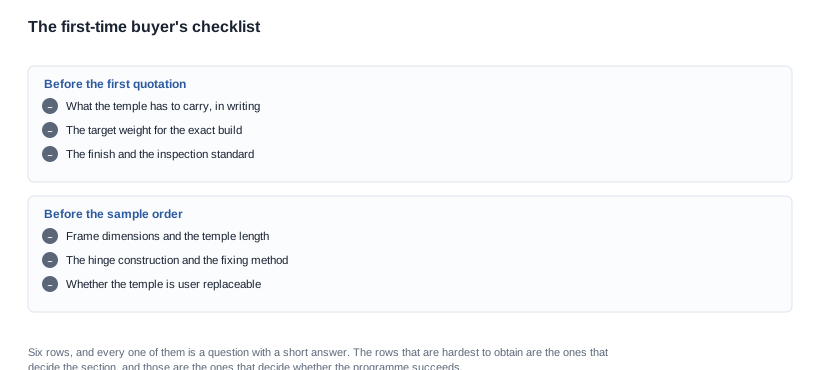
- What is the frame mass in grams for the exact configuration, including the fitted cell?
- What is the frame material, and what is the finish process?
- What are the temple dimensions and the temple curve? These decide how the frame sits and are the variable that drives returns.
- Which parts of the frame are user-replaceable, and how are they fixed? A replaceable temple or a replaceable charging-interface assembly changes the service model entirely.
- What has to go in the temple, and what section thickness does that require?
- What certificate numbers does the supplier hold for this exact model string?
The first four are the ones that decide the product. The fifth is the one that decides the material. The sixth is the one that decides whether the product can ship. What to ask is the question, but the practical form of it is the numbered list, because a numbered request gets a numbered answer and an answer that cannot be attached to a build is not usable.
There is a seventh question worth adding that is not about the frame at all: what does the supplier need from us, and when do they need it? A first-time buyer in this category is often the least well-informed party in the room about the programme's own dependencies — the cell configuration, the charging interface, the firmware, the branding. Our published cell configurations run from 40mAh single cells in the children's models through 55mAh×2, 70mAh×2 and 90mAh×2 dual arrangements to single cells at 100mAh, 115mAh, 200mAh, 220mAh, 260mAh, 265mAh and 290mAh, and each of those implies a different section. A supplier who asks for the cell configuration early is saving you a tool.
Why a smart frame is not an optical frame
Concretely, we publish the figure we hold — 158 g for the MT6 glasses unit including its cell and its camera and excluding the foldable charging case — and not published for the rest, and we will not fill a material or a dimension row with a typical value from the optical industry, because a smart glasses frame is not an optical frame and the values do not transfer.
We will also be direct about the limit. We cannot tell you which material is right for your product without knowing what the temple has to carry and what the mass target is, and we will not present a general preference as though it were a recommendation for your programme.
Before you order a first programme, it is worth deciding what kind of order you are making: a branded build on an existing platform, or a new configuration. The total cost of the two is not comparable at the unit price, and the difference is the tool. What we can do is narrow the options honestly. If you send the requirement set and the target mass, we will tell you which material families are realistic for that payload, which of them need a new moulding process rather than a different colour, and which published rows we can fill for you today. That is the shortlist, and it is the start of a conversation about how to evaluate the models on it rather than a finished answer. Our range includes published temple details on a small number of models — the G07 with an ultra-slim and a detachable temple, the YK12 with a slim temple, and the V03 Pro with flexible temples — and where a model publishes a temple description we can tell you how the service construction works.
For a first programme, the practical route is the Smart Glasses OEM ready platforms page, where the configuration is already settled and the variable is your branding rather than the frame. The colour options are covered under standard OEM colour options, the frame assessment procedure is under frame assessment from a sample, and the wider material context is under materials and ergonomics.
Related reading
- Materials and ergonomics
- Bluetooth audio glasses comfort and fit
- Standard OEM colour options
- Smart Glasses OEM ready platforms
Send the requirement set and the target mass and we will tell you which material options are realistic.


