

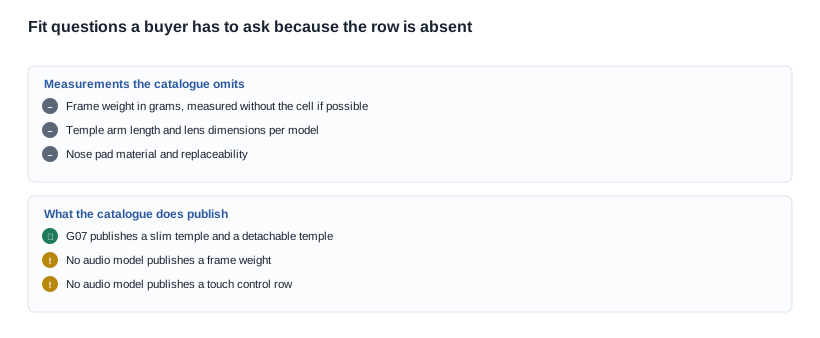
No Bluetooth audio glasses model in our range publishes a frame weight. Not the K01 or the K02, not the D11 or the D12, not the LC-105-1 or the LC-105-2, and not the G07 or the YK12. Temple arm length, lens dimensions and nose pad specification are absent from every one of the eight as well. For a buyer, that is not an omission in an otherwise complete table — it is the largest structural gap in this category, and it is the one that drives return rates and therefore channel cost.
This article therefore does not name a most comfortable model, because no published row supports such a conclusion. What it does instead is set out which measurements a buyer has to obtain, in the order that minimises rework, which published row is the nearest available proxy, and what belongs in the agreement so that the gap does not become a dispute after the first shipment.
Bluetooth audio glasses comfort and fit: why the published rows cannot answer it
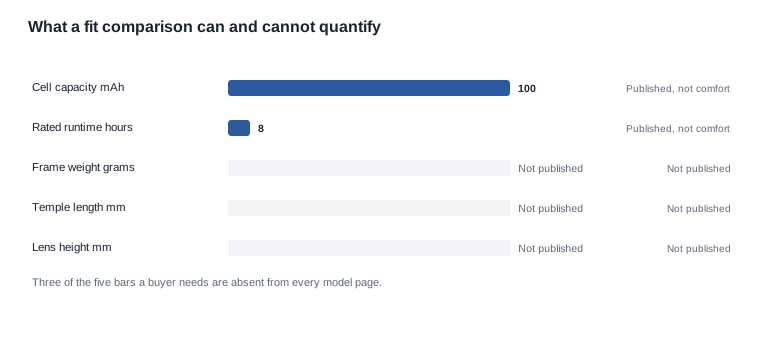
The instinct on receiving a specification sheet is to treat the larger cell as the heavier frame. That inference fails in both directions here, and the reason is worth stating precisely before any shortlist work begins: the published cell values tell you how much energy a model carries, not how much mass sits on the nose bridge.
The eight audio models publish three cell configurations. The K01 and the K02 publish 90mAh*2, the LC-105-1 and the LC-105-2 publish 55mAh*2, and the D11 and the D12 publish a single 100mAh. Two of those three are dual-cell designs and one is single-cell. A dual-cell design plausibly spreads mass across two temples, which would tend to reduce concentrated pressure, and a single-cell design plausibly concentrates it. Those are engineering intuitions about plausible constructions, and they are exactly the kind of intuition a buyer should not build a shortlist on, because no published row confirms either one.
The failure mode is quantified by the size of the spread. The difference between a 55mAh*2 configuration and a 90mAh*2 configuration is a small fraction of a gram of lithium across two cells. The difference in unit mass between frames of any real construction is many times larger than that. In other words, the published row varies by a negligible amount while the quantity that actually governs pressure varies substantially. The variable on the sheet is not a weak proxy for the variable that matters — it is effectively uncorrelated with it, which is a stronger statement than saying the data is insufficient.
The five measurements a shortlist comparison has to include
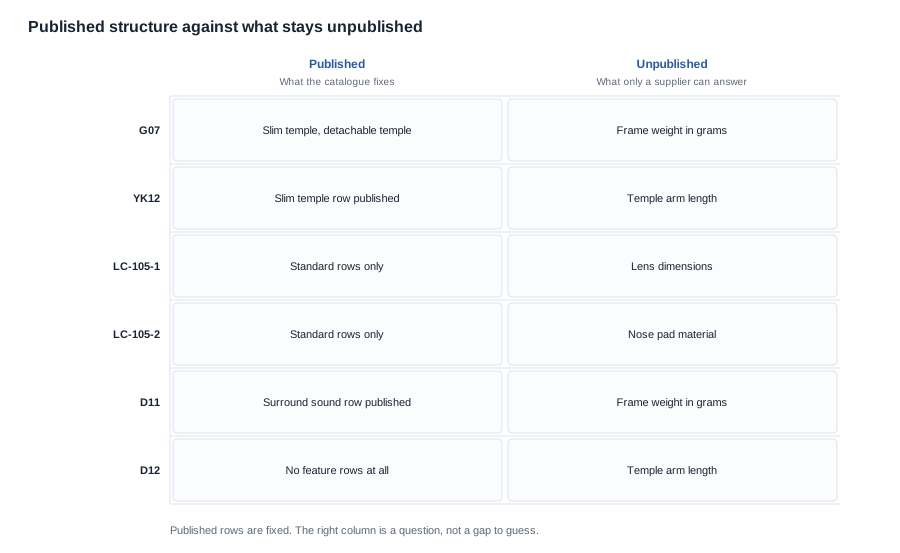
Stating the absence is only useful alongside the list of what replaces it. A shortlist comparison in this category needs five measurements, and the catalogue publishes none of the five.
-
Unit weight in grams, measured as the unit ships. This is the figure that governs pressure across a working day, and it has to be a unit weight rather than a bare frame weight, because the cell and the electronics are part of what a head carries.
-
Temple arm length, in millimetres. Arm length determines whether a frame migrates forward over a day, and forward migration is what produces the pressure marks that generate returns.
-
Lens height and lens width. Vertical lens dimension governs how much of the field sits ahead of the eye, and it also determines whether the retail proposition is an everyday frame or something else.
-
Nose pad material and whether pads are replaceable. Replaceable pads are a serviceable part, and serviceability changes what a distributor can resolve locally rather than return for a credit.
-
The mass of any detachable component, and whether it is included in the unit weight. This is the item most often quoted ambiguously, and the ambiguity is unavoidable wherever a detachable temple is involved.
What the catalogue does publish, and how far it gets
The audio range publishes the cell configuration, a rated charge time of two hours or less, the rated endurance, the charging method, the Bluetooth version and a small number of feature rows. Those feature rows bear on geometry in exactly two places in the whole range.
The G07 publishes a row describing a slim temple and a detachable temple. The YK12 publishes a row describing a slim temple. Those two rows are the only published structural facts in the entire catalogue that bear on how a frame sits on a head. A detachable temple is not a comfort specification — it is an adjustability and serviceability specification, and it is the single published structural difference among the eight with direct bearing on geometry.
The D11 publishes a surround-sound row and a long-endurance row, neither of which is a geometry fact and neither of which should be cited in an argument about pressure or adjustment. The D12 publishes no feature rows at all: it carries the five standard specification rows and nothing beyond them. That makes the D12 the model in this range about which a geometry claim has the fewest published references of any kind.
One caution about the published weight elsewhere in the catalogue
A buyer comparing the audio range against the camera range will encounter exactly one published weight figure in the whole catalogue, and it belongs to the MT6. That figure is 158 g for the glasses unit itself, including its 265 mAh cell and the camera, and excluding the foldable charging case. It is not a bare frame weight, it is not a frame weight for any audio model, and transferring it into an audio comparison is a category error that survives all the way into a retail listing. The weight comparison article sets out that distinction in full.

An assessment protocol that produces comparable data
Because no published row answers the geometry question, the only route to an answer is a measurement programme — and it has to be structured, or it produces anecdotes instead of evidence a shortlist can be defended with. The sequence below has a checkable completion criterion at each step.

Order a sample of every shortlisted model, not one. A single sample cannot be compared against anything; the entire value of the exercise comes from having two or more units assessed under identical conditions. The sample order is the step most often under-scoped, because it is treated as a formality rather than as the measurement that everything downstream depends on.
Weigh each unit and record the figure with the cell fitted. Weighing has to happen on the unit as it would ship. A bare frame and a shipped unit are two different products, and a comparison that mixes the two states is not a comparison. If a detachable temple is part of the configuration, weigh both states and record both figures.
Measure temple arm length and lens dimensions directly. These are physical measurements a buyer can take with a ruler in a few minutes, and taking them removes the dependency on a supplier response for the first three of the five required measurements.
Log onset time and pressure location rather than a comfort verdict. The useful variable is when discomfort appears, not whether it appears. A frame that is acceptable at one hour and problematic at four is a different product from one that is problematic at one hour, and only a timed log separates the two.
Record refit frequency for any detachable temple. A temple that has to be removed and reinserted every morning is a worse proposition than one fitted once, so the frequency belongs in the same log as the pressure record rather than in a separate note.
Record every figure against a written configuration. A measurement taken on a sample is only meaningful if the sample is identifiable as a configuration. Recording model, cell, charging method and colourway next to each measured number is what makes the data usable at reorder stage, when the physical sample no longer exists and cannot be re-measured.
Why supplier questionnaires cannot replace this stage
The reason this stage cannot be delegated to a supplier questionnaire is an asymmetry in what each party is measuring. A supplier asked for frame weight will give a number, and that number will be accurate for a bare frame, because a bare frame is what a supplier weighs. The shipped unit carries a cell and an electronics assembly in addition, and that difference is the part which contacts the head. The two answers are both correct and they answer different questions.
The same asymmetry applies to temple adjustment. A supplier describes the adjustment range a design permits. A buyer needs to know whether that range covers the head-shape distribution in the channel being served. For a brand retailing to a broad audience, the second question determines the return rate, and it cannot be answered by any published row or by any specification the factory holds.
The two situations most likely to produce a channel problem
Two groups in this range deserve separate handling because they are the configurations most likely to generate returns.
The first is the dual-cell group — the LC-105-1 and the G07, the YK12 and the LC-105-2, and the K01 and the K02. Two cells means more total mass distributed across the frame, and the question that has to be answered is whether that distribution is symmetric. Symmetry cannot be established from a specification sheet and has to be confirmed by assessment.
The second is the single-cell group, the D11 and the D12. A single-cell design concentrates mass, and where that mass sits relative to the contact points is the question a buyer should put to the supplier directly. The D11 publishes a surround-sound row and the D12 publishes no feature rows, so if the two differ in how the cell and the audio hardware are arranged, the catalogue does not record that difference.
Red flags to watch for in a supplier answer
Four answers in this area indicate that the supplier is quoting a different product from the one being ordered, and each is worth recognising before a deposit is discussed.
An answer that gives a bare frame weight without stating whether the cell is included. An answer that gives a weight for a model without naming the model. An answer that describes the temple as adjustable without giving a range. An answer that returns a single comfort verdict where a measurement or a protocol was requested. None of the four is unusual, and none is disqualifying on its own; the point is that each one leaves the configuration unidentified, and an unidentified configuration cannot be controlled at reorder.
What this means for the total cost of a channel
Because geometry is unpublished, the cost it generates cannot be priced at quotation stage either, and a buyer who builds a channel model without it is understating the number by whatever the return rate turns out to be. The arithmetic is straightforward once the return rate is known: the cost per retained unit is not the unit price, it is the unit price divided by the retention rate, plus the reverse-logistics cost of the units that come back, plus the review and reputational cost that follows a run of returns on a new listing.
A geometry problem therefore does not stay a geometry problem. It becomes a landed-cost problem in the second shipment and a channel-ranking problem in the third, which is why an assessment programme that costs a few days in the pre-order phase is cheap relative to the alternative. The bulk ordering article covers how the commercial terms for this range are structured once a configuration has been settled.
What this means for repeat orders
The second run of any configuration faces a specific geometry risk that the first run does not. The first run is built from a sample that a buyer has measured. The second run is built against a written description, and the written description is where the missing measurements bite: if the unit weight, the temple length and the lens dimensions were never written into the approved specification, there is nothing to hold the second run against.
The remedy is procedural rather than technical. At the point of sample approval, the measured figures should be written into the configuration record alongside the published rows, and that record should be the document the purchase order references. A repeat order that references the published rows alone has left the geometry uncontrolled, and the only way to detect a substitution at goods-in is to weigh and measure a sample of the delivered units against the approved figures.
That check is cheap — a scale and a ruler against a documented baseline — and it is the only geometry control available to a buyer when the catalogue publishes no geometry at all.
Handling the two groups where the assessment takes longest
The dual-cell group needs longer because the comparison is harder. Four of those six models — the LC-105-1 and the YK12, and the G07 and the LC-105-2 — publish the same 55mAh*2 cell configuration and the same magnetic charging method, so the published rows cannot separate them at all. The only two that publish any distinguishing row are the G07, with its slim and detachable temple, and the YK12, with its slim temple. That leaves four models that a buyer cannot rank on anything except geometry — and geometry is precisely what is not published.
That is the strongest argument in this article for running an assessment programme rather than reading a table. When the published rows are identical, the published rows are not evidence, and any shortlist built on them is a guess presented as a finding. The two models that do publish a temple row can be separated from the four that do not, and that separation is the only structural distinction available within the 55mAh*2 group.
The single-cell pair, the D11 and the D12, is easier to separate structurally because the D11 publishes a surround-sound row and the D12 publishes no feature rows. The buyer still has to assess both, but at least the two are distinguishable on published evidence before any measurement happens.
What to do when a sample disagrees with the approved configuration
Sometimes the measured unit does not match what was expected, and the useful move is to know what that mismatch is evidence of. A unit that is heavier than the approved sample by a material margin indicates a cell change, a component change or an accessory change — and all three have consequences beyond geometry, because each of them can alter the charging method, the parcel contents or the published rows.
Treating a weight mismatch as purely a comfort issue is the mistake to avoid. The mismatch is a configuration-control signal, and it should be investigated before the shipment is accepted, not logged as an observation about how the product feels. A configuration that has drifted from the approved one means the order is no longer against the specification it was placed under, and every downstream document built on that specification — the transport file, the packaging artwork, the retail listing — is now potentially out of step with what is physically in the carton.
Four clauses turn the geometry gap from an assumption into a controlled item, and each is cheap to request before signature and expensive to add afterwards.
The first is a clause requiring the shipped unit to match the approved sample on unit weight within a stated tolerance. The second is a clause naming the configuration — model, cell, charging method, colourway — as the controlling description, so that a repeat order runs against a document rather than a model name. The third is a clause making both the published rows and the recorded measurements part of the specification, so that a change to either is a change to the order. The fourth is a returns clause that defines a defective-unit geometry case explicitly, rather than leaving it to a general satisfaction standard that cannot be enforced.
None of these clauses asks the supplier to publish anything it does not hold. They ask for the figures to be named in the document where the buyer can use them, which is a different request and a much easier one for a factory to agree to.

Where our published boundary sits on geometry
On this, our position is narrow and we would rather draw it explicitly than fill the gap with a plausible figure. We publish the electrical rows and the feature rows for all eight audio models, in the form the factory builds them. We do not publish a frame weight for any audio model, we do not publish temple length or lens dimensions, and we do not publish a nose pad specification. We are not going to publish a typical weight that cannot be verified against a specific configuration.
Where a constraint maps onto a published row — the cell configuration, the charging method, the Bluetooth version, and the two slim-temple feature rows — a buyer can narrow the range today without asking us anything. Where the constraint is geometry, there is no published row to read and the answer has to come from an assessment programme and from the supplier. That is an inconvenient boundary, but it is a real one, and a buyer who plans around it early will not be the buyer who discovers it after the first shipment. The charging options article covers the accessory decision that shares the same carton, and the entry level grouping article covers how the published rows can be grouped without reference to price.
What to measure, and in the order that saves rework
The order below is the sequence in which measurements stop being expensive, and it is written so that a buyer can issue it as a work instruction rather than as a discussion.
-
Unit weights for every shortlisted configuration, measured as the unit ships, with any detachable component in its shipping state.
-
Temple arm length and lens dimensions for each unit, taken directly so that the first three required figures do not depend on a supplier response.
-
A timed assessment log per unit recording onset time and pressure location rather than a binary verdict.
-
Refit frequency for any detachable temple, recorded in the same log as the pressure data.
-
A written record of every measured figure against the configuration it was measured on, so the data survives the sample being consumed, modified or lost.
-
A supplier question covering what measurement cannot settle: whether pads are replaceable, whether the temple adjustment range covers the head-shape distribution in the target channel, and whether any quoted weight is a shipping weight or a bare frame weight.
Related reading
- The parcel and unit weight arithmetic — Bluetooth audio glasses weight comparison
- The accessory that shares the same carton — Bluetooth audio glasses charging options
- Which way the range is decided — Bluetooth audio glasses buying guide
Send us the models you are assessing, the head-shape range your channel serves and the order quantity, and we will tell you which configurations exist and which measurements you will have to take yourself.


